


Key Takeaways
- Physical therapy local search keywords are not what most PT practices think they are. Patients search by condition, symptom, and location — not by service category. A practice targeting ‘physical therapy for knee pain in [city]’ competes against a handful of local clinics for a patient who is ready to book.
- Local-intent and ‘near me’ searches make up a large share of US Google search activity.
- 76% of people who search on their smartphones for something nearby visit a business within a day, per Think with Google research. Physical therapy local search is not awareness marketing — it is patient acquisition at the moment of decision.
- The highest-converting PT keyword pattern is condition + location + intent: ‘physical therapy for rotator cuff injury in [city].’ These long-tail searches have lower volume but dramatically higher conversion rates — the patient has already identified the problem and is in provider-selection mode.
- Even a keyword with modest monthly local search volume can generate genuine patient leads every month. Do not dismiss low-volume local terms — a patient who finds the practice for a specific condition search is exactly the patient who books.
- AI Overviews now appear for 88% of healthcare-related queries, per BrightEdge’s 2026 research. The practice whose condition content targets the long-tail keywords patients use in AI search prompts earns AI Overview citations — extending its local authority beyond patients who search on Google directly.
Table of Contents
Physical therapy local search keywords are not what most PT practices are targeting. The most common keyword mistake in PT SEO is targeting broad service-category terms — ‘physical therapy,’ ‘PT near me,’ ‘physical therapist’ — without the condition-specific, location-specific modifiers that match how patients actually search when they are in provider-selection mode.
Local-intent and ‘near me’ searches make up a large share of US Google search activity. The volume of local healthcare searches in any mid-size metro market is large enough to build a meaningful patient acquisition channel entirely through organic local search — if the keyword targeting matches how patients actually search.
The local visibility guide covers the full local search system, of which keyword targeting is the foundation. Getting the keywords wrong undermines every other signal built on top of them.
Physical Therapy Local Search Keywords: Why Patients Search Differently Than Practices Expect
Per Google research, 76% of people who search on their smartphones for something nearby visit a business within a day. Physical therapy local search is not awareness marketing — it is patient acquisition at the moment of decision. The patient performing a local PT search has already decided they need PT; they are choosing which practice to go to.
Patients search by condition and symptom first — not by service category. A patient with a torn rotator cuff does not search for ‘physical therapy.’ They search for ‘physical therapy for shoulder pain,’ ‘PT for rotator cuff,’ or ‘rotator cuff rehab near me.’ A practice that has built a condition page targeting ‘physical therapy for shoulder pain in [city]’ appears at the exact moment that patient is deciding where to go. The educational hub system structures condition-specific content into a permanent keyword footprint that grows with each new condition page.
Even a keyword with modest monthly local search volume can generate genuine patient leads every month — because every searcher is a potential patient in provider-selection mode. A practice that ranks first for ‘physical therapy for ACL reconstruction in [neighborhood]’ with 30 monthly searches is in front of 30 patients per month who are specifically looking for that expertise.

The Physical Therapy Local Visibility Guide covers how the right local search keywords connect to location pages, your Google Business Profile, and map pack rankings.
The 3 Physical Therapy Local Search Keyword Tiers
PT local search keywords fall into three tiers based on specificity, search volume, and conversion intent. A complete keyword strategy targets all three tiers — not because every tier converts equally, but because each tier serves a different stage of the patient’s research process and contributes to the practice’s total local search footprint.
Tier 1 of Physical Therapy Local Search Keywords — Brand and Practice Category
Tier 1 keywords include the practice name, generic service-category terms (‘physical therapy [city]’), and ‘near me’ terms. These keywords attract patients at the awareness stage — they know they need PT and are researching their options. Tier 1 keywords are worth targeting but should not be the primary focus of a PT practice’s keyword strategy. The acquisition playbook covers how Tier 1 search traffic connects to the full patient acquisition pipeline — and how awareness-stage visitors are converted through the practice’s content and trust-building infrastructure.
Tier 2 — Condition and Service Keywords
Tier 2 keywords are the highest-value keyword tier for most PT practices: condition-specific terms combined with a location modifier. ‘Physical therapy for knee pain in [city],’ ‘shoulder PT near me,’ ‘post-surgical physical therapy [city],’ ‘sports injury rehab [city].’ Each condition the practice treats at high volume should have a dedicated condition page targeting the relevant Tier 2 keywords. The lead generation system covers how condition pages connect to the conversion infrastructure that turns Tier 2 search visitors into booked evaluations.
Tier 3 — Specialty and Niche Keywords
Tier 3 keywords target specialty certifications, specific treatment modalities, and niche patient populations: ‘pelvic floor physical therapy [city],’ ‘dry needling near me,’ ‘vestibular therapy [city],’ ‘pediatric PT [city].’ These keywords have lower search volumes but the patients who search for them are specifically looking for that specialty — making them the highest conversion-rate keywords in the entire local PT keyword landscape. The authority distribution system amplifies specialty keyword content through syndication channels that build the external citations and domain authority that make specialty pages rank in competitive local markets.

Not sure which keyword tiers your practice is missing?
Building Content That Ranks for Physical Therapy Local Search Keywords
Each keyword tier requires a different content type to rank. Tier 1 keywords rank from the homepage, the main service page, and a well-optimized GBP profile. Tier 2 keywords rank from dedicated condition pages. Tier 3 keywords rank from specialty pages. The clinical authority guide covers how condition pages and specialty pages build the E-E-A-T signals that Google requires for YMYL healthcare content — and why clinician attribution on every condition and specialty page is a ranking requirement, not just a trust signal.
Keyword Integration in Location Pages
Location pages serve a critical keyword function in the PT local search system: they rank for the ‘[specialty] + [specific location]’ queries that bring geographically targeted patients to the practice. Each location page should target the city and neighborhood-level keywords specific to that clinic’s geographic market. The location pages guide covers the full location page content structure — including how condition keywords are integrated into location pages without creating duplicate content with the practice’s standalone condition pages.
Near Me Keyword Strategy
‘Near me’ queries are resolved by Google using the searcher’s device location — not by keyword matching on the page. A practice ranks for ‘physical therapy near me’ by optimizing its GBP profile, building a strong local citation footprint, earning consistent reviews, and ensuring its location page is correctly linked from the GBP profile. The multi-location guide covers how multi-location practices manage ‘near me’ visibility across every clinic location simultaneously.
AI Overview Keyword Strategy
Per BrightEdge research, AI Overviews now appear for 88% of healthcare-related queries. The practice whose condition content targets the question-form keywords patients use in AI search prompts earns AI Overview citations — extending its local authority beyond patients who search on Google directly. The content playbook covers the full content structure — including patient question H3s and direct answer formatting — that earns both traditional search rankings and AI Overview citations simultaneously.

Keyword Research Process for PT Practices
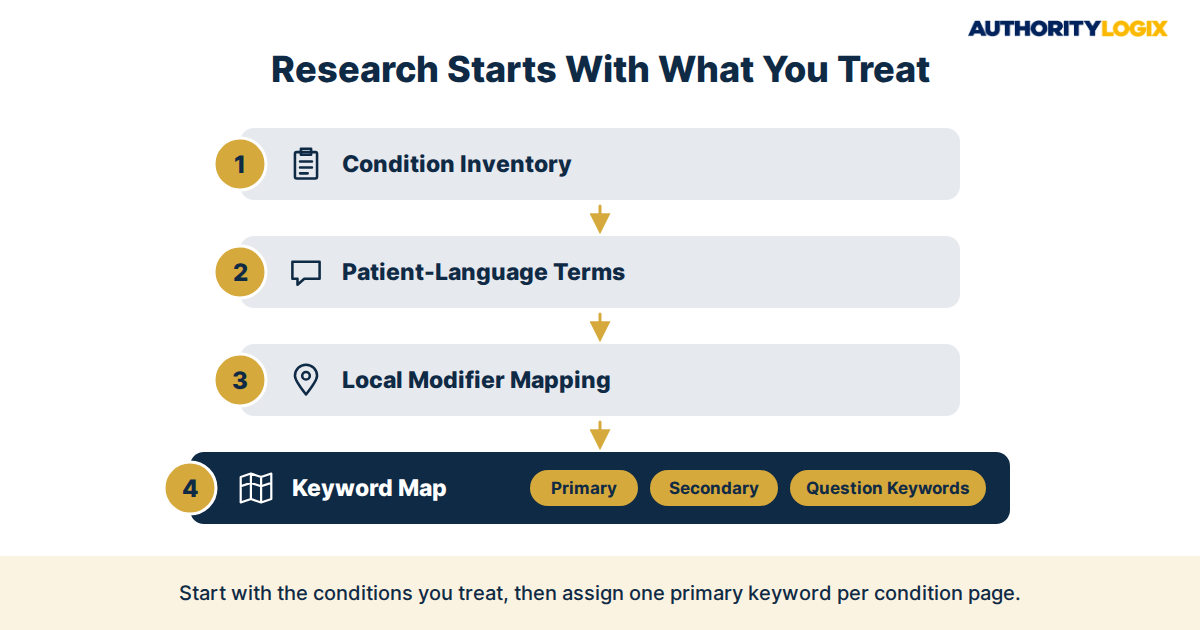
The keyword research process for a PT practice starts with a condition inventory — the full list of conditions the practice treats, organized by volume. For each condition, identify: the patient-language term, the most common local modifier combinations, and any specialty or certification terms that differentiate the practice’s approach. The PT industry hub demonstrates the full five-system framework — content, local search, patient education, lead generation, and authority distribution — that keyword research feeds as the foundational input to the entire system.
For each condition term identified, verify local search demand using a keyword research tool — Google Keyword Planner, Semrush, or Ahrefs — filtering for the specific metro or geographic area the practice serves. Build a keyword map that assigns: the primary keyword for each condition page, two to four secondary keywords for each page, and a set of question-form keywords for the condition page FAQ section. The growth blueprint covers how the keyword map connects to the practice’s full content production calendar — and how to sequence condition page production for maximum early local search impact.
Frequently Asked Questions
How many keywords should a PT practice target per page?
One primary keyword per page, supported by two to four secondary keywords and a set of question-form keywords for the FAQ section. Targeting multiple primary keywords on a single page dilutes the topical focus and reduces the page’s ability to rank for any of them competitively. The local search system covers how the practice’s local keyword map — one primary keyword per condition page, one primary keyword per location page — builds a non-overlapping keyword footprint across the entire website.
Should the practice target branded keywords?
Yes — branded keywords (the practice name, the practice name plus city) should be targeted through the homepage and GBP profile. Branded keywords are typically the easiest to rank for because the practice is the only entity competing for its own name. The more important investment is in the condition-specific and specialty keywords that bring non-branded local searches to the practice.
How competitive are PT local search keywords?
Competitiveness varies significantly by metro market size and keyword tier. In large metro markets, Tier 1 and Tier 2 keywords for major conditions can be highly competitive. Tier 3 specialty keywords and neighborhood-specific condition keywords are typically less competitive even in large markets — which is why they are the highest-priority targets for most independent PT practices. The educational hub system covers how building a comprehensive condition page library across multiple keyword tiers creates a compound keyword footprint that grows in total local search visibility even as individual competitive terms fluctuate.
How often should keyword targeting be revisited?
Keyword targeting should be revisited every six months — or immediately when a significant change in the practice’s condition mix, clinician specializations, or local competitive landscape occurs. The acquisition playbook covers how keyword performance data — including which condition pages are driving the most patient inquiry — informs both the content production calendar and the practice’s clinical emphasis in local search.
Ready to target the exact local searches your future patients are typing, and own the results for them?