

Key Takeaways
- Multi-location SEO physical therapy strategy requires a separate, fully optimized Google Business Profile for every physical clinic — never consolidated, never shared.
- 94% of high-performing multi-location brands have a dedicated local marketing strategy versus only 60% of average performers, per BrightLocal’s Brand Beacon Report — strategy gap directly correlates with performance gap at every location.
- Keyword cannibalization is the most common multi-location SEO failure: two of a practice’s own location pages competing for the same search query instead of a competitor’s page. Each location must target a distinct, non-overlapping set of geographic keywords.
- NAP inconsistency compounds with scale. A practice with five locations and 20% citation inconsistency has one location actively generating negative trust signals at every directory where its data differs from GBP.
- Businesses with consistent NAP data across major citation sources are 40% more likely to appear in the local pack, per BrightLocal — making citation management a revenue-critical operational function at every location.
- Review velocity must be managed per location, not per brand. A centralized review strategy that pools all reviews to one GBP profile fails the location-specific authority that each clinic’s map pack ranking requires.
- Multi-location brands with consistent listing data across directories tend to see higher engagement than those with inconsistent data — the engagement gap is large enough to represent meaningful patient volume differences across a multi-clinic practice.
Table of Contents
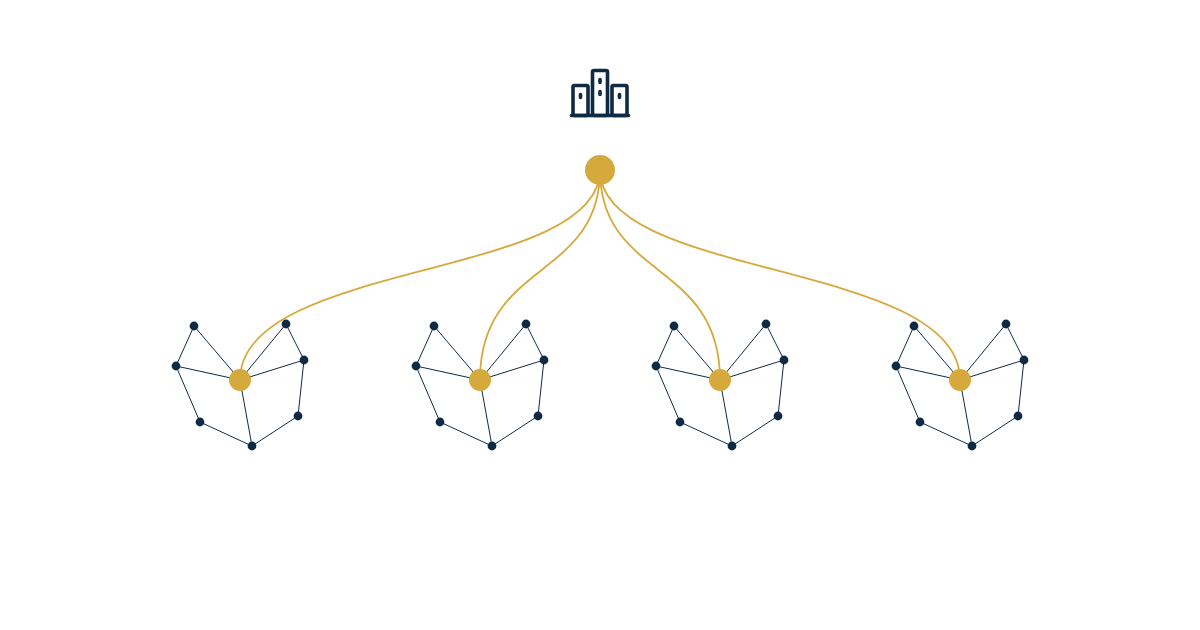
Multi location SEO physical therapy strategy is one of the most operationally complex challenges a growing PT practice faces. Each clinic is a separate local entity in Google’s eyes — with its own GBP profile, its own location page, its own review profile, and its own citation footprint. A practice that treats all its locations as a single SEO unit will rank well for the brand and poorly for every individual clinic.
Per Brand Beacon Report, 94% of high-performing multi-location brands have a dedicated local marketing strategy versus only 60% of average performers. The gap is not in budget — it is in operational discipline: treating each location as a distinct local entity that requires its own optimization work. The local visibility guide covers the foundational local search system that each location’s presence is built on — the principles apply at every scale from one clinic to twenty.
The Core Rule: One Location, One GBP Profile, One Location Page
Every physical clinic requires a separate, fully optimized Google Business Profile and a separate, substantive location page on the practice website. These are not optional enhancements — they are the baseline infrastructure without which multi-location local search visibility cannot function. The local search system covers the full per-location GBP optimization checklist — including category selection, service area settings, attribute completion, and the website link field that should point to the location page, not the homepage.
Per BrightLocal, businesses with consistent NAP data across major citation sources are 40% more likely to appear in the local pack. For a multi-location practice, NAP consistency must be maintained independently for each clinic — the name, address, and phone number for each location must match exactly across GBP, the location page, and every directory citation. The location pages guide covers the full technical requirements for each clinic’s location page — including NAP exact match, LocalBusiness schema, embedded maps, and location-specific condition content.
Multi-location brands with consistent listing data across directories tend to see higher engagement than those with inconsistent data. The engagement gap translates directly into patient inquiry volume.
The authority distribution system covers how consistent citation data is built and maintained across every directory and platform as the practice scales. That maintenance is what keeps the engagement gap from reopening.

The Physical Therapy Local Visibility Guide covers the full local search framework every clinic location needs to get found in its own market.
Multi Location SEO Physical Therapy Problem: Keyword Cannibalization Most Practices Ignore
Keyword cannibalization is the most damaging and most overlooked multi-location SEO problem in PT practice: two of the practice’s own location pages competing for the same search query instead of competing against a rival practice. When two of a practice’s clinic pages both target ‘physical therapy [city],’ Google must choose which one to rank — and frequently ranks neither at their full potential. The keyword strategy guide covers the full keyword targeting framework — including how to map non-overlapping geographic keyword sets to each location page to eliminate cannibalization and maximize the practice’s total local search footprint.
The solution is distinct geographic keyword targeting for each location. Each clinic’s location page should target: the specific city or neighborhood where it is located, the surrounding neighborhoods or suburbs it serves, and any condition or specialty keywords unique to that clinic’s patient population or clinical focus. The educational hub system covers how condition content on location pages — organized into a coordinated content architecture — builds topical authority for each clinic without creating internal content competition.
Per-Location Review Strategy for Multi-Clinic PT Practices
Review velocity is a per-location ranking signal — Google evaluates each clinic’s GBP profile independently when determining local pack rankings for that clinic’s geographic market. A multi-location practice that routes all review generation through a single brand GBP profile, or that focuses review generation on its flagship location, is building authority for one location while starving the others. Each clinic needs its own review generation system. The lead generation system covers how per-location patient communication workflows — including automated review request sequences — are built and managed across multiple clinic locations without requiring manual coordination for each.
The content playbook covers how review response — which Google evaluates as an engagement signal — should be managed per location: each clinic’s GBP profile should have regular, location-specific review responses that reference the specific clinic, the specific clinician when named, and the specific condition treated when mentioned. Generic ‘thank you for your review’ responses do not carry the engagement signal weight that specific, personalized responses do.

Not sure how each of your clinic locations compares in local search visibility?
Citation Management at Scale for Multi Location SEO Physical Therapy Practices
Citation management compounds with each additional location. NAP inconsistency undermines local pack visibility — a practice cannot outrank the inconsistency with content or review volume. The authority distribution system covers the citation audit and management infrastructure that multi-location practices use to maintain accurate data at scale.
The citation audit process for a growing multi-location practice should include: a baseline audit of all existing citations for each location, identification of every inconsistency (address formatting, suite number conventions, phone number format, practice name abbreviations), a systematic correction campaign starting with the highest-authority directories, and a maintenance cadence that audits for new inconsistencies quarterly. The PT industry hub demonstrates the full five-system framework — content, local search, patient education, lead generation, and authority distribution — that citation management supports at the brand level.

Content Strategy for Multi-Location PT Practices
Brand-Level vs. Location-Level Content in Multi Location SEO Physical Therapy
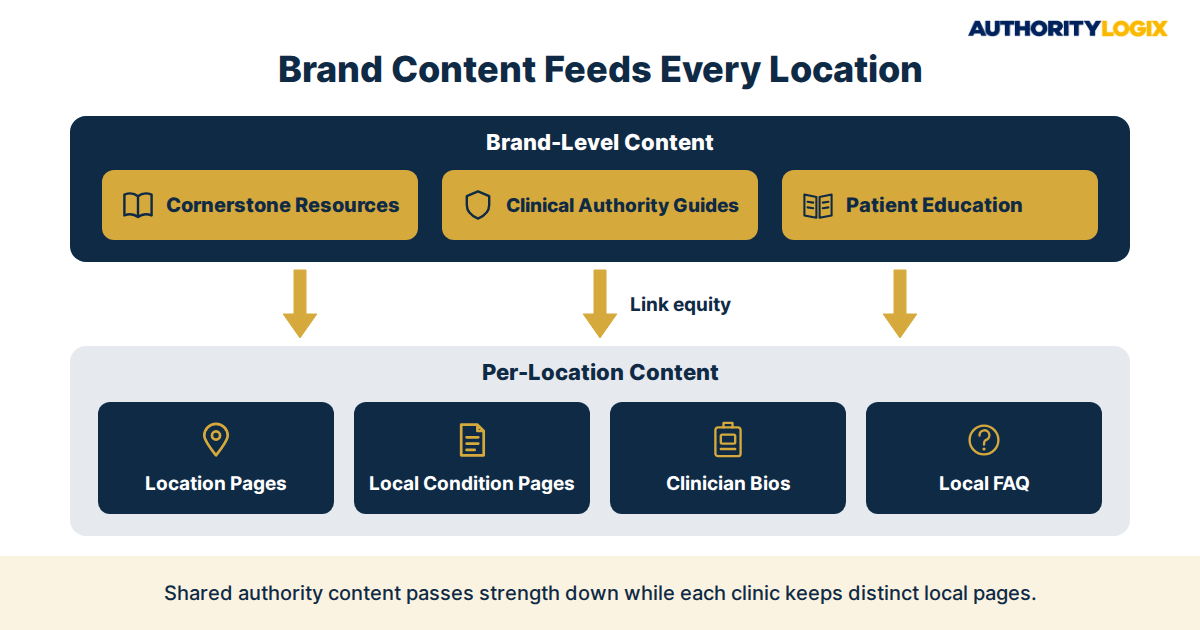
Content strategy for multi-location PT practices requires a clear hierarchy: brand-level cornerstone content that establishes the practice’s overall clinical authority, and location-level content that establishes each clinic’s specific relevance in its local market. The growth blueprint covers how brand-level authority content — cornerstone resource assets, clinical authority guides, patient education resources — feeds link equity and brand authority to each location’s content through the practice’s internal link architecture.
What Each Location Page Needs
Each location’s content — condition pages that reference the specific clinic, clinician bios for the therapists at that location, a location-specific FAQ, and local community content — must be substantively distinct from every other location’s content. The acquisition playbook covers how each location’s patient acquisition pipeline connects to the brand’s overall content infrastructure — and how to avoid the content duplication trap that many multi-location PT practices fall into.
Frequently Asked Questions
How many GBP profiles should a multi-location PT practice have?
One per physical clinic location. A practice with three locations needs three separate, fully optimized GBP profiles — each verified independently, each with its own category selection, photos, hours, service area, and review profile. Consolidating multiple locations into a single GBP profile is not supported by Google’s guidelines and is a ranking liability for every location the consolidated profile is supposed to represent. The local search system covers the full per-location GBP optimization checklist — including the verification process for newly added clinic locations.
How do you prevent keyword cannibalization between location pages?
Assign distinct, non-overlapping geographic keyword sets to each location page before building the content. Each clinic’s primary keyword should be ‘[specialty] + [specific city or neighborhood]’ — never the same city name on two different location pages. The keyword strategy guide covers the geographic keyword mapping process in detail — including how to use proximity data and patient origin data to define each clinic’s non-overlapping local search territory.
Should all locations have the same condition pages?
Each location should have condition pages that reflect the conditions most commonly treated at that specific clinic — which may overlap with other locations but should not be identical. A clinic with a sports injury specialization and a clinic with a post-surgical rehabilitation focus should have different primary condition pages, even if both offer general PT services. Content that is identical across location pages is thin content at every location where it appears.
How long does it take to see results from multi-location SEO work?
NAP consistency corrections can improve local pack eligibility within 60 to 90 days. Per-location GBP optimization improvements can affect engagement signals within 30 to 60 days. Location page content improvements typically affect rankings within one to three algorithm update cycles. Review velocity improvements have a cumulative effect that builds over three to six months. The growth blueprint covers the compounding timeline across all five systems — and how multi-location practices sequence their optimization work for maximum early impact.
Want every one of your clinic locations to rank on its own in the local searches that matter?