

Key Takeaways
- Physical therapy location pages are an on-page local SEO signal — part of the on-page category that ranks among the largest controllable local pack factors alongside Google Business Profile and reviews.
- A dedicated location page is not a contact page with an address. It is a full content asset that tells Google and the patient exactly where the practice operates, what it treats, and how to reach it.
- Having a city-specific location page linked directly from the GBP profile is one of the most commonly overlooked on-page local SEO actions for single-location PT practices.
- Location pages that include NAP matching the GBP exactly, LocalBusiness schema markup, embedded maps, and substantive condition- and service-specific copy consistently outrank generic contact-us pages in local organic results.
- For multi-location practices, a separate, non-duplicated location page per clinic is required — thin pages created by swapping a city name into a template are a thin-content liability, not an asset.
- NAP inconsistencies across citation sources can keep a business out of Google AI Mode local answers — making NAP accuracy on every location page a data hygiene priority.
- A well-built location page serves both audiences simultaneously: the search engine that needs geographic signals and the prospective patient who needs enough information to decide whether to call.
Table of Contents
Physical therapy location pages are one of the most underbuilt assets on PT practice websites — and one of the highest-leverage fixes available in local SEO. A location page is not a contact page with an address appended. It is a content asset that signals to Google exactly where the practice operates, what conditions it treats in that location, and which patients it serves — while simultaneously giving prospective patients the information they need to choose to call.
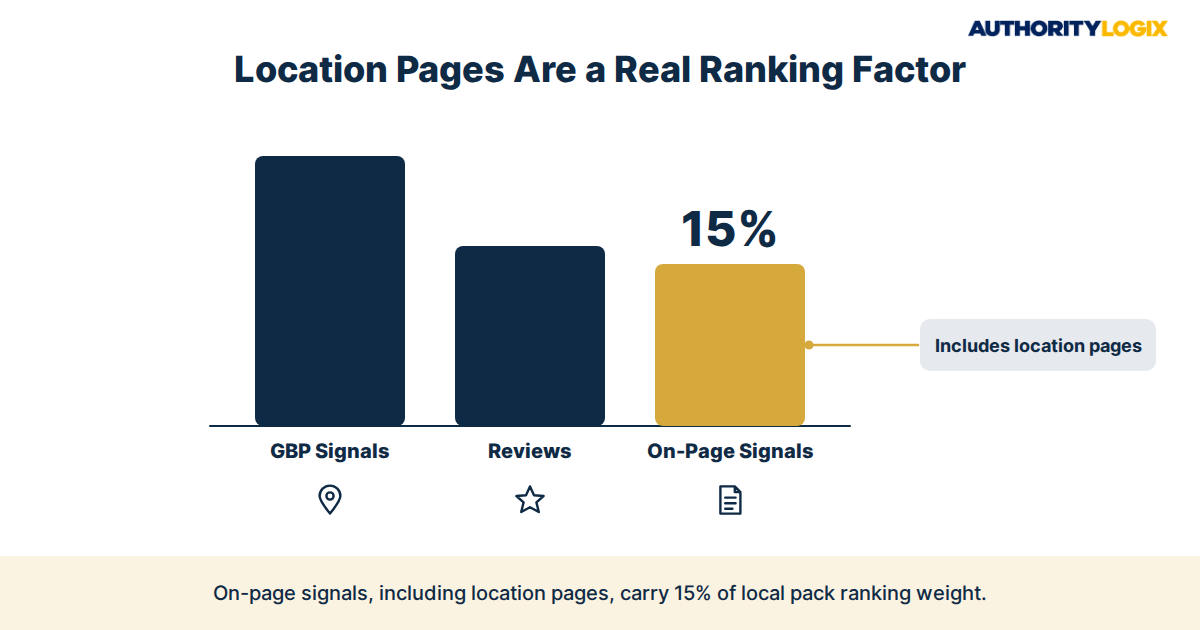
On-page signals carry meaningful local pack ranking weight, which makes them one of the largest controllable factors alongside Google Business Profile and reviews. A PT practice that has invested in GBP optimization and review generation but has not built a substantive, dedicated location page is leaving the third-largest ranking lever unpulled. The local visibility guide covers the full local search system — location pages are a core component, not an add-on.
Why Physical Therapy Location Pages Are a Ranking and Conversion Asset
Having a city-specific location page linked directly from the GBP profile is one of the most commonly overlooked on-page local SEO actions for single-location PT practices. A GBP profile that links to the practice’s homepage instead of a dedicated location page misses the geographic reinforcement signal that helps Google confirm the practice’s relevance for local searches. The local search system covers how GBP profiles, location pages, and NAP consistency work as a coordinated local signal system — not as independent elements.
From the patient perspective, a location page serves as a pre-visit trust checkpoint. Google research shows that 76% of people who search on their smartphones for something nearby visit a business within a day. The patient who finds the practice through a local search is often ready to act — the location page either confirms that the practice is the right fit or sends them to a competitor’s site.
NAP inconsistencies across citation sources are a common local SEO problem — and one that can keep a business out of Google AI Mode local answers. A location page with NAP data that does not match the GBP profile exactly is an active source of trust erosion — not just a missed opportunity.
The authority distribution system covers how consistent NAP data across every platform, directory, and location page is maintained and monitored as the practice scales. That monitoring is what catches drift before it starts costing rankings.
Location pages that combine NAP consistency, LocalBusiness schema markup, embedded maps, and substantive condition-specific copy give a practice a stronger local organic presence than a generic contact-us page. The gap between a minimal address page and a content-rich location page in local search rankings is not marginal — it is the difference between appearing in the map pack and not appearing at all.
The Physical Therapy Local Visibility Guide covers the full local search framework that location pages are built on, from Google Business Profile to reviews and citations.
The Elements Every Physical Therapy Location Page Must Include
A compliant, high-ranking physical therapy location page is built from a specific set of elements — each serving either a search engine signal function, a patient trust function, or both simultaneously. Missing any of these elements weakens the page’s ranking potential and its ability to convert local search visitors into booked evaluations.
NAP Consistency for Physical Therapy Location Pages — Name, Address, Phone
The practice name, address, and phone number must appear on the location page exactly as they appear on the GBP profile — not as an approximation, not with suite number formatting that differs, not with a tracking phone number that does not match the GBP listing. NAP consistency is a binary trust signal: it either matches or it doesn’t. The educational hub system covers how location-specific content — including NAP-consistent clinic information — is organized into a content architecture that builds both local search rankings and patient education value simultaneously.
LocalBusiness Schema Markup
LocalBusiness schema markup is the structured data layer that tells Google’s systems exactly what type of entity the location page describes — a physical therapy practice at a specific address, with specific hours, a specific phone number, and a specific set of services. Schema markup helps Google correctly classify and display the location’s information in rich results, AI Mode local answers, and voice search responses. The content playbook covers the full technical content architecture — including schema markup types — that PT practice websites use to maximize structured data signals.
Embedded Google Map
An embedded Google Map on the location page gives the patient a clear visual of where the clinic is located and reinforces the geographic signal that Google reads from the page’s content. The map should be embedded as an iframe directly on the page — not linked to Google Maps as an external destination. The lead generation system covers how location pages connect to the conversion infrastructure — including click-to-call, booking CTAs, and the intake form placement that turns location page visitors into scheduled evaluations.
Condition and Service Content Specific to That Location
The most common location page failure is thin content — a page that lists the address, phone number, and hours, and nothing else. Each location page should include: the conditions most commonly treated at that specific clinic, the clinicians who work at that location with their credentials, any location-specific specialties or equipment, and a location-specific FAQ covering the practical questions patients have about that clinic. The clinical authority guide covers how condition content and clinician credentials — when placed on location pages — simultaneously build local search rankings and patient trust at the same touchpoint.
Patient Reviews Specific to That Location
For multi-location practices, displaying reviews that reference the specific clinic location on that location’s page strengthens both the relevance signal and the patient trust signal simultaneously. A patient reading a location page for a specific clinic wants to see reviews from patients who were treated at that clinic — not aggregate reviews from across the brand. The multi-location guide covers the per-location review management strategy that ensures each clinic’s GBP profile and location page carry location-relevant social proof.

Not sure how your location pages compare to local competitors?
Location Page Content Strategy for Single-Location PT Practices
Single-location PT practices have a distinct location page opportunity: the ability to build a deeply location-specific page that targets the neighborhood, district, or borough-level geographic keywords that map to the specific patient base the practice serves. A practice in a specific neighborhood of a major city should build a location page that targets the neighborhood name alongside the city name — not just the city. The keyword strategy guide covers the full local keyword targeting framework — including how neighborhood-level keywords outperform city-level terms for single-location practices with a geographically concentrated patient base.
The location page for a single-location practice should include: the full street address and neighborhood name in the H1, a neighborhood-specific opening paragraph that describes the clinic’s location relative to recognizable landmarks or transit stops, the conditions most commonly treated at the clinic with links to the relevant condition pages, the full clinical team with credentials linked to individual bio pages, clinic hours, insurance accepted, and a location-specific FAQ. The acquisition playbook covers how the single-location practice’s patient acquisition system connects neighborhood-level local search to a full-funnel conversion infrastructure.
Location Page Content Strategy for Multi-Location PT Practices
Multi-location practices face the additional challenge of building location pages that are genuinely distinct — not duplicate content with city names swapped. Each location page must have: unique clinic-specific copy that cannot be applied to any other location, the specific clinicians assigned to that clinic with their individual credentials, location-specific reviews, location-specific condition and service emphasis based on the patient population that clinic serves, and a location-specific FAQ. The growth blueprint covers how multi-location practices build a compounding local authority system — with each location’s page contributing to the brand’s overall local search presence without cannibalizing the others.
The PT industry hub demonstrates the full five-system framework — content, local search, patient education, lead generation, and authority distribution — that each location page feeds into. A location page is not a standalone asset; it is a node in the practice’s full local search infrastructure.

Technical Requirements for Physical Therapy Location Pages
URL Structure
Each location page should have a clean, location-specific URL: /physical-therapy-[city]/ or /locations/[city]/. Avoid URL structures that bury location pages under multiple subdirectory levels — Google treats shallower URL structures as higher-priority pages within the site architecture. The local visibility guide covers the full site architecture recommendations that support location page authority — including internal linking from the homepage and service pages to each location page.
Internal Linking From the Homepage and Service Pages
Every location page should be linked directly from the homepage — typically via a ‘Locations’ navigation item or a footer link for each clinic. Service pages and condition pages should also link to the relevant location page when the content references a specific clinic. The authority distribution system covers how internal linking strategy across the practice’s full content library amplifies the authority of individual location pages as the content inventory grows.
GBP Profile Link
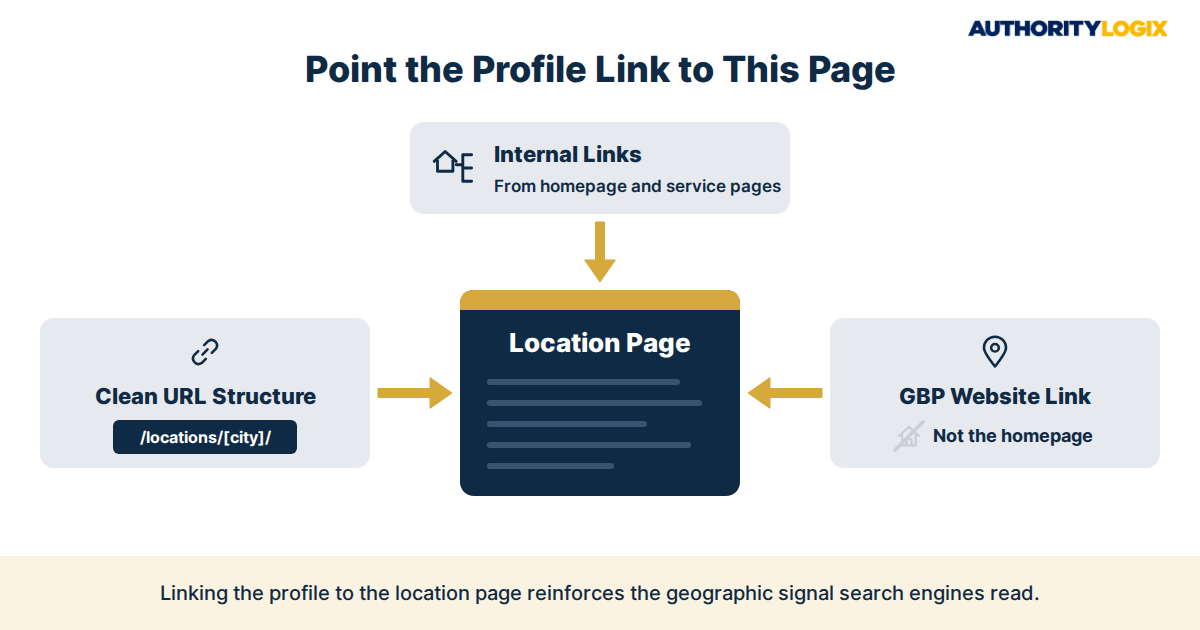
The GBP profile’s website link should point to the location page — not the homepage — for each clinic location. This is the single highest-impact technical action most PT practices have not taken: linking the GBP profile directly to the location page reinforces the geographic signal at the most authoritative local SEO touchpoint Google reads. The local search system covers the full GBP optimization checklist — including the website link field, service area settings, and the Q&A pre-population that turns the GBP profile into a patient acquisition tool.
Frequently Asked Questions
How long should a physical therapy location page be?
A compliant PT location page should run 400 to 800 words of body content — enough to include substantive condition and service copy, clinician information, a location-specific FAQ, and the trust elements patients need to make a decision. The educational hub system covers how location pages integrate into the practice’s broader content architecture — each location page both serves local search and feeds internal link equity to the condition and service pages it references.
Should all location pages have the same structure?
Yes for structure, no for content. Each location page should follow the same template — NAP, schema markup, embedded map, condition content, clinician bios, FAQ, CTA — but every element of that template must be filled with genuinely location-specific information. The condition emphasis, the clinician roster, the neighborhood context, and the FAQ questions should all reflect that specific clinic’s patient population and physical setting.
How does a location page differ from a service area page?
A location page describes a physical clinic location — an address where patients visit and clinicians work. A service area page describes a geographic area the practice serves without a physical location there. A location page with a physical address consistently outranks a service area page for map pack rankings because Google treats confirmed physical locations as higher-authority local signals. The multi-location guide covers the service area page strategy for practices that want to extend visibility into geographic markets where they do not yet have a physical presence.
How often should location pages be updated?
Location pages should be updated immediately any time a clinician joins or leaves the clinic, hours change, new conditions or services are added, or the practice participates in a local event or community program worth noting. Beyond reactive updates, an annual content refresh keeps the page fresh and signals to Google that the location is actively maintained. The lead generation system covers how location page updates — including new booking CTAs, updated clinician bios, and refreshed FAQ content — connect to the patient acquisition pipeline.
Want location pages that rank in every neighborhood you serve and turn local searches into booked evaluations?