


Key Takeaways
- Physical therapy AI content is not the problem on its own; Google’s guidance tells site owners to focus on accuracy, quality and relevance.
- Google Search Central warns that using generative AI tools to generate many pages without adding value for users may violate its spam policy on scaled content abuse.
- PT AI blog writing helps with outlines and plain-language rewrites, and fails at first-hand experience, local details and clinical claims.
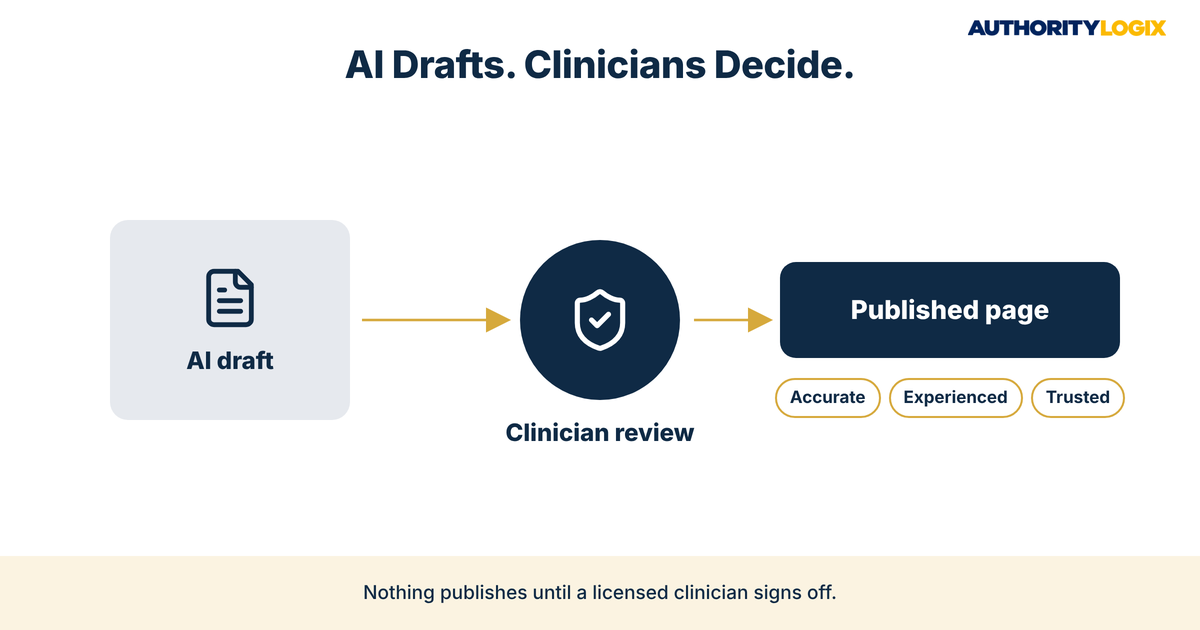
- Physical therapy ChatGPT content should be treated as a draft that a licensed clinician corrects, adds experience to and signs off before it publishes.
- Google says trust is the most important part of E-E-A-T, so physical therapy AI content needs visible reviewer names and credentials.
- A written PT AI content review process with a sign-off checklist lets physical therapy AI content scale without losing clinical voice.
Table of Contents
Can Physical Therapy AI Content Rank Without Hurting Trust?
Physical therapy AI content is now the fastest way for a busy practice to fill a blog, but speed is not the same as authority. Your clinicians know the material cold; what they lack is time to write it down. The risk is a tool with no clinical training producing pages that sound confident, read like every other clinic’s site, and quietly undercut trust your team spent years earning. Well-built content systems treat AI as one station on the line, not the whole factory.
Patients searching for help with a sore shoulder are not grading prose. They want to know whether this practice understands their problem and whether the people behind it are real, licensed and local. Physical therapy AI content that skips those signals fills a page without earning the call, which is why patient education pages need the clinician’s own voice and judgment.
So can physical therapy AI content earn its place? Yes, but only inside a system that adds what the tool cannot. Google’s own guidance on generative AI does not tell site owners to avoid the tools; it tells them to focus on accuracy, quality and relevance.
The stakes are practical. Every page either moves a prospective patient toward an evaluation or gives them a reason to keep searching. Physical therapy AI content belongs in your patient acquisition plan only when each page does a specific job for a specific patient and a clinician has confirmed every claim on it.
The Physical Therapy Content SEO Playbook lays out the publishing system that physical therapy AI content has to fit inside, from topic planning to review and distribution.
What Google Actually Says About AI-Generated Pages
Google has published direct guidance on this. Google Search Central’s page on using generative AI content tells site owners to focus on accuracy, quality and relevance, especially when content is generated automatically. The same page says it is critical to manually fact-check and review all AI-generated content for accuracy and trustworthiness.
Google notes that this review also applies to metadata such as title elements, meta description elements and structured data, so the SEO title and description of physical therapy AI content get the same scrutiny as the body copy. The wider framework sits in Google’s helpful content guidance, which asks site owners to judge pages by who created them, how and why.
Health topics carry a higher bar. Google’s people-first content guidance says its systems give even more weight to strong E-E-A-T on topics that could significantly impact the health, financial stability or safety of people, which Google calls Your Money or Your Life topics. Physical therapy AI content sits squarely inside that category.
Scaled Content Abuse and Why Volume Alone Is Risky
The clearest warning in the guidance is about volume. Google’s AI content guidance states that using generative AI tools to generate many pages without adding value for users may violate Google’s spam policy on scaled content abuse. A practice that publishes dozens of near-identical condition pages in a weekend is building exactly the pattern that sentence describes.
Volume without infrastructure is just noise. The fix is to publish fewer, better pages, each with a clear purpose, a named reviewer and details only your practice could supply. That principle sits at the center of our process: every page is planned before it is drafted and checked before it goes live, so physical therapy AI content never publishes on autopilot.
Where PT AI Blog Writing Helps and Where It Fails
PT AI blog writing is good at the parts of publishing that are mechanical and slow. It can turn a clinician’s rough notes into a clean outline, suggest the questions patients ask, rewrite dense language at a plainer reading level, and draft titles and descriptions. Those jobs eat hours most owners do not have.
It fails at the parts that make a page trustworthy. A general AI tool has never evaluated a patient, does not know your clinic’s approach, and cannot tell which of its sentences are wrong. It also writes in the same smooth voice for every practice. The table below sorts the work for physical therapy AI content.
| Publishing task | Can an AI draft help? | What the clinician must own |
|---|---|---|
| Outlines and section structure | Yes, as a fast first structure | Final order and emphasis |
| Plain-language rewrites | Yes, for a simpler reading level | Checking that nothing clinical was lost |
| Condition and treatment claims | No, errors are likely | Every clinical statement |
| First-hand experience and examples | No, the tool has none | All of it |
| Local details such as parking and hours | No, details are often invented | All of it |
AI tools help with format, and clinicians own the facts. A practice building an educational hub of condition guides can use AI to keep every page on the same structure, while the clinician supplies what each guide says, so physical therapy AI content stays consistent without the tool deciding what is true.
Location pages are where the tool is weakest. An AI draft will happily describe a parking lot that does not exist, and that error lands with the patients most likely to book. Pages built for local search depend on details your front desk could confirm in a minute, so PT AI blog writing for location pages needs the heaviest editing.

How to Use Physical Therapy ChatGPT Content as a Draft, Not a Final Copy
Physical therapy ChatGPT content works best when everyone on the team agrees on one rule: nothing the tool writes is final. The draft is raw material, and it moves through the same editing as any other copy. Practices that skip that rule end up publishing the tool’s guesses as their own clinical positions.
Prompting for Outlines, Not Clinical Claims
The prompt decides what kind of draft you get. Ask a tool to explain a condition and it produces confident claims with no source; ask it to outline a new patient’s questions and it produces a structure your clinician can fill. Prompts for outlines, question lists and rewrites of the clinician’s own notes keep physical therapy AI content in its lane.
Feed the tool your material, not the internet’s. A clinician’s voice memo or a recorded answer to a common patient question gives physical therapy AI content your practice’s actual thinking. Never paste patient names, records or identifying details into a public AI tool.
Once reviewed, the same material can be adapted for email, social posts and partner newsletters. That reuse is the job of authority distribution, and it only works when the source page is accurate, because physical therapy AI content that is wrong once becomes wrong everywhere.
Drafts for location and service-area pages need an extra pass. Hours, addresses and provider names should match your Google Business Profile exactly, since mismatched details weaken the local visibility a practice has built. Physical therapy ChatGPT content tends to fill gaps with plausible guesses, and on a location page a plausible guess is still an error.
Not sure whether your pages would pass a clinician’s review today? The assessment shows where your physical therapy AI content is helping, where it is thin, and what to fix first.
Adding the Experience and Expertise AI Can’t Supply
Experience is the first E in E-E-A-T, and it is the one an AI tool cannot supply honestly. Google’s people-first content guidance asks whether content clearly demonstrates first-hand expertise and a depth of knowledge, the kind that comes from having actually done the work. A tool that has never treated a patient cannot answer that question for you.
Your clinicians can. A short note on how your team approaches a first visit, or why the practice structures sessions the way it does, turns generic physical therapy AI content into something only your practice could have published. Each addition puts real clinician expertise on the page.
Expertise is the asset, so make it visible. Put the reviewer’s name, credentials and a short bio on every clinical page, plus a clear date showing when the page was last reviewed. Those details are the E-E-A-T signals that turn an anonymous AI draft into a page with a licensed professional standing behind it.
Trust carries the most weight. Google states that of the E-E-A-T aspects, trust is most important, and it notes that E-E-A-T itself is not a specific ranking factor. For physical therapy AI content, trust comes from accuracy, real names and pages that never promise outcomes a clinician would not promise in person.
Google also says that sharing information about how a piece of content was created can help give readers more context. A short line noting that physical therapy AI content was drafted with AI assistance and reviewed by a named clinician is honest and easy to add.

Building a PT AI Content Review Process Before Anything Publishes
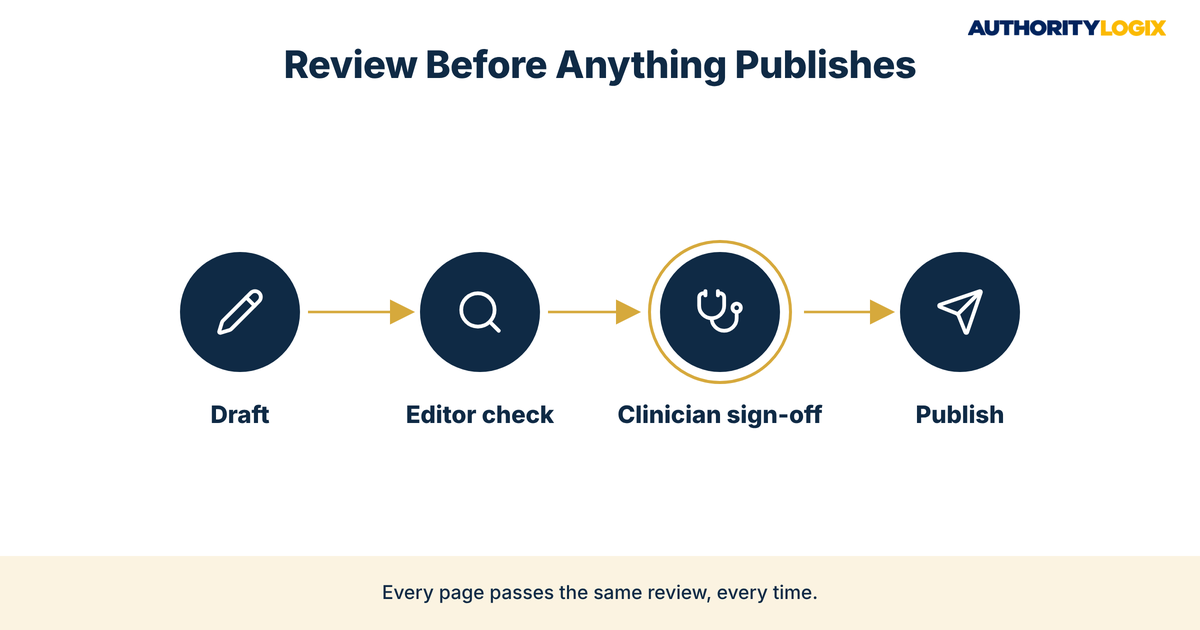
A PT AI content review process is what separates a practice that uses AI responsibly from one that is gambling with its reputation. It needs to be written down, assigned to named people and followed on every page. Without it, review happens when someone remembers, which in a busy clinic means rarely.
Start by naming three roles: an editor for structure and readability, a licensed clinician for every clinical statement, and one person who approves publishing. One person may hold two roles, but the clinician check is never skipped. Documenting that workflow and running it on every page is part of our services for practices that want to publish more without adding hours to the owner’s week.
A Clinician Sign-Off Checklist for Physical Therapy AI Content
The sign-off checklist is short on purpose, so it actually gets used. A clinician should be able to run it on a typical page in a single sitting, and the page does not publish until every line is checked.
- Every clinical statement is accurate, current and consistent with how your clinicians practice.
- No sentence promises a recovery, a timeline or a result.
- No patient names, stories or identifying details appear on the page.
- At least one first-hand insight from your team has been added.
- The reviewer’s name, credentials and review date are visible.
- The title, meta description and FAQ answers were checked as carefully as the body.
Keep the signed checklist with each page so you can show who reviewed what and when. When a clinician leaves, that record shows which pages need another look, which makes the PT AI content review process an asset rather than a chore. Practices that want examples of finished, reviewed pages can browse the PT resources library to see the structure in practice.
Frequently Asked Questions About Physical Therapy AI Content
Does Google penalize AI content?
Google’s published guidance on generative AI focuses on accuracy, quality and relevance, and it warns that generating many pages without adding value for users may violate its policy on scaled content abuse. The practical test for physical therapy AI content is whether each page adds something a patient could not get from any other site.
Can ChatGPT write effective blog posts for a physical therapy practice?
It can write a usable draft, especially an outline or a plain-language rewrite of a clinician’s notes. It cannot supply first-hand experience, verify clinical claims or know your local details, so physical therapy ChatGPT content still needs a clinician’s edit and sign-off before it represents your practice.
Is it safe to use Chat GPT for blog writing about the conditions we treat?
It is reasonable as a drafting tool when review is strict. The danger is publishing condition content no clinician has checked, because a confident error on a health page costs far more trust than a slower schedule. Practices that build review into their PT marketing from the start keep that risk under control.
How can a patient tell whether a clinic website used AI responsibly?
Look for a named, licensed clinician who reviewed the page and a recent review date, and be cautious of pages that promise specific results. That review standard is a large part of why practices choose to build their content with AuthorityLogix instead of buying unreviewed AI pages in bulk.
Is AI for physical therapy clinics only useful for blog posts?
No. The same drafting help applies to FAQ pages, email newsletters, condition-guide outlines and social posts adapted from approved pages. The review rules for physical therapy AI content stay the same wherever the words end up.
Ready to build a publishing system where AI speeds up the drafting and a licensed clinician signs off on every page before a patient ever reads it?
Using AI to Scale Output While Keeping Clinical Voice Intact
The honest picture is that physical therapy AI content is neither a threat nor a shortcut. It is a drafting tool. Inside a written process it lets a small team publish more without lowering the standard; without one, it fills a site with generic copy patients learn to skip.
What holds up over time is the system around the tool: planned topics, clinician input, review, sign-off and distribution. That system is laid out in the practice authority growth blueprint, and it reflects the same kind of planned infrastructure behind BKDSCR.com, AuthorityLogix’s own proof-of-concept platform, built with 18 pillar pages, 7 interactive tools and 48 blog posts, with zero paid ads, in under 18 months.
Every reviewed page should also connect to a next step, whether that is a booking link, a guide or a phone call. Content that earns trust but gives patients nowhere to go is only half of lead generation, and the other half is a clear path from reading to scheduling an evaluation.
The honest answer is that your clinicians already have the expertise patients are searching for. AI can help put more of it on the page, faster, but only your team can make physical therapy AI content true, specific and trustworthy, and no tool should ever be the last one to touch a page that carries your practice’s name.