

Key Takeaways
- A physical therapy authority gap assessment measures three things: whether patients can find your practice, whether they trust what they find, and whether they can book once they decide.
- Whitespark’s 2026 ranking factors survey ranked the primary Google Business Profile category as the top map pack factor.
- BrightLocal’s 2026 survey found 97% of consumers read reviews for local businesses, and 47% won’t use a business with fewer than 20 reviews.
- Experian Health’s 2025 survey found 80% of patients want to schedule appointments anytime from home or a mobile device.
- This self-check is a preview of a full physical therapy authority gap assessment, which goes deeper and ranks what to fix first.
- Fix the widest gap first and keep your answers as a baseline.
Table of Contents
A physical therapy authority gap assessment answers a question most practice owners never get a straight answer to: where, exactly, do prospective patients slip away before they book an evaluation? You may have clinicians with years of specialty training and referring physicians who respect your work — and still lose the patient who searched “physical therapy near me” last night and picked another clinic. That is the credible but invisible problem, and it is rarely about effort.
Most practices only see the symptom: a slow month or an evaluation schedule with holes in it. The work described on the AuthorityLogix PT industry hub starts from a different premise — the gap is structural, and it can be measured. This article walks you through a self-check version of a physical therapy authority gap assessment so you can put your own gaps on paper before deciding what to build.
What a Physical Therapy Authority Gap Assessment Measures in a Local Practice
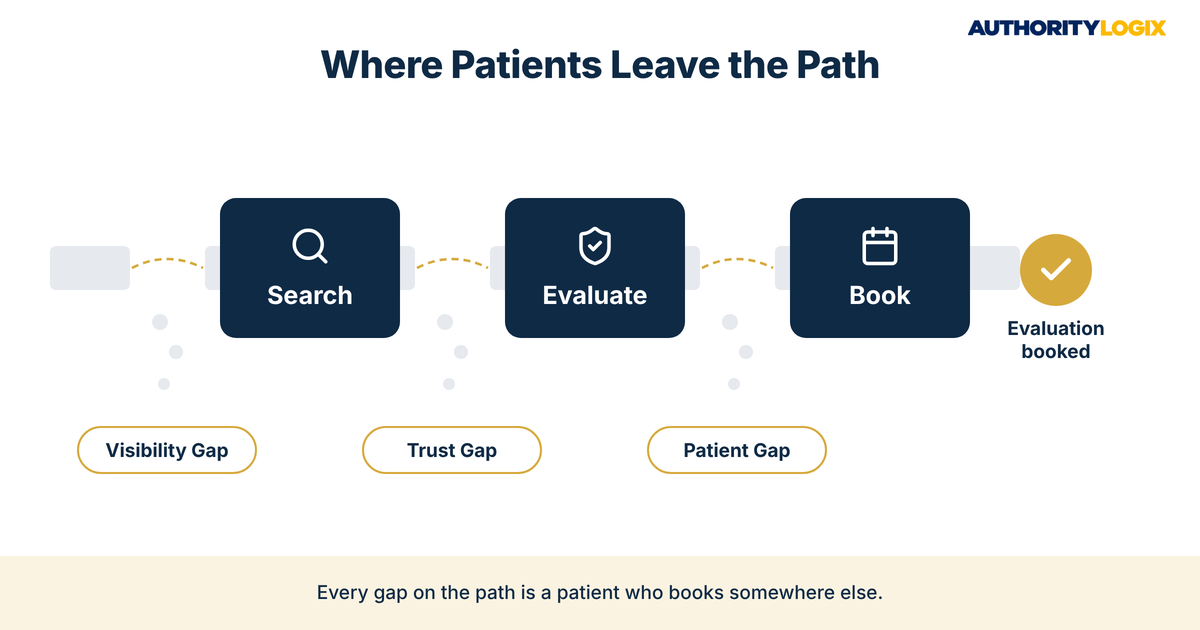
A physical therapy authority gap assessment is not a website audit and not a marketing report card. It follows the path a prospective patient takes — search, evaluate, decide, book — and marks every point where that path breaks. For a local practice, the path almost always breaks in one of three places.
The Three Gaps a Physical Therapy Authority Gap Assessment Scores
- Visibility gap — whether your practice appears in the map pack and organic results for the services you offer.
- Trust gap — whether your reviews, clinician bios, and condition pages give a patient a reason to choose you.
- Patient gap — whether a patient who has decided can book an evaluation without phone tag or a slow reply.
Each gap feeds the next. Strong reviews with no map pack presence means a visibility gap hides your trust, and strong rankings with a hard booking path means a patient gap wastes them. That dependence is why a physical therapy authority gap assessment scores all three, and why what we do is organized as connected systems rather than one-off fixes.
A self-check also needs a reference point, because a gap only exists relative to the practices patients compare you with. Pair this framework with a competitive authority analysis of the clinics that appear above you, and the physical therapy authority gap assessment stops being abstract. You will see what they have that you do not.
The Physical Therapy Practice Authority & Growth Blueprint shows how visibility, trust, and booking fit into one growth system — the framework a physical therapy authority gap assessment measures against.
Running a PT Marketing Gap Analysis on Your Map Pack and Local Visibility
Start with visibility, because nothing downstream matters if patients never see you. A PT marketing gap analysis begins with how Google describes local ranking: according to Google’s Business Profile help documentation, local results are mainly based on relevance, distance, and prominence. Google also states that businesses with complete and accurate information are more likely to show up in local search results.
Whitespark’s 2026 Local Search Ranking Factors survey of 47 local search experts ranked the primary Google Business Profile category as the number one map pack factor. In the organic results below the map, the same survey ranked a dedicated page for each service as the top local organic factor. Both belong on the checklist of any physical therapy authority gap assessment.
For the self-check, open a private browser window and search the way patients search. Use the services you offer most — “physical therapy near me,” “sports physical therapy” plus your town, “back pain physical therapist” plus your neighborhood — and note where your practice appears. This is the visibility half of a physical therapy authority gap assessment, and it needs no special software.
Then look at your profile the way Google reads it. Is the primary category the most specific one that fits, are your services listed by name, and is every field filled in? The local search system AuthorityLogix builds treats the profile, location pages, and clinician listings as one asset, because Google reads them together.
Finally, check the organic results under the map. If a competitor ranks with a dedicated page for vestibular therapy and you have one general services page, that is a measurable gap. Closing it is a build covered step by step in the local visibility guide, from the profile to location pages to citations.

The Trust Gap: Reviews, Clinician Credentials, and Condition Pages
Once a patient finds you, the next question is whether they believe you. BrightLocal’s 2026 consumer review survey of 1,002 US adults found that 97% of consumers read reviews for local businesses, and 85% say positive reviews make them more likely to use a business. The same survey found that 47% won’t use a business with fewer than 20 reviews, and 74% only care about reviews written in the last three months.
Reviews are only the first layer of trust. Patients also want to know whether the clinician understands their specific problem, which is why clinician bios with credentials and plain-language condition pages carry so much weight. How those pages show expertise without crossing into clinical advice is the subject of the clinical authority guide for PT practices.
For the trust half of a physical therapy authority gap assessment, count rather than judge. How many Google reviews do you have, how many arrived in the last three months, and do you reply to them? How many clinicians have a full bio with credentials, and how many of the conditions you treat have their own page?
Condition pages are often where a physical therapy authority gap assessment finds the widest trust gap. A practice that treats a long list of conditions but explains only a few online is asking patients to trust what they cannot see. That changes with an educational hub organized by condition and body region.
The hard part is keeping those pages current, because bios go stale and review requests stop when the front desk gets busy. Without content systems that make updates routine, a physical therapy authority gap assessment run next year will find the same gaps it found this year.
This self-check is a preview of a physical therapy authority gap assessment. The full PT Authority Gap Assessment examines your visibility, trust, and booking path from the outside and shows which gap costs your practice the most.
The Patient Gap: Where Evaluation Bookings and Direct-Access Patients Drop Off
In a physical therapy authority gap assessment, the patient gap is the distance between a patient choosing your practice and that patient arriving for an evaluation. Experian Health’s 2025 State of Patient Access survey found that 80% of patients want to schedule appointments anytime from their home or a mobile device, while 54% of providers said they offer self-scheduling. A phone-only practice asks patients to work around the front desk.
Direct access widens the opportunity and the gap. According to APTA’s 2025 report on the state of direct access, patients in all 50 states, the District of Columbia, and the U.S. Virgin Islands have direct access to physical therapist services, although APTA notes that some provisions tied to treatment without a referral persist in a number of states. A patient who searches before seeing a physician is a patient your website has to convert on its own.
Closing the PT Visibility Trust Patient Acquisition Gap
The PT visibility trust patient acquisition gap is the combined leak across all three stages, and the booking stage is the easiest place to measure it. Try to book an evaluation on your own website from your phone one evening. Count the taps, and note whether you could choose a time and received a confirmation.
Then trace what happens to a web inquiry. Who answers it, and how fast? If the honest answer is “whoever gets to it,” the gap is the handoff, a pattern laid out in the article on conversion gaps.
Track one more number in this part of the physical therapy authority gap assessment: how many new patients came from a physician referral and how many found you directly. A practice that depends on a few referring physicians has a patient gap even when its schedule is full. One referring doctor retires and the pipeline dries up overnight. Building direct-access channels that reduce that dependence is the focus of the acquisition playbook.

A Physical Therapy Authority Audit Self Assessment You Can Run This Month
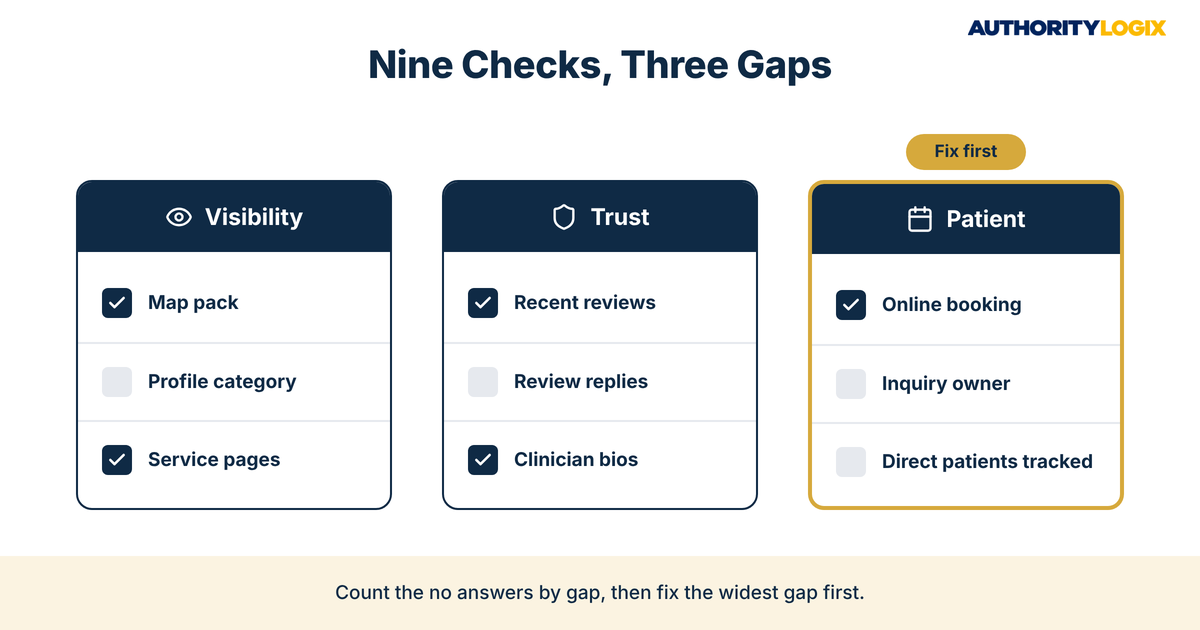
Everything above fits on one page. The physical therapy authority audit self assessment below turns a physical therapy authority gap assessment into nine yes-or-no checks you can complete with a phone and your practice management reports.
| Gap | Physical Therapy Authority Gap Assessment Check | The Gap Shows Up When |
|---|---|---|
| Visibility | Do you appear in the map pack for “physical therapy near me”? | Competitors appear and you do not |
| Visibility | Is your primary profile category the most specific fit? | The category is general |
| Visibility | Does each core service have its own page? | One services page covers everything |
| Trust | Any new Google reviews in the last three months? | The newest review is older |
| Trust | Do you reply to every review? | Reviews sit without a response |
| Trust | Does every clinician have a bio with credentials? | Bios are missing or thin |
| Patient | Can a patient book online from a phone? | A phone call is required |
| Patient | Is every web inquiry answered by a named person? | No one clearly owns inquiries |
| Patient | Do you track how many patients found you directly? | Only referrals are tracked |
How to Score Your Physical Therapy Authority Gap Assessment
Score each line yes or no, then total the no answers by gap. The gap with the most no answers is where a physical therapy authority gap assessment would point you first, and a tie goes to visibility, because patients who never find you never reach the other gaps. Write the date beside your answers — the baseline matters more than the score.
No answers in the visibility rows usually trace back to site architecture: services without pages and pages without a clear structure. Organizing service and condition pages so Google reads the practice as a connected library rather than a brochure is what the content SEO playbook for physical therapy covers.
No answers in the patient rows trace back to the booking path and the follow-up behind it. A self-scheduling link, an inquiry form that routes to a named person, and a reminder sequence are the parts of lead generation infrastructure most practices can add without changing how the clinic runs.
AuthorityLogix holds its own build to the same standard. BKDSCR.com, AuthorityLogix’s proof-of-concept in the NYC outer-borough DSCR real estate niche, is organized around the same stages: 18 pillar pages, 7 interactive tools, and 48 SEO-optimized blog posts, each built for a specific search and a specific next step. It generates inbound leads organically with zero paid ads.
What Most PT Practices Get Wrong About a Physical Therapy Authority Gap Assessment
Practice owners who run this self-check tend to ask the same questions about a physical therapy authority gap assessment. Here they are, answered directly.
Is a physical therapy authority gap assessment the same as an SEO audit?
No. An SEO audit looks at the website, while a physical therapy authority gap assessment follows the patient from the search to the booked evaluation, including reviews, clinician bios, and how inquiries are answered. A site can pass an SEO audit and still lose patients at the front desk.
We get plenty of physician referrals. Do we still need this?
Referral volume shows how strong your physician relationships are, not how visible you are to patients who search on their own. With direct access in every state, a referral-only practice misses the patients who skip the physician step.
Can we close the gaps by posting more on social media?
Posting more rarely closes a gap on its own, because none of the three is a volume problem. Distribution matters once the pages and reviews exist to send people to — that is the role of authority distribution, which puts expertise in front of a qualified audience.
How often should we run a physical therapy authority gap assessment?
Run it once to set a baseline, then again after each major change, such as a new location or a new website. Between those, a quarterly look at reviews and rankings keeps small gaps small.
Can the gaps be closed without pulling clinicians away from patients?
Yes, if the system is designed around clinician time rather than in competition with it. Clinicians supply the expertise through short interviews, and the sequence in how we build handles the pages, profile, and follow-up around that. No one can promise a ranking position or a set number of new patients.
Ready to close the visibility, trust, and booking gaps your self-check uncovered? AuthorityLogix builds the profile, pages, review flow, and booking path that turn local searches into scheduled evaluations.
What to Fix First Once the Gaps Are on Paper
Fix the widest gap first, not the easiest one. If you are missing from the map pack, polishing condition pages helps only the few patients who already find you; if you rank well but lose inquiries, more rankings only add to the loss. A physical therapy authority gap assessment is useful precisely because it ranks the gaps instead of just listing them.
Then sequence the fixes so each one feeds the next — profile and service pages before content volume, booking path before any ad spend. That ordering is central to our approach, and it is why the work keeps building on itself instead of resetting every month.
To go deeper on a single gap before acting, the PT resource library covers each one in a separate guide. Pick the guide that matches the widest gap your physical therapy authority gap assessment found.
The honest answer is that a physical therapy authority gap assessment almost never uncovers a shortage of expertise. It uncovers expertise the market cannot see — a build problem, not a talent problem. Put the gaps on paper this month, and you will know what to build first.