

Key Takeaways
- A physical therapy competitive authority analysis tells a PT practice exactly where it is visible in its local market, where competitors are winning, and which specific gaps represent the highest-priority opportunities to close first.
- 84% of patients read online reviews before selecting a provider — meaning the competitive authority analysis starts with the review profile, the most patient-visible authority signal in any PT market.
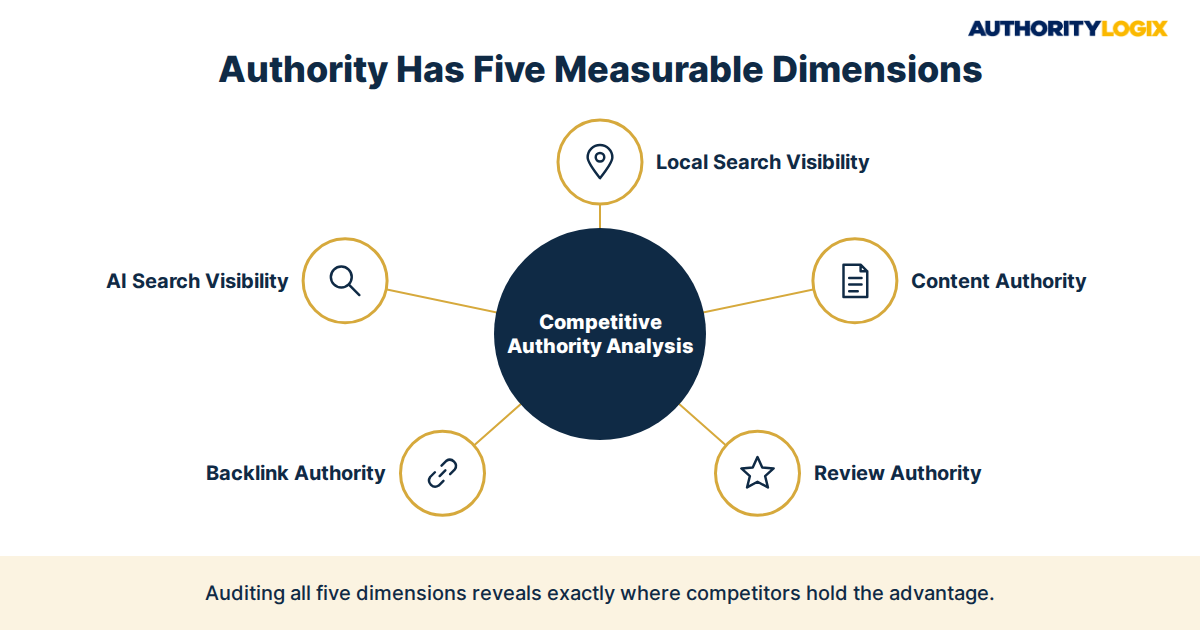
- A physical therapy competitive authority analysis covers five dimensions: local search visibility, content authority, review authority, backlink authority, and AI search visibility.
- The purpose is not to copy competitors — it is to identify where competitors are winning patient attention the practice is not, and determine which authority gaps can be closed within a realistic 90 to 180 day window.
- A competitive authority analysis conducted quarterly gives PT practices the market intelligence to respond to competitor moves before those moves compound into entrenched authority advantages.
- The most actionable output is a ranked gap list: the specific service pages, condition pages, GBP categories, and review volume targets that would move the practice to a measurably stronger authority position.
- Authority gaps in a local PT market tend to compound over time rather than self-correct — a competitor who has been publishing condition pages for 18 months has a compounding advantage that takes sustained investment to overcome.
Table of Contents
A physical therapy competitive authority analysis is the market intelligence process that tells a PT practice exactly where it stands relative to the other practices competing for the same patients in its local market — not in terms of clinical quality, but in terms of the digital authority signals, local search visibility, and patient trust infrastructure that determine which practice a patient chooses when they search for PT online. Most practices have never actually measured this gap, which is exactly why it persists.
This article covers what a physical therapy competitive authority analysis is, what five dimensions it covers, how to conduct each dimension, and how to turn the analysis output into a prioritized action plan. The growth blueprint covers the full practice authority and growth framework — this article focuses specifically on the competitive intelligence process that reveals where the practice’s authority gaps are.
Why Every Physical Therapy Competitive Authority Analysis Matters
The physical, occupational and speech therapy market is growing at a 2.9% CAGR through 2026, reaching $55.7 billion, per IBISWorld — with competition intensifying. Every local PT market is a competition between practices with similar clinical capabilities but different levels of digital authority. Per rater8’s Patient Choice Report research, 84% of patients check online reviews before booking with a provider.
The visibility guide covers how local search authority is built — this article covers how to measure it relative to competitors. Measurement is what turns the analysis into a prioritized action plan.
The competitive authority analysis matters because authority gaps in a local PT market compound over time. The local search system connects competitive authority analysis findings to the local SEO infrastructure that closes the most critical gaps.
Explore the AuthorityLogix PT Practice Authority and Growth Blueprint for physical therapy practices.
Dimension 1 — Local Search Visibility Audit
The local search visibility audit measures how visible each practice in the competitive set is for core service keywords. It covers: map pack rankings, GBP completeness, and citation consistency. The PT industry hub demonstrates how the five-system framework coordinates local search authority.
Physical Therapy Competitive Authority Analysis: The Local Search Visibility Audit
Search the practice’s top 5 service keywords in a private browser from within the practice’s primary service area. Record which practices appear in the map pack. Note GBP completeness of each competitor. Run a citation audit using BrightLocal or Moz Local. The content systems built for PT practices include the GBP content workflow that closes GBP completeness gaps against map pack competitors.
Dimension 2 — Content Authority Audit
The content authority audit measures topical authority built through published content. Condition explainer articles are often among the strongest content types for new patient traffic. The educational hub organizes the content architecture into the knowledge library structure that makes each new piece of content compound the authority of the whole site.
How to Conduct the Content Authority Audit
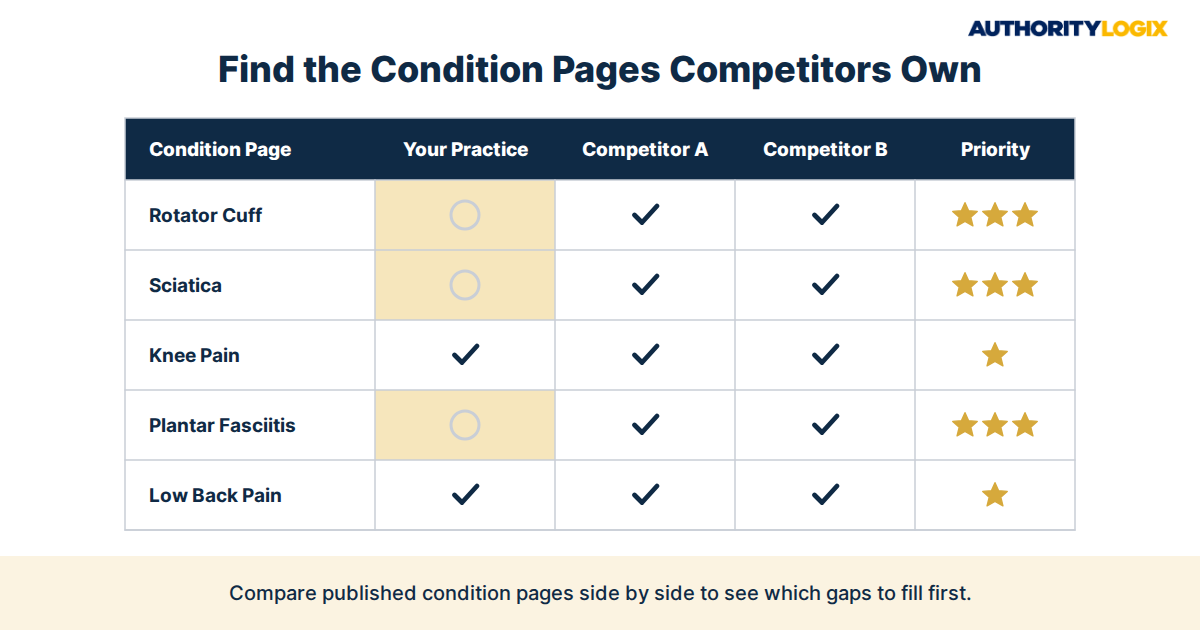
Visit the top 3 to 5 competitor websites and record: condition page count, service page count, clinician bio completeness, and FAQ content presence. Build a gap table listing specific conditions the practice should have pages for but does not. The authority distribution system amplifies each new condition page through external syndication.
Dimension 3 — Review Authority Audit
The review authority audit measures total review volume, recency, and response rate. The lead generation system connects the review authority audit to the review generation infrastructure — including the post-visit review request workflow and SMS templates that accelerate review velocity.
Review Authority Gap Benchmarks
The review authority audit produces three specific gap measurements: volume gap (target: within 25% of market leader’s volume), recency gap (reviews per month versus competitors), and response rate gap (BrightLocal’s 2026 survey found 80% of consumers are more likely to use a business that replies to all its reviews, making response rate a measurable competitive advantage). Each gap becomes a specific quarterly target in the practice’s review growth plan.

Dimension 4 — Backlink and Citation Authority Audit
The backlink and citation authority audit measures external authority signals: NAP data consistency across healthcare directories, external website links, and external publication mentions. The AI search article covers how entity authority — the external citation footprint AI systems use to validate a named practice — connects to AI Overview citation eligibility.
Dimension 5 — AI Search Visibility Audit
The AI search visibility audit measures which practices in the competitive set are being cited in Google AI Overviews for informational and comparison queries. The pillar pages article covers how the pillar-cluster content architecture that earns AI Overview citations is built — the AI search visibility audit identifies which competitors are already inside that architecture.
Not sure where your practice stands in your local PT authority market?
Turning Your Physical Therapy Competitive Authority Analysis Into an Action Plan
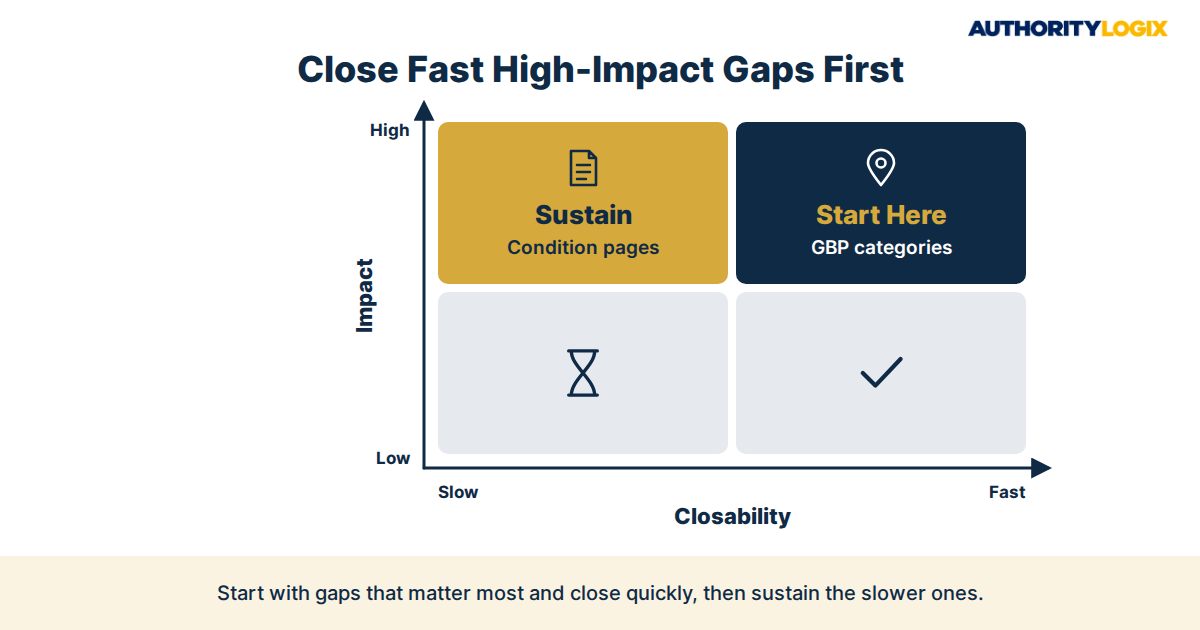
The action plan prioritizes gaps by two criteria: impact (which gap would produce the largest patient acquisition improvement if closed) and closability (which gap can be meaningfully closed within a 90-day production window). The acquisition playbook covers how competitive authority analysis findings connect to the patient acquisition pipeline.
Frequently Asked Questions
How often should a PT practice run a competitive authority analysis?
Quarterly — once every 90 days — aligns with the 90-day content production planning cycle and ensures the practice is tracking competitor moves before they compound into entrenched advantages. The authority guide covers how the quarterly analysis cycle connects to the content calendar and local search optimization schedule.
What free tools can a PT practice use for the competitive authority analysis?
Google Search (private browser): map pack ranking audit. Google Business Profile competitor profiles: GBP completeness audit. Google Search Console: content authority audit for the practice’s own site. Google “People Also Ask” boxes: AI search visibility audit. BrightLocal or Moz Local (free trial): citation consistency audit. These five free tools produce a functional competitive authority analysis across all five dimensions without requiring a paid SEO platform.
What is the single most important dimension of the competitive authority analysis?
For most independent PT practices in 2026, local search visibility — specifically map pack ranking for top service keywords — governs the majority of high-intent patient inquiries. The PT industry hub demonstrates how the five-system framework coordinates all five competitive authority dimensions into a unified patient acquisition infrastructure that compounds authority across all five simultaneously.
Ready to see exactly where your competitors’ authority ends and yours can begin, then build past it?