

Key Takeaways
- Physical therapy blog frequency SEO has no universal number; the right cadence is the one your practice can hold for a year without the quality slipping.
- Content Marketing Institute’s 2026 B2B trends research found 28% of marketers name creating enough quality content as a top challenge, and 39% name resource constraints.
- Google’s own guidance on people-first content warns against producing lots of content on many topics in hopes some of it performs in search.
- Ahrefs found that 72.9% of pages in Google’s top 10 are more than three years old, so consistency over time matters more than bursts of volume.
- A PT publishing frequency strategy should follow the patient pipeline: condition questions, local searches, and the service pages each article supports.
- Physical therapy blog frequency SEO works when publishing is a system with topics, roles, and review steps, not a reminder on someone’s calendar.
Table of Contents
Why Physical Therapy Blog Frequency SEO Questions Have No Universal Number
Physical therapy blog frequency SEO is the question practice owners ask right after deciding to start a blog: how often do we have to publish before Google notices? It is a fair question with an uncomfortable answer. There is no posting quota that guarantees rankings, and a practice that chases one usually burns out its clinicians, publishes thin articles, and quits within a few months. A publishing schedule only helps once you know what cadence you can actually hold.
The clinic down the street with half your experience may publish every week, and that can look like the reason it ranks. Often it is not the frequency at all. It is that their articles answer the questions patients search, link to the right service pages, and keep arriving on a steady rhythm. That is the credible but invisible problem in publishing form: your expertise is real, but an irregular blog hides it.
Google’s own guidance points the same way. Its documentation on creating helpful, reliable, people-first content asks whether a site is producing lots of content on many different topics in hopes that some of it might perform well in search results, and it treats that as a warning sign. Physical therapy blog frequency SEO is about publishing with purpose, not about filling a quota.
So the real question is not how often, but how often your practice can publish an article worth ranking. Answering that takes content systems — a topic plan, a clinician interview routine, an editor, and a review step — because physical therapy blog frequency SEO depends on the system that produces the posts more than on the number of posts.
The Physical Therapy Content & SEO Playbook shows how a practice blog fits into the full site architecture, so your physical therapy blog frequency SEO plan supports service pages and condition pages instead of running on its own.
Building a PT Publishing Frequency Strategy Your Team Can Sustain
A PT publishing frequency strategy starts with capacity, not ambition. Count the hours your clinicians can give to interviews or review, the hours an editor or writer can give to drafting, and the time it takes to publish and link each article. The cadence that fits inside those hours is your real physical therapy blog frequency SEO target, and anything faster will collapse the first busy month.
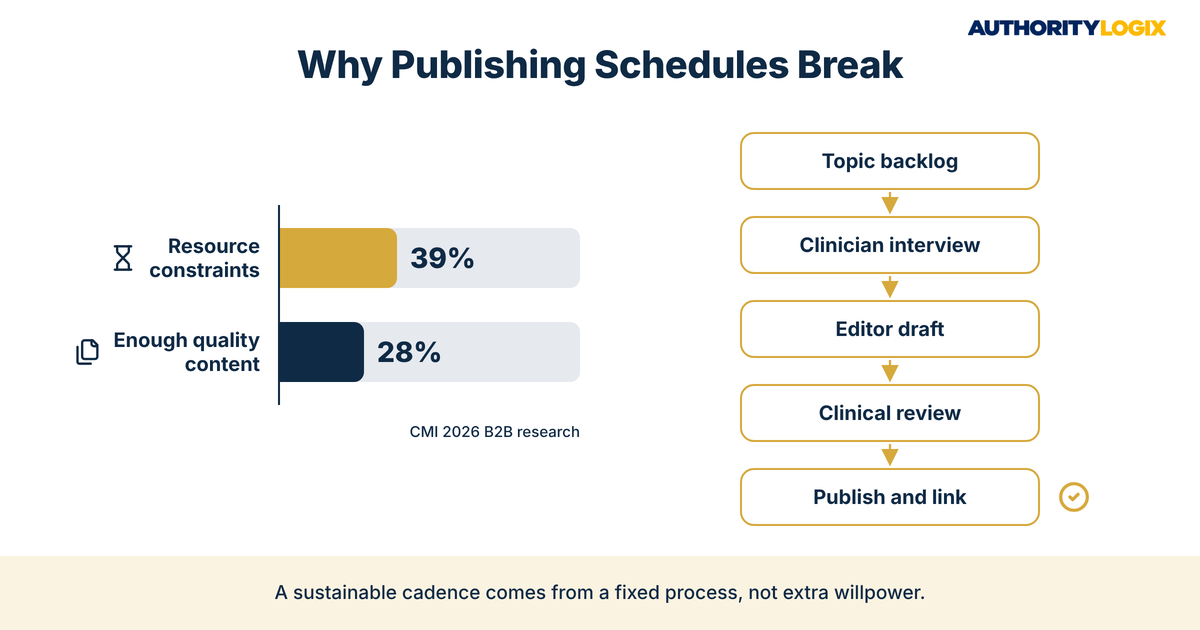
Capacity is the constraint almost everyone hits. Content Marketing Institute’s October 2025 trends report on 2026 B2B content, run with MarketingProfs among 1,015 B2B marketers, found 28% named creating enough quality content to meet their organizational needs as a top challenge, while 39% named resource constraints. Those are full-time marketing teams, and a physical therapy practice usually has less room, so physical therapy blog frequency SEO plans that ignore capacity fail early.
What a Sustainable Cadence Requires Behind the Scenes
A cadence holds when every article has a clear path from idea to published page. The parts are simple, and each one removes a reason the schedule slips:
- A topic backlog built from real patient questions, so no one starts from a blank page
- A short clinician interview for each article instead of asking clinicians to write
- One editor who owns drafting, structure, and search details
- A clinical review step so every article is accurate before it goes live
- A fixed publishing day and a standard internal-linking checklist
The topic backlog matters most, because a schedule without topics fails first. A list of content topics organized by condition, service, and patient stage gives the team months of articles before anyone has to brainstorm. Physical therapy blog frequency SEO gets easier once the next ten articles are already decided.
The rest is process. That is part of how we build publishing systems for practices: the interview, draft, review, and publish steps are set before the first article goes live, so a busy week delays one article instead of stopping the blog entirely.
Physical Therapy: How Often to Blog Based on Your Patient Pipeline
The better way to set physical therapy blog frequency SEO goals is to start from the patients you want more of. A practice short on direct-access orthopedic patients needs articles that answer the questions those patients search before they book. A practice trying to fill a new pelvic health or vestibular program needs a different set of articles, and that need sets the cadence for that program.
Those pipeline stages — symptom, search, shortlist, booked visit — are laid out in the acquisition playbook, and each stage calls for a different kind of article. Early articles explain a symptom in plain language. Later ones compare options, explain what a first visit looks like, and point to the service page where the patient can book. Physical therapy blog frequency SEO planning means covering every stage, not just the first.
Answering the “Physical Therapy How Often Blog” Question by Pipeline Stage
Practice owners who type “physical therapy how often blog” into Google are usually asking a capacity question disguised as a ranking question. The useful answer is to fill each pipeline stage before adding volume to any one of them. A blog with three strong articles for every core service will usually serve patients better than a blog with thirty articles on scattered topics.
Every article also needs somewhere to send the reader. An article on knee pain that ends without a clear next step informs the patient and then loses them. The lead generation layer — a booking link, a phone number, and a short contact form tied to the related service page — is what turns physical therapy blog frequency SEO from traffic into evaluations.
Not sure whether your blog is supporting your patient pipeline or just adding pages? The PT Authority Gap Assessment shows where your content, service pages, and local signals are weakest and what to build first.
PT Content Cadence SEO Impact: Consistency Versus Volume
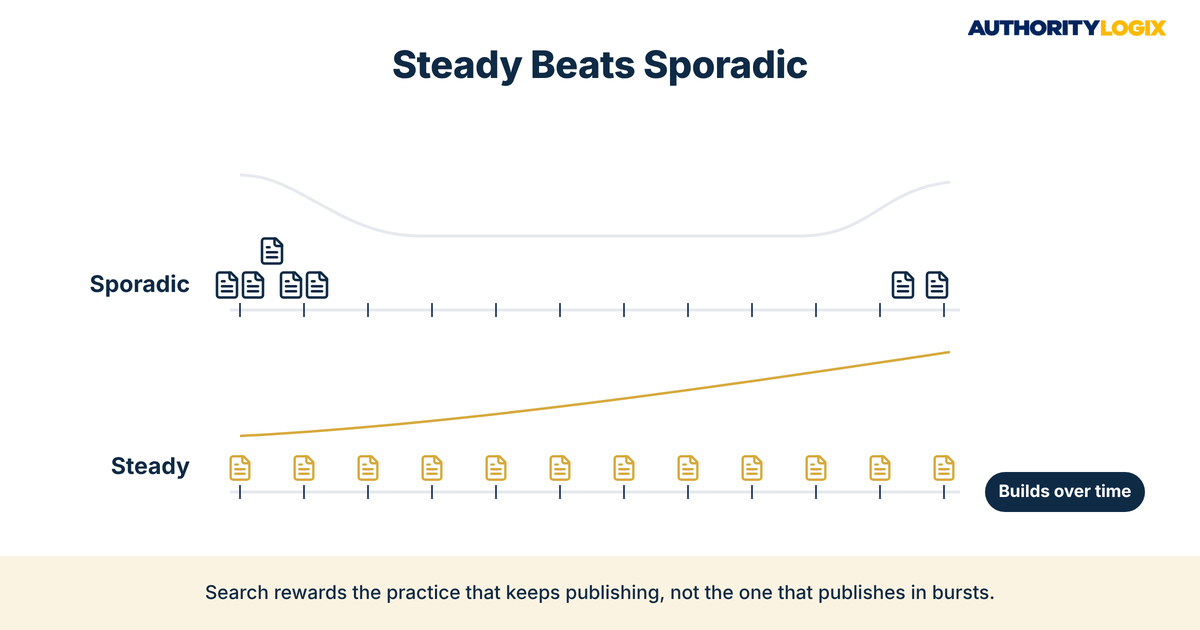
The PT content cadence SEO impact shows up slowly, and that is the point. Ahrefs’ May 2025 study of how long pages take to rank found that 72.9% of pages in Google’s top 10 are more than three years old. Rankings favor pages that have been in place, earning links and signals, for a long time. A blog that publishes steadily for years builds a library of those pages; a blog that publishes in bursts keeps restarting.
Volume without infrastructure is just noise. Twenty rushed articles in one month, followed by silence, give search engines a scattered set of thin pages and give patients a blog that looks abandoned by spring. Steady, linked, reviewed articles build topical depth around the services you actually offer, which is where physical therapy blog frequency SEO starts paying off.
Why Physical Therapy Blog Frequency SEO Rewards Local Focus
PT patients usually look for care close to home, so blog articles should support the clinic’s local search signals rather than compete with them. An article on running injuries that mentions the trails and races in your area, links to the relevant service page, and reflects the clinic’s location helps physical therapy blog frequency SEO compound locally instead of chasing national traffic that will never book.
That local layer runs through the Google Business Profile, reviews, and citations covered in the local visibility guide. Blog articles can feed those channels too: a new article can become a profile post, and a patient question answered on the blog can become a profile Q&A entry. Each publish then strengthens more than one signal, and physical therapy blog frequency SEO starts working across channels.
Over time, the articles should form a connected library rather than a chronological feed. An educational hub groups articles by condition and service so patients can move from one answer to the next. That structure is what keeps the PT content cadence SEO impact building long after an article’s publish date.

Setting Physical Therapy Blog Frequency SEO Targets by Practice Size and Goals
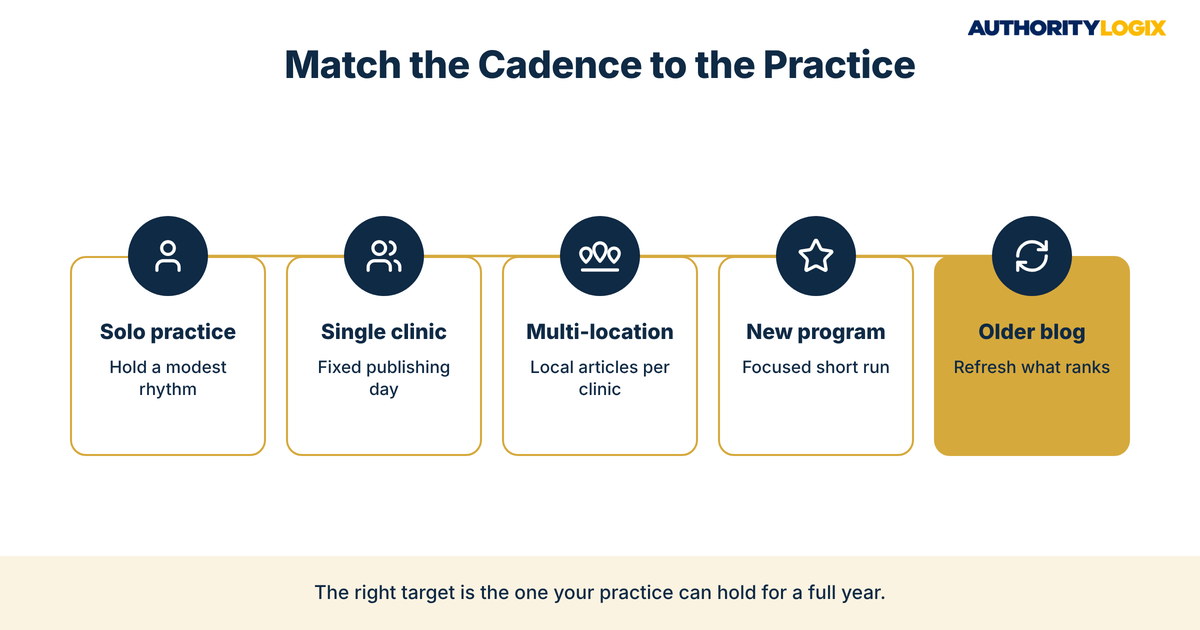
Physical therapy blog frequency SEO targets should match the practice you run today, not the one you plan to have in five years. A solo clinician, a three-location group, and a practice launching a new specialty program all need different publishing plans. The table below shows how the focus shifts by situation, without pretending a single posting number fits all of them.
| Practice Situation | Cadence Focus | What to Publish First |
|---|---|---|
| Solo or two-clinician practice | A modest rhythm the owner can hold every month without skipping | Articles supporting the two or three services that bring the most direct-access patients |
| Single clinic with a small team | A fixed publishing day with one editor and a clinician interview routine | Condition articles that link to each core service page |
| Multi-location group | A shared calendar with location-specific articles added on top | Local articles for each clinic’s community, linked to that location’s pages |
| New specialty program | A short, focused run of articles for the program before returning to the normal rhythm | The questions patients ask before booking that specialty |
| Established blog with older articles | Updating and expanding existing articles alongside new ones | Refreshes of articles that already rank on page two |
Notice that refreshing older articles counts as publishing. Google’s helpful-content guidance specifically asks whether pages have their dates changed to seem fresh when the content has not substantially changed, so a real update means new information, not a new date. A substantive refresh is one of the most practical physical therapy blog frequency SEO wins available to an established practice.
Targets should also connect to the practice’s larger plan. The growth blueprint treats the blog as one part of a visibility system that includes service pages, local search, and reputation, so the cadence is set by what the whole system needs rather than by habit.
For most practice owners, the hard part is not choosing the target but holding it while running a clinic. That is what we do for physical therapy practices: build the topic plan, the interview routine, and the publishing process so the cadence holds without the owner writing every week.
What Most PT Practices Get Wrong About Publishing Schedules, as Patients See It
Patients never see your publishing schedule directly. They see its results: a blog that answers their question, or one whose newest article is two years old. These are the questions patients and practice owners raise most often about physical therapy blog frequency SEO, answered from the patient’s side of the screen.
Does a patient notice when a clinic’s blog has gone quiet?
Many do. A blog whose latest article is years old suggests a clinic that stopped paying attention, even when the care is excellent. A steady rhythm, even a modest one, signals an active practice.
Do patients care how many articles a practice has published?
Patients care whether the article in front of them answers their question clearly and comes from a qualified clinician. Named authors, credentials, and clinical review are the trust signals in the clinical authority guide, and they matter more to a patient than the size of the archive. One trustworthy article beats ten generic ones.
Is it better to publish often or to publish longer articles?
Neither on its own. Google’s guidance states plainly that it has no preferred word count, so length should follow the question being answered. Physical therapy blog frequency SEO improves when each article fully answers one patient question at whatever length that takes.
Can a practice catch up by publishing a large batch at once?
A batch can fill gaps, but it cannot replace consistency. Publishing a stack of articles in one week and then nothing for months recreates the burst pattern, and the library still needs regular additions. If you do publish a batch, the PT resource library model of grouping articles by topic keeps them organized for patients.
Should the practice owner write the blog?
The owner and clinicians should supply the expertise, but they rarely have time to write on schedule. A short interview per article captures what they know, and an editor turns it into the article. That split is what keeps physical therapy blog frequency SEO steady through busy seasons.
Ready for a publishing system that keeps your practice blog on a steady cadence your clinicians can support? Let’s build the topic plan, interview routine, and publishing process together.
The Honest Bottom Line: Steady Beats Sporadic
The honest answer to how often a practice should publish is the most frequent rhythm it can keep for a year without cutting corners. Physical therapy blog frequency SEO rewards practices that publish useful, reviewed, well-linked articles on a steady schedule, and it does very little for practices that publish in bursts and then go quiet.
A blog also reaches further when every article is distributed beyond the website. That is the job of authority distribution, which puts each article in front of local partners, referral sources, and publications, so one piece of clinical expertise earns more than one audience. Distribution multiplies the return on physical therapy blog frequency SEO without adding more articles.
BKDSCR.com, the AuthorityLogix proof-of-concept build in the NYC outer-borough DSCR real estate niche, shows what a steady publishing system produces: 48 SEO-optimized blog posts alongside 18 pillar pages and 7 interactive tools, built in under 18 months with zero paid ads. It is a different industry, but the PT industry hub applies the same publishing structure to physical therapy practices.
Most practices already have the clinical knowledge patients are searching for. What they lack is the infrastructure that turns that knowledge into a steady stream of articles, and building it is the core of our approach. Pick a physical therapy blog frequency SEO cadence you can hold, build the system behind it, and let the library grow.