


Key Takeaways
- A physical therapy content calendar built around patient search intent is a publishing plan that maps specific content topics to specific patient search queries — producing content that earns organic rankings, AI Overview citations, and patient trust rather than content that fills a publishing schedule without targeting any patient need.
- 54% of healthcare website traffic comes from organic search, per 2026 healthcare marketing research — the content calendar determines whether the practice’s organic traffic grows, stagnates, or declines.
- Content marketing generates 3x more leads at 62% less cost than traditional outbound marketing — but those results compound only when the content calendar is consistent and intent-driven.
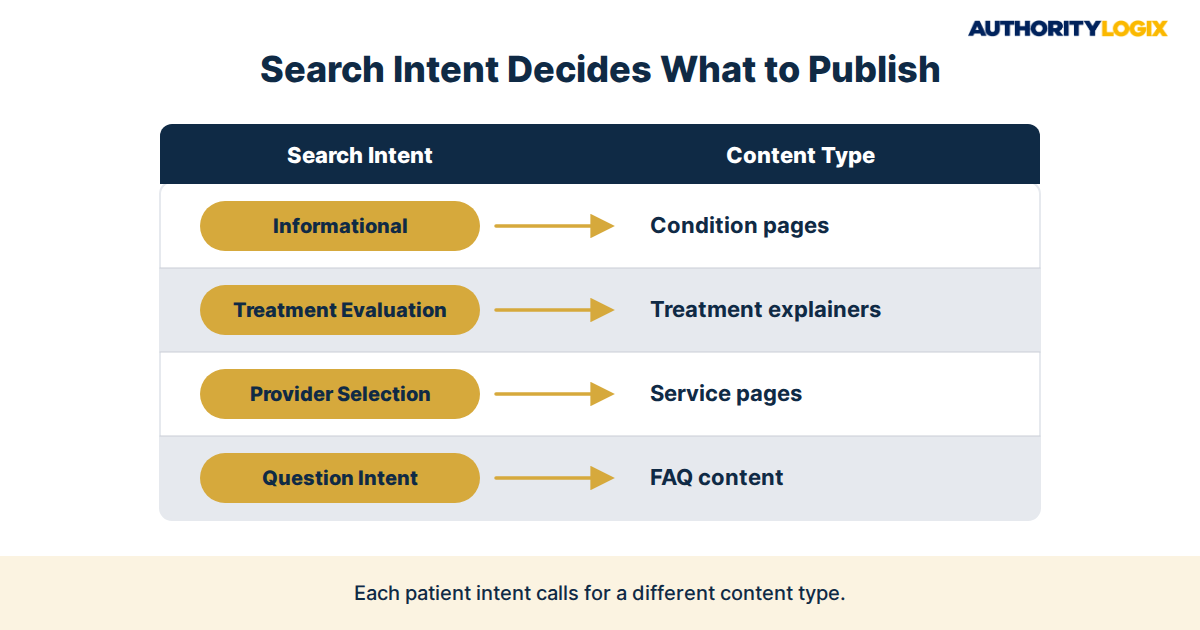
- Patient search intent falls into four categories: informational, treatment evaluation, provider-selection, and question intent. Each requires a different content type and publishing priority.
- A realistic physical therapy content calendar is more effective than an ambitious one. A practice that commits to one substantive piece per month will outperform one that plans four per month for two months, then stops.
- The physical therapy content calendar has three core components: a rolling 90-day production plan, a seasonal intent overlay, and a quarterly review cycle.
- After 12 months of consistent content publishing, organic search can become a substantial source of new patient acquisitions for healthcare practices.
Table of Contents
Physical therapy content calendar patient search intent planning is the infrastructure that turns content production effort into patient acquisition results. Without it, content production is an activity rather than an investment. With it, every piece of content published serves a specific patient at a specific moment in their search journey, targeting a specific keyword that connects the practice to a patient who is actively looking for what the practice offers.
This article covers how to build a physical therapy content calendar around patient search intent — including how to identify the right content topics, how to sequence them for maximum topical authority development, and how to build the seasonal and quarterly review cycles that keep the calendar current and compounding. The content topics article covers the five PT content topic categories that populate the calendar — this article covers the calendar structure itself and the planning process.
Why Patient Search Intent Is the Foundation of the Physical Therapy Content Calendar
Patient search intent is the reason behind a specific search query. A content calendar built around search intent produces content that intercepts patients at the exact moment of maximum relevance. Per 2026 healthcare marketing research, healthcare websites draw 54% organic traffic from search — making the content calendar, in practical terms, the patient acquisition plan for the majority of a PT practice’s new patient pipeline.
The content strategy article covers the five categories of PT content that map to the four patient search intent types. Matching a calendar to those categories is what keeps intent and content aligned month over month.
The distinction between intent-driven and topic-driven content calendars is the difference between content that earns rankings and content that does not. An intent-driven calendar publishes on “searched” topics — the specific condition keywords, treatment keywords, and patient question keywords that patients in the practice’s geographic market are actively typing into search engines. The acquisition playbook covers how intent-driven content connects to the full patient acquisition pipeline.
Content marketing generates 3x more leads at 62% less cost than traditional outbound marketing, per Demand Metric — but those results require the content to be targeting the right patient at the right search stage. A calendar with no intent mapping behind it rarely sees numbers close to that benchmark.
Explore the AuthorityLogix PT Content and SEO Playbook built for physical therapy practices.
The 3 Components of a Physical Therapy Content Calendar Patient Search Intent Plan
Physical Therapy Content Calendar Patient Search Intent Component 1 — Rolling 90-Day Plan
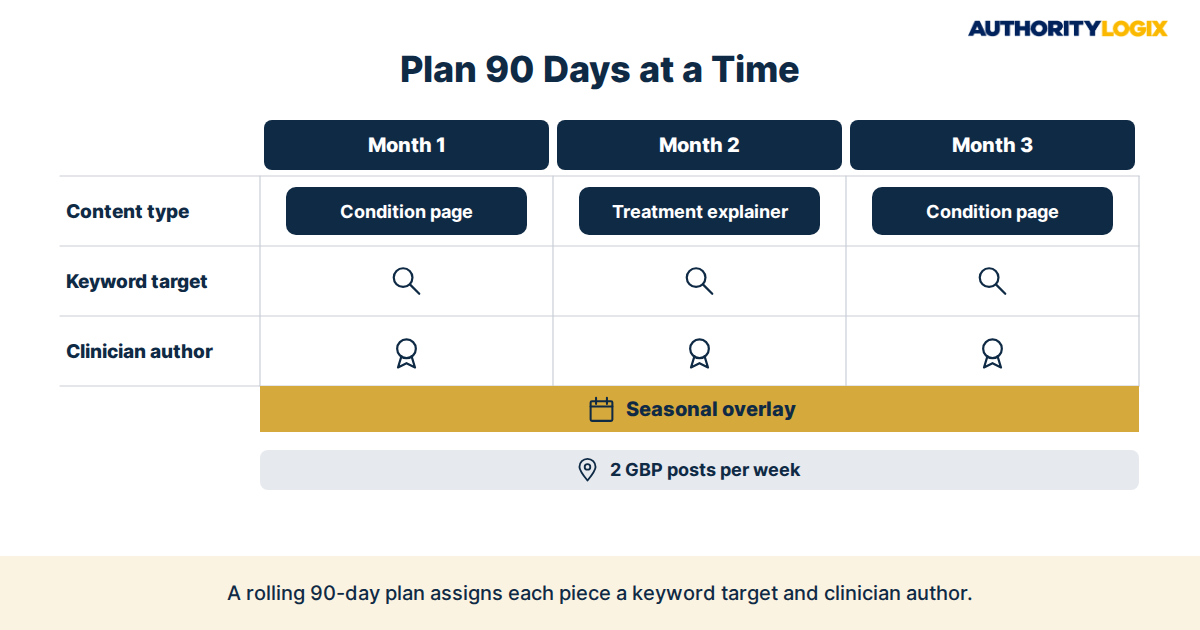
The rolling 90-day production plan lists specific topics — not categories, but specific titles and keyword targets — for the next 90 days of content production, with a clinician author assigned to each topic, a publication date, and a content type assigned to each entry. Rolling 90 days is the right horizon because it is long enough to maintain a publication cadence but short enough to adjust to new keyword opportunities. The local search system connects the rolling production plan to the geographic keyword signals that ensure each piece of new content is locally targeted.
Component 2 — The Seasonal Intent Overlay
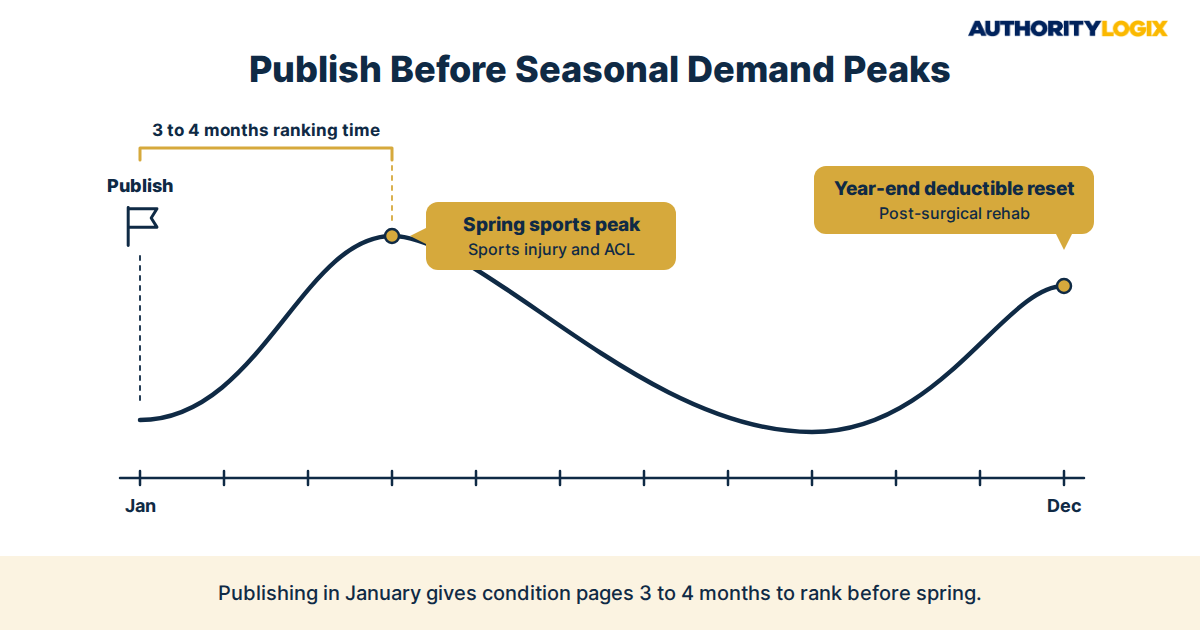
The seasonal intent overlay adds time-sensitive content planning to the rolling 90-day plan. PT patient search volume for specific conditions peaks at predictable times of year — spring sports season drives sports injury and ACL searches; year-end deductible resets drive post-surgical rehabilitation. A practice that publishes its spring sports injury condition pages in January earns 3 to 4 months of ranking time before peak search volume arrives. The authority guide covers how seasonal condition content connects to the practice’s clinical authority positioning.
Component 3 — The Quarterly Review Cycle
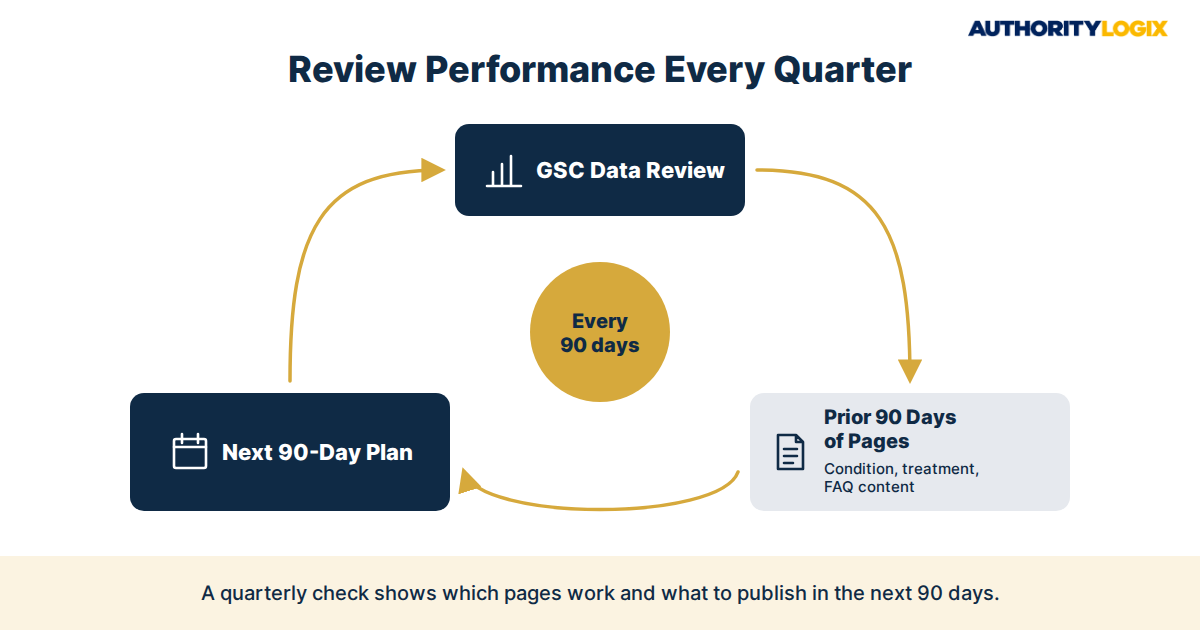
The quarterly review cycle is the calibration mechanism that keeps the physical therapy content calendar producing real results. At the end of each 90-day period, the practice reviews GSC data for all condition pages, treatment explainers, and FAQ content published in the prior 90 days. After 12 months of consistent content publishing, organic search can become a substantial source of new patients. The growth blueprint covers the long-term measurement framework that tracks content calendar performance over the 12 to 24 month compounding horizon.
Physical Therapy Content Calendar Patient Search Intent: How to Populate It
Populating the physical therapy content calendar starts with the practice’s own patient data: the top 10 diagnoses treated in the prior 12 months, ranked by patient volume. These are the condition page topics for the first 90 days. The educational hub organizes condition page content into the knowledge library architecture that makes each new condition page findable through the site’s navigation.
Topic Prioritization Within the Calendar
Topic prioritization follows a specific sequencing logic: highest-volume conditions first, specialty differentiators second, seasonal peaks third, and patient question content woven throughout at a consistent cadence. The lead generation system connects each condition page publication to the conversion infrastructure — ensuring that each new page has a clear path from organic search visitor to evaluation booking.
Assigning Clinician Authors
Every condition page and treatment explainer is assigned to a named clinician before the topic is added to the production queue. The clinician assigned is the PT with the deepest clinical experience in that specific condition — not the PT with the most availability, but the PT whose credentials most directly support the E-E-A-T signals the condition page requires. The visibility guide covers how clinician authorship connects to local search authority.
Not sure which content topics your PT calendar should prioritize?
Physical Therapy Content Calendar Publishing Cadence
The most effective physical therapy content calendar publishing cadence is the one the practice can sustain for 24 months. A realistic and sustainable cadence: one condition page or treatment explainer per month, plus two GBP posts per week. This produces 12 condition pages per year. A consistent cadence published over time outperforms an ambitious cadence that collapses after two months. The content systems built for PT practices include the content production workflow that makes the monthly condition page cadence achievable for a busy practice without a dedicated marketing team.
The authority distribution system amplifies each piece of content published on the calendar — syndicating condition pages and FAQ content to external platforms that build the citation footprint that reinforces organic rankings. The distribution system turns a single condition page publication into a multi-channel authority signal: organic ranking, external citation, and GBP post amplification all targeting the same condition keyword.
Frequently Asked Questions
Can a solo practitioner maintain a PT content calendar?
Yes — the most realistic solo practitioner content calendar is one condition page per month, assigned to the solo PT, covering the conditions that PT treats most frequently. At this cadence, the solo practice builds a 12-page condition library in its first year. The PT industry hub demonstrates how the five-system framework operates for solo and small practices, not just multi-location operations.
What happens when the content calendar is paused?
Existing rankings do not immediately disappear when a content calendar is paused — organic rankings earned by well-built condition pages persist for months without new content additions. What declines is the compounding trajectory: new pages are not being added to the topical authority pool, new keywords are not being targeted, and new AI Overview citations are not being earned. The ranking loss from a paused content calendar is invisible in the short term and significant in the 6 to 12 month view.
How does the content calendar connect to GBP posting?
GBP posts and content calendar publications are complementary. When a new condition page is published, schedule a GBP post for the same week linking to the condition page. When the seasonal overlay indicates an upcoming condition search peak, schedule GBP posts two to three weeks before the seasonal spike. The local search — already referenced above — covers the full GBP content strategy, including how to structure GBP posts that support condition page rankings.
Want a content calendar built on patient search intent instead of guesswork, published on schedule for you?