Key Takeaways
- Physical therapy condition specific landing pages meet a patient at the moment they search for a problem by name, which is where high-intent visits begin.
- Pew Research Center’s 2013 Health Online report found that 77% of online health seekers began at a search engine such as Google, Bing or Yahoo.
- A condition page and a service page do different jobs: one answers the patient’s problem, the other describes what the practice offers.
- PT condition page lead capture works when the call button, the short form and online evaluation booking sit on the page itself, not one click away.
- Ahrefs found that 96.55% of all pages in its index get zero traffic from Google, so physical therapy condition specific landing pages need real search demand and a connected site behind them.
- Physical therapy condition specific landing pages are infrastructure: they work alongside the Google Business Profile, clinician credentials and educational content, never alone.
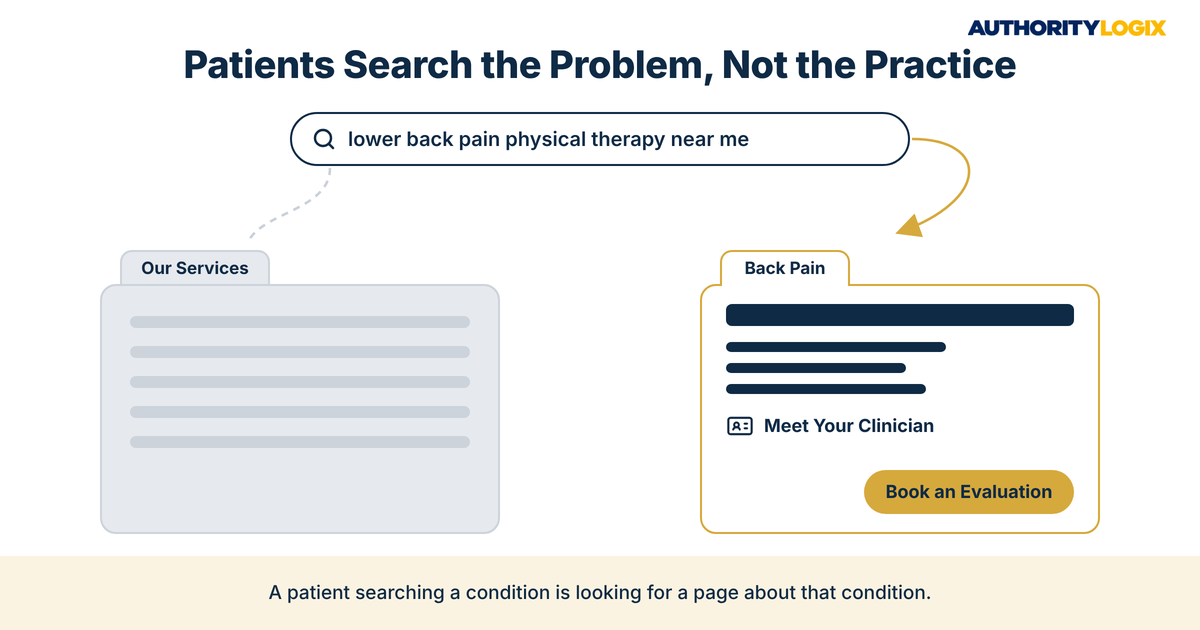
Physical therapy condition specific landing pages are where a patient who already knows what hurts decides whether your practice is the one to call. You may have treated thousands of back, knee and shoulder cases and still be absent when that patient types a condition and a town into Google. The
content SEO playbook maps the full search structure behind a PT website, and this article stays on one piece of it: the page that turns a condition search into a booked evaluation.
That is the credible but invisible problem in its most expensive form. A patient searching for help with a named condition is close to a decision, and physical therapy condition specific landing pages exist to answer that patient before a competitor’s page does.
Why Physical Therapy Condition Specific Landing Pages Capture High-Intent Patients
Pew Research Center’s 2013 Health Online report, based on a survey of 3,014 U.S. adults, found that 72% of internet users had looked online for health information in the past year, and that 35% of U.S. adults had gone online to figure out a medical condition. Among online health seekers, 77% said they began at a search engine. The data is old, but the pattern holds: patients start with the problem, not the provider, and physical therapy condition specific landing pages are built for that pattern.
A practice that already publishes
condition pages has the raw material, but a page that describes a condition is not the same as a page built to convert the person reading it. The difference is whether the page answers the patient’s next question — can I come in without a referral, who will I see, how do I book — or stops at the description. Physical therapy condition specific landing pages close that distance on purpose.
Publishing alone does not produce visits. Ahrefs’
search traffic study, published by Tim Soulo in December 2023, found that 96.55% of all pages in its index get zero traffic from Google. The study points to three common causes: no search demand, no backlinks on competitive terms, and a mismatch with what the searcher wanted. Physical therapy condition specific landing pages avoid all three when they target conditions patients actually search for and sit inside a linked site.
Where Physical Therapy Condition Specific Landing Pages Fit in a Direct-Access Market
APTA marks 2015 as the year all 50 states reached some form of direct access to physical therapists, although APTA also notes that significant barriers to patient access remained in many states. That shift means a patient can find you without a physician in the loop, but only if your site answers the search they actually run. Physical therapy condition specific landing pages are how a referral-dependent practice starts earning direct-access patients from search.
The Physical Therapy Patient Acquisition Playbook shows where condition landing pages sit in the full new-patient pipeline, from the first condition search to the first booked evaluation.
Acquisition Playbook →
Condition Pages vs Service Pages: How PT Condition Landing Page Patient Conversion Differs
Most PT websites are organized around what the practice offers, because that is how clinicians think about the work. Patients rarely do. As the AuthorityLogix
PT industry hub lays out, the visibility problem in this field is structural, and the service-first website is one of its clearest symptoms: it describes the practice well and matches almost nothing a patient types.
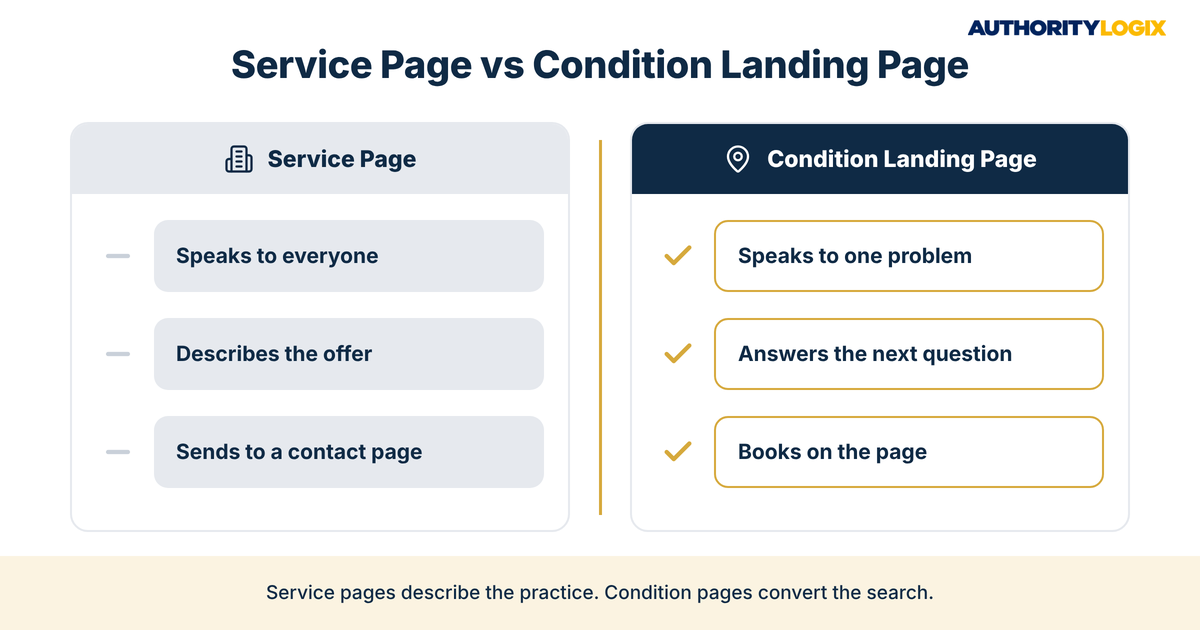
PT condition landing page patient conversion starts from the other direction. The page opens with the patient’s problem, uses the words patients use for it, and treats the practice’s services as the answer rather than the headline. Physical therapy condition specific landing pages and service pages both belong on the site, but they do different jobs, and the table below shows where they split.
| Element |
Service Page |
Condition Landing Page |
| Who it speaks to |
Anyone browsing the practice |
One patient with one named problem |
| Search it matches |
“physical therapy [town]” |
“[condition] physical therapy near me” |
| Opening line |
What the practice offers |
The problem the patient searched for |
| Main conversion path |
A general contact page |
Call, form and booking on the page itself |
| Job in the system |
Describes the offer |
Converts high-intent searches into evaluations |
The table is a simplification, but the conversion gap it shows is real. A service page asks the patient to translate their problem into your clinical vocabulary, while a condition page does that translation for them. Broader
condition content feeds physical therapy condition specific landing pages with search visibility, while the landing page itself carries the patient to a booking.
Building a Physical Therapy Back Pain Landing Page That Answers Real Patient Questions
Back pain makes a useful example because nearly every outpatient practice treats it, so the local search tends to be crowded. A physical therapy back pain landing page is not a medical article. Its job is to answer the questions that stand between a searching patient and a booked evaluation, in plain language, without promising results.
Those questions are rarely clinical. Patients want to know whether they need a referral, whether their insurance is accepted, who they will see, what the first visit involves, and how soon they can get in. The trust side of those answers — clinician credentials, plain-language explanations, honest scope — is covered in the
clinical authority guide, and a back pain page borrows directly from it.
Page Structure for Physical Therapy Condition Specific Landing Pages
A physical therapy back pain landing page that converts follows the order in which the patient’s questions arrive. That order keeps the page focused on the decision to book rather than on clinical detail the evaluation itself will cover:
- An opening that names the problem in the patient’s own words and the area the practice serves
- A short, general description of what a first evaluation visit involves — no treatment promises or outcome claims
- The clinicians who see back pain patients, with credentials and a photo
- Plain answers on direct access, referrals and the insurance plans you accept
- A call button, a short form and an online booking option, repeated after the main content
- Links to deeper educational articles for patients who are still researching
The last item matters more than it looks. A patient who is not ready to book today needs somewhere to keep reading, and an
educational hub keeps that patient on your site instead of sending them back to the results page. When they return ready, physical therapy condition specific landing pages are one click away.
Building one page is a project, and building one for every condition you treat is a system. Practices that write condition pages between patient visits tend to stall, which is why the work belongs inside
content systems that turn clinician knowledge into published pages on a steady schedule. Physical therapy condition specific landing pages keep paying off only when the library keeps growing.
Not sure whether your condition pages convert the searches they already attract? The PT Authority Gap Assessment shows where your pages, profile and booking paths are losing high-intent patients.
Authority Gap Assessment →
PT Condition Page Lead Capture: Calls, Forms and Evaluation Bookings
PT condition page lead capture is where most condition pages fail quietly. The page ranks, the patient reads it, and the only next step is a contact page that asks them to start over. Every extra click is another chance for the patient to call the next practice on the list.
Patients increasingly expect to book on their own terms. Experian Health’s 2025 State of Patient Access survey found that 80 percent of patients surveyed want to schedule appointments anytime from their home or mobile device. Physical therapy condition specific landing pages should offer that option directly, alongside a phone number for patients who would rather talk to the front desk.
Three Capture Paths Every Condition Page Needs
The first path is the phone call, placed as a tap-to-call button high on the page for mobile visitors. The second is a short form — name, phone number and preferred time — kept free of detailed health questions that belong in a HIPAA-compliant intake process. The third is online evaluation booking, the option most patients in the Experian Health survey said they want.
Those capture paths are one part of a wider
lead generation system that also covers follow-up and reminders. A form that sends an email nobody reads for two days is not lead capture; it is a leak with a submit button. Whoever answers the phone and replies to forms is part of PT condition page lead capture.
None of the three paths requires a large budget, but each needs an owner. That split — your clinical expertise on the page, an outside team building and maintaining the capture system — is
what we do for PT practices that are credible in their market and missing from its search results. Physical therapy condition specific landing pages without an owner drift out of date quietly.

How Physical Therapy Condition Specific Landing Pages Support the Map Pack and Clinician Credentials
A condition page does not rank in a vacuum. Local searches for a condition plus a town pull from both the map pack and the organic results, and the
local visibility guide covers how the Google Business Profile, reviews and citations drive the first of those. Physical therapy condition specific landing pages strengthen the second, and they give the profile a relevant page to send patients to.
The connection runs both ways. A Business Profile whose services list names the conditions you treat, backed by a landing page for each one, tells Google and patients the same story. That alignment sits at the core of
local search work for PT practices, turning a profile visit into a condition page visit.
Clinician credentials are the other half. A patient comparing two practices will look at who they would actually see, so physical therapy condition specific landing pages should name the clinicians who handle that condition and their credentials. The page earns trust by being specific about people, not by making promises about results.
Credentials carry further when they also show up off your site. Clinician articles in local publications and directory profiles point back to the practice, which is the job of
authority distribution. Each mention gives physical therapy condition specific landing pages one more reason to be trusted when a patient arrives.
The same model already works outside physical therapy. BKDSCR.com, the AuthorityLogix proof-of-concept built in the NYC outer-borough DSCR real estate niche, runs on 18 pillar pages, 7 interactive investor tools and 48 SEO-optimized blog posts, each built around a specific search, and it generates inbound leads with zero paid ads. Different industry, same principle.

What Most PT Practices Get Wrong About Condition Pages (and What Searching Patients Want)
Most practices that struggle with physical therapy condition specific landing pages are not short on clinical knowledge. They are working from assumptions borrowed from service pages or blogs, and the questions below come up most often.
Can one page cover every condition we treat?
A single conditions page with one paragraph per condition gives Google nothing specific to rank and gives patients nothing specific to read. Physical therapy condition specific landing pages work because each one is about one problem, written for the person who has it.
Should a condition page explain treatment in detail?
Patients need enough to understand what a first visit involves, not a clinical protocol. Treatment detail belongs in educational articles, and outcome claims do not belong on physical therapy condition specific landing pages at all, because no honest practice can promise a result before an evaluation.
How many condition pages does a practice need?
Start with the conditions that bring in the most evaluations today, then build outward. That sequencing is a growth decision as much as a marketing one, and the
growth blueprint frames how condition pages fit a long-term positioning plan. A short list of strong pages beats a long list of thin ones.
Where should a patient go if they are still researching?
Somewhere on your site, not back to the search results. Practice owners who want to see how condition pages connect to education, local search and authority building can browse the full PT
resource library for the related guides. The same principle applies to patients: give them a next page to read, and physical therapy condition specific landing pages become the destination when they are ready.
Will paid ads cover the gap while condition pages rank?
Ads can buy a place at the top of the results, but that place disappears the day the budget does. Physical therapy condition specific landing pages keep working after they are built. Infrastructure compounds. Ads stop.
Ready to turn the conditions you treat into landing pages that capture high-intent patients and book evaluations? We build the condition page and capture system your local market is already searching for.
Work With Us →
The Honest Close: A Condition Page Is Only as Strong as the System Around It
Physical therapy condition specific landing pages are one of the clearest wins available to a referral-dependent practice, but they are not a shortcut. A page with no Business Profile behind it and no booking path inside it will rank for little and convert less. The sequence in
how we build puts the profile, the capture paths and the first condition pages in place together for that reason.
None of this replaces clinical skill, and none of it should. The pages work because the expertise behind them is real, and
our approach starts with the knowledge you already have rather than generic copy written from the outside. Physical therapy condition specific landing pages simply make that expertise visible at the moment a patient searches for it.
The honest answer is that most PT practices already have the expertise patients are searching for. What is missing is the infrastructure that puts the right page in front of the right patient with a clear way to book, and that infrastructure is worth building in the right order.