


Key Takeaways
- A physical therapy content repurposing strategy turns one well-built article into several formats, so a clinician’s expertise reaches patients in more places without starting from scratch each time.
- In Content Marketing Institute’s 2024 survey of 980 B2B marketing respondents, content repurposing was a challenge for 37%. That is B2B data, not PT data, but the bottleneck is familiar to any practice.
- Physical therapy content multiplication works when every format has its own job: a short video earns attention, a social post starts a conversation, and the article does the explaining.
- PT blog to social media repurposing should carry the clinician’s name, credentials, and voice into every clip and post, or it reads like generic advice.
- Every repurposed piece should point back to the full article and to a clear booking path.
- A physical therapy content repurposing strategy saves time only when the original article is worth repeating.
Table of Contents
Why a Physical Therapy Content Repurposing Strategy Gets More From Every Article
A physical therapy content repurposing strategy starts from an uncomfortable fact: most practices spend hours getting one good article written, publish it once, and never use it again. The clinician who explained it knows the subject cold, the article may be the best explanation in your market, and a month later it sits on page two of your blog where almost nobody sees it. The work behind it deserved more than one appearance.
A physical therapy content repurposing strategy fixes that by treating the article as raw material rather than a finished product. One condition article can become a short video, a handful of social posts, a patient email, a clinic handout, and a Google Business Profile update. Practices that run their publishing through content systems plan those formats before the article is written, so the extra pieces come out of the same interview and the same review.
The challenge is not unique to physical therapy. In its October 2024 benchmarks report, the Content Marketing Institute surveyed 980 B2B marketing respondents, and its B2B research found that content repurposing is a challenge for 37%. The same survey found that 92% had used short articles or posts and 76% had used videos in the previous 12 months. These are B2B marketers, not PT practices, but the pattern is the same: teams keep creating new pieces while the good ones they already have go unused.
This is the credible but invisible problem in content form. A practice can publish genuinely useful patient education and still be unknown outside its referral network, because each article reaches only the few people who happen to find the blog. A physical therapy content repurposing strategy pairs the article with authority distribution, so the same expertise shows up in feeds, inboxes, and local search results where prospective patients already spend their time.
The Physical Therapy Content & SEO Playbook shows how the articles behind a physical therapy content repurposing strategy are planned, written, and connected so each one is worth turning into more.
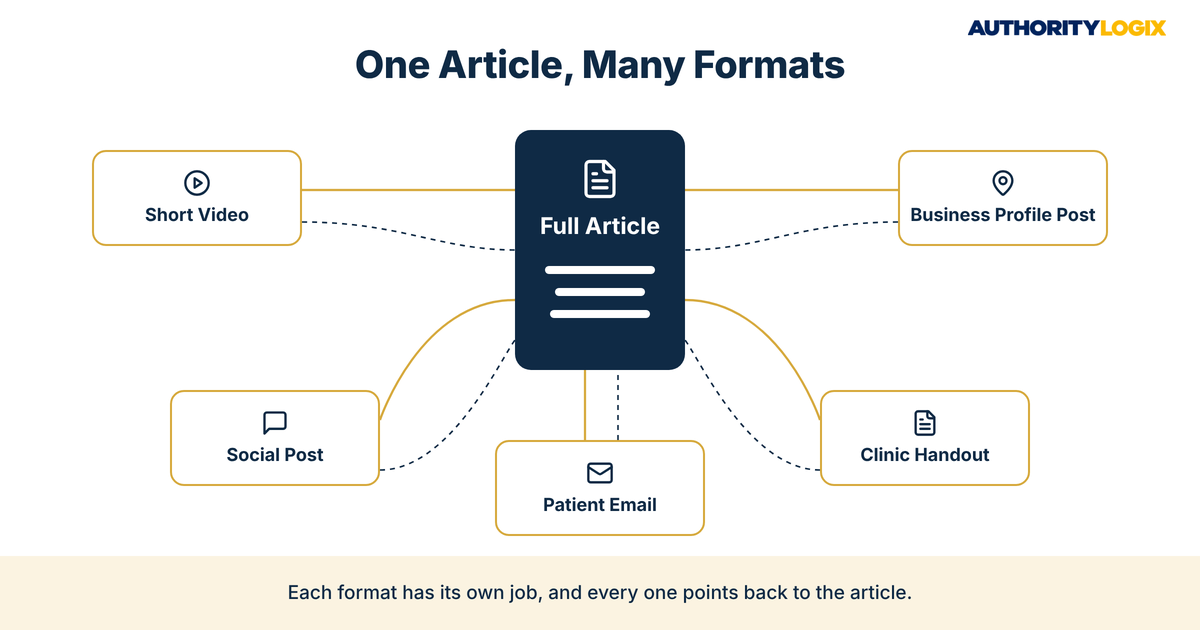
Physical Therapy Content Multiplication: Which Formats One Article Can Become
Physical therapy content multiplication is not about chopping an article into random pieces. Each format pulls out a different part of the article and does a different job for a different moment in the patient’s decision. A physical therapy content repurposing strategy maps those jobs first, so nothing gets created just because it can be.
| Format | What It Takes From the Article | Where It Lives | Its Job |
|---|---|---|---|
| Short video | One key point explained by the clinician on camera | Social channels and the article page | Earns attention and shows the clinician |
| Social posts | A single question, myth, or tip from one section | Practice and clinician social profiles | Starts a conversation and points to the article |
| Patient email | The summary and the practical takeaways | Your patient and past-patient list | Keeps the practice in mind between visits |
| Clinic handout | The plain-language overview of the topic | Front desk and treatment rooms | Gives patients something to take home and share |
| Business Profile post | A short local angle with a link | Your Google Business Profile | Adds fresh activity where local patients search |
Start From an Article Worth Multiplying
The best source articles for a physical therapy content repurposing strategy answer a question patients actually ask, in enough depth that several separate points can stand on their own. A condition article that explains when to seek care, what an evaluation involves, and what questions to ask can feed weeks of formats. A short post about a holiday closure cannot. Practices building an education library around patient questions already have the right raw material.
Source articles also work best when they live inside a structured home on the site. An educational hub gives every repurposed clip and post a strong destination, because the patient who clicks through lands on a page connected to related conditions, clinicians, and a booking path. A physical therapy content repurposing strategy without that destination sends interested people to a page that leads nowhere.

PT Blog to Social Media Repurposing Without Diluting Clinician Credibility
PT blog to social media repurposing goes wrong in a predictable way. The article was written by a named clinician with real credentials, and the social version strips all of that out, leaving a generic tip that could have come from any clinic in the country. Patients scrolling a feed cannot tell your post from countless others, and the authority that made the article worth reading disappears.
The fix is a physical therapy content repurposing strategy that carries the clinician into every format. Each post names who wrote the article, uses the clinician’s own phrasing where possible, and links back to the full piece with the byline and credentials visible. The E-E-A-T principles in the clinical authority guide apply to a social caption just as much as to a condition page, because patients judge expertise wherever they meet it.
Healthcare guardrails travel with the content too. A social post should educate and point to the article, never promise a result or tell a stranger what to do about their own symptoms. Keeping posts in the “here is what to ask, here is when to get evaluated” register protects the practice and keeps PT blog to social media repurposing focused on what it does well, which is earning attention for expertise the practice already has.
Local reach matters as much as social reach. A repurposed post on your Google Business Profile puts the same expertise in front of people searching nearby, and a physical therapy content repurposing strategy that includes the profile turns one article into a local signal as well. The local visibility guide covers how profile activity fits with reviews, location pages, and the rest of the local picture.
Not sure whether your current articles are strong enough to repurpose, or where your content and visibility gaps are? The PT Authority Gap Assessment shows what to fix first.
How to Repurpose a PT Article Into Video and Social Clips
Video is where most repurposing plans stall, because practice owners picture a production shoot. It does not need to be one. In the same Content Marketing Institute survey, B2B marketers ranked videos as the content type that produced the best results, cited by 58%, the highest of any format. Again, that is B2B data, but it explains why a short clip deserves a place in a physical therapy content repurposing strategy.
Setting Up a PT Repurpose Article Video Social Workflow
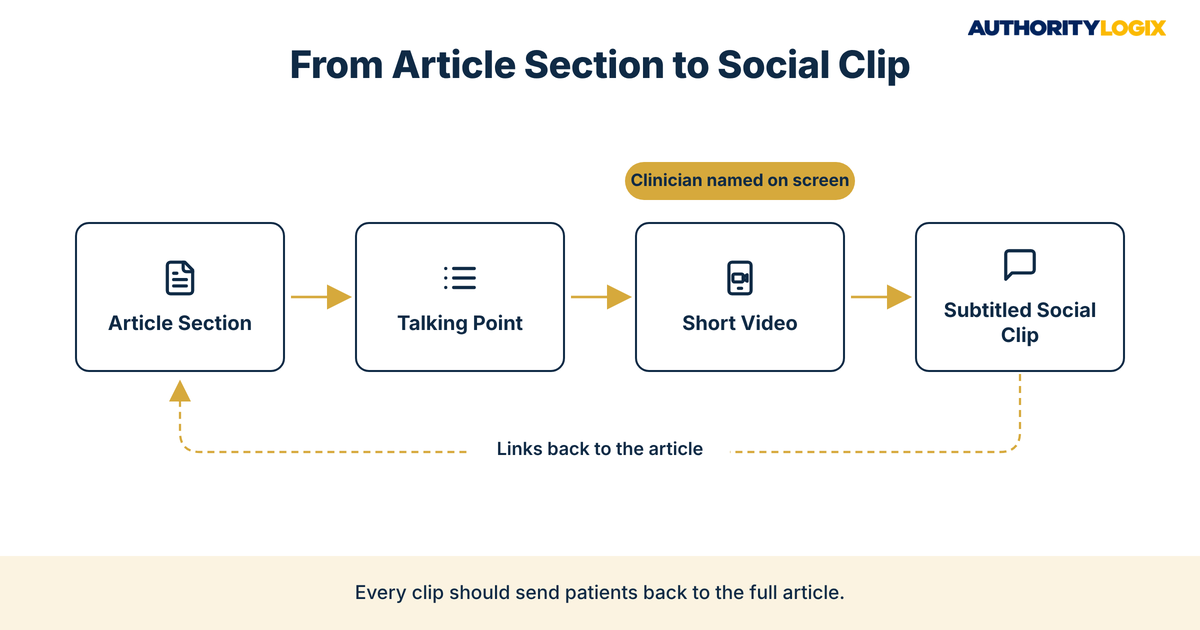
A workable PT repurpose article video social workflow starts with the article’s section headings. Each heading becomes a talking point, the clinician records a short answer to each one on a phone in a quiet treatment room, and an editor trims the clips, adds captions, and writes a caption that links to the full article. One recording session can produce a clip for each major section.
- Pick the three or four sections that answer a single patient question each
- Turn each section heading into a one-sentence prompt the clinician can answer
- Record in a single session with steady framing and clear audio
- Add on-screen captions so the clip still works with the sound off
- End every clip by pointing to the full article on your website
- Keep every clip educational, with no promises about outcomes
Clips that mention your town or neighborhood work harder, because the same video posted to your Business Profile and location pages reinforces your local search visibility. A clinician explaining a common question to “patients here in town” sounds like a neighbor with expertise, not an advertisement, and that tone is what earns a click through to the article.
In a physical therapy content repurposing strategy, the structure matters more than the camera. The process outlined in how we build puts the article, the clip list, and the posting schedule into one plan before anything is recorded, so the clinician spends one focused session and the rest of the work happens without them. That is the difference between a repurposing habit and a repurposing project that fades after a few weeks.
Building a Physical Therapy Content Repurposing Strategy Into Your Weekly Workflow
A physical therapy content repurposing strategy only works if it runs every week without depending on anyone’s spare time. That means the formats are decided when the article is planned, not afterward, and each one has an owner and a date. A practice’s publishing schedule is where those decisions live, so the article and its formats move through the week together.
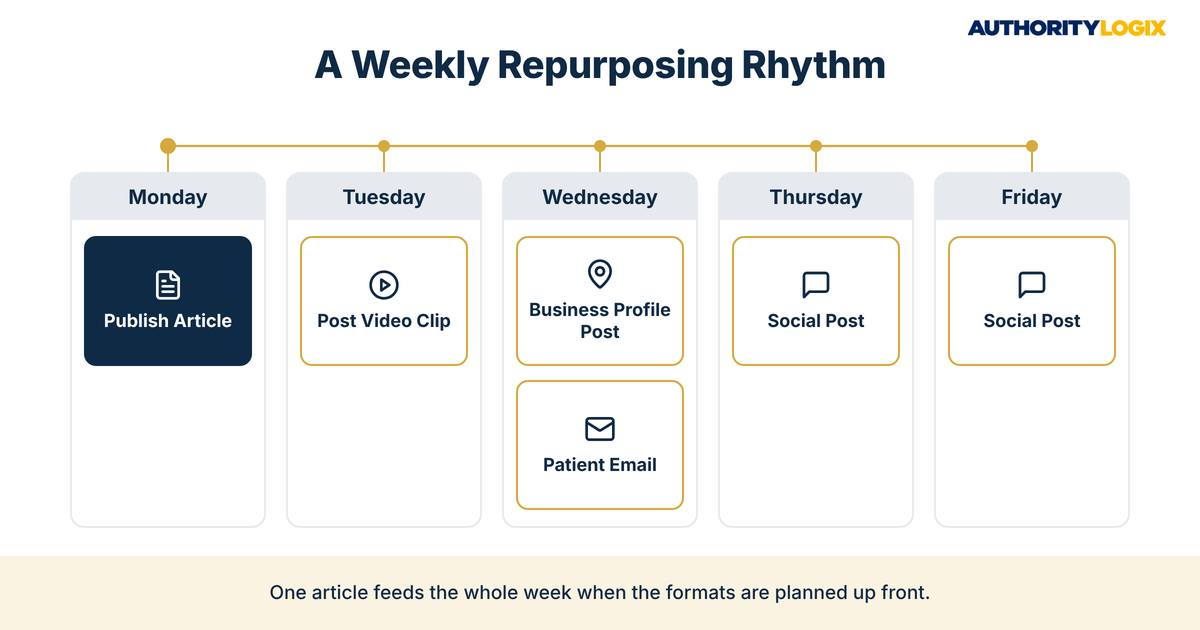
A Weekly Physical Therapy Content Repurposing Strategy Rhythm
A simple rhythm works for most practices. The article publishes early in the week, the clips and first social post follow a day or two later, the Business Profile post and the patient email go out midweek, and the remaining posts spread across the following days. The physical therapy content repurposing strategy repeats with each new article, so the practice always has fresh material without the clinicians writing anything new.
Each repurposed piece needs a home to point to, and that home should be organized. The AuthorityLogix PT resource library is built the same way, with every article connected to a parent guide so any piece pulled from it lands readers somewhere useful. A physical therapy content repurposing strategy that sends people to a disorganized blog wastes the attention it worked to earn.
BKDSCR.com, AuthorityLogix’s own proof-of-concept build in the NYC DSCR real estate niche, shows what a body of work looks like when every piece has a place: 18 pillar pages, 7 interactive investor tools, and 48 SEO-optimized blog posts, built in under 18 months with zero paid ads. It is not a PT practice, but the same rule applies. Material that already exists should keep working.
Most practice owners do not have time to run a physical therapy content repurposing strategy themselves, and they should not have to. The clinician supplies the expertise in one interview and one recording session, and the system handles the rest. Building and running that system is what we do for practices that want their best clinical knowledge in front of more patients without adding hours to anyone’s week.
What Most PT Practices Get Wrong About Repurposing, and What Patients Tune Out
Mistakes in a physical therapy content repurposing strategy rarely come from lack of effort. They come from treating formats as copies instead of translations, and from forgetting the patient on the other end. These are the questions practice owners and prospective patients raise most often, and what each one reveals.
Why do I keep seeing the same post from this clinic everywhere?
Because the practice posted identical text on every channel. Patients notice, and repetition without variation reads as noise. A physical therapy content repurposing strategy rewrites each piece for its channel, so the video, the post, and the email share an idea but not the same words.
Who actually wrote this, and should I trust it?
If the repurposed post does not say, patients will assume nobody qualified did. Naming the clinician and linking to the article with full credentials answers the question before it is asked, and it is one of the cheapest trust signals a repurposed piece can carry.
I watched the video. Now what?
This is where most repurposing falls apart: the clip ends with no next step. Every format should point to the full article, and the article should offer a clear way to book. The patient journey in the acquisition playbook treats that path as part of the pipeline, not an optional extra at the bottom of the page.
Is repurposing just a way to post more?
It should not be. Volume without infrastructure is just noise, and a feed full of recycled tips does nothing if none of them lead anywhere. Repurposing earns its place when every piece connects to lead generation infrastructure, such as an evaluation request or a call option, that turns attention into a conversation with the front desk.
Can old articles be repurposed, or only new ones?
Older articles are often the best candidates for a physical therapy content repurposing strategy, as long as they are still accurate and still answer a question patients ask. Review them with the clinician first, update anything that has changed, and then run them through the same formats as a new piece.
Ready to turn your clinicians’ best articles into a weekly run of videos, posts, and emails that bring prospective patients back to your practice?
The Honest Trade-Off: Repurposing Saves Time Only If the Original Is Worth Repeating
Repurposing multiplies whatever you feed it. A physical therapy content repurposing strategy built on thin, generic articles produces thin, generic clips and posts, only more of them. The time savings are real only when the original article carries real clinical insight, a clear patient question, and a named expert, which is why the growth blueprint treats source quality as the foundation and formats as the multiplier.
That makes the order of work simple. Build a small set of articles worth repeating first, then build the physical therapy content repurposing strategy around them. The PT industry hub lays out how the content, local, education, and distribution pieces fit together for a practice, so repurposing sits inside the larger system instead of running as a separate side project.
The honest answer is that most PT practices already have the expertise patients are searching for. What they lack is a way to put it in front of people more than once. A physical therapy content repurposing strategy closes that gap, as long as the article at the center is worth hearing again. That is our approach with every practice: start with the expertise, and let the system carry it further.