Key Takeaways
- Physical therapy content syndication authority is the trust a practice earns when its educational content is republished on outside sites with clinician credit and a link back to the original.
- In the CMI and MarketingProfs survey of 980 B2B marketers, 89% used organic social platforms to distribute content and 84% used paid channels.
- Google’s spam policies list links with optimized anchor text in articles, guest posts, or press releases distributed on other sites as link spam, so syndication must be built for credit, not link counts.
- A PT authority distribution strategy starts with the condition pages already on your site, and every syndicated version points back to one of them.
- Clinician names, credentials, and a link to the original have to travel with every syndicated piece, or the authority builds for someone else.
- Physical therapy content syndication authority supports local prominence and patient trust over time, but it cannot guarantee rankings or patient volume.

What Physical Therapy Content Syndication Authority Means for a Local Practice
Physical therapy content syndication authority is the trust your practice earns when its educational content appears on outside sites, credited to your clinicians and pointing back to your own pages. You may have a team of doctors of physical therapy, years of evaluations behind you, and a steady flow of patients from the surgeons down the street — and still be unknown to anyone who has never been referred. That is the credible but invisible problem, and the system that carries expertise past the edge of a referral network is
authority distribution.
Syndication means republishing a piece you already wrote — a condition explainer, a first-visit guide, a clinician Q&A — on other platforms, with permission and with attribution. It is not copying content onto dozens of low-quality sites, and it is not a shortcut to rankings. Done properly, physical therapy content syndication authority tells search engines and prospective patients the same thing: this clinic’s clinicians are cited outside their own website, and the original lives on the clinic’s site.
Local practices sometimes assume that reach beyond their town is wasted attention. It is not, because a patient in your town who reads your clinician’s article on a regional outlet, or hears it as a podcast episode, is still a patient in your town. That is why the AuthorityLogix
PT industry hub treats distribution as one of five connected systems rather than a stand-alone tactic.
Why Physical Therapy Content Syndication Authority Is Different From Publishing More
Publishing more articles on your own blog adds pages. Syndication adds outside sources that point to those pages. The difference matters more now that patients can choose a clinic without a referral: APTA’s June 25, 2025 report on the state of direct access states that patients in all 50 states, the District of Columbia, and the U.S. Virgin Islands have either provisional or unrestricted direct access to physical therapist services for evaluation and treatment.
Self-directed patients research before they call, and they rarely research on a single site. Physical therapy content syndication authority puts the same clinician name in front of them in several trusted places before they ever search for a clinic. When they do land on your site, the pages they reach have to be built to convert, and the
content SEO playbook explains how to structure those destination pages so the visit becomes an evaluation request.
The Physical Therapy Practice Authority & Growth Blueprint shows where physical therapy content syndication authority fits inside the full growth system — positioning, reputation, measurement, and the long-term build.
Growth Blueprint →
Why Evaluation Bookings Stall When Content Never Leaves Your Own Website
Most PT practice websites hold good content that almost nobody outside the current patient base ever reads. The condition pages are accurate, the clinician bios are real, and the blog has years of posts. Without physical therapy content syndication authority, a site with few outside references depends on signals it does not have, so evaluation bookings stay tied to whoever refers — and one referring doctor retires and the pipeline dries up overnight.
Other industries stopped expecting a website to distribute itself years ago. In the
CMI survey of 980 B2B marketers, fielded with MarketingProfs between June and August 2024, 89% had used organic social platforms to distribute content and 84% had used paid distribution channels. The lesson carries over to clinics: content earns attention when it is carried to where readers already are.
The pipeline effect is practical rather than mysterious. A prospective patient who reads your clinician’s explanation of what to expect at a first evaluation for shoulder pain on a community health site, then sees the same name in the map pack a week later, arrives already familiar with your practice. That familiarity is the condition a
lead generation system needs to turn a website visit into a booked evaluation.
Syndication does not replace physician relationships; it reduces how much of the schedule depends on them. The
acquisition playbook maps the full path from first exposure to booked evaluation, and syndicated content sits at the very top of that path. Most practices have nothing working there, so physical therapy content syndication authority fills a gap rather than duplicating a channel.

Building a PT Authority Distribution Strategy Around Your Condition Pages
A PT authority distribution strategy begins on your own website, not on someone else’s. Every syndicated piece needs a home version to point back to, and the strongest home versions are the condition pages patients already search for — low back pain, knee pain, post-surgical rehab, dizziness and balance. If those pages are thin, physical therapy content syndication authority has nothing solid to build on.
The production side has to be reliable before the distribution side can be. Practices that publish only when a clinician finds a free evening cannot feed a syndication schedule, which is why
content systems that turn clinician knowledge into finished, reviewed articles on a set cadence come first. Physical therapy content syndication authority is built from that steady supply, not from one lucky article.
Topic selection should follow search demand, not guesswork. A sound
content SEO strategy for a PT practice identifies which conditions and questions local patients search most often, and the syndication plan reuses that same topic map. Every outside piece then reinforces a page you already want to rank.
| Content on Your Site |
Syndicated Version |
Where It Points Back |
| Condition page (for example, knee pain) |
Educational article on a regional health or community outlet |
The condition page, with the treating clinician credited |
| Clinician Q&A |
Podcast or video episode |
The clinician’s bio page |
| First-visit explainer |
Slideshow or short video |
The booking or contact page |
| Seasonal guide (for example, running season) |
Feature in a local partner’s newsletter |
The matching blog article |
| Practice news or new location |
Press release distribution |
The location page |
The table only works if the home library is organized. An
educational hub that groups condition pages, FAQs, and clinician articles gives every syndicated piece a clear destination, and it gives patients who arrive from outside a reason to keep reading. That hub is where physical therapy content syndication authority turns into time on site, return visits, and evaluation requests.
Not sure whether your condition pages are strong enough to anchor physical therapy content syndication authority? The PT Authority Gap Assessment shows where your content, profile, and distribution are weakest and what to build first.
Authority Gap Assessment →
How Physical Therapy Content Syndication Backlinks Support Your Map Pack Presence
Physical therapy content syndication backlinks are the links from republished pieces back to your site. They are one signal among many, and they need careful handling. Google’s spam policies list “links with optimized anchor text in articles, guest posts, or press releases distributed on other sites” as an example of link spam, so a plan that stuffs “best physical therapist in [town]” into every byline can do more harm than good.
Earning Physical Therapy Content Syndication Backlinks Through Credit, Not Anchor Text
The safer pattern is plain attribution: the clinic name, the clinician’s credentials, and a simple link to the original article. The same Google policy page describes scraping as republishing content from other sites without adding original value or even citing the original source. Credited, permission-based syndication is the opposite of that, and physical therapy content syndication authority comes from being cited rather than from engineering links.
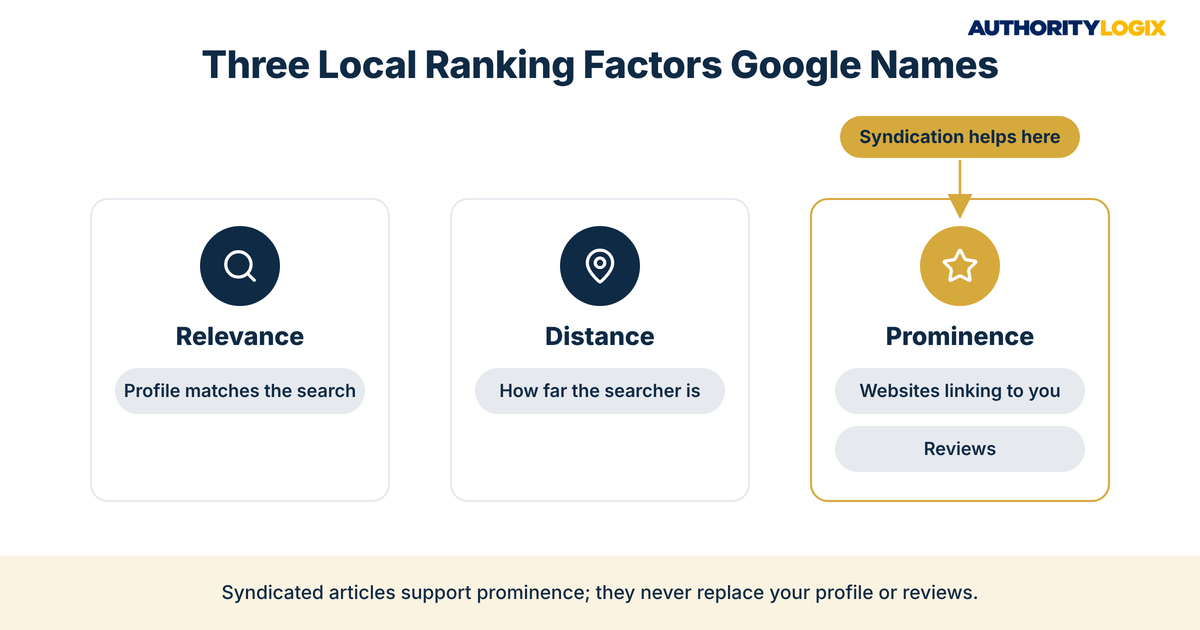
For the map pack, the connection is indirect but real. Google’s Business Profile help page names three local ranking factors — relevance, distance, and prominence — and says prominence is based on information such as how many websites link to your business and how many reviews you have. Your profile, categories, and reviews are handled by
local search work directly, while physical therapy content syndication authority adds outside mentions that describe the same business your profile describes.
No one can promise a map pack position, and no syndication plan should be sold that way. The
local visibility guide covers the full set of local signals, and syndicated content belongs in that picture as supporting evidence of prominence. It is never a substitute for a complete profile, consistent practice details, and steady reviews.
Using AmpiFire Syndication for PT Practices Without Diluting Clinician Credentials
AmpiFire is one of the services built for this kind of multi-format distribution. Its AmpCast product, by AmpiFire’s own description, turns a single idea into formats that include a news article, a blog post, short videos, podcast episodes, and slideshow PDFs, with syndication to platforms such as YouTube, Spotify, LinkedIn, and Google News. For physical therapy content syndication authority, that means one clinician-reviewed condition article can reach readers, viewers, and listeners.
Setting Up PT AmpiFire Syndication So Credentials Travel With the Content
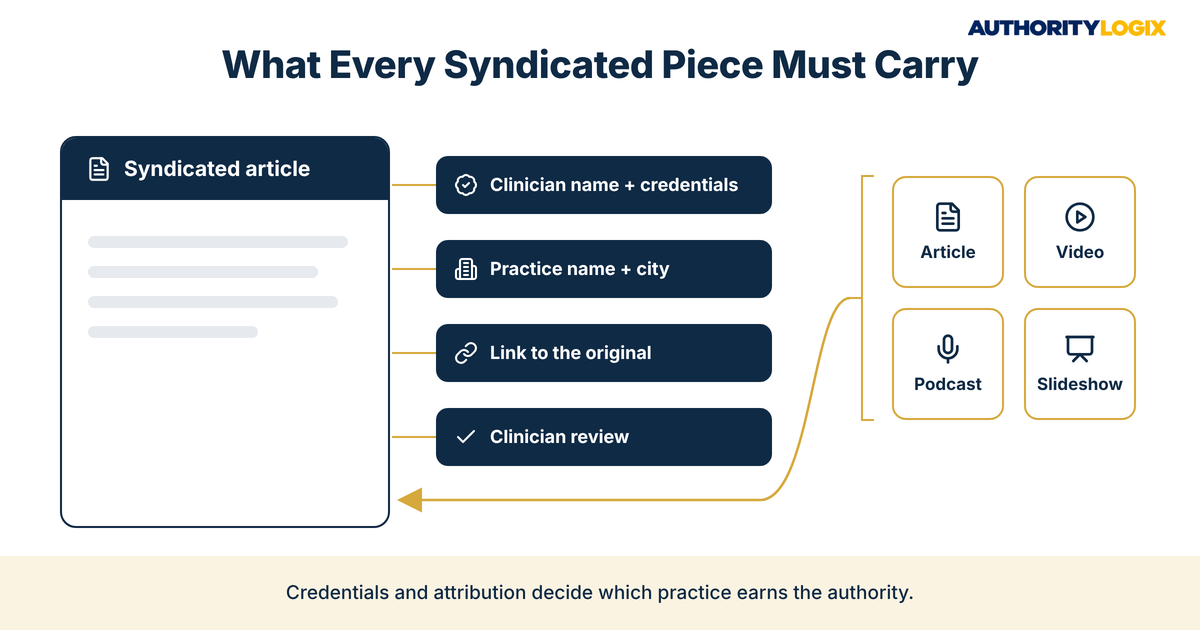
The risk is dilution. A syndicated piece that drops the clinician’s name, strips the DPT or board certification, and loses the link home builds reach for the platform and nothing for your practice. Every item in a PT AmpiFire syndication workflow should pass a short checklist before it goes live:
- A named clinician author, with credentials listed exactly as they appear on your site
- The practice name, city, and phone number, matching your Google Business Profile
- A link to the original article on your own condition page or blog
- Educational framing only, with no outcome promises and no patient details
- A clinician review of every format before it is published
The review step matters most for video and audio versions, where generated scripts can drift from what the clinician actually wrote. The
clinical authority guide explains how credentials, bios, and condition content work together as trust signals. Those are the same signals a syndicated piece has to preserve if it is going to build physical therapy content syndication authority for your practice rather than generic reach for someone else.
AuthorityLogix runs this model on its own proof-of-concept before recommending it to anyone. BKDSCR.com, built in the NYC outer-borough DSCR real estate niche with 18 pillar pages, 7 interactive investor tools, and 48 SEO-optimized blog posts, distributes through a full AmpiFire syndication engine with zero paid ads, and it was built in under 18 months. The order used there is the order described in
how we build: pages first, production second, distribution third.
What Most PT Practices Get Wrong About Physical Therapy Content Syndication Authority
Most practice owners who give up on physical therapy content syndication authority made one of a few predictable mistakes. These are the questions owners ask most often, along with the ones prospective patients ask from the other side of the screen.
Will syndicating our articles count against us as duplicate content?
Permission-based syndication with clear credit and a link to the original is a long-standing publishing arrangement. Google’s spam policies target scraping, meaning republishing without added value or a citation, and manipulative links, rather than credited republication. The practical safeguard is simple: publish on your own site first, then make sure every syndicated version names and links the original.
Should we pay for links on health directories to speed things up?
No. Google’s spam policies name buying or selling links for ranking purposes as link spam, along with low-quality directory or bookmark site links. Paid shortcuts risk long-term visibility for a short-term bump.
Does syndication make sense for a single-location clinic?
Yes, as long as the home site is ready to receive the attention. A single location benefits most when syndicated pieces reinforce the clinic’s town and specialties, which is the job of
local authority positioning for a one-office practice. Physical therapy content syndication authority does not require a regional footprint to be useful.
As a patient, how can I tell whether a syndicated article is trustworthy?
Look for a named clinician with stated credentials, a practice you can actually locate, and a link back to the original source. Articles that promise specific recovery results, or that share identifiable patient stories, are warning signs, and careful practices avoid both.
How should a practice measure whether syndication is working?
Track referral visits from syndicated sources to your condition pages, branded searches for your practice and clinicians, and evaluation requests from patients who say they found you online. Those measures move slowly, so review them quarterly rather than weekly. The
resource library includes measurement articles that support that review.
Ready to build physical therapy content syndication authority that credits your clinicians and sends patients back to your own condition pages?
Work With Us →
The Honest Truth About What Syndication Can and Cannot Do for Your Practice
Syndication can carry your clinicians’ expertise to readers who would never have found your website on their own. It can add credited, attributed mentions that support your practice’s prominence over time. It cannot fix thin condition pages, an incomplete Google Business Profile, or a front desk that misses calls, because physical therapy content syndication authority amplifies whatever system already exists.
That is why the sequence matters more than the platform you choose. Pages, production, and local signals come first, and distribution comes after — the same order behind
what we do for PT practices that are credible in their market but missing from its search results.
The full stack was built and tested on our own proof-of-concept before it was offered to anyone else, which is the plain answer to
why AuthorityLogix rather than a generalist agency. Physical therapy content syndication authority is a slow build measured in quarters, and it works best for practices that treat it as part of a connected system rather than a campaign.
The honest answer is that most PT practices already have the expertise patients are looking for. What is missing is physical therapy content syndication authority — the infrastructure that carries that expertise beyond the referral network and brings the attention back home, where it can become an evaluation on the schedule.