

Key Takeaways
- Physical therapy existing content optimization improves the service, condition, and clinician pages a practice already owns before anyone writes a new article.
- Ahrefs reports that its own link reclamation post, which never got more than an estimated 350 organic visits per month, tripled its traffic after an August 2024 rewrite.
- Google’s people-first content guidance questions changing page dates to look fresh when the content has not substantially changed.
- A PT content refresh SEO strategy starts in Search Console: pages with impressions but few clicks, pages just past page one, and pages that slid.
- Physical therapy existing content optimization works through accuracy, structure, and internal links, so PT content optimization without new publishing is still real work.
- Physical therapy existing content optimization works best on pages that already deserve to rank; it cannot rescue a page with nothing to say.
Table of Contents
Why Physical Therapy Existing Content Optimization Often Beats Publishing New Posts
Physical therapy existing content optimization is the work of making the pages your practice already published earn the rankings they were built for. Most practice owners hear “you need more content” and assume the answer is another blog post, when the real gap sits inside a site that already has dozens of service, condition, and clinician pages. A sound SEO strategy treats those pages as assets that need maintenance, not as finished projects to be ignored once they go live.
That gap is the credible but invisible problem in a familiar form. Your clinicians have real expertise, and your site holds pages that describe your services accurately enough — but not well enough to compete. Physical therapy existing content optimization closes the distance between what your practice knows and what those pages currently show Google and prospective patients.
The case for refreshing before starting over is clearest in a publisher’s own numbers. In a 2025 guide on republishing content, Ahrefs’ Louise Linehan reports that the company’s link reclamation post, first published in 2018, never got more than an estimated 350 organic visits per month, and that after Ahrefs rewrote and republished it in August 2024, traffic did not double but tripled. That is one publisher’s example, not an industry rate, but it shows what physical therapy existing content optimization aims for: more return from a page that already exists.
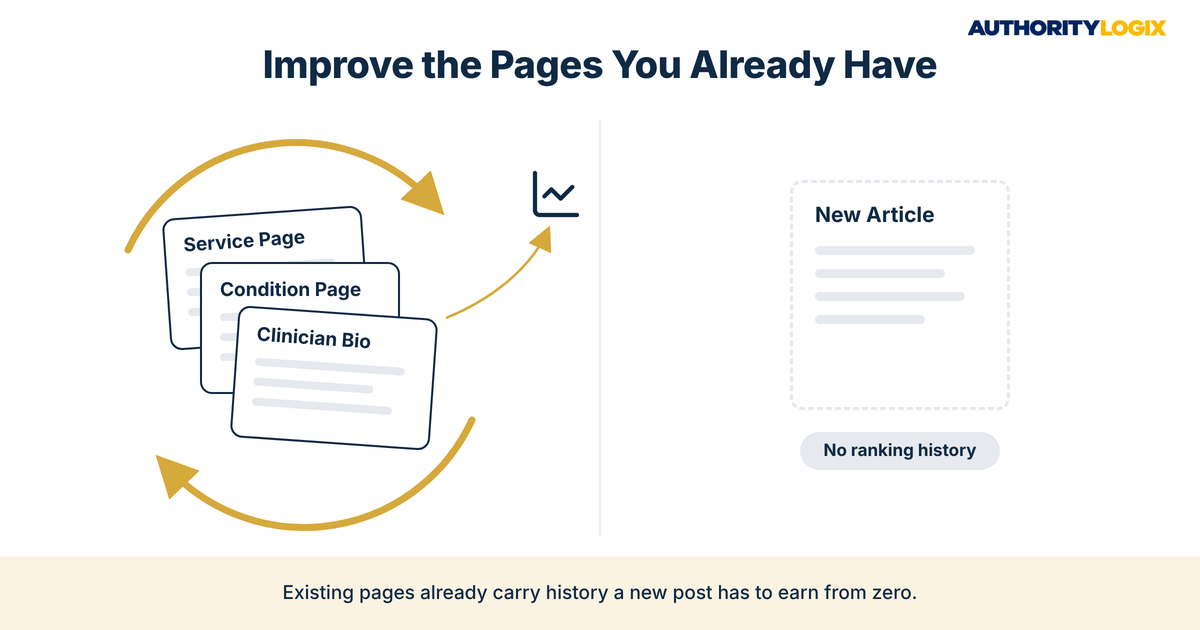
The logic is simple. A new article starts with no ranking history, no internal links pointing at it, and no record of how searchers respond, while an older page usually has at least some of each. Physical therapy existing content optimization works from that head start, which is why so many guides in the AuthorityLogix physical therapy resource library treat updating as a standing part of the publishing system rather than an occasional cleanup.
The Physical Therapy Content & SEO Playbook maps the full content system that physical therapy existing content optimization plugs into — service pages, condition pages, and the internal structure that connects them.
Choosing Which Pages Get a PT Content Refresh SEO Strategy First
A PT content refresh SEO strategy begins with deciding which pages earn the first pass. The clearest signal sits in Google Search Console, where the Performance report shows clicks, impressions, and average position for the pages on your site. Google defines impressions as how many times your site appeared in Search results, and the report’s default view shows the past three months of click and impression data.
Physical Therapy Existing Content Optimization Starts in Search Console
Three patterns point to the pages where physical therapy existing content optimization pays back fastest. A page with plenty of impressions but few clicks is being seen and skipped, which usually means the title and description do not match what the searcher wanted. A page sitting just past page one has relevance Google already recognizes and needs depth or structure to move up. A page that once ranked and slid has usually been outpaced by fresher, more complete competitors.
| Search Console Signal | What It Usually Means | First Optimization Move |
|---|---|---|
| High impressions, low clicks | The page appears, but the title does not earn the click | Rewrite the title and meta description around the question patients actually ask |
| Average position just past page one | Google sees relevance but ranks fuller pages higher | Add the missing questions, sections, and clinician detail |
| Steady decline over several months | Competitors published fresher, more complete pages | Compare against the current top results and close the gaps |
| Ranking for an unintended query | The page answers a different question than planned | Retitle to match the real query, or move the effort to a better page |
| No impressions at all | Google does not see the page as relevant to any search | Decide whether physical therapy existing content optimization means a merge, a rebuild, or retirement |
Triage also depends on what each page was meant to rank for. If the original page was written without keyword research, the update starts by confirming the terms prospective patients actually type, which often differ from the clinical name a therapist would put in a heading. Matching the page to the real query usually matters more than adding words, and Google’s own people-first content guidance states that it has no preferred word count.
The pages you choose should also fit how the site is organized, and practices that run their pages through defined content systems can see which service and condition pages belong together, which overlap, and which compete with each other for the same search. Two thin pages targeting the same condition are often better merged into one strong page than refreshed separately, and that decision is part of a PT content refresh SEO strategy too.

How to Update Old Physical Therapy Content to Recover Rankings
Once the priority list exists, physical therapy existing content optimization follows a consistent order on each page: search intent first, substance second, and presentation last. Jumping straight to cosmetic changes is how practices spend hours on an update and see nothing move.
Physical Therapy Update Old Content Rankings: A Five-Step Sequence
Owners who search for physical therapy update old content rankings advice tend to find scattered tactic lists. The sequence below is the order that holds up across service, condition, and clinician pages:
- Confirm the query: check which searches the page already appears for and whether the content answers them.
- Compare against the current top results: note the questions, sections, and details those pages cover that yours does not.
- Update the substance: add what is missing, correct outdated details such as insurance networks and clinician names, and remove what no longer applies.
- Restructure for scanning: clear headings, short paragraphs, and an FAQ block built from real patient questions.
- Refresh the title and meta description so the search result reflects the improved page.
Ahrefs’ guidance makes the same point about substance. Linehan writes that a post she updated on on-page SEO saw a 36% uplift in organic traffic according to Ahrefs’ Site Explorer, and the same guide warns readers not to just change the publish date. A new date on unchanged content is not physical therapy existing content optimization; it is a label.
Google’s people-first content guidance asks site owners directly whether they are changing the date of pages to make them seem fresh when the content has not substantially changed. That question describes the shortcut a refresh has to avoid. It is also why the update process described in how we build starts with what the page says, not with the date stamp at the top.
Location details deserve their own check. Hours, addresses, and clinician names change more often than most practices update their pages, and a page that disagrees with your Google Business Profile sends mixed signals to Google and to patients. Keeping service pages aligned with your local search profile is one of the least glamorous parts of physical therapy existing content optimization and one of the most useful.
Not sure which of your existing pages are holding your practice back? The PT Authority Gap Assessment shows where physical therapy existing content optimization will move rankings first.
Physical Therapy Existing Content Optimization for Service, Condition, and Clinician Pages
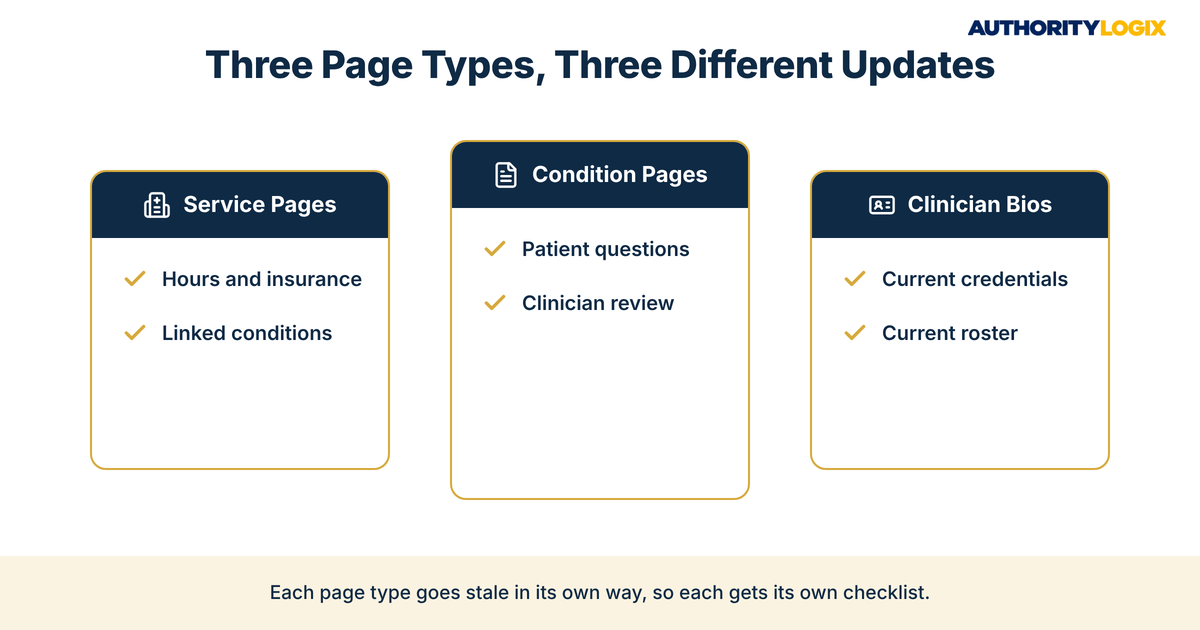
Different page types go stale in different ways, so physical therapy existing content optimization looks different on each one. Service pages drift on business details, condition pages stay thin, and clinician pages get neglected even though they carry the expertise signals patients and Google look for.
Condition pages are usually where a practice has the most room to grow. A knee pain page written as two short paragraphs can be expanded with the questions patients ask before booking — how an evaluation works, whether a referral is needed, what to bring — without making any promise about results. The clinical authority guide covers how that kind of patient education builds trust, and every expansion should be reviewed by a licensed clinician before it goes live.
Service pages need accuracy first and depth second. Physical therapy existing content optimization on a service page confirms every business detail, then links the page to the condition content that supports it, so a patient reading about manual therapy can reach the related condition explanations in one click. That structure is the backbone of an educational hub, where each page has a clear job and points patients to the next useful answer.
Clinician bios are the page type most practices forget to revisit. New certifications, new hires, and departures all change the accuracy of the page, and an outdated roster tells a prospective patient the site is not maintained. Physical therapy existing content optimization on bio pages is a small effort, and the PT industry hub shows how those expertise signals connect to the rest of a practice’s visibility system.
PT Content Optimization Without New Publishing: Links, Structure, and Freshness
PT content optimization without new publishing still means changes Google can see. The three levers that matter most are internal links, page structure, and genuine freshness, and none of them requires a new article. Each one makes an existing page easier for Google to understand and easier for a patient to use.
Internal Links That Point Authority at Existing Pages
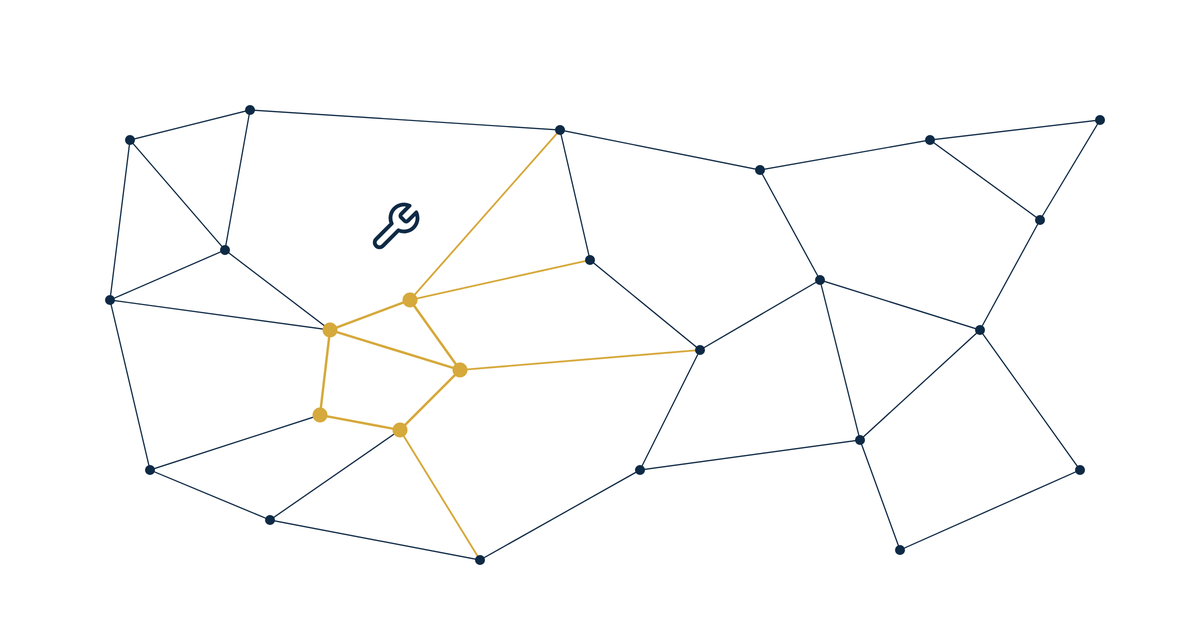
Internal links tell Google which pages matter and how they relate. A blog post never linked to the service page it supports leaves both pages weaker than they need to be. Location pages need the same attention, and the local visibility guide explains how location and service pages reinforce each other when they are linked correctly.
AuthorityLogix built this structure into its own proof-of-concept platform, BKDSCR.com, a real estate investor education site with 18 pillar pages and 48 SEO-optimized blog posts connected so that each post supports a pillar. It ranks for competitive DSCR and NYC real estate terms with zero paid ads. The niche is different from physical therapy, but the internal linking logic is the same one physical therapy existing content optimization applies to service and condition pages.
Structure and freshness finish physical therapy existing content optimization. Clear headings and an FAQ section let patients find answers quickly, while real updates — current insurance details, new clinician credentials, expanded condition answers — keep the page accurate. Once a refreshed page is solid, authority distribution puts it back in front of people through newsletters, social channels, and local partners, so an old page reaches a second audience instead of waiting to be rediscovered.

What Most PT Practices Get Wrong When Updating Content (and What Patients Notice)
Most update mistakes come from treating physical therapy existing content optimization as a technical chore instead of a patient-facing one, and prospective patients notice the results long before Google does. These are the questions practice owners and patients raise most often.
Does changing the date on a page help it rank?
Not on its own. Google’s guidance specifically questions date changes made without substantial content changes, and a patient who sees a recent date above outdated insurance information loses trust quickly. Update the content first, and let the date reflect real work.
Will a patient notice if a page is outdated?
Usually within seconds. An old clinician roster, a closed location, or a service the practice no longer offers tells a prospective patient the site is not maintained, and some will simply call another clinic instead of asking. Physical therapy existing content optimization protects the acquisition playbook pipeline at the exact point where a search turns into a phone call.
Should we delete old blog posts that get no traffic?
Sometimes, but deleting is the last option. A post with no impressions is often better merged into a stronger related page, which gives the surviving page more depth. Retire a page only when it has nothing worth keeping.
Is updating content enough to bring in new patients?
Physical therapy existing content optimization improves the pages patients find, but each page also needs a clear next step. If a refreshed condition page ranks and the only option is a generic contact form, the improvement stops at the visit. Pairing updated pages with lead generation paths — online booking, a call button, a short evaluation request — is what turns rankings into evaluations on the schedule.
How often should a practice review its existing pages?
There is no fixed rule for every practice. A practical rhythm is a quarterly look at Search Console for your priority pages, plus an immediate update whenever business details change.
Ready to turn the service, condition, and clinician pages you already have into pages that rank and book evaluations? AuthorityLogix builds the update system that keeps them current.
The Honest Limit: Optimization Works on Pages That Already Deserve to Rank
Physical therapy existing content optimization is not a fix for every visibility problem. If a page has no real expertise behind it, no clear purpose, and no patients searching for its topic, updating it rearranges the problem without solving it. Those pages need to be rebuilt or retired, and the growth blueprint explains where updating fits among the other systems a practice needs to grow.
Where the pages are sound, though, updating is often the most sensible place to start. Your practice already paid for those pages once, and every improvement builds on rankings, links, and history the site has already earned. That is what we do for physical therapy practices: build the update system so existing pages keep working instead of slowly going stale. Authority compounds.
Practice owners who ask why AuthorityLogix focuses on systems rather than one-off posts will find the reason here. A maintained page keeps earning, and an abandoned page slowly loses ground to the clinic that kept its pages current.
The honest answer is that most physical therapy practices already have more useful content than they realize. What is missing is the discipline of physical therapy existing content optimization — the review, the update, and the connections between pages — that makes the market see the expertise those pages already describe.