


Key Takeaways
- Physical therapy patient local search behavior plays out on the results page: ratings, reviews, photos and hours are checked before anyone calls.
- BrightLocal’s 2026 survey found 97% of consumers read reviews online and 41% “always” read them, up from 29% the year before.
- BrightLocal also found 74% seek reviews written in the last three months, so an old review total reads as an inactive clinic.
- Whitespark’s 2026 survey ranked “business is open at time of search” fifth among map pack factors, so accurate hours decide who is even seen.
- Clinician pages and a clear booking path are where physical therapy patient local search behavior turns into an evaluation request.
- Physical therapy patient local search behavior rewards infrastructure: a complete profile, steady reviews and pages that answer patient questions.
Table of Contents
What Physical Therapy Patient Local Search Behavior Looks Like Before the First Call
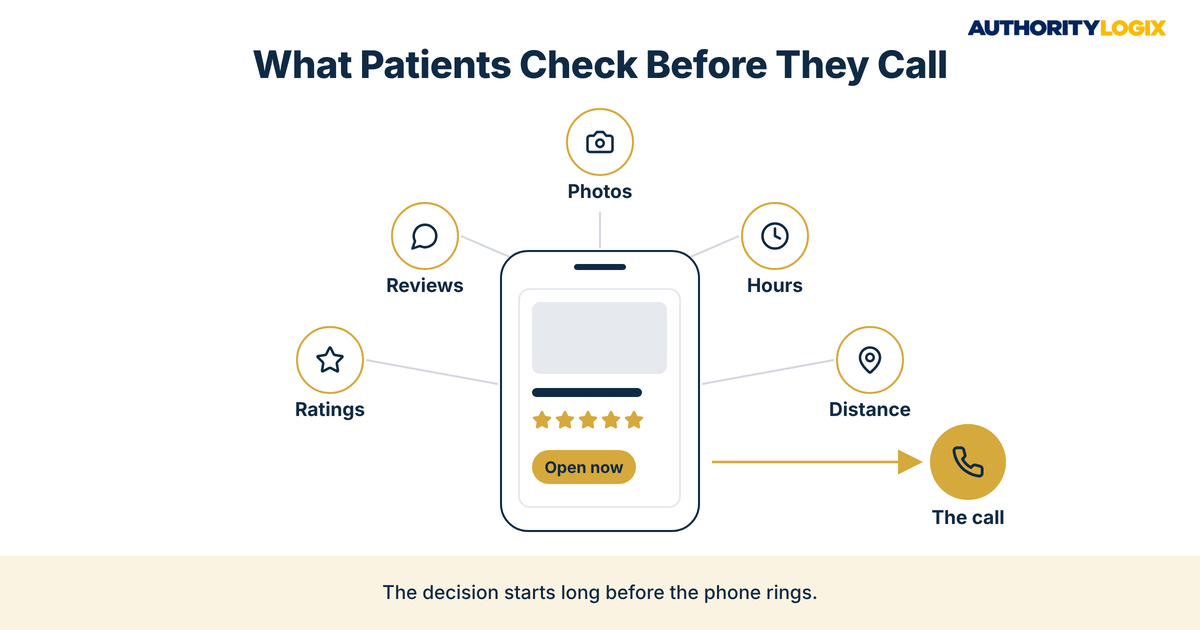
Physical therapy patient local search behavior decides which clinic gets the call long before anyone picks up the phone. Someone with a stiff back or a sore shoulder searches, scans a few names on a map, reads a handful of reviews, glances at photos and hours, and calls one clinic. The AuthorityLogix PT industry hub explains why that short window is where many independent practices lose patients they never knew were looking.
Direct access makes that window matter more. APTA’s 2025 State of Direct Access report states that patients in all 50 states, the District of Columbia and the U.S. Virgin Islands have either provisional or unrestricted direct access to physical therapist services for evaluation and treatment. A patient who does not need a referral chooses a clinic on their own, and the acquisition playbook treats that self-directed search as a pipeline to build rather than a lucky break.
That is the credible but invisible problem in plain view. Your clinicians may be the most experienced in town, but the patient only sees what the results show — a star rating, a review date, a photo, an open-or-closed label. Physical therapy patient local search behavior rewards the clinic whose local search infrastructure makes that expertise visible in those few seconds.
The Physical Therapy Local Visibility Guide shows how to build the profile, reviews and location pages that physical therapy patient local search behavior rewards before the first call.
PT Patient Online Research Before Calling: Reviews, Photos and Hours
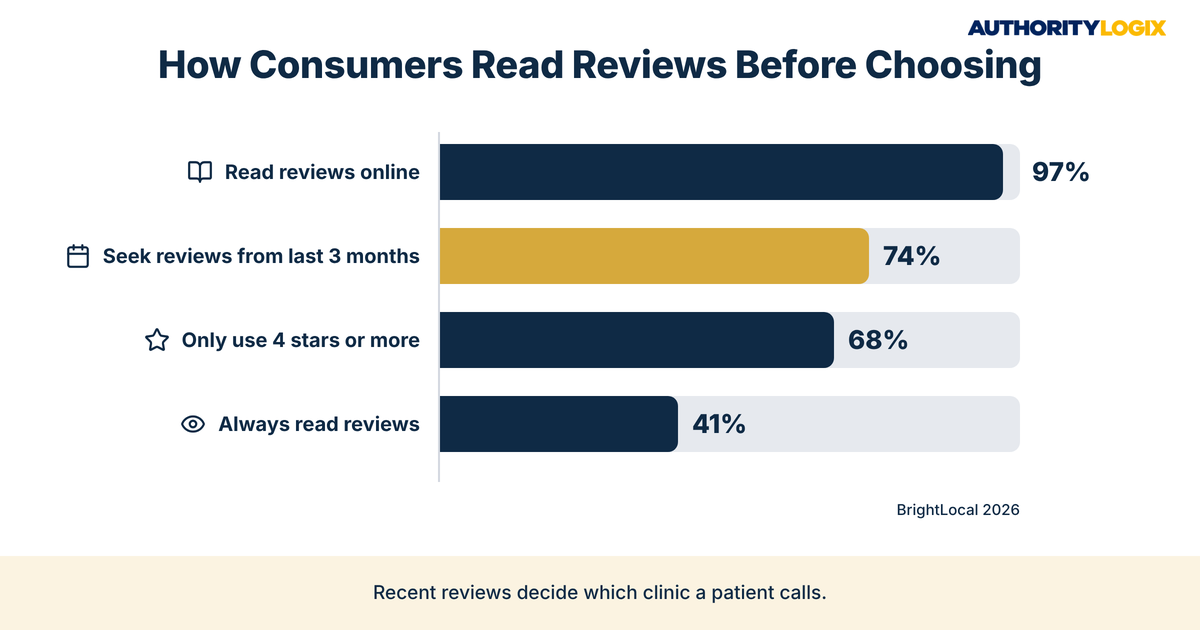
PT patient online research before calling is shorter than most owners assume, and reviews sit at the center of it. BrightLocal’s 2026 review survey found that 97% of consumers read reviews online, and 41% say they “always” read reviews when browsing for businesses, up from 29% the year before. In physical therapy patient local search behavior, your review profile is part of the first impression, not an afterthought.
| What the Patient Checks | BrightLocal 2026 Finding | What It Means for Your Clinic |
|---|---|---|
| Reviews at all | 97% read reviews online | Your review profile is part of every first impression |
| Every time | 41% always read reviews, up from 29% | A search for your name is now a review check |
| Recency | 74% seek reviews written in the last three months | A steady monthly flow beats an old total |
| Star threshold | 68% only use businesses with four or more stars, up from 55% | Below four stars, most searchers rule you out |
| Owner replies | 80% likely to use a business that responds to all reviews | Reply to every review, without patient details |
| Next step | 54% check the website after reading positive reviews | Reviews send patients to your site, so it must answer them |
Those figures describe consumers in general, not physical therapy patients alone, but they set the standard your listing is judged by. The reviews worth encouraging describe the experience in plain terms — how the front desk treated people, how soon they got in, whether the therapist explained things clearly. The wider patient journey runs from first symptom to discharge, while physical therapy patient local search behavior is the narrow slice before the first call.
Photos and Hours Patients Check
Photos matter in physical therapy patient local search behavior too. In the same BrightLocal survey, 36% of consumers said an appealing photo or video accompanying a review matters to them when reading reviews, and Google encourages businesses to use photos and videos to show customers what they offer. Real photos of your treatment space, front desk and entrance tell a prospective patient what walking in will feel like, and a steady supply comes from content systems that capture them as part of normal clinic operations.
Hours are the quiet filter in physical therapy patient local search behavior. Whitespark’s 2026 Local Search Ranking Factors survey ranked “business is open at time of search” fifth among map pack factors, with a score of 189, and Google says businesses with complete and accurate information are more likely to show up in local search results. A patient searching after work is less likely to see a clinic listed as closed, so keep regular and special hours current.
Physical Therapy Patient Decision Local Search Signals in the Map Pack
Think of the physical therapy patient decision local search creates as a short scan of a few listings. The patient compares ratings, review counts, distance and whether each clinic is open, then taps one. Whitespark’s 2026 survey ranked primary GBP category first with a score of 227 and proximity to the point of search second at 225, so your category and your location decide whether you appear in that scan at all.
Why Physical Therapy Patient Local Search Behavior Starts With the Stars
In physical therapy patient local search behavior, ratings shape the scan before a single review is opened. BrightLocal found that 31% of consumers will only use a business with 4.5 stars or more, up from 17% in 2025, and Whitespark ranked high numerical Google ratings sixth among map pack factors. With 68% of consumers ruling out anything below four stars, a clinic under that line loses most of the scan regardless of the care it delivers.
Whitespark’s experts also reported that the biggest changes for 2026 are “an increased importance of review signals and behavioural signals.” That means physical therapy patient local search behavior is not only something to respond to — the way patients interact with listings is itself a ranking input. An educational hub that answers common questions gives patients a reason to choose and contact your clinic straight from the results page.
Review content matters as much as the stars. A review that mentions a named therapist, a clear explanation or an easy first visit tells the next reader what to expect, and the clinical authority guide explains how that kind of visible expertise builds trust before a patient meets your team. Reply to every review without confirming anyone was a patient or mentioning their care.
Not sure what patients see when they search for your practice? The PT Authority Gap Assessment shows where your profile, reviews and pages fall short of physical therapy patient local search behavior, and what to fix first.
PT What Patients See Before Booking: Your Profile, Site and Clinician Pages
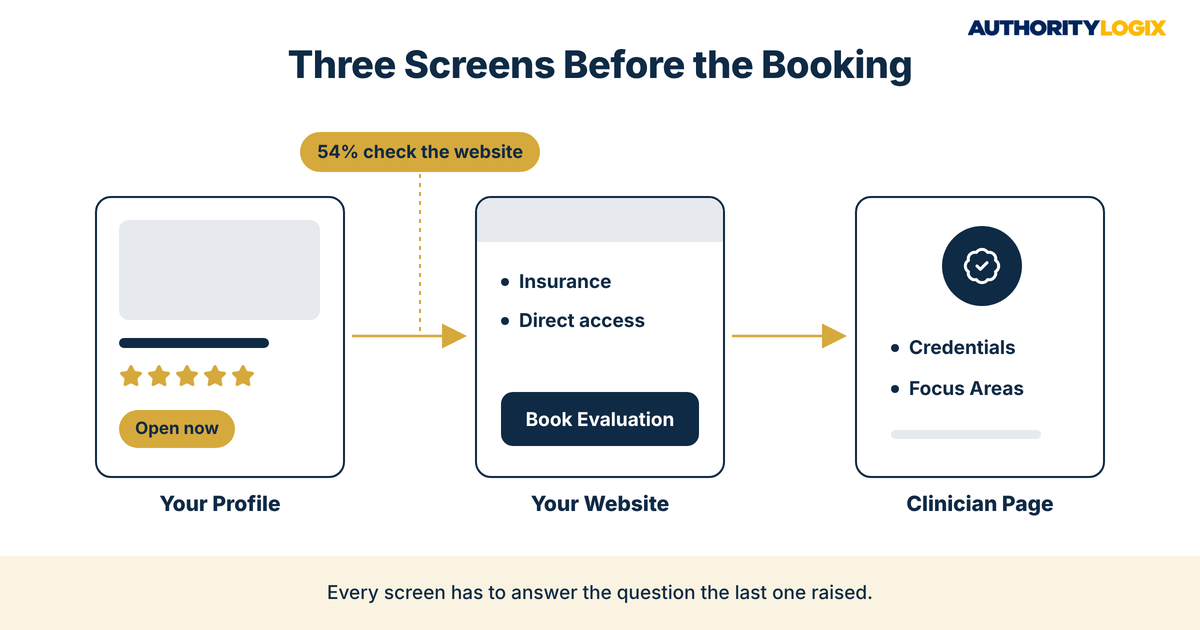
Run a simple PT what patients see before booking test this week, because physical therapy patient local search behavior is easiest to understand from the patient’s seat. Search for physical therapy on a phone from a few blocks away and look at your listing the way a stranger would: the category, the rating, the newest review date, the photos, the hours and the website button. Then tap through to your site and see whether it answers the questions the reviews raised.
That tap matters. BrightLocal found that 54% of consumers check a business’s website after reading positive reviews, so physical therapy patient local search behavior continues on your site. If the page they land on is a generic homepage with no insurance information, no clinician names and no clear way to book, the research often ends there and the patient goes back to the map.
Clinician Pages Patients Open Before They Call
Clinician pages are where a stranger becomes someone the patient feels ready to call. A page for each therapist with credentials, focus areas and a short plain-language introduction answers the “who will I see” question, and a page built around common patient questions answers the rest. Physical therapy patient local search behavior favors the clinic that answers before it is asked.
The questions a patient brings from the search results are predictable. Each one deserves a clear answer on your site before the patient has to call to ask it:
- Do you take my insurance, and do I need a referral?
- Who will I see, and what are their credentials?
- What happens at the first evaluation?
- How soon can I get in, and what are your hours?
- Where do I park, and is the clinic easy to get into?
- How do I book — by phone, form or online?
Each of those answers belongs on a specific page, not buried in one long FAQ. The content SEO playbook lays out how service, condition and clinician pages connect, so a patient arriving from any search lands on the right answer and Google understands what each page is for.
Then make the next step obvious. A click-to-call button, an evaluation request form and online scheduling where you offer it form the lead generation layer that turns physical therapy patient local search behavior into a booked appointment instead of a closed tab.
Turning Physical Therapy Patient Local Search Behavior Into Evaluation Bookings
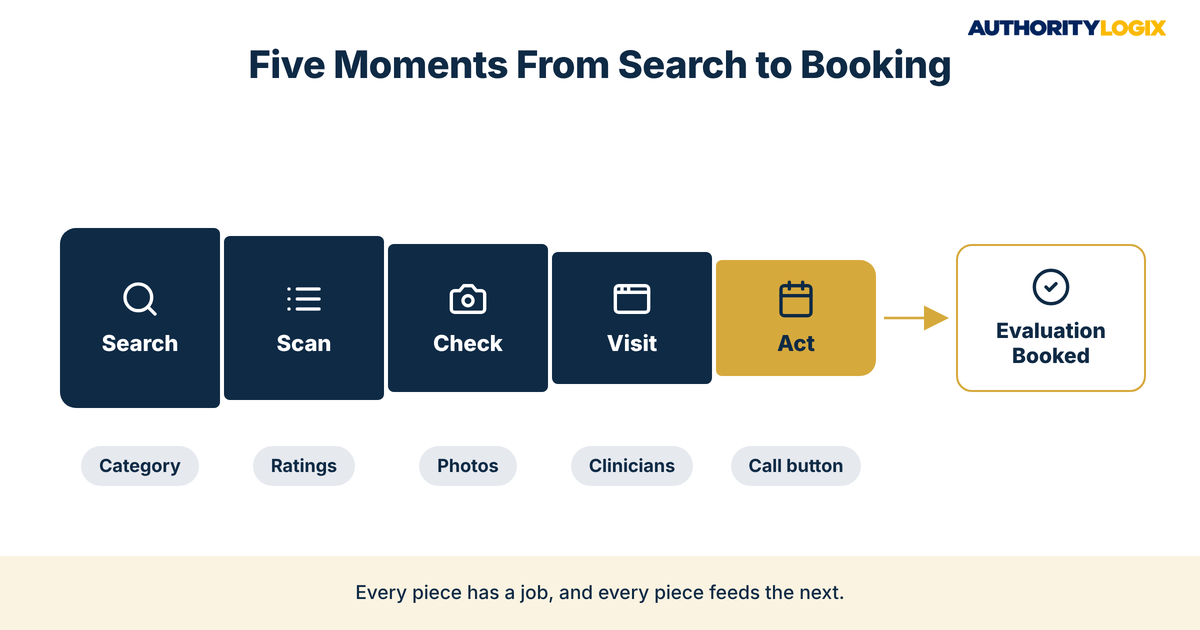
Turning physical therapy patient local search behavior into evaluation bookings is a system problem, not a single fix. Profile, reviews, photos, pages and booking paths each handle one moment of the patient’s research. Every piece has a job. Every piece feeds the next:
- Search: a specific category and accurate hours keep you in the results
- Scan: recent reviews and a strong rating earn the tap
- Check: real photos and personal owner replies build trust
- Visit: clinician and condition pages answer the questions
- Act: a visible call button and request form capture the decision
Prominence is the part patients never see directly but still feel. Google describes prominence as how well-known a business is, and local mentions — a community health talk, a school sports partnership, a quote in the local paper — build it over time. That is why authority distribution runs as a system that keeps those mentions coming instead of leaving them to chance.
Measure what patients do, not just where you rank. Track calls from the profile, direction requests, website clicks and evaluation requests each month, and compare them with the changes you made, so you can see which moment of the search is costing you patients. The PT resource library has a guide for each part of this system, so you can fix the weakest moment in physical therapy patient local search behavior first.
What Most PT Practices Get Wrong About How Patients Choose
Most practices misread physical therapy patient local search behavior because they judge their visibility from the inside — they know the clinic is good, so they assume patients will see it too. These are the questions owners ask most often once they look from the patient’s side.
We have plenty of reviews. Isn’t that enough?
Not if they are old. BrightLocal found 74% of consumers seek reviews written in the last three months, so a large total with nothing recent can look like a clinic that has gone quiet. Recency is one of the clearest signals in physical therapy patient local search behavior.
Do patients use ChatGPT or other AI tools to find a clinic now?
Increasingly, yes. BrightLocal reported that use of ChatGPT and other generative AI tools for local recommendations rose from 6% to 45% in a year, while Google’s share as a review source dipped from 83% in 2025 to 71%. Complete, consistent information across your profile and site gives those tools accurate material to draw on.
Our physician referrals are strong. Why does patient search matter?
A referred patient may still look you up before calling, and a self-referred patient chooses entirely from what the search shows. That is why physical therapy patient local search behavior matters even for a referral-strong practice — referrals and search work together, and neither replaces the other.
Who should manage all of this in a busy clinic?
Your clinicians should own the expertise, and someone else should own the system, because therapists with full schedules will not update profiles, answer reviews and publish pages every week. That split is what we do for practices that patients already trust once they walk in. The expertise stays with your team while the visibility work runs alongside it.
How quickly will changes show up in patient calls?
Fixes patients see immediately — hours, photos, replies — can change how your listing reads right away, while new pages take longer to earn rankings. The growth blueprint explains why this is a long-term asset rather than a quarterly campaign. No one can honestly promise a set number of new calls, and anyone who does is guessing.
Ready to build the profile, review and clinician page system that turns patients’ pre-call research into booked evaluations? Let’s start with what your patients see today.
What You Can Control in the Patient Search and What You Cannot
Some of physical therapy patient local search behavior is out of your hands. You cannot control where a patient is standing when they search, which tool they use, or what an unhappy patient chooses to write. Proximity will always favor the clinic closest to the searcher, and no amount of work changes that.
Almost everything else in physical therapy patient local search behavior is yours: the category, the hours, the photos, the replies, the clinician pages and the booking path. The sequence in how we build starts with the fixes patients notice first and lets the page library mature behind them, so each improvement supports the next instead of competing with it.
AuthorityLogix built the same kind of system for its own proof-of-concept, BKDSCR.com, in the NYC outer-borough DSCR lending niche: 18 pillar pages, 7 interactive investor tools and 48 SEO-optimized blog posts, with zero paid ads. That build in a different industry is why AuthorityLogix can explain this work with specifics instead of promises.
The honest answer is that most physical therapy practices already deliver what patients are searching for. What is missing is a listing and a website that show it in the few seconds a patient spends deciding. Build the parts you can control, keep them current, and let the patient’s own research do the rest.