


Key Takeaways
- Physical therapy patient testimonials persuade the most hesitant prospects, because a story from someone in a similar situation answers doubts that a clinic’s own claims cannot.
- Edelman’s 2026 Trust Barometer reports that 7 in 10 respondents are unwilling or hesitant to trust someone who has different values, facts, problem-solving approaches or cultural background, which is why stories from people like the prospect carry weight.
- Testimonials vs online reviews is not an either-or choice: reviews build breadth on Google, while physical therapy patient testimonials do the detailed persuading on your own pages.
- Patient story marketing works when each story describes the patient’s situation, decision and experience in their own words, without promising anyone else the same result.
- Collect physical therapy patient testimonials only with signed written authorization, let the patient approve the final wording, and keep the form with your compliance records.
- PT social proof marketing pays off when each story sits on the service page, booking page or profile where a prospect actually decides to book.
Table of Contents

Why Physical Therapy Patient Testimonials Persuade Prospects Who Hesitate to Trust Strangers
Physical therapy patient testimonials do a job that clinical credentials cannot do alone: they let a hesitant prospect hear from someone who has already walked through your door. Most practices have years of satisfied patients, skilled clinicians and a solid reputation with the physicians who refer to them. Yet the person searching for help late at night sees none of that history, only a website describing the practice in its own words.
Credible but invisible is the pattern in its plainest form. It shows up in independent clinics and multi-location groups alike, and it is a common reason PT practices with excellent reputations still depend on a few referring doctors for new evaluations. The expertise is real, but the proof a stranger needs is missing from the places that stranger looks.
Hesitation toward strangers is measurable. Edelman’s 2026 Trust Barometer, a survey of 33,938 respondents in 28 countries conducted between October 25 and November 16, 2025, reports that 7 in 10 respondents are unwilling or hesitant to trust someone who has different values, facts, problem-solving approaches or cultural background. A prospective patient choosing a physical therapist for the first time is being asked to trust strangers with their body and their time.
Physical therapy patient testimonials shrink that distance. When a prospect reads about someone with a similar job, sport or stage of life who felt unsure, booked anyway and was treated with care, your practice stops being a stranger. That kind of borrowed familiarity is a large part of how people decide whom to trust, and it is something your own marketing claims cannot manufacture.
Testimonials also keep working long after they are published. Each new story adds another reason to book, another answer to a specific doubt and another signal that real people choose your clinic. Treated as part of your authority growth plan rather than a one-off project, physical therapy patient testimonials become an asset that supports new evaluations month after month.
The Physical Therapy Patient Acquisition Playbook shows where physical therapy patient testimonials fit inside a complete new-patient pipeline, from the first search to the booked evaluation.
Testimonials vs Online Reviews: What Each Does in the Patient Decision
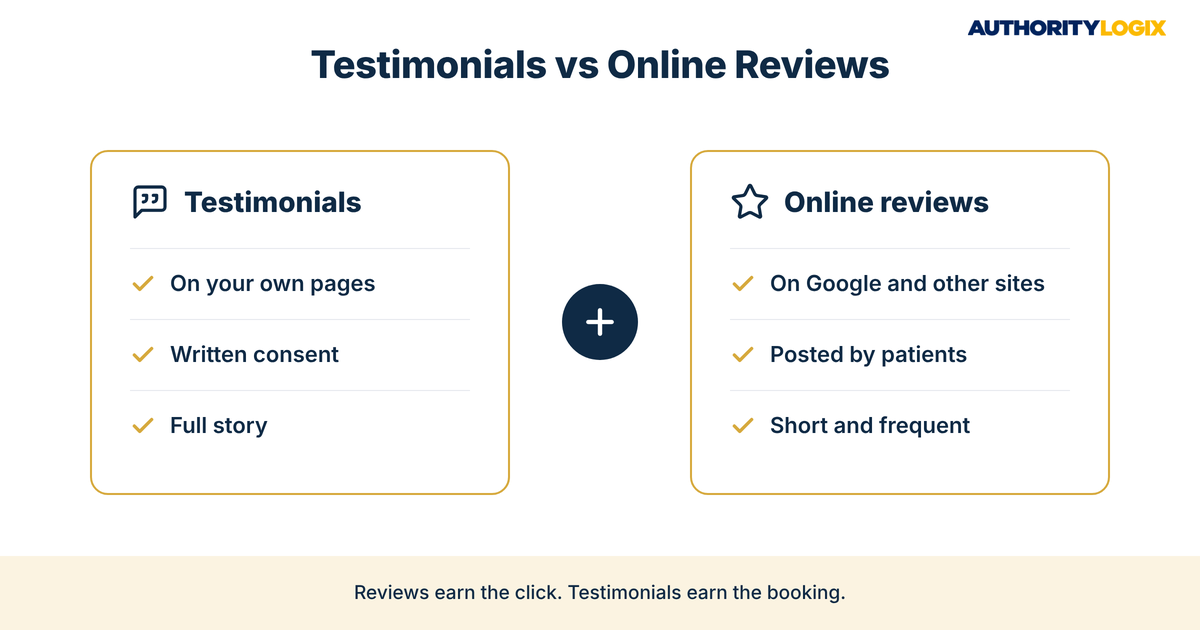
Practice owners often treat testimonials vs online reviews as the same thing under two names. They are not, and confusing them leaves gaps in both. Online reviews are short comments that patients choose to post on third-party sites, and a practice can encourage patient reviews but cannot write, edit or time them.
That independence is what makes reviews credible. A prospect who sees a steady stream of recent Google reviews beside your listing reads it as a sign that real people keep choosing you. Reviews answer the question of whether the practice is legitimate, active and well regarded.
Physical therapy patient testimonials answer a different question: will this practice understand someone like me? A testimonial is a fuller story that the practice collects with written consent and places on its own pages, close to the decision it supports. Reviews create breadth, and testimonials create depth.
| Factor | Physical therapy patient testimonials | Online reviews |
|---|---|---|
| Where it lives | Your website, booking pages and printed materials | Google, Facebook and other third-party sites |
| Who controls it | The practice selects, formats and places it with the patient’s approval | The patient writes and posts it; the practice can only respond |
| Length and depth | A full story of the situation, the decision and the experience of care | A few lines and a star rating |
| Consent | Written authorization signed before anything is published | Posted by the patient on their own initiative |
| Main job | Answering specific doubts close to the booking decision | Showing broad credibility and recent activity in search |
The two work best together. Reviews help earn the click from a map listing, and testimonials finish the job once the prospect lands on your site. A practice that invests in local search without testimonials on its pages often wins the visit and loses the evaluation, because the visitor still has not found physical therapy patient testimonials that match their own situation.
How Patient Story Marketing Turns a Recovery Journey Into a Reason to Book
Patient story marketing goes one step beyond a quote. A line such as “great staff, highly recommend” is pleasant, but it tells a prospect almost nothing. A story explains who the patient was before they called, why they hesitated, what made them choose your practice and what the experience of care felt like from their side.
Those details are what make physical therapy patient testimonials persuasive, and they rarely appear by accident. Practices that collect strong stories usually have a simple, repeatable process behind them: a standard set of interview questions, a consent step, an editor who shapes the draft and a schedule for publishing. That process belongs inside your content systems, not in the owner’s spare time.
Story Structure Without Outcome Promises
A useful structure has four parts. The situation describes the patient’s life in general terms, such as a weekend runner or a parent of young children. The decision explains why they chose your clinic over waiting or going elsewhere. The experience covers how the team explained the plan and treated them, and the final part is the patient’s own words about where they are now.
That last part needs care. Physical therapy patient testimonials must never imply that every reader will get the same result, and the practice should never add claims the patient did not make. Keep the focus on the experience of being heard, informed and supported, and add a plain note that individual results differ. That framing respects the patient, protects the practice and still answers the prospect’s real question.
Stories also strengthen your pages for search when they are written with intent. A testimonial from someone who searched for help with a specific problem uses the same words future prospects type, which supports the content SEO work on the matching service page. Write each headline and summary in plain patient language, and physical therapy patient testimonials serve readers and search engines at once.

Not sure whether your website gives hesitant prospects the stories they need? The assessment shows where physical therapy patient testimonials are missing from your pages and which gaps to close first.
How to Collect Physical Therapy Patient Testimonials With Consent and Privacy Built In
Collection is where many practices stall, usually because the owner worries about privacy and never builds the process. The concern is valid, and the answer is a clear system rather than avoidance. Detailed case studies and short quotes follow the same principle: nothing identifies a patient publicly until that patient has agreed in writing.
Timing matters as well. The best moment to ask is near the end of a plan of care, when the patient has had time to reflect on the whole experience, rather than in the middle of treatment. Ask in person first, explain exactly where the story will appear and make it easy to say no. A patient who feels pressured is not giving meaningful consent, and physical therapy patient testimonials collected that way read as forced.
Written Consent and HIPAA Authorization Basics
Under HIPAA, a practice needs valid, written authorization from a patient before it publishes a testimonial, whether on the website, social channels, print or radio. The authorization should cover why the story will be used, what will be shared and how it will appear. The law does not dictate word-for-word language, so have your compliance advisor or attorney review the form your practice uses for physical therapy patient testimonials.
A repeatable checklist keeps every request consistent. Use the same steps for written quotes, photos and video, so nothing depends on who happens to be at the front desk that day:
- Signed authorization on file before any drafting begins
- Every channel the story may appear on named in the form, such as website, social and print
- Final wording, photo or video approved by the patient before publishing
- A simple, documented way for the patient to withdraw permission later
- Signed forms stored with compliance records, not in a shared marketing folder
Privacy also shapes how you write. Use first names or initials only with permission, describe conditions in general terms and leave out dates, employers and other details that could identify someone. Each story should sit alongside your patient education pages, so the testimonial supplies the human proof while the education page supplies the clinical explanation.
Where PT Social Proof Marketing Belongs on Your Website and Profiles
PT social proof marketing fails most often because of placement, not quality. Practices gather a handful of strong stories and then bury them on a single testimonials page that few prospects ever open. Social proof works where the decision happens, and for most practices that means the pages and profiles a prospect reaches through local visibility searches.
Placing Physical Therapy Patient Testimonials on Service Pages
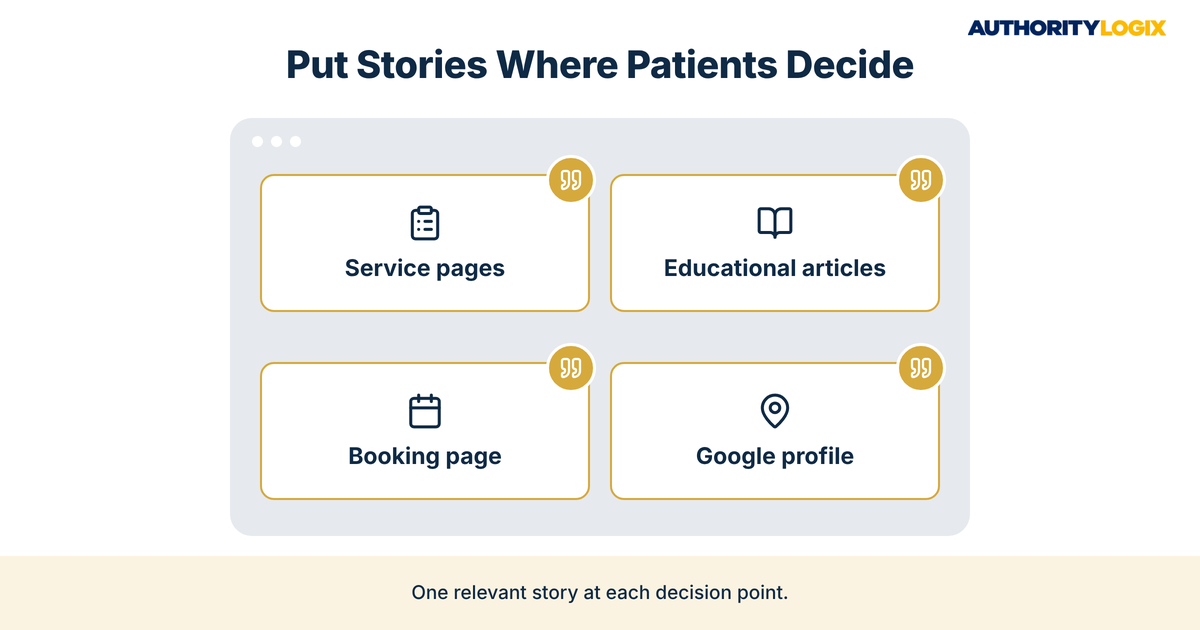
Service and condition pages are the highest-value location. A prospect reading about your approach to back pain or post-surgical care is already close to booking, and one relevant story on that page answers the doubt they still have. Match physical therapy patient testimonials to the page they support, so a runner’s story sits on the sports page and a desk worker’s story sits on the page about work-related aches.
Educational articles are the next layer. When a prospect reads a guide in your educational hub, a short story at the end shows that real people with the same question chose your practice. That connection between education and proof moves readers from learning to acting without a hard sales pitch.
Booking pages and forms need a story too. A brief quote beside the request form reassures the visitor at the exact moment of hesitation, and it is one of the simplest improvements to your lead generation pages. Your Google Business Profile, email follow-ups and printed welcome materials can each carry approved stories as well, as long as the signed authorization covers those channels.
This is placement as infrastructure, not decoration. AuthorityLogix built its own proof-of-concept platform, BKDSCR.com, on the same principle: 18 pillar pages, 7 interactive tools and 48 posts, each placed to answer a specific question at a specific stage of the visitor’s decision, with zero paid ads. Physical therapy patient testimonials deserve the same deliberate placement inside your site.
Physical Therapy Patient Testimonials FAQ for Practice Owners
These are the questions practice owners ask most often when they start building a testimonial library. The answers keep the focus on marketing and visibility, not on clinical care.
When should you use patient testimonials instead of reviews?
Use physical therapy patient testimonials wherever a prospect needs depth: service pages, condition pages, booking pages and educational articles. Use reviews for breadth on Google and other third-party sites. Most practices need both working at the same time.
How do I collect effective patient testimonials without making patients uncomfortable?
Ask near the end of care, in person, with a clear explanation of where the story will appear. Offer a short set of questions so the patient does not have to start from a blank page, and make it easy to decline without any awkwardness.
Can we share testimonials on social media and in email?
Yes, if the signed authorization names those channels. A story approved for the website is not automatically approved for social posts or newsletters. Once the consent covers them, steady distribution across email, social and printed materials puts each story in front of more of the people it can help.
Do physical therapy patient testimonials need to mention results?
No, and the strongest ones often focus on the experience instead. Prospects want to know they will be listened to, given a clear plan and treated with respect. Let the patient describe their own experience, and avoid any wording that suggests a guaranteed outcome.
How many testimonials does a practice need?
Start with one story for each major service page, then add more as you build new pages. Relevance matters more than volume. The guides in our PT resources library show how each story connects to the pages around it.
Ready to build the consent process, story pages and placement system that turn physical therapy patient testimonials into new evaluations every month?
Turning a Testimonial Library Into a Steady Source of New Evaluations
A library of physical therapy patient testimonials becomes a source of new evaluations when it is treated as infrastructure. That means a standing process for asking, a consent step that never gets skipped, an editor who shapes each story and a placement plan that puts every story where it does its job. Building that system for practices is a core part of our services, because the stories already exist inside your patient base.
Start small and stay consistent. One approved story a month, placed on the right page, adds up to a library that answers most of the doubts prospects bring. That steady rhythm, measured against booked evaluations, is how our process turns patient goodwill into a dependable part of the pipeline. Authority compounds.
The honest answer is that most practices already have the stories. Patients have been telling your front desk and your clinicians for years why they chose you and what the experience meant to them. The missing piece is the system that captures those stories with consent and puts physical therapy patient testimonials in front of the next person who is still deciding whether to trust you.