


Key Takeaways
- Physical therapy rank tracking is only useful when it measures the searches patients type for each service line, across the neighborhoods you serve, not one vanity keyword.
- According to Semrush, 69% of local businesses use SEO tools or keyword tracking software to track how their business ranks for relevant local search terms, so most competitors are already measuring.
- Map pack position changes with the searcher’s location, which is why grid-based PT local ranking monitoring gives a truer picture than a single check.
- Physical therapy GBP insights show calls, direction requests and website clicks, the profile actions closest to a booked evaluation.
- PT local SEO analytics matter only when they connect to the schedule, so every physical therapy rank tracking report ends with evaluations from search.
- A monthly visibility review turns physical therapy rank tracking data into one or two clear decisions about pages, reviews and the profile.
Table of Contents
What Physical Therapy Rank Tracking Should Measure Beyond a Single Keyword
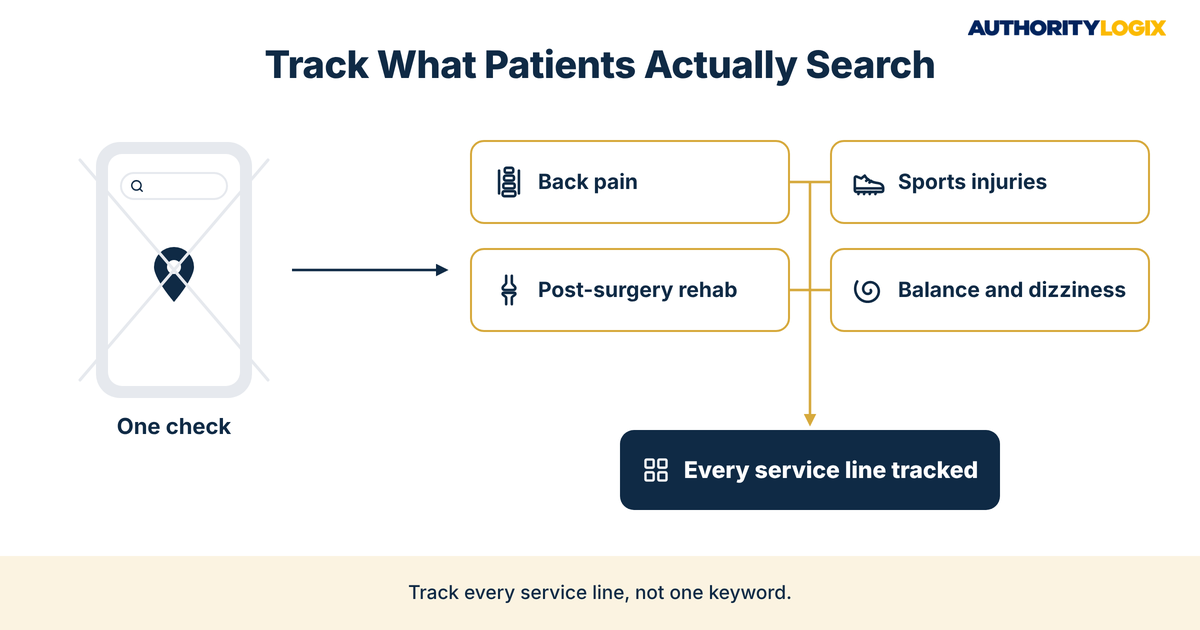
Physical therapy rank tracking tells you where your practice appears when a nearby patient searches for help, and most practices measure it the wrong way. Someone types a phrase into a phone at the front desk, sees the clinic near the top, and assumes the job is done. That check reflects one keyword, one device and one street corner, so it says little about your real local search visibility across the neighborhoods you serve.
You already have the clinical credibility. What the market sees before the first visit is different: a ranking that may be strong on one block and missing two miles away. That gap leaves good practices credible but invisible, and physical therapy rank tracking is how you measure it instead of guessing.
Your competitors are probably measuring already. According to Semrush’s local SEO statistics, 69% of local businesses use SEO tools or keyword tracking software to track how their business ranks for relevant local search terms. The practices that pull ahead are not the ones with the most software. They are the ones whose physical therapy rank tracking follows the right searches, in the right places, and acts on what the numbers show.
Keywords Worth Tracking for Each Service Line
Start physical therapy rank tracking with the services that bring in evaluations, not with one generic phrase. A practice that treats back pain, sports injuries, post-surgical rehab and balance problems needs a short list of searches for each one, written the way patients type them. Building that list is the same work covered in the guide to local keywords, and it keeps every report tied to the care you actually provide.
A useful keyword set for each service line mixes a few kinds of searches. Each kind shows a different stage of the patient’s decision.
- Service plus town, such as sports physical therapy in your town
- Condition plus neighborhood, such as a back pain physical therapist near a local landmark
- Direct-access phrasing, such as physical therapy without a referral
- Your practice name and the names of your clinicians
- Booking phrasing patients use when they are ready to schedule
Each tracked keyword should map to a page that answers it. Track pelvic floor therapy in your town without a page explaining that service, and the ranking stalls however often you check it. That connection between tracked searches and published pages sits at the heart of a working content SEO system, and it is why physical therapy rank tracking and page building belong in the same plan.
The Physical Therapy Local Visibility Guide covers the full local search system behind these rankings, from the Google Business Profile to location pages, and shows where physical therapy rank tracking fits inside it.
Why Map Pack Position Changes Block by Block
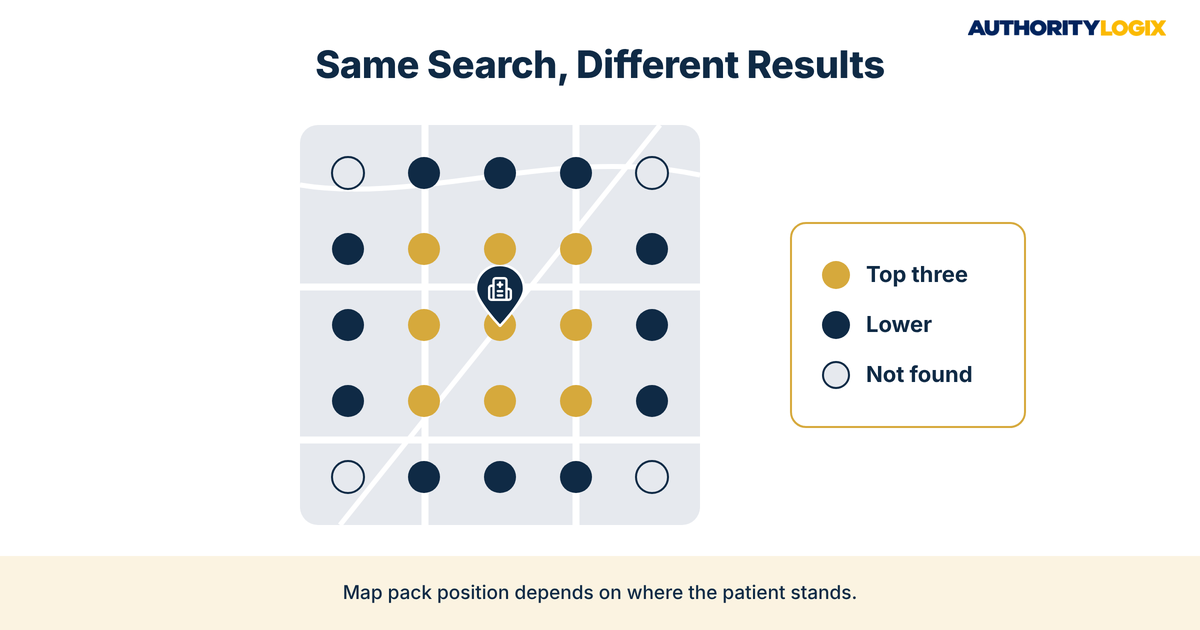
Google’s local results are not one fixed list. As BrightLocal puts it, what makes Google local rankings different is that they change based on where someone is. A patient searching from a train station downtown and a patient searching from a quiet street three miles out may see two different sets of practices in the map pack, even when they type exactly the same words.
That is why physical therapy rank tracking from a single point misleads. A practice can look dominant from its own parking lot and be missing where many of its direct-access patients live, and only physical therapy rank tracking across many points shows the real shape of your visibility.
Distance is only part of the picture. Reviews, profile completeness, website pages and mentions elsewhere all shape how a profile performs. Semrush reports that businesses in the top three spots in local search results have an average of 561 Google reviews and an average review rating of 4.8.
Prominence is also built away from your website. Clinicians quoted in local media and listed on partner sites signal an established practice, which is the job of authority distribution. Physical therapy rank tracking then shows whether that work is pushing the practice outward into the streets around it.
Setting Up PT Local Ranking Monitoring With Grid-Based Tracking
PT local ranking monitoring works best with a grid. BrightLocal describes its grid tool as one that simulates searches from dozens of points in a city or neighborhood to highlight local performance. Instead of one ranking, you get a map of rankings, with each point showing where your practice appears for a given keyword from that exact spot.
Set the grid to match your real service area, not an arbitrary radius. Center it on the clinic, size it to the distance patients actually travel, and run the keywords you chose for each service line.
Grids also show where to focus. Points in the top three need protection, points just outside it are the closest wins, and points where you do not appear usually signal a missing location page or thin local content. Reading that pattern is part of practical local SEO for physical therapists, and it turns physical therapy rank tracking from a report into a work list.
How Often Physical Therapy Rank Tracking Should Run
BrightLocal’s grid reports can be run ad hoc, weekly or monthly, and for most practices a weekly or monthly schedule is enough. Weekly checks catch a sudden drop, such as a suspended profile, while monthly snapshots show the trend.
Consistency matters more than frequency. Run physical therapy rank tracking on the same day, with the same keywords and the same grid, so changes reflect real movement rather than a different setup. When numbers shift after a new condition page goes live, the timing tells you which work moved them, which is why rank data and content systems should share one calendar.
Most owners lack time to read grids weekly. That is why measurement belongs in our process from the first month, with PT local ranking monitoring set up before any new page goes live. A baseline from physical therapy rank tracking at the start is the only way to show later whether the work changed anything.
Not sure how your practice ranks beyond its own front door? The assessment shows where your local visibility drops off and which gaps physical therapy rank tracking should watch first.
Reading Physical Therapy GBP Insights: Calls, Directions, and Website Clicks
Rankings show where you appear. Physical therapy GBP insights show what people do when they find you. Google’s Business Profile performance report covers views, searches, calls, messages, bookings, directions and website clicks, and only the metrics that apply to your business appear.
| Metric | What Google counts | What it tells a PT practice |
|---|---|---|
| Views | How many people viewed your Business Profile on Search and Maps | Whether physical therapy rank tracking gains are turning into attention |
| Searches | The search terms people used to find your business | Which conditions and services patients connect with your practice |
| Calls | The number of times a customer clicked the call button on your profile | Patients ready to ask about an evaluation |
| Directions | How many people asked for directions to your business | Patients planning a visit to the clinic |
| Website clicks | The number of times people clicked the website link on your profile | Patients who want details before they call |
Each metric needs context. Google notes that a person can only be counted once a day in the Views figure, and that calls are tracked only if you have added a phone number to your profile. The Searches metric updates at the start of each month and may take up to 5 days to appear.
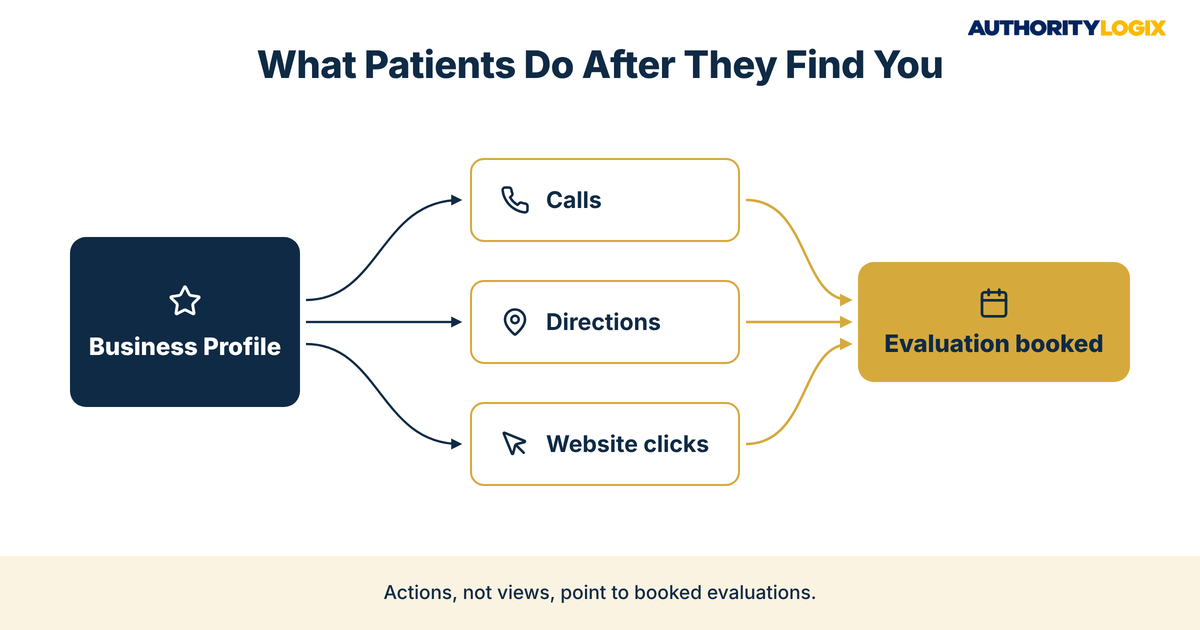
Calls, direction requests and website clicks are the actions closest to a booked evaluation, and they belong at the center of physical therapy rank tracking reports. Rankings that rise with no change in calls mean the profile is seen but not chosen. That is a patient acquisition problem rather than a ranking problem, and it often comes down to photos, reviews and how clearly the profile explains what you treat.
Website clicks deserve follow-through. A patient who clicks to your site is still deciding, and what they find decides whether the click becomes a call. Pages built for lead generation, with a clear booking path and a plain explanation of direct access, are what turn physical therapy GBP insights into evaluations.
The Searches report doubles as a content map. Condition phrases such as sciatica or rotator cuff pain show what your market wants to understand before it books, and answering them with clear patient education pages gives the profile more reasons to appear next time.
Connecting PT Local SEO Analytics to New Patient Evaluations
PT local SEO analytics only earn their place when they connect to the schedule. A report that shows better rankings and more profile views is encouraging, but the number that keeps a clinic open is new patient evaluations. Every physical therapy rank tracking report should trace the path from ranking, to profile action, to website visit, to booked evaluation.
That path needs a few pieces. Ask every new patient how they found you, with Google search and Google Maps as their own answers. Give your Business Profile a booking link with a source tag so profile bookings can be separated from other channels, then compare evaluations from search with the physical therapy rank tracking data for the same month.
Over time, this shows which service lines and neighborhoods deserve more investment. If grid results improve for sports rehab but sports rehab evaluations stay flat, the problem sits on the page or the profile, not in the rankings. Decisions like that are what a long-term practice authority plan is built on, because they move budget toward what brings patients in.
Metrics That Look Good but Don’t Book Evaluations
Some numbers flatter a report without filling the schedule. Total views, rankings for your own name and broad keywords outside your service area can rise while evaluations stay flat. They are not useless, but they belong at the bottom of the report rather than the top.
Website traffic is the most common trap. A post that ranks nationally for a general exercise question brings visits from people who will never see your clinic. Local, condition-focused pages inside an educational hub attract the patients who can actually book, which is why PT local SEO analytics should always be filtered by location.
Physical Therapy Rank Tracking FAQ: What Owners Want to Know
What is local rank tracking for a physical therapy practice?
It means checking where your clinic appears in Google’s local results for patient searches, from the places those patients live. Good physical therapy rank tracking covers each service line, uses a grid, and is read alongside booked evaluations.
How reliable are Google Business Profile insights?
They are useful for trends but are not perfect counts. Google counts a person only once a day in Views and tracks calls only when a phone number is listed, so treat physical therapy GBP insights as direction rather than exact totals. Month-over-month comparisons are more reliable than one month alone.
Do I need special software for PT local ranking monitoring?
A grid-based local rank tracker is the simplest way to see rankings across your service area, and several tools offer one. For physical therapy rank tracking, the setup matters more than the tool: the right keywords, a matched grid and a consistent schedule. Our library of PT resources covers the local search work those reports measure.
How long does it take for rankings to change after new work?
There is no fixed timeline, and anyone promising a ranking by a date is guessing. New pages, reviews and profile updates tend to show movement gradually, which is why monthly physical therapy rank tracking is more useful than daily checking. Keep the keywords and grid unchanged so movement is easy to see.
Can I track rankings myself, or should someone else handle it?
Many owners do it themselves. According to Semrush, 56% of business owners manage local SEO for their business themselves, and 25% have someone on their team do it. Either works for basic checks, but turning physical therapy rank tracking data into monthly fixes is the hard part, and it is where our services fit for practices that want the whole system handled.
Ready to have the grid tracking, profile reporting and monthly fixes built for you, so your local rankings connect straight to booked evaluations?
Turning Ranking Data Into a Monthly Visibility Review
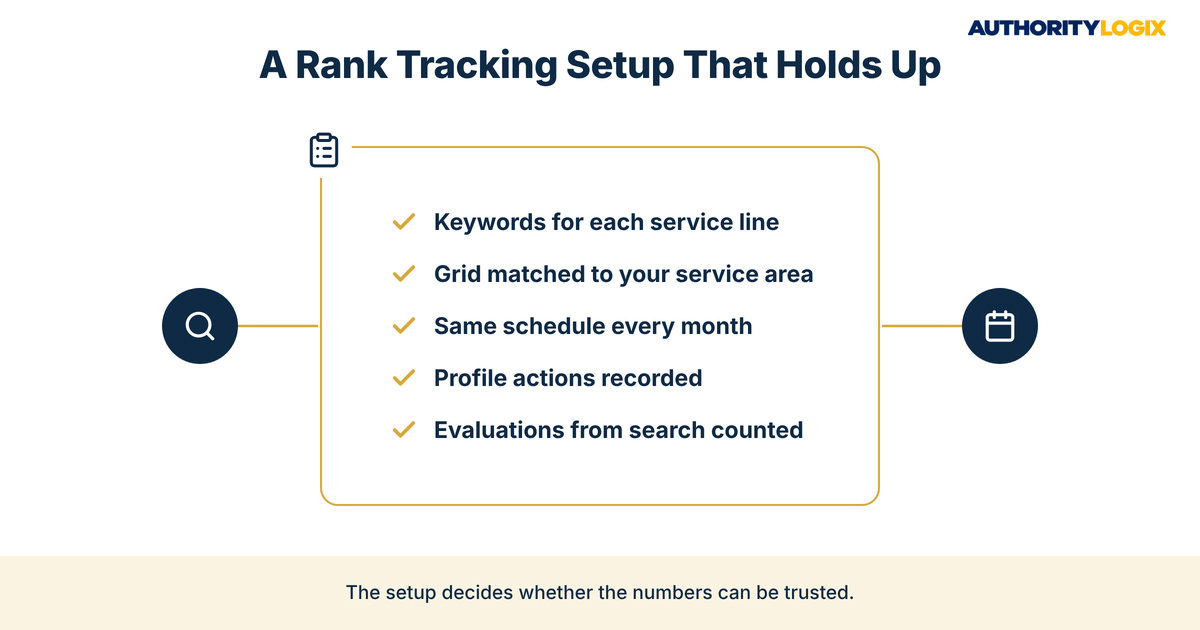
Physical therapy rank tracking pays off only when someone reviews it and acts. A monthly visibility review keeps the focus on decisions. Work through the same agenda every month so the numbers compare like with like.
- Grid results for each tracked service line
- Calls, direction requests and website clicks from the profile
- New terms in the Searches report
- New patient evaluations attributed to Google
- One page, review or profile fix for next month
The point of the review is a decision, not a document. A weak area in the grid might call for a location page, more recent reviews, or a condition guide that answers a term from the Searches report. Each choice connects back to the wider PT marketing system, so the next round of physical therapy rank tracking shows whether it worked.
The same discipline applies to any authority platform. AuthorityLogix built BKDSCR.com, its own proof-of-concept in the NYC DSCR real estate niche, with 18 pillar pages, 7 interactive investor tools and 48 SEO-optimized blog posts, with zero paid ads, in under 18 months. A build like that is judged by where it appears, not by how much was published.
The honest assessment is that most practices already have the clinical reputation to rank. What they lack is a clear view of where they appear and a monthly habit of closing the gaps. Practices weighing who should build that system can see why AuthorityLogix treats measurement as infrastructure, and the rankings tend to follow the work rather than the other way around.