

Key Takeaways
- Physical therapy schema markup structured data labels your clinic name, address, phone, and hours in a format Google uses to understand the page.
- Google Search Central lists only two required LocalBusiness properties, name and address, and says the required properties must be present for rich result eligibility.
- Google says to use the most specific LocalBusiness sub-type possible; its documentation does not name a physical therapy type.
- BrightLocal’s 2021 Business Listings Trust Report found 63% of consumers said incorrect information would stop them from choosing a business.
- Google does not guarantee that structured data will show up in search results, so physical therapy schema markup structured data supports visibility rather than promising it.
- Test every change with the Rich Results Test and the URL Inspection tool before physical therapy schema markup structured data goes live across locations.
Table of Contents

Physical therapy schema markup structured data is the layer of your website that patients never see and Google reads on every crawl. You may have experienced clinicians, a well-run Business Profile, and years of goodwill with local physicians, yet your location pages still present that information as loose text for Google to interpret. The PT industry hub calls that gap credible but invisible: the facts are real, but nothing on the page labels them for the systems deciding who appears.
What Physical Therapy Schema Markup Structured Data Tells Google About Your Clinic
Google Search Central describes structured data as a standardized format for providing information about a page and classifying the page content. It also says Google uses structured data it finds on the web to understand the content of the page. Physical therapy schema markup structured data applies that format to a clinic: this is the business name, this is the street address, these are the hours, this is the phone number.
None of that replaces the visible page. It labels what is already there, which is why it fits inside a patient acquisition playbook rather than sitting off to the side as a developer task. When the labels match what a patient reads, Google has one consistent version of your clinic to work with, and physical therapy schema markup structured data stops being a guessing game.
Most PT practices invest in local search through Business Profile updates, reviews, and location pages, then leave the code layer empty. Google generally recommends JSON-LD for structured data if your site setup allows it, and a JSON-LD block sits in the page without changing a word of the copy. That makes physical therapy schema markup structured data one of the lowest-disruption additions a clinic website can make.
The Physical Therapy Local Visibility Guide covers every layer of local search for PT clinics, from Business Profile and reviews to the physical therapy schema markup structured data underneath your location pages.
PT LocalBusiness Schema SEO: The Properties Every Location Needs
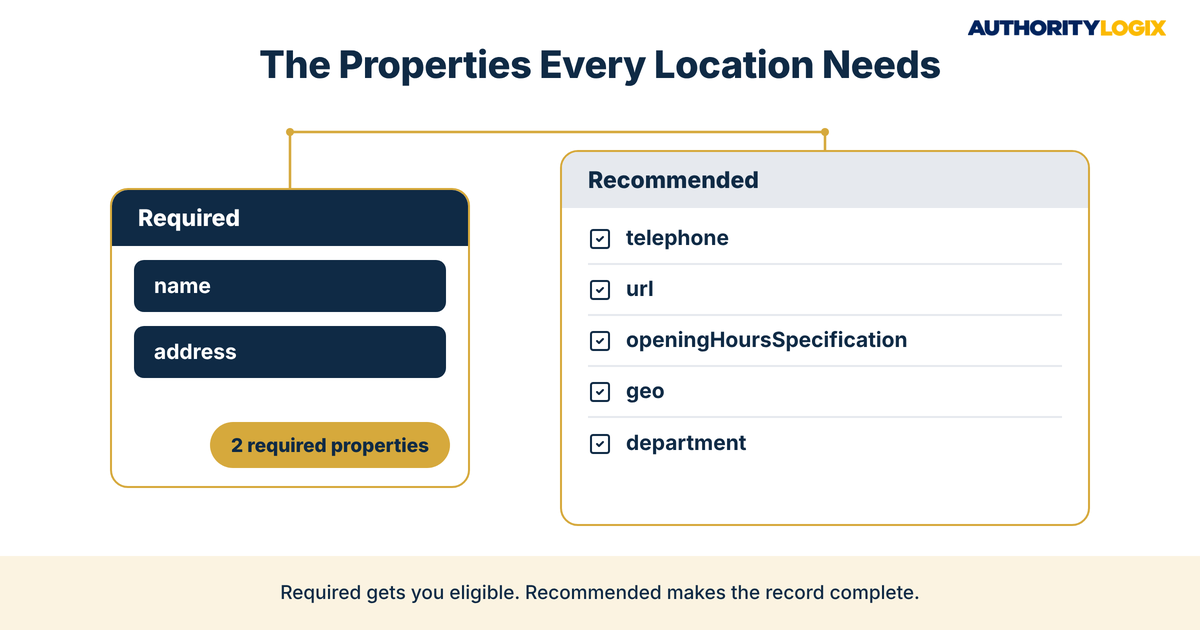
Google Search Central’s LocalBusiness structured data documentation, last updated in September 2026, says the markup lets you “tell Google about business hours, different departments within a business,” and more. Only two properties are required: name and address. Google says you must include the required properties for your content to be eligible for display as a rich result, so PT LocalBusiness schema SEO starts there.
| Property | Google Status | What a PT Location Enters | Google’s Guidance |
|---|---|---|---|
| name | Required | The clinic name exactly as it appears on the sign and profile | The name of the business |
| address | Required | The full street address of this location | The physical location; include as many properties as possible |
| telephone | Recommended | The direct line for this location | Include the country code and area code |
| url | Recommended | This location page, not the homepage | The URL must be a working link |
| openingHoursSpecification | Recommended | Hours for this location, including early and late days | Hours during which the business location is open |
| geo | Recommended | Latitude and longitude of the front door | Precision of at least 5 decimal places |
Each location needs its own physical therapy schema markup structured data record on its own page. A three-clinic practice that puts one block on the homepage with the headquarters address tells Google nothing useful about the other two. PT LocalBusiness schema SEO works page by page, and so does the content behind it: the condition pages and service pages that each location links to give the record context.
Google also lists department as a recommended property, a nested item for a single department. A practice with a separate aquatic therapy or pediatric program at one address can describe it this way, but only if the page shows that program to patients. Physical therapy schema markup structured data should never claim a service the visible page does not mention.
Choosing the type matters too. Google says to use the most specific LocalBusiness sub-type possible and links to schema.org for the list, but its own documentation does not name a physical therapy type. Keeping that choice consistent across every location is a job for the same content systems that publish your pages, so the eighth location gets the same record as the first.
Physical Therapy Structured Data Local Search: Matching Schema to Your GBP
Google’s LocalBusiness documentation does not mention Google Business Profile, but patients see both. If your markup says the clinic closes at 7 and your profile says 6, one of them is wrong, and the patient who arrives at 6:30 finds out which. Physical therapy structured data local search work starts with one source of truth for name, address, phone, and hours.
BrightLocal’s 2021 Business Listings Trust Report, a survey of 1,141 US consumers, found that 63% said finding incorrect information would stop them from choosing a business. The same report found 77% had seen conflicting information about a business across different online directories. Physical therapy schema markup structured data cannot fix a listing elsewhere, but it can make sure your own website is not one of the conflicting sources.
A Physical Therapy Schema Markup Structured Data Consistency Check
Before any physical therapy schema markup structured data goes live, line up four sources side by side: the Business Profile, the location page text, the structured data block, and your top directory listings. Every field should match character for character, including suite numbers and the format of the phone number. Long articles in your educational hub that mention a location should use the same details, because a stale address in a blog post is another conflicting source.
- Clinic name: identical on the sign, profile, page, and markup
- Street address: same suite format everywhere
- Phone number: the location line, with country and area code in the markup
- Hours: updated in every source on the same day, including holidays
- Location page URL: the page the profile links to
Consistency is a trust signal as much as a technical one. A patient comparing two clinics notices when one has the same details everywhere and the other contradicts itself, and the clinical authority guide treats that kind of reliability as part of clinical credibility. Physical therapy structured data local search work simply makes the reliability readable by machines too.
Not sure whether your location pages, Business Profile, and structured data tell the same story? The PT Authority Gap Assessment shows where your local signals conflict and what to fix first.
PT Schema Markup Implementation on Clinician and Condition Pages
Location pages carry the LocalBusiness record, but they are not the only pages that benefit from labels. Google’s structured data guidelines say your structured data must be a true representation of the page content, and they advise using the most specific applicable type and property names defined by schema.org. PT schema markup implementation therefore follows the page: each page type gets markup that describes what that page actually shows.
Clinician pages are the clearest example. A page that shows a therapist’s name, credentials, and the location where they practice can carry markup describing that same information, and nothing more. Well-built clinician bio pages make this easy because the facts are already on the page in a consistent order, which is what physical therapy schema markup structured data needs to stay accurate.
Condition pages work the same way. A page explaining what to expect from an evaluation for low back pain can carry markup that describes the visible article, written by a named clinician, and nothing that is missing from the page. The content SEO playbook covers how those pages are planned, and physical therapy schema markup structured data labels them once they exist.
Keep PT Schema Markup Implementation Tied to Visible Content
Google’s guidelines are direct: do not mark up content that is not visible to readers of the page. That rules out adding hidden service lists, extra locations, or claims that appear only in code. It also means your booking path needs care, because a lead generation form or click-to-call button should carry the same phone number and location details that the markup states.

Testing Physical Therapy Schema Markup Structured Data Before It Goes Live
Google’s LocalBusiness documentation lays out a testing sequence, and it is worth following exactly. Validate the code using the Rich Results Test and fix any critical errors, deploy a few pages, then use the URL Inspection tool to test how Google sees each page. Physical therapy schema markup structured data that skips those steps can break quietly across every location at once.
- Run each location page through the Rich Results Test
- Fix every critical error before anything else
- Publish markup on a few pages first, not the whole site
- Check those pages with the URL Inspection tool
- Watch Search Console for structured data issues
- Roll out to remaining locations only after the first pages pass
Testing does not stop at launch. Hours change, clinicians move between locations, and new sites open, and each change touches the markup as well as the visible page. Physical therapy schema markup structured data needs the same update schedule as your Business Profile, ideally on the same day by the same person.
The same discipline applies to content published off your site. Directory listings, partner pages, and articles placed through authority distribution often repeat your address and phone number, and each one should match the physical therapy schema markup structured data on your location pages. A single conflicting listing can undo the consistency your own pages work to build.
Keep a simple record of every location’s details and the date each source was last checked. Practices that publish regularly can tie that record to the PT resource library workflow, so physical therapy schema markup structured data gets reviewed whenever new content goes up rather than once a year.

What Most PT Practices Get Wrong About Schema
Most practices that get schema wrong are not careless. They are following plugin defaults or advice written for restaurants and retailers, which do not match how a PT clinic works. These are the questions practice owners and prospective patients ask most often.
Will schema markup move my clinic up in the map pack?
There is no promise to make here. Google’s Business Profile help page lists relevance, distance, and prominence as the factors that determine local ranking, and structured data is not one of them. Its job is to help Google understand your pages accurately.
Can we add star ratings to our own location pages?
Google says aggregateRating and review markup is only recommended for sites that capture reviews about other local businesses. A clinic marking up its own reviews on its own location pages is outside that guidance, so leave it out of physical therapy schema markup structured data.
What happens if the markup is wrong or misleading?
Google says a structured data issue can result in a manual action, which means a page loses eligibility for appearance as a rich result, though it does not affect how the page ranks in Google web search. Google also says not to use structured data to deceive or mislead users. Accurate, visible, consistent physical therapy schema markup structured data avoids the problem.
Is there a physical therapy schema type Google supports?
Google’s LocalBusiness documentation does not name one. It says to use the most specific LocalBusiness sub-type possible and points to schema.org for the options, so the choice belongs in your implementation plan. The growth blueprint covers how decisions like this fit a multi-location plan, where one consistent choice beats a different guess on every page.
Who should maintain the markup?
Not your front desk and not your clinicians. Physical therapy schema markup structured data needs an owner who updates it every time hours, locations, or staff change, which is part of what we do for practices with the reputation but not the infrastructure behind it. Your team keeps caring for patients while the system keeps the records current.
Ready for location pages, Business Profile details, and structured data that all tell Google the same story? Let’s build the local record system your clinics need.
What Schema Can and Cannot Do for Local Visibility
Google does not guarantee that your structured data will show up in search results. In Google’s words, using structured data enables a feature to be present, but it does not guarantee that it will be present. Physical therapy schema markup structured data improves your eligibility and Google’s understanding, not your position by decree.
Google does publish case studies on the upside. It reports that Rotten Tomatoes added structured data to 100,000 unique pages and measured a 25% higher click-through rate, and that Nestlé measured an 82% higher click-through rate on pages that show as rich results. Neither is a healthcare business, and neither result transfers automatically to a PT clinic, but both show why the work is worth doing correctly.
The bigger value is that physical therapy schema markup structured data forces discipline. A practice that has to state its name, address, phone, and hours in code, page by page, ends up with cleaner location pages and fewer conflicts everywhere else. That is why how we build puts the location record in place before the content library grows around it.
AuthorityLogix built BKDSCR.com, its own proof-of-concept platform in the NYC DSCR real estate niche, on the same principle: 18 pillar pages, 7 interactive investor tools, and 48 blog posts on one consistent structure, with zero paid ads, in under 18 months. That record is part of why AuthorityLogix can talk about infrastructure from experience rather than theory.
The honest answer is that most PT practices already have the clinical reputation patients are looking for. What is usually missing is a website that states the basic facts clearly and consistently, and physical therapy schema markup structured data is one of the quieter ways to fix that.