


Key Takeaways
- Physical therapy service page SEO conversion is two jobs on one page: rank for the search a patient runs, then turn the visit into a scheduled evaluation.
- APTA reports that patients in all 50 states, the District of Columbia, and the U.S. Virgin Islands can see a physical therapist directly, so a service page is often the first point of contact.
- Nielsen Norman Group found in 2008 that users have time to read at most 28% of the words on an average web page, so the booking path must be visible to a skimmer.
- A PT service page writing strategy built around the patient’s question — can you help, and how do I start? — gives a reader a reason to book.
- Ahrefs found only 1.74% of newly published pages reach Google’s top 10 within a year, so physical therapy service page SEO conversion is measured in quarters.
- Physical therapy service page SEO conversion is an infrastructure build: pages, local signals, education, tracking, and a booking path working as one system.
Table of Contents

Why Physical Therapy Service Page SEO Conversion Starts With the Patient’s Question
Physical therapy service page SEO conversion is the measure most clinic websites never track: how many people who land on a service page actually book an evaluation. You may have experienced clinicians and a reputation your referring physicians trust — and still have a low back pain page that ranks on page two and sends visitors back to Google. Most service pages describe the clinic instead of answering the person deciding whether to call.
That is the credible but invisible problem at the page level. The expertise is real, but the page a prospective patient reads does not show it in the few seconds they give it, so the visit ends without a booking. Physical therapy service page SEO conversion closes that gap by treating every service page as the front door of the practice.
The patient’s path has changed. APTA’s June 2025 report on the state of direct access notes that patients in all 50 states, the District of Columbia, and the U.S. Virgin Islands can see a physical therapist directly, on provisional or unrestricted terms. A patient who can book without a referral searches first, and the page they find decides whether your practice is in the conversation.
Every patient question has two halves: can this practice help, and what happens if I reach out? Physical therapy service page SEO conversion depends on answering both on the same page, in that order. The AuthorityLogix PT industry hub organizes the work as connected systems for that reason: a single page cannot carry the load alone.
The Physical Therapy Content & SEO Playbook lays out the full site architecture that physical therapy service page SEO conversion depends on — from service and condition pages to the supporting content that feeds them.
A PT Service Page Writing Strategy That Answers Direct-Access Patients
A PT service page writing strategy starts with the person reading, not the clinic doing the writing. A direct-access patient searching for help with shoulder pain is not shopping for modalities. They want to know whether you see people with their problem, who they would work with, and whether their insurance is accepted. Pages that open with equipment lists answer none of that.
Those questions map to the patient journey stages in the acquisition playbook, from symptom to search to shortlist to booked visit. Physical therapy service page SEO conversion sits at the shortlist stage. The page has already earned the click, and now it has to earn the call.
What a Direct-Access Patient Needs to See Above the Fold
Jakob Nielsen of Nielsen Norman Group found in 2008 that users have time to read at most 28% of the words during an average web page visit, and that 20% is more likely. A booking path hidden below six paragraphs is written for a reader who does not exist. Physical therapy service page SEO conversion depends on a top section built for the skimmer:
- A headline naming the condition in the patient’s words, such as “Physical Therapy for Low Back Pain in [Town]”
- Who the page is for and what the first visit involves
- The clinicians who see these patients, with credentials
- Insurance, direct-access, and scheduling details in plain language
- A booking button or phone number before the first scroll
Writing that page takes clinical knowledge and search structure at once, which is why so many service pages read thin. A clinician knows what patients ask at intake, and a writer knows how Google reads a page. Built content systems pair the two, so the clinician’s knowledge shapes every page without the clinician writing it.
This is where physical therapy service page SEO conversion stops being a copywriting exercise. The structure, the order of information, and the booking prompt all come from the same patient question set, so every new service page starts from a working template instead of a blank screen.

Physical Therapy Service Page Ranking: Structure, Keywords, and Local Signals
Physical therapy service page ranking depends on three things: a structure search engines can read, keywords that match how patients describe their problem, and local signals that tie the page to a real clinic. Miss one and the page either ranks for searches that never book or never ranks at all. Physical therapy service page SEO conversion starts with ranking for the right search.
Patients search for the service plus a place — “physical therapy for sciatica near me” — and Google answers with the map pack first. Each service page therefore needs the clinic’s local search foundation behind it: a maintained Google Business Profile, consistent address details, and location references. For local searches, physical therapy service page SEO conversion begins in that map pack.
The detail work behind those signals — categories, reviews, citations — is covered in the local visibility guide, and it matters here for one reason. A service page with strong copy and weak local signals can sit below a thinner page from a clinic two miles closer. Physical therapy service page SEO conversion needs both halves of the ranking picture.
Keywords That Match How Patients Describe the Problem
Patients search in symptoms and situations, not in billing codes. They type “knee pain when climbing stairs,” and a page titled “Orthopedic Rehabilitation Services” does not match it. Each service page should target the phrase patients use, with the clinical term alongside it so both the patient and the search engine understand the page.
Search engines and patients both look for signs that a page came from someone qualified to write it. Named clinicians and stated credentials are the trust signals explained in the clinical authority guide, and they support physical therapy service page ranking and booking at once. A patient who sees a named clinician has one less reason to keep searching.
Not sure where your service pages stand on physical therapy service page SEO conversion? The PT Authority Gap Assessment shows which pages rank, which ones lose visitors, and what to fix first.
PT Service Page Patient Conversion: From Page Visit to Scheduled Evaluation
PT service page patient conversion is the half of the job most practices skip. Ranking brings the visitor, and conversion decides whether that visitor becomes a scheduled evaluation or another anonymous session in your analytics. The difference usually comes down to friction between reading the page and booking the visit.
Most of that friction is invisible from inside the practice. The front desk sees the calls that come in, not the visitors who gave up on a long form or a buried phone number. Those are the conversion gaps that quietly undercut physical therapy service page SEO conversion even when rankings look healthy.
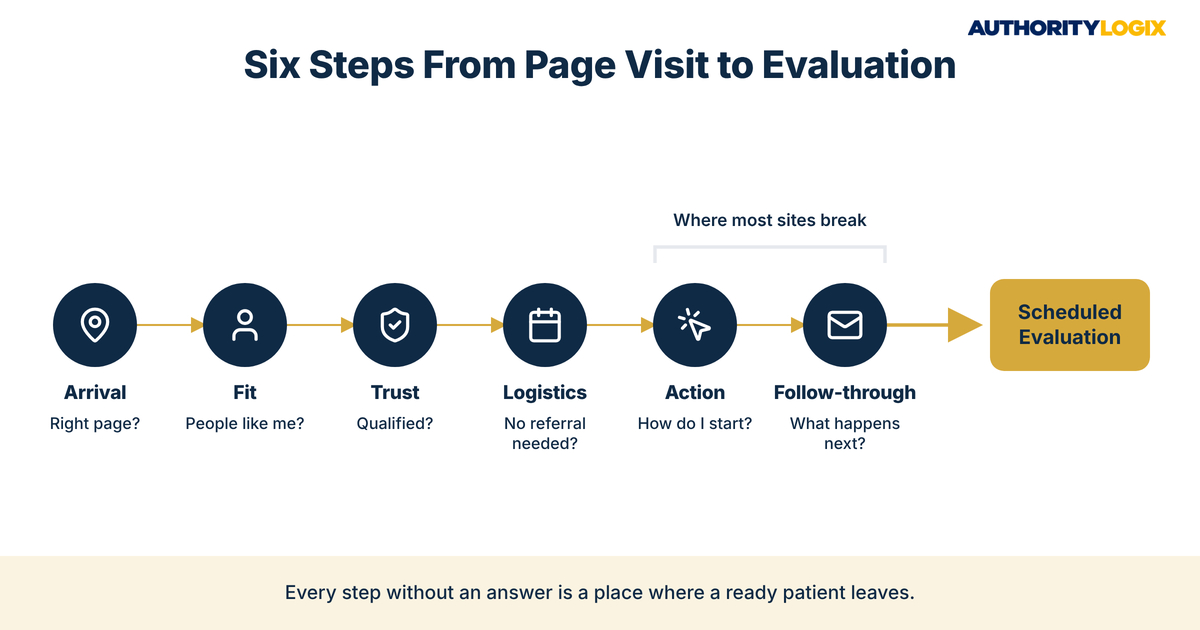
The Physical Therapy Service Page SEO Conversion Path, Step by Step
Every service page needs a short, predictable path from question to booking. The table below breaks it into the moments a patient passes through.
| Patient Moment | What the Patient Is Asking | What the Page Must Show |
|---|---|---|
| Arrival | “Is this the right page for my problem?” | A headline naming the condition or service in plain language |
| Fit | “Do they see people with my problem?” | Who the service is for and which clinicians provide it |
| Trust | “Are these people qualified?” | Credentials and recent reviews |
| Logistics | “Can I book without a referral, and is my insurance accepted?” | Direct-access and insurance details stated plainly |
| Action | “How do I start?” | A booking button repeated at the top, middle, and end |
| Follow-through | “What happens after I submit?” | A confirmation message and a stated response time |
The action and follow-through rows are where clinic websites most often break. A booking request that lands in an unmonitored inbox turns a ready patient into a lost one. The lead generation infrastructure behind a service page — online scheduling, call tracking, and same-day response — is what turns PT service page patient conversion from a hope into a process.
None of this requires a clinical claim. Physical therapy service page SEO conversion never depends on promising results; it depends on being clear about who the service is for, who provides it, and how to begin. Patients make the booking decision themselves once the page gives them what they need.
Measuring Physical Therapy Service Page SEO Conversion After Launch
Physical therapy service page SEO conversion is measured in two places that rarely talk to each other: search data and booking data. Search Console shows which queries bring visitors to each page, and the scheduling system shows which visits became evaluations. Until those two connect, a practice can watch traffic rise without knowing whether any of it books.
Patience is part of the measurement plan. In a ranking study published in May 2025, Ahrefs’ Patrick Stox found that only 1.74% of newly published pages rank in Google’s top 10 within a year, and that the average #1 ranking page is 5 years old. Judge a new page’s ranking in quarters and its booking rate from the first month of traffic.
Four numbers tell you whether physical therapy service page SEO conversion is working on a given page. Track each one per page, not for the site as a whole:
- Impressions and clicks for the queries the page targets, from Google Search Console
- Booking actions — calls, form submissions, and scheduler starts — tracked as events
- Booked evaluations attributed to the page, matched against the scheduling system
- Booking rate: booked evaluations divided by page visits, tracked month over month
Tracking has to be set up before launch, not added after the first disappointing month. That is part of how we build every service page: call tracking, form events, and scheduler attribution go in alongside the copy, so physical therapy service page SEO conversion can be read page by page from the first week of traffic.
When a page ranks but does not book, the fix is usually on the page; when it books well but does not rank, the fix is usually in the signals around it. The PT resource library covers both sides, so each diagnosis has a clear next step. Reading both numbers together is how physical therapy service page SEO conversion becomes a measurable patient pipeline.

What Most PT Practices Get Wrong on Service Pages, From the Patient’s Point of View
Most practices that struggle with service pages are not short on expertise or effort. They are working from assumptions about physical therapy service page SEO conversion that do not hold up from the patient’s side of the screen. These are the questions patients and practice owners raise most often.
Why does my service page rank but never produce calls?
Usually it ranks for a search with no booking intent, or the booking path is hard to find. Physical therapy service page SEO conversion depends on matching the page to the search a ready patient runs, then putting the booking option where a skimmer will see it.
Do patients really read the whole page before booking?
Most do not, which is why the essentials belong at the top. Deeper questions — what a condition is, what a first visit looks like — belong in an educational hub of supporting articles that link back to the service page. The service page stays short and decisive, and the education answers the patient who wants more before booking.
Should every condition we treat get its own service page?
Not every condition, but every service patients search for by name deserves a page that answers that search. One “Our Services” page cannot rank for back pain, sports injuries, and post-surgical rehab at once. Build pages first for the searches that bring your best-fit patients.
Can ads cover for service pages that do not rank?
Ads can place a clinic above the organic results, but the placement ends with the budget, and the ad still lands on a page that has to convert. Infrastructure compounds. Ads stop.
What does a service page need from outside the practice’s own website?
Mentions and links from local organizations and health publications help show that the clinic is established in its market. That outside reach is the job of authority distribution, and it lifts the service pages that every distributed article points back to. A page with no outside references competes on copy alone.
Want service pages that rank for the searches your patients run and turn those visits into scheduled evaluations? Let’s build the pages, tracking, and booking path your practice needs.
The Honest Answer: Service Pages Convert When the Whole Site Backs Them Up
A service page is the easiest part of a practice website to blame. In practice, physical therapy service page SEO conversion rarely fails because of one page; it fails because the page stands alone, without local signals behind it, education around it, or tracking under it. Rewriting the copy helps, but connecting the page to the rest of the system matters more.
That connected approach is what the growth blueprint describes at the practice level: visibility that keeps producing patients after the build phase ends. Every service page that ranks and books becomes a durable source of direct-access evaluations, which matters for any clinic relying on a few referring physicians.
BKDSCR.com, the AuthorityLogix proof-of-concept build in the NYC outer-borough DSCR real estate niche, was built on the same model — 18 pillar pages, 7 interactive tools, and 48 SEO-optimized blog posts connected into one library, with zero paid ads. Different industry, same structure — and it is what we do for physical therapy practices missing from their market’s search results.
The honest answer is that most practices already have the clinical expertise patients are searching for. What is missing is service pages built to be found and built to book, backed by the infrastructure that makes the market see it — which is the short version of why AuthorityLogix exists. The rest is building it in the right order.