


Key Takeaways
- Physical therapy social media builds market visibility with local people before they need care, but it only produces evaluation bookings when every post connects to a website and a clear booking path.
- According to Pew Research Center, 84% of U.S. adults use YouTube, 71% use Facebook and 50% use Instagram, so the audience for a local practice is already on these platforms.
- PT clinic Instagram marketing works best with short educational video and carousels that answer the questions patients ask before they book, not generic motivation posts.
- Physical therapist Facebook posts reach neighbors through local groups, events and shares, which makes Facebook a community channel rather than a broadcast feed.
- Social content evaluation bookings can be traced with tagged profile links and one intake question, so the practice knows which posts start real patient conversations.
- Patient names, photos and stories need written, HIPAA-compliant authorization before they appear in any physical therapy social media post.
Table of Contents

Where Physical Therapy Social Media Fits in How Local Patients Choose a Clinic
Physical therapy social media is where many local patients first notice a practice, long before they have a reason to book an evaluation. You already have the clinical credibility — licensed therapists, years of experience, a front desk that knows patients by name. What the market sees, though, is often a feed of holiday greetings and staff birthdays that says nothing about why your clinic is the right choice.
That gap is common among PT practices that grew on physician referrals. When referrals slow, the owner turns to social channels, posts for a few weeks, sees little change and decides social does not work for physical therapy. The problem is rarely the platform. It is that the posts were never connected to anything — no page to visit, no booking step, no reason to remember the practice name.
The audience is not the issue. According to Pew Research Center’s 2025 survey of U.S. adults, 84% use YouTube, 71% use Facebook and 50% use Instagram. Those are the same neighbors who will one day look for help with a sore shoulder or a stiff back, and physical therapy social media is how your practice becomes a name they already recognize when that day comes.
Pew’s figures also show how differently age groups use each platform. Eight in ten adults ages 18 to 29 say they use Instagram, compared with 19% of adults 65 and older, while 80% of adults ages 30 to 49 use Facebook. A practice that treats active young adults and older patients needs both channels, with a different message for each.
Social channels sit beside search, not in place of it. Many people who see a post about your clinic will still look you up on Google before they call, which is why physical therapy social media works best when it feeds your local visibility rather than competing with it. A post creates recognition, and a strong Google profile and website confirm it.
Think of the feed as an extension of the work you already do in town. Race-day booths, school sports talks and employer workshops all make better posts than stock graphics, and they show the practice as part of the neighborhood. Physical therapy social media makes that community presence visible to people who were not in the room, which is where recognition starts turning into trust.
The Physical Therapy Patient Acquisition Playbook shows where physical therapy social media fits inside a full new-patient pipeline, from first recognition in a local feed to a booked evaluation.
PT Clinic Instagram Marketing: What to Post and What to Skip
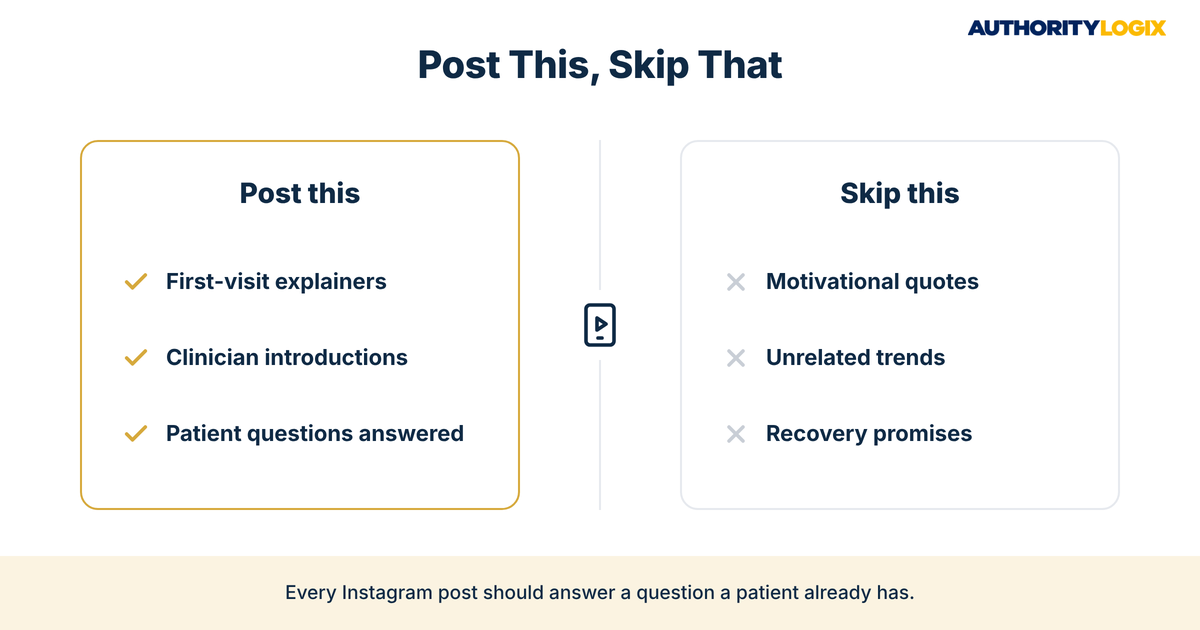
PT clinic Instagram marketing works when every post answers a question a prospective patient is already asking. What does a first evaluation involve? Do I need a referral? How long is a typical visit? Is my problem the kind a physical therapist sees? Posts that answer these questions build familiarity and clinical trust at the same time.
Those answers should not be invented one post at a time. Practices that publish with purpose pull their posts from the topics their website already covers, so Instagram becomes the short version of a longer explanation. That is the job of repeatable content systems: a fixed set of topics, written once in depth, then cut into the formats each channel needs.
Short Video and Carousel Formats
Short vertical video and multi-slide carousels are the two formats that suit physical therapy social media on Instagram. A brief clip of a therapist explaining what happens during an evaluation, or a carousel that walks through the questions to ask when choosing a clinic, gives the viewer something useful without a long caption. Both formats also show your clinicians’ faces and voices, which matters more than polished graphics.
Keep clinical boundaries clear in every format. Instagram is a place to explain what physical therapy is and how your practice works, not to diagnose viewers or prescribe exercises to strangers. A post that says an evaluation can identify what is going on is educational; a post that promises a pain-free result is a guarantee no practice should make.
What to skip matters just as much. Generic motivational quotes, trending audio with no connection to care, and before-and-after recovery claims fill a feed without telling anyone why to choose you. The topics that earn attention on Instagram are usually the same ones that rank in search, which is why your physical therapy social media plan and your content SEO plan should share one topic list instead of running separately.
Physical Therapist Facebook Posts That Reach Neighbors, Not Just Current Patients
Physical therapist Facebook posts reach a different audience than Instagram does. Facebook is where local parents, retirees, coaches and community groups share news, events and recommendations, and it is often where someone asks a neighborhood group which physical therapist to see. A practice that posts with that neighbor in mind writes differently from one that posts only for its existing patients.
The most useful physical therapist Facebook posts are local and specific. Announce a free workshop at the library, share a guide for parents before the fall sports season, introduce a new clinician with their training and the conditions they focus on, or explain your state’s direct access rules in plain language. Each of these gives a neighbor a reason to pass the post to someone who needs it.
Reach on Facebook comes from shares and local groups more than from the practice page itself. Posting the same workshop announcement to your page, a community group, a partner gym’s page and your email list is a distribution decision, not a creative one, and it is where most practices leave reach on the table.
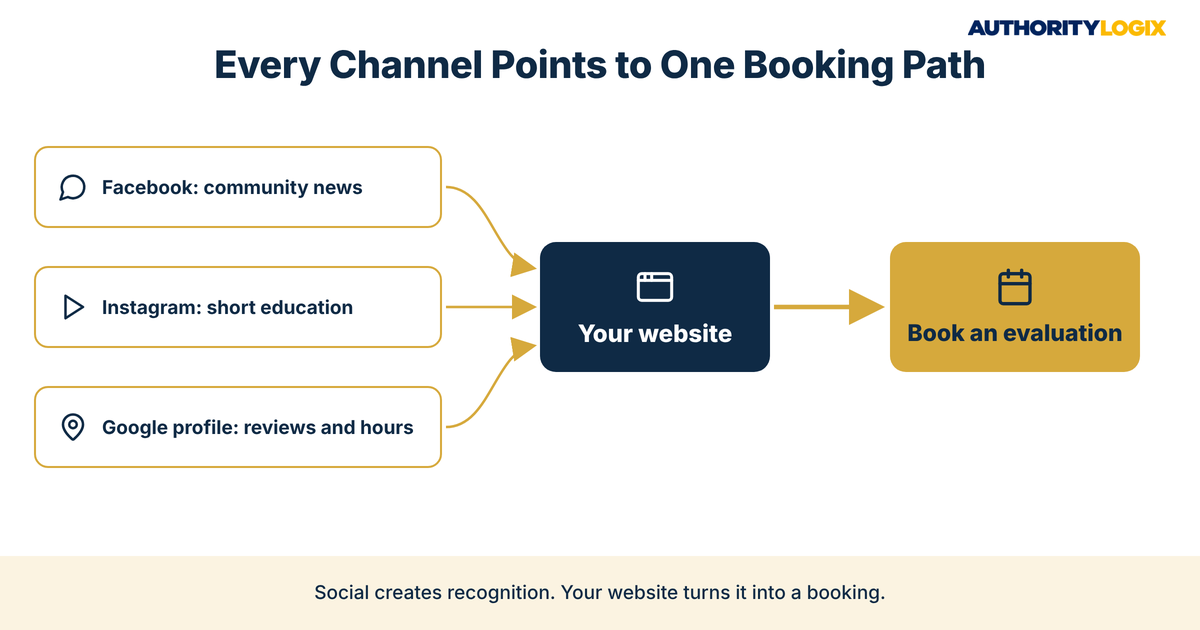
Facebook activity also supports how people confirm they have found the right clinic. Consistent business details across your Facebook page, Google profile and website remove doubt, and reviews on Facebook add to the social proof a prospective patient sees. That is why physical therapy social media and local search should be managed from one shared set of practice details.
Measure Facebook by conversations, not likes. Messages asking about insurance, calls that mention a post, and workshop sign-ups tell you far more about physical therapy social media performance than reaction counts ever will.
Not sure whether your physical therapy social media, website and Google profile are working together or losing patients between them? The assessment shows where the gaps are and what to fix first.
From Scroll to Schedule: Tracing Social Content Evaluation Bookings
Social content evaluation bookings are the number that matters, and most practices cannot see them. A patient sees a carousel on Tuesday, searches the clinic on Friday and calls the front desk the following week. Without a plan to trace that path, the booking gets credited to Google or word of mouth, and physical therapy social media looks like it produced nothing.
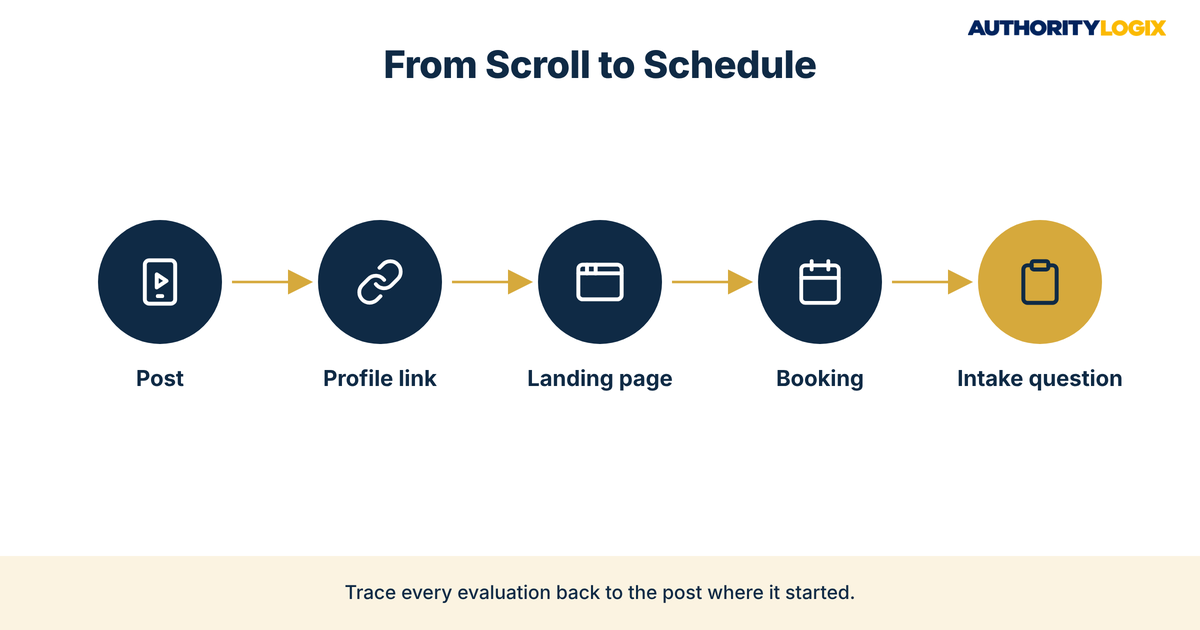
The path from a physical therapy social media post to an evaluation runs through a profile link, a landing page, a booking step and an intake conversation. Each step needs to exist, and each needs to be easy. Treating that path as part of your lead generation system, rather than an afterthought, is what turns a feed into a pipeline.
| Step | What the patient does | What the practice needs in place |
|---|---|---|
| Post | Sees a short video or carousel | A clear topic and a reason to visit the profile |
| Profile link | Taps the link in the bio or page | A tagged booking link and current contact details |
| Landing page | Reads about the condition or the first visit | A page that matches the post and introduces the clinicians |
| Booking | Requests an evaluation online or calls | A short form or a front desk that answers quickly |
| Intake | Says where they first heard about you | A recorded source for every new patient |
Tracking Bookings From Social Profiles
Start with the profile link. Give Instagram and Facebook their own tagged booking URLs so your website analytics can separate social visitors from search visitors, and send each one to a page built for that audience rather than the homepage. If your scheduling software supports it, add a source field so online requests carry the channel with them.
Then close the loop at the front desk. Add one intake question — where did you first hear about us? — and record the answer for every new patient, including those who first saw a post and later found you on Google. Reviewing that list each month alongside the tagged link data is part of our process for showing practices where their social content evaluation bookings actually come from.
Expect the numbers to tell a mixed story. Social channels often start the decision while search or a referral finishes it, so the honest measure of physical therapy social media is how often it appears anywhere in the path, not only as the last click.
Building a Physical Therapy Social Media Calendar Your Team Can Sustain
Most physical therapy social media efforts stall for the same reason: the owner or one enthusiastic staff member carries the whole load between patient visits. When that person gets busy, posting stops, and the feed goes quiet just as it was starting to build recognition. Volume without infrastructure is just noise, and a stop-and-start feed does less than a steady, modest schedule.
A sustainable physical therapy social media schedule starts with fewer original ideas used in more ways. One in-depth article about returning to running after a setback can become a short video, a carousel, a Facebook post for a local running club and an email. That kind of repurposing lets a small team publish all week from material produced once.
The source material should live on your website, not inside the social apps. When posts point back to condition pages, first-visit guides and FAQs in a practice educational hub, every post sends people somewhere useful, and the site keeps working long after the post has scrolled out of view.
Assign clear roles. A clinician approves anything clinical, a staff member schedules posts and replies to messages, and the owner reviews results once a month. Topics come from the questions patients ask at intake, which keeps physical therapy social media grounded in real patient education instead of guesses about what might perform.
AuthorityLogix runs the same publish-once, distribute-everywhere structure on its own proof-of-concept build, BKDSCR.com, in the NYC real estate investment niche: 18 pillar pages and 48 blog posts, built with zero paid ads. The industry is different. The system behind it is the one a physical therapy practice needs.
Physical Therapy Social Media Privacy Rules for Patient Content
Physical therapy social media carries privacy obligations that ordinary small-business posting does not. Patient names, faces and stories are protected health information, and posting them requires the patient’s written, HIPAA-compliant authorization first. Staff should also never confirm that someone is a patient when replying to comments or reviews.
The risk is real. In a resolution agreement published by the HHS Office for Civil Rights, a Los Angeles-area physical therapy practice agreed to pay $25,000 after it posted patient testimonials, including full names and full face photographs, on its website without valid HIPAA-compliant authorizations. Have a compliance professional review your authorization form and social media policy before any patient content goes live.
Physical Therapy Social Media FAQ for Practice Owners
These are the questions practice owners and front desk teams ask most often when they start treating physical therapy social media as part of patient acquisition. The answers focus on marketing and visibility, not clinical decisions.
How often should a physical therapy practice post on social media?
For physical therapy social media, consistency matters more than volume. A schedule your team can keep every week, built from repurposed website material, will do more than a burst of daily posts that stops after a month.
Which platform should a local PT clinic start with?
Start where your patients already are. Pew Research Center found that 80% of adults ages 30 to 49 use Facebook and eight in ten adults ages 18 to 29 use Instagram, so many practices run both, with Facebook carrying community news and Instagram carrying short educational video.
Can we share patient success stories on social media?
Only with the patient’s written, HIPAA-compliant authorization, and only the details they have agreed to share. Many practices skip patient stories and focus on clinician introductions and education instead, an approach reflected throughout the PT resources we publish for practice owners.
Does social media replace our website or Google profile?
No. Social channels create recognition, but a post rarely answers everything a prospective patient wants to know before booking. Building every channel to point back to one strong website is central to our approach, because the website is the asset the practice owns.
Ready to build a physical therapy social media system that publishes from your clinicians’ expertise and sends every post toward a booked evaluation?
Connecting Social Awareness to Your Website and Booking Path
Physical therapy social media is a visibility channel, not a booking system on its own. The practices that see evaluations come from it are the ones whose posts lead somewhere — a page that answers the question, a clinician the patient can read about, a booking step that takes a minute. That connected structure is the core of long-term authority growth, and it is the piece most social efforts skip.
None of this depends on chasing trends. It depends on publishing what your clinicians already know, distributing it where neighbors spend time, and tracking which posts start real conversations, which are the same pieces that make up our services for physical therapy practices.
The honest answer is that most practices already have the expertise their community is looking for. The missing piece is the infrastructure that connects a post someone saw on their phone to the evaluation they book with you.