Key Takeaways
- Physical therapy treatment options content written for other clinicians, not patients, is one of the most common reasons a practice website fails to convert visitors into booked evaluations.
- Most printed patient education materials in physical therapy are written above an eighth-grade reading level, well past what health literacy research recommends.
- Physical therapy treatment options content needs plain-language equivalents for clinical terms, without losing the specific accuracy that makes the content trustworthy.
- Structure and formatting matter as much as word choice — a wall of dense paragraphs reads as clinical even when the vocabulary is simple.
- Readability can be tested directly, not guessed at, and physical therapy treatment options content should be checked the same way any patient-facing material is checked.
- This content works best connected to condition pages and clinician bios, not published as an isolated page with nowhere to send the reader next.
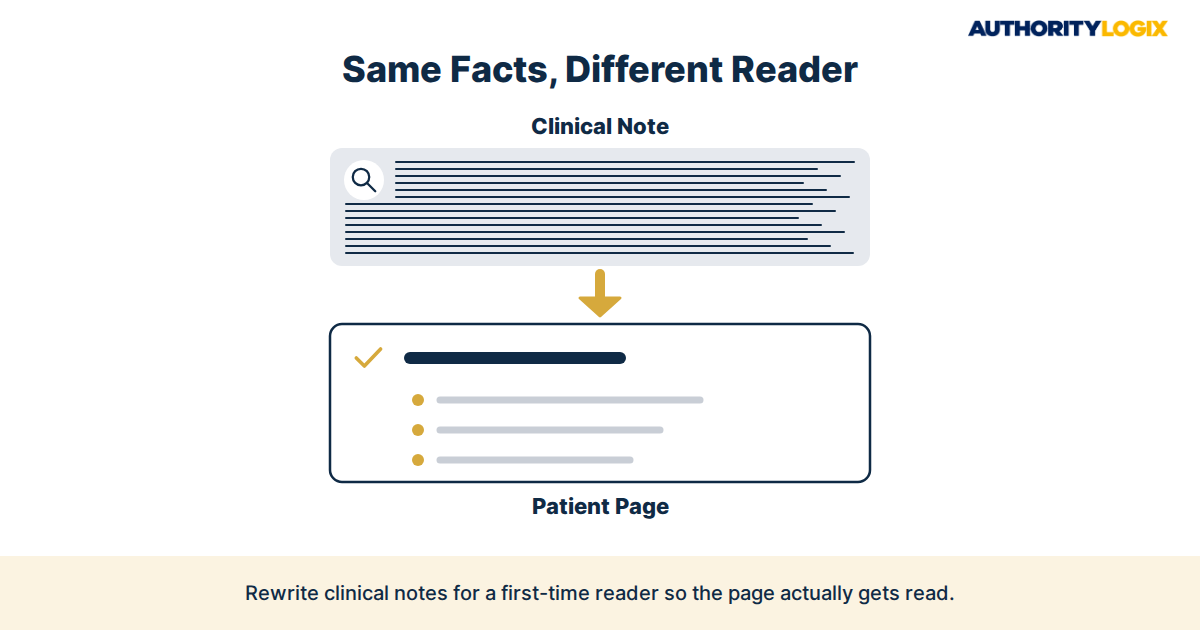
A prospective patient reading physical therapy treatment options content is trying to answer one question: will this actually help my specific problem. Most treatment pages fail to answer it, not because the underlying clinical information is wrong, but because it is written the way a clinical note is written — accurate, dense, and organized for a colleague rather than a worried patient trying to decide whether to book an evaluation.
This is a solvable problem, and it does not require simplifying the clinical substance to the point of being vague. Physical therapy treatment options content can stay specific and accurate while reading like something a real person wrote for another real person, and the practices that get this right consistently convert more of their website traffic into booked evaluations than the ones that leave their treatment pages sounding like discharge paperwork. The fix is rarely a matter of removing information — it is almost always a matter of translating information that already exists into language the intended reader can actually use.
Why Physical Therapy Treatment Options Content Needs a Different Voice Than a Clinical Note
A clinical note exists to document care accurately for other clinicians, insurers, and legal purposes. Physical therapy treatment options content exists to help a stranger decide whether to trust this specific practice with their specific problem. Those are different jobs, and content written for the first job rarely succeeds at the second one without deliberate rewriting.
The
educational hub system treats this distinction as foundational, not optional. A practice that simply republishes internal clinical language as physical therapy treatment options content is publishing accurate information that very few prospective patients will actually finish reading, which defeats the purpose of publishing it at all.
The
treatment content framework separates condition pages from treatment pages for exactly this reason — a condition page explains what is happening to the patient, while physical therapy treatment options content explains what the practice will actually do about it, in language built for a first-time reader rather than someone already fluent in the terminology. Keeping these two jobs separate also keeps each page shorter and more focused, which is its own readability win independent of word choice.
The Physical Therapy Patient Education & Clinical Authority Guide covers the full framework this content is built on.
Clinical Authority Guide →
What Overly Clinical Physical Therapy Treatment Options Content Costs a Practice
Overly clinical physical therapy treatment options content has a measurable readability problem, not just a stylistic one. A peer-reviewed study of physical therapy patient education materials found that a majority were written above an eighth-grade reading level, well past what health literacy research recommends for materials aimed at the general public. Content written at that level does not fail because patients are unintelligent — it fails because most readers, regardless of education, skim rather than parse dense technical prose, especially when they are anxious about pain or mobility. That anxiety matters more here than in most other content contexts, because a stressed reader has even less patience for a page that makes them work to understand it.
The
patient education authority framework treats this readability gap as a trust problem as much as a comprehension problem. A prospective patient who cannot follow physical therapy treatment options content on the first read is unlikely to conclude that the practice is especially rigorous. They are more likely to close the tab and look for a competitor whose website is easier to understand, regardless of which practice actually has the stronger clinical program.
CMI research on what separates the most effective content programs from the rest points to the same underlying discipline outside healthcare entirely: the best-performing content consistently puts the audience’s actual informational needs ahead of what the organization wants to say about itself. Physical therapy treatment options content that reads like internal documentation gets that priority backward, describing the practice’s process in the practice’s own terms instead of answering the question the reader actually brought to the page.
Writing PT Treatment Explanation Patient-Friendly Content Without Losing Accuracy
PT treatment explanation patient-friendly content is not the same as vague content. Specificity and simplicity are not in tension — the goal is to describe the exact same clinical process in language a first-time reader can follow without a glossary. Physical therapy treatment options content that achieves this usually shares a few habits: short sentences, active voice, and a term defined in plain language the first time it appears rather than assumed as common knowledge.
Replacing Jargon With Plain-Language Equivalents in Physical Therapy Treatment Options Content
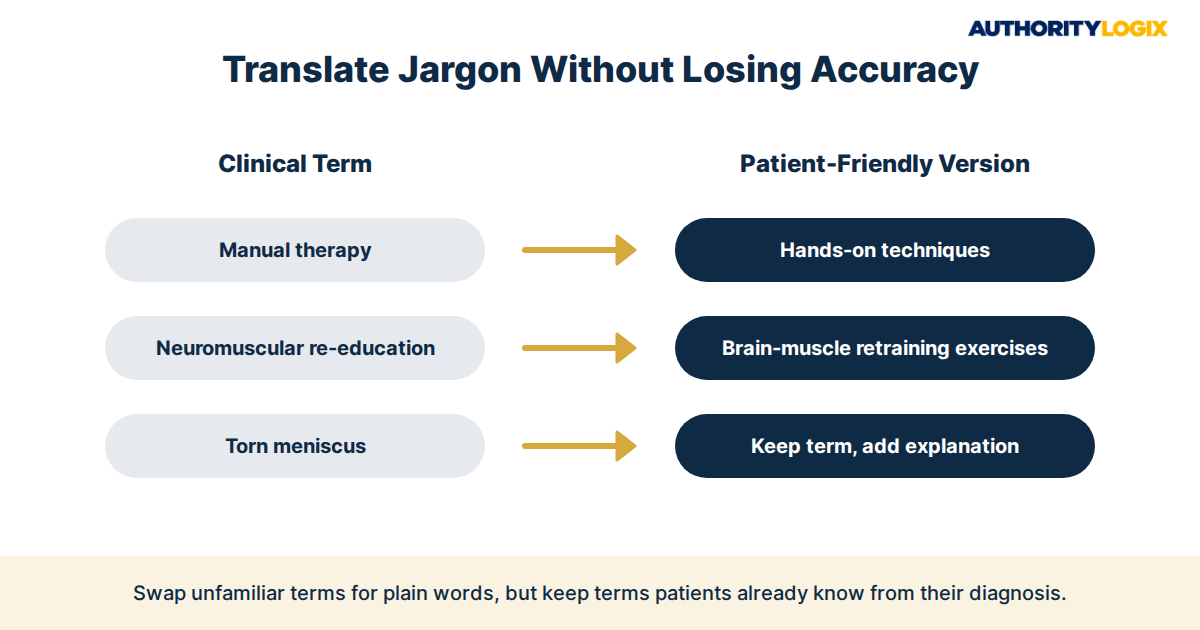
“Manual therapy” can become “hands-on techniques your therapist uses to improve movement and reduce pain.” “Neuromuscular re-education” can become “exercises that retrain how your brain and muscles communicate after an injury.” Neither rewrite loses accuracy — both simply translate a term a patient has never encountered into language built from words they already know. The same approach applies to nearly every technical term a practice currently uses without translation: name the mechanism in plain terms first, then attach the clinical name for the reader who wants to look it up or mention it to their physician.
When Clinical Terms Are Worth Keeping
Not every term needs replacing. A patient who was told by their surgeon they have a “torn meniscus” benefits from seeing that exact phrase on the practice’s physical therapy treatment options content, immediately followed by a plain-language explanation of what it means for their treatment. Removing a term the patient already has attached to their own diagnosis makes the content harder to connect to their situation, not easier.
The test worth applying to any term is simple: does the patient already know this word from their own diagnosis or referral, or would they only encounter it for the first time reading this page. Terms in the first category are usually worth keeping. Terms in the second are almost always worth translating into something a first-time reader can follow without stopping to look anything up.
Physical Therapy Service Content Clarity: Structure and Formatting
Physical therapy service content clarity depends on formatting as much as word choice. A page that uses short paragraphs, descriptive subheadings, and a bulleted list for anything resembling a sequence of steps reads as clearer even when the underlying sentences have not changed at all. A wall of unbroken text feels clinical regardless of the vocabulary used inside it, simply because nothing about the page’s structure invites a skimming reader in.
The
clinician authority signal a page carries also depends partly on structure. Content organized around clear questions — what this treatment is, who it helps, what a session looks like — reads as more credible than the same information delivered as one continuous paragraph, because the structure itself signals that someone thought carefully about how a reader would actually use the page.
The
SEO playbook covers how this same structure also supports search performance — the subheadings that make a page easier for a patient to scan are frequently the same elements that help a search engine understand what physical therapy treatment options content is actually about. A page that is easy for a human to navigate is, in practice, usually easy for a crawler to parse as well, so the two goals rarely conflict.
PT Clinical Content Readability: How to Test and Measure It
PT clinical content readability does not have to be a matter of opinion. Standard readability formulas score a passage’s grade level based on sentence length and word complexity, and free tools can run that score on any draft in seconds. Physical therapy treatment options content aimed at a general patient audience should land in roughly the sixth- to eighth-grade range, which is the same target health literacy researchers recommend for patient-facing material across healthcare generally.
The
patient FAQs approach benefits from the same readability discipline, since a complicated answer to a simple question undermines the entire point of an FAQ section. Running a readability check before publishing takes a few minutes and catches the kind of unintentional complexity that is nearly impossible to notice in a document the writer has already read a dozen times.
The
visibility guide covers how clearer, more scannable physical therapy treatment options content also tends to hold a visitor’s attention longer, which is a signal search engines increasingly weigh when deciding how well a page actually serves the query that brought a visitor to it in the first place. A page visitors abandon within seconds sends the opposite signal, regardless of how accurate its content is.
Where Treatment Options Content Fits Alongside Condition Pages and Bios
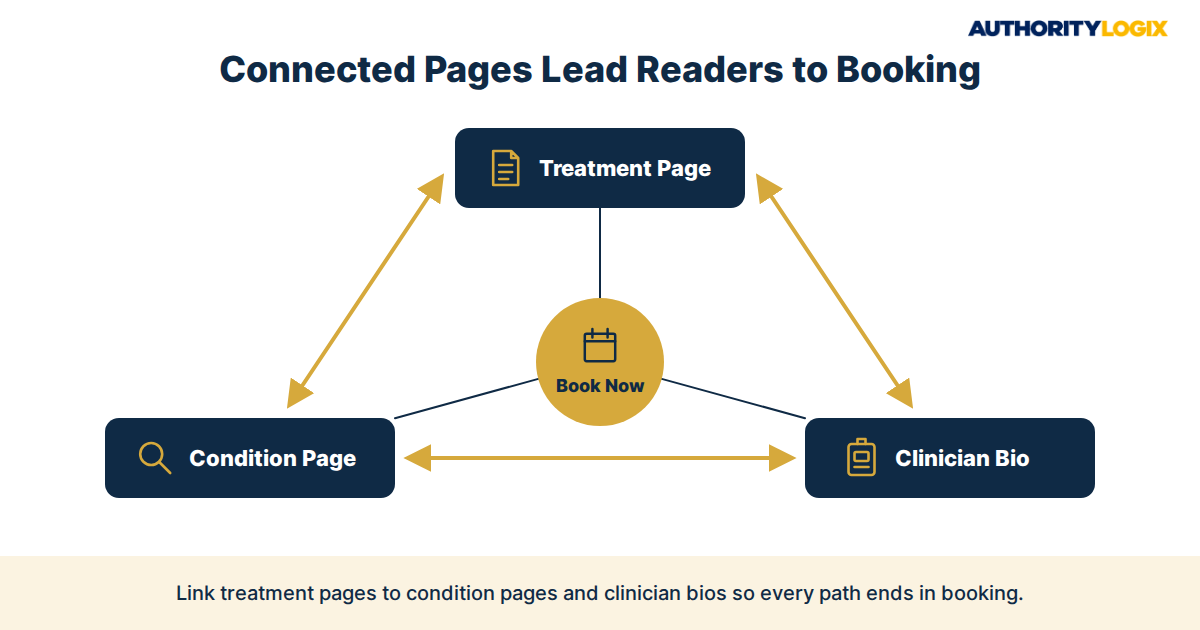
Physical therapy treatment options content works best connected to the rest of a practice’s library rather than published as an isolated page. It should link out to the condition pages it applies to and back to the
education library those condition pages belong to, so a reader who starts anywhere in the structure can reach the specific treatment information relevant to them without a separate search.
A treatment page should also connect to the clinician who actually performs that treatment. The
bio page of the specific therapist gives a reader a named, credentialed person to attach to the treatment description, which converts an abstract explanation of a technique into a concrete answer to “who would actually be doing this to me.”
From there, physical therapy treatment options content should feed directly into the practice’s
acquisition playbook, with a clear path to booking placed where a convinced reader is most likely to act on it rather than buried at the bottom of a long page they may not scroll to. A single, visible scheduling link near the top of the page captures readers who decide quickly, while a second one at the end catches readers who wanted the full explanation first.
What Most PT Practices Get Wrong About Treatment Content
They copy internal clinical documentation directly onto the website
Repurposing an internal clinical summary as physical therapy treatment options content saves time during the initial build but produces a page written for the wrong reader. The
authority distribution layer that shares this content further only amplifies the problem — distributing a page that already fails to connect with a general reader does not fix the underlying issue, it just shows the same dense content to a wider audience.
They treat every treatment page as equally important to write well
A practice with limited time to rewrite every page should start with the treatments that generate the most patient volume, not the most clinically interesting ones to write about. The
growth blueprint covers this same prioritization logic across every type of content a practice builds — start where the volume already is, then expand outward.
The
why us page makes a related point about sequencing infrastructure work generally: a small number of well-rewritten, high-volume treatment pages produce more value in the first month than a large batch of quickly rewritten low-volume pages ever will. Depth on the pages that matter most beats breadth across pages nobody was searching for in the first place.
Patient Questions Treatment Options Content Should Answer
The
our approach page covers the measurement side of content quality in more depth, but physical therapy treatment options content earns its keep by answering the specific questions a reader actually has before booking.
Will this treatment actually help my specific condition?
A well-written page names the specific conditions the treatment addresses rather than describing it in vague, universal terms that could apply to almost any diagnosis.
What will actually happen during this treatment?
A short, concrete walkthrough of a typical session reduces the anxiety that comes from not knowing what to expect on a first visit.
Is this the same as what I might have read about somewhere else?
Naming the technique by its common name alongside its clinical name helps a patient connect what they already researched to what this specific practice actually offers.

Want treatment content written in the plain language worried patients are actually searching for?
Work With Us →
Building Clearer Treatment Pages: Where to Start
Pick the three treatment pages that get the most traffic or drive the most bookings, and rewrite those three before touching anything else. Run each draft through a readability check, replace jargon with plain-language equivalents where the term itself carries no diagnostic value to the patient, and link each page out to its related condition content and the treating clinician’s bio. Resist the temptation to rewrite every page at once — a focused rewrite of the highest-traffic pages, done well, teaches the practice what good treatment content actually looks like before that standard gets applied everywhere else. The
what we do page outlines how this fits into the broader content system a practice is building over time.
The honest answer is that most practices already know which treatments matter most to their patient volume — they simply have not gone back and rewritten the pages that describe them in language a first-time visitor can actually follow. Physical therapy treatment options content does not need a complete overhaul to start working better. It needs the accuracy a practice already has, translated into the plain, specific language a worried patient is actually looking for.
That translation work is rarely difficult once a practice commits to doing it — the expertise was never the missing ingredient. The
PT industry hub demonstrates how the five-system framework — content, local search, patient education, lead generation, and authority distribution — connects treatment options content to the rest of the practice’s growth system.


