Key Takeaways
- Physical therapy video condition treatment education answers a patient’s questions about a condition and about what care involves before that patient ever calls your front desk.
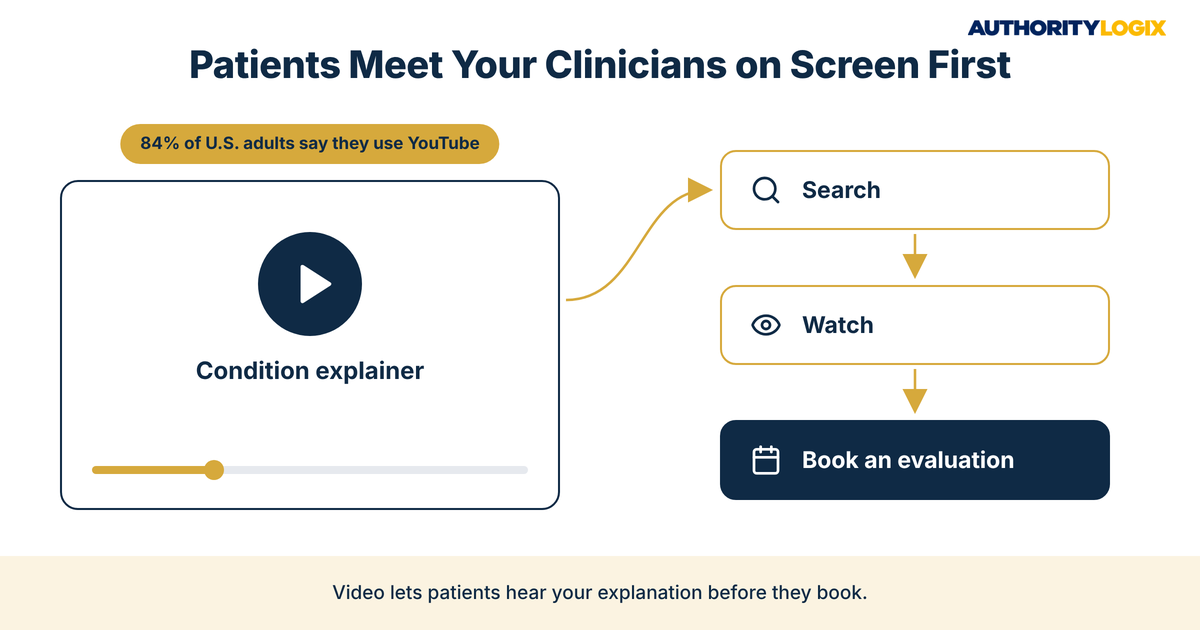
- Pew Research Center’s 2025 survey found 84% of U.S. adults say they ever use YouTube, compared with 71% for Facebook.
- Wyzowl’s State of Video Marketing 2026 report found 63% of people would most like to learn about a product by watching a short video.
- A PT video patient education strategy starts with the conditions that already fill your evaluation schedule, not with cameras or editing software.
- Physical therapy video condition treatment education works hardest when every video is embedded on a matching condition page instead of living only on YouTube.
- Consistency, visible clinician credentials and a connected page structure matter more to physical therapy video condition treatment education than production value.
Why Physical Therapy Video Condition Treatment Education Matters Before the First Evaluation Booking
Physical therapy video condition treatment education is how a practice explains a condition, and what care for it involves, before a patient ever books. Your clinicians may explain a diagnosis better than anyone in town, yet a prospective patient searching late at night never hears that explanation. The patient pipeline mapped in the
acquisition playbook starts long before the phone rings, and video is one of the few formats that lets a patient meet your clinicians before the first visit.
That is the credible but invisible problem inside a physical therapy practice. The expertise lives in the treatment room, where only current patients ever see it. Physical therapy video condition treatment education moves a small, honest piece of the treatment-room conversation onto the screens where patients already spend their time.
And people are already looking. Pew Research Center’s 2025
social media survey of 5,022 U.S. adults, fielded from February 5 to June 18, 2025, found that 84% of U.S. adults say they ever use YouTube, compared with 71% for Facebook. Your future patients are on that platform today; the question is whether any video they find was recorded by a clinician in their town.
A video that is filmed once and never connected to a page, a profile or a follow-up step does very little on its own. That is why physical therapy video condition treatment education belongs inside the same
content systems that produce your condition pages, patient FAQs and new-patient emails, where each piece points to the next.
Practices that have built condition pages and patient FAQs, the kind covered across the physical therapy
resource library, already hold the scripts for their first dozen videos. The sections below follow the build order for physical therapy video condition treatment education: what to film, where it gets found, who appears on camera, where videos live and what goes wrong.
The Physical Therapy Patient Education & Clinical Authority Guide shows where physical therapy video condition treatment education fits inside a complete patient education and clinician authority system.
Clinical Authority Guide →
Which Conditions Deserve a Video First: Building a PT Video Patient Education Strategy
A PT video patient education strategy starts with your own schedule, not with a camera. List the conditions behind most of last year’s evaluation bookings, such as low back, knee and shoulder pain or post-surgical rehab. Those are the topics patients in your area are already searching for, and they are the first candidates for physical therapy video condition treatment education.
That list should line up with the keyword research behind your website. The
content SEO playbook explains how condition topics are grouped into pillar and cluster pages, and video follows the same map: one core explainer for each priority condition, then shorter answers to the specific questions patients ask about it. When the video plan and the page plan match, each one makes the other easier to find.
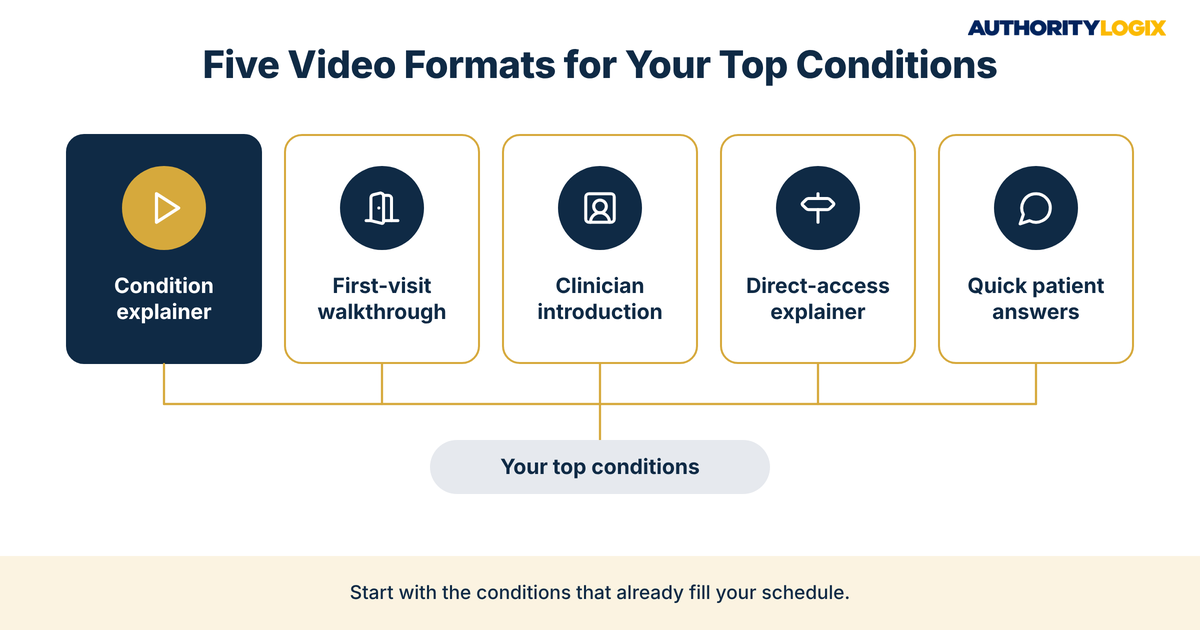
Not every video needs to be a full condition explainer. Most practices get further with a small set of repeatable formats that one clinician can record in a single afternoon. The table below lays out the formats that carry physical therapy video condition treatment education, the patient question each one answers and where it belongs on your site.
| Video Format |
Patient Question It Answers |
Where It Lives |
| Condition explainer |
“What is this condition, and how does a physical therapist approach it?” |
The matching condition page and your YouTube channel |
| First-visit walkthrough |
“What happens at my first evaluation?” |
The new-patient page and the booking confirmation email |
| Clinician introduction |
“Who will I be working with?” |
The team page and your Google Business Profile |
| Direct-access explainer |
“Do I need a referral to book?” |
The insurance and referral page |
| Quick patient answers |
“How long is a visit? What should I wear?” |
The FAQ page and YouTube Shorts |
Five formats across ten priority conditions is a manageable library, not an endless production schedule. Organized properly, those videos become the backbone of an
educational hub where patients move from a general explainer to the specific question they came with. Physical therapy video condition treatment education built this way keeps answering questions long after the recording day.
One rule applies to every format: the video explains, it does not promise. A condition explainer can describe what an evaluation looks at, but it should never suggest a recovery timeline or result, or feature a real patient’s name, story or case details. That keeps your physical therapy video condition treatment education clear of outcome claims and privacy problems.
How Physical Therapy YouTube Condition Videos Reach Direct-Access Patients Searching Locally
Direct access changed who a practice’s video is for. APTA’s 2025 report on the state of direct access states that patients in all 50 states, the District of Columbia and the U.S. Virgin Islands have either provisional or unrestricted direct access to physical therapist services. Many patients can choose a physical therapist without seeing a physician first, and that choice can start with a search.
Physical therapy YouTube condition videos work on two search surfaces at once. YouTube runs its own search, and Google can show video results next to standard web listings for condition questions. That is why physical therapy video condition treatment education is worth planning around real search phrases instead of internal clinic terms.
Video alone does not make a practice local, though. A patient still has to connect the clinician in the video with a clinic they can drive to, and the signals in the
local visibility guide, such as a complete Google Business Profile, consistent location details and recent reviews, make that connection. Every piece of physical therapy video condition treatment education should name your town and clinic in its title and description.
Your Google Business Profile is a video destination too. Short clinician introductions and first-visit walkthroughs can be added to the profile, so a patient comparing three clinics in the map pack sees your team before seeing a phone number. That is where video and
local search start supporting each other.
Titles matter more than thumbnails. A video titled “Knee Pain” competes with every hospital system on YouTube, while one titled for the actual question and town competes with far fewer channels. Titles for physical therapy video condition treatment education should read like the patient’s own search.
Not sure whether your practice’s videos, condition pages and local profile are working together? The PT Authority Gap Assessment shows where your physical therapy video condition treatment education has gaps and what to build first.
Authority Gap Assessment →
Who Belongs on Camera: Clinician Credentials and PT Educational Video Trust Building
Patients book with people, and the most useful thing a video can show is the clinician who will actually evaluate them. A library that features each treating therapist, with name, credentials and focus areas on screen, puts real
clinician expertise in front of patients before the first visit. PT educational video trust building is mostly a matter of letting the people who do the work explain it.
Some practices assume YouTube will label their channel as a credible health source. YouTube’s health source information panels and health content shelves are real features, but YouTube’s published application criteria list licensed doctors, nurses, psychologists, marriage and family therapists and clinical social workers, and physical therapists are not on that list. The same criteria require more than 1,500 valid public watch hours in the last 12 months and a channel that primarily covers health information.
That leaves credibility in the practice’s own hands. State the clinician’s name and license on screen, link each video to a bio page that lists education and certifications, and keep every statement inside what a clinician would say to a new patient in the room. PT educational video trust building comes from those visible, checkable details rather than from a platform badge.
A clinician reading a script sounds like an advertisement, while a clinician answering a question heard every week sounds like the person a patient wants to see. That difference shapes
our approach to practice video, which starts with recorded answers to real front-desk questions and builds the edit around them. Physical therapy video condition treatment education should sound like the evaluation room, not the waiting-room television.

Where the Videos Live: Pairing Physical Therapy Video Condition Treatment Education With Condition Pages
A video that lives only on YouTube mostly helps YouTube. A video embedded on the matching condition page helps your website as well, because the page now answers the question in two formats and gives the patient a clear next step. The page-per-condition model behind strong
condition content is exactly where physical therapy video condition treatment education should land first.
What a Video-Ready Condition Page Includes
Each page needs a few supporting elements before the video can do its job. None of them requires new production work, and most practices already have the raw material:
- A short written summary of the video, so the page still reads well without pressing play
- Captions and a full transcript, which make the video accessible and give search engines text to read
- The clinician’s name and credentials placed beside the video
- A clear booking path with a plain note on referral requirements
- Links to the related quick-answer videos and FAQ entries
Across a full practice site, those pages form a connected library instead of a pile of uploads. The AuthorityLogix
PT industry hub organizes this work as connected systems for that reason, since video, condition pages, local search and lead capture each depend on the others. Physical therapy video condition treatment education is the format, and the page structure is what turns it into an asset.
The model is not theoretical. BKDSCR.com, AuthorityLogix’s own proof-of-concept build in the NYC outer-borough DSCR real estate niche, uses the same connected structure: 18 pillar pages, 7 interactive tools and 48 SEO-optimized blog posts, built with zero paid ads. The industry is different, but the principle carries straight over to physical therapy video condition treatment education.

What Most PT Practices Get Wrong About Video (and the Questions Patients Actually Ask)
Most practices that give up on video were not short on effort. They hit predictable mistakes, and patients have matching questions the videos should have answered, framed below the way owners and patients ask them.
Do we need professional production before we start?
No. Wyzowl’s State of Video Marketing 2026 report, based on 266 respondents, found that 96% of people have watched an explainer video to learn about a product or service, and an explainer is about clarity rather than cinematography. Good physical therapy video condition treatment education needs clear audio, steady framing and a clinician who knows the subject far more than it needs a film crew.
Why do our videos get views but no bookings?
Views without a next step are a dead end. A video embedded on a page with a booking link, a referral note and a short form connects to the
lead generation path that turns a curious viewer into an evaluation request. Physical therapy video condition treatment education that ends without telling the patient what to do next leaves the decision to chance.
As a patient, will a video tell me what my recovery will look like?
It should not, and a responsible practice will say so on screen. Well-made physical therapy video condition treatment education explains what the condition is, what a physical therapy evaluation looks at and how a plan of care is built for each person. Only an evaluation with a licensed clinician can speak to an individual case.
Can I book an evaluation without a referral after watching?
Often, yes. APTA reports that every state allows either provisional or unrestricted direct access, although provisional rules carry limits and insurance plans set their own requirements. The video should point to a page that explains your state’s rules and your accepted plans in plain language.
Who should run the video program inside a practice?
Clinicians should own the expertise and someone else should own the system, because a therapist with a full schedule will not title, caption, embed and distribute videos every week. That split, your clinical knowledge with an outside build, is
what we do for practices that are credible in their community but missing from its search results.
Ready to turn your clinicians’ everyday explanations into a video condition education system that brings direct-access patients to your evaluation schedule?
Work With Us →
The Honest Truth About Practice Video: Consistency Beats Production Value
Practice video does not reward the best camera. It rewards the practice that records a dozen useful answers this quarter and another dozen next quarter, each placed on the right page. The
growth blueprint describes how visibility built this way keeps paying off after the build phase ends, and physical therapy video condition treatment education is one of the clearest examples of that pattern.
Distribution finishes the job. A clip from your physical therapy video condition treatment education library can run on the practice’s Google Business Profile, in a new-patient email, on social channels and in a local newsletter, which is the work of
authority distribution rather than another production day. Volume without infrastructure is just noise.
The sequence matters as well. Start with the five formats for your top conditions, embed each on its page, then add quick answers as new questions come in, the order laid out in
how we build practice content libraries. No one can guarantee a ranking or booking count from any single video.
The honest answer is that most physical therapy practices already have the explanations patients are searching for; they simply deliver them in the treatment room. Physical therapy video condition treatment education moves those explanations to where the next patient is looking. The camera is the easy part, and the system around it is what makes the market see the expertise you already have.


