


Key Takeaways
- Physical therapy website contact form conversion is the last step between a patient who has chosen your practice and a booked evaluation.
- Experian Health’s 2025 State of Patient Access survey found that 80 percent of patients surveyed want to schedule appointments anytime from their home or mobile device.
- Physical therapy booking form friction usually comes from too many fields, a layout that breaks on a phone, and insurance or referral questions asked too early.
- Baymard Institute’s 2024 research put the average e-commerce checkout at 11.3 form fields while most sites need only 8, a useful warning for physical therapy website contact form conversion.
- PT contact form guidelines for direct-access patients start with plain answers on referrals and insurance next to the form, not hidden on another page.
- Physical therapy website contact form conversion only improves when someone measures it and follows up fast, because a submitted form is not yet a patient.
Table of Contents
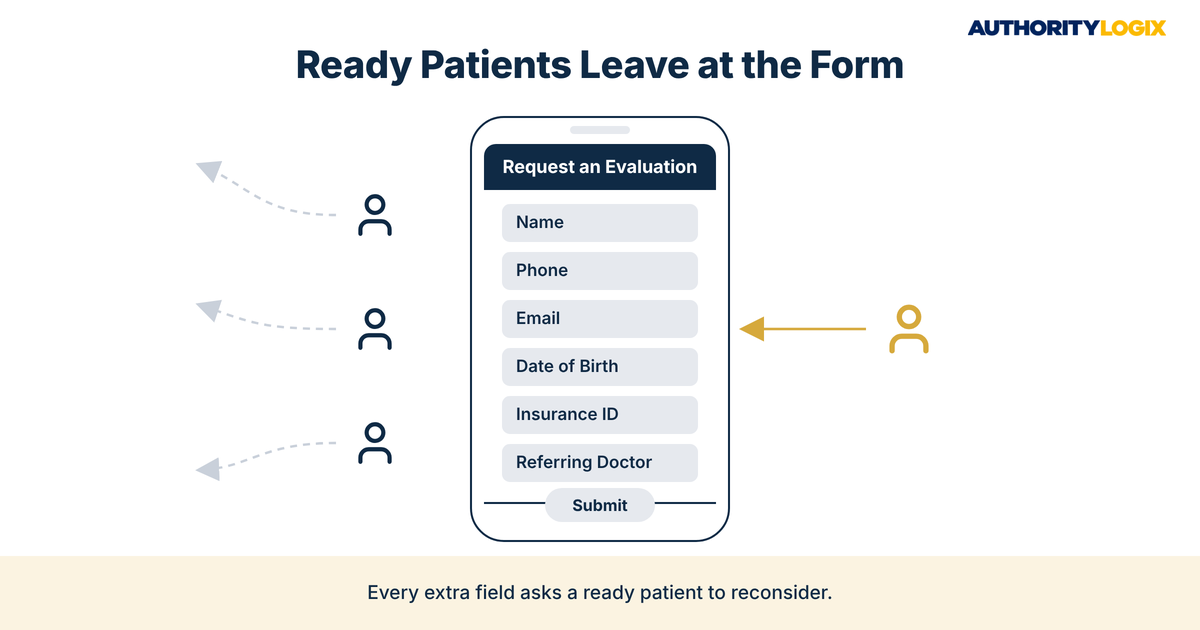
Physical therapy website contact form conversion is the point where a patient who already chose your practice either books an evaluation or quietly leaves. You may have a strong reputation, skilled clinicians and years of physician referrals, yet a patient on a phone at 10 p.m. meets a nine-field form, a required insurance ID and a submit button below the fold. The broader pattern of website abandonment starts long before the form, but this article stays on the form itself, where the patient is closest to saying yes.
That is the credible but invisible problem at its narrowest point. The practice earned the visit, the page earned the patient’s trust, and the form gives that trust back to a competitor with a shorter one. Physical therapy website contact form conversion is how a practice measures that loss.
Why Physical Therapy Website Contact Form Conversion Decides Your Evaluation Count
Patients increasingly expect to book on their own schedule. Experian Health’s 2025 patient access survey found that 80 percent of patients surveyed want to schedule appointments anytime from their home or mobile device. For a PT practice, that means the form or booking tool on your website is often the front desk a new patient meets first, and physical therapy website contact form conversion is the measure of how well that front desk works.
The same survey shows the provider side is still catching up. Among providers surveyed, 54% offer self-scheduling and another 10 percent plan to offer it in the next six months, while 55% said patients are unsure how to navigate self-scheduling. Having a form is not the same as having a form patients can finish.
What Physical Therapy Website Contact Form Conversion Actually Measures
The number is simple: completed submissions divided by the visitors who reached the page with the form. What it reveals is less simple, because a weak rate can come from the form, the page around it, or the traffic arriving there. The form sits at the end of a lead generation system, so physical therapy website contact form conversion should be read alongside the pages and searches that feed it, not on its own.
A practice with steady physician referrals can ignore this number for years, because referred patients call the office regardless of how the website works. Direct-access patients do not have that path. They have the website, and physical therapy website contact form conversion decides whether that path ends in an evaluation.
The Physical Therapy Patient Acquisition Playbook shows where the contact form sits in the full new-patient pipeline, from the first search to the first booked evaluation.
Where Physical Therapy Booking Form Friction Starts
Physical therapy booking form friction rarely comes from one bad field. It builds up: a form that asks for information the front desk will collect again at intake anyway, a date picker that fights the patient’s thumb, an error message that clears everything already typed. Each of these is small, and together they account for many of the conversion gaps a practice sees between page visits and booked evaluations.
Forms are a solved problem in other industries, which makes the comparison useful. Baymard Institute’s 2024 checkout research found that the average e-commerce checkout had 11.3 form fields, while most sites need only 8 fields in total. A PT contact form is not a checkout, but the lesson carries over: every field a patient does not need to fill in at this stage is physical therapy booking form friction.
| Friction Point | What the Patient Experiences | What Fixes It |
|---|---|---|
| Too many fields | A form that feels like paperwork before any help is offered | Ask only what the front desk needs to call back |
| Required insurance details | Hunting for a card before knowing if the visit is possible | Make insurance optional and answer coverage questions on the page |
| Referral question up front | Doubt about whether they are even allowed to book | Explain direct access beside the form |
| Desktop-only layout | Tiny fields and a hidden button on a phone | Single-column layout with large tap targets |
| No confirmation | Uncertainty about whether the request went through | A clear on-screen message and a confirmation text or email |
| Slow reply | Waiting a day for a call back after submitting | Response time tracked as part of physical therapy website contact form conversion |
The table also shows why physical therapy website contact form conversion problems look different from practice to practice. Some forms fail on length and others on trust. The AuthorityLogix PT industry hub frames visibility and conversion as one structure for exactly that reason: a fix at the form only works if the rest of the path holds.

PT Website Form Optimization: Fields, Mobile Layout and Insurance Questions
PT website form optimization starts with a short question: what does the front desk need in order to call this patient back? Usually that is a name, a phone number, a preferred time to call, and a general reason for the visit chosen from a short list. Everything else can wait for intake, where it belongs, and physical therapy website contact form conversion rises when the form stops asking for it.
The Short List of Fields That Earns the Call Back
- First and last name
- Mobile phone number, with a checkbox for text replies
- Preferred contact time — morning, afternoon or evening
- Reason for visit from a short general list, such as back, neck, knee or sports injury
- Optional insurance carrier, never a required member ID
- Optional preferred location for multi-location practices
Notice what is missing. Detailed symptom descriptions, medical history and diagnosis questions do not belong on a website contact form; collecting health details requires a HIPAA-compliant form tool and a clear reason, and most of it belongs in intake. Keeping the form general protects the patient and keeps physical therapy website contact form conversion from paying for questions nobody needed answered yet.
Mobile layout is the other half of PT website form optimization. A single column, large tap targets, the right keyboard for phone fields and a submit button that stays visible are basic, and they are easy to lose when a site is updated. Forms like these hold up only when they are maintained inside content systems that test pages on a schedule instead of once at launch.
None of this needs a redesign. A practice can rebuild its form in an afternoon, but keeping every form, page and booking link working across a growing site is ongoing work, and that is what we do for PT practices that would rather spend the time with patients. The fix is small; the upkeep is the system.
Forms also depend on the page they sit on. A form at the bottom of a strong condition page converts differently from the same form alone on a contact page, which is why the content SEO playbook treats page structure and conversion paths as one design problem. Physical therapy website contact form conversion improves fastest when the form appears where the patient’s questions are answered.
Not sure where your website forms are losing ready patients? The PT Authority Gap Assessment shows where your pages, forms and follow-up are leaking evaluations.
PT Contact Form Guidelines for Direct-Access Patients
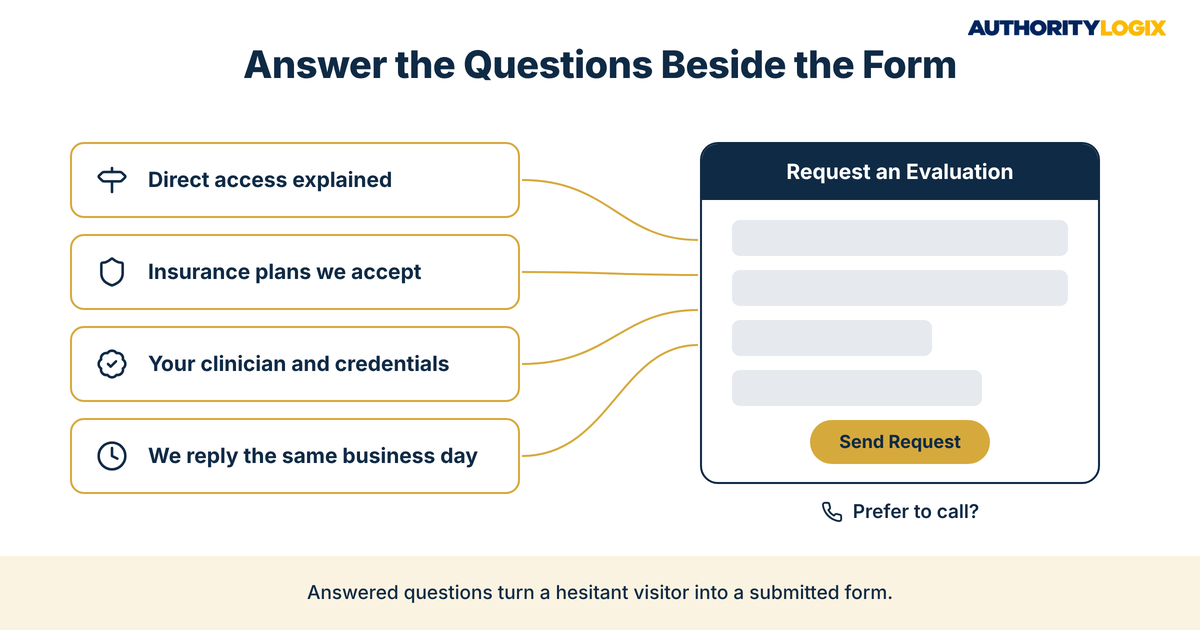
Direct-access patients arrive with questions a referred patient never asks. Do I need a doctor’s referral? Will my insurance cover a visit without one? Is this the right kind of clinic for my problem? PT contact form guidelines for this patient start with answering those questions right next to the form, before the patient has to decide whether to fill it in. For this patient, physical therapy website contact form conversion depends on those answers more than on the form design.
Trust is the deciding factor at that moment. A short block beside the form naming the clinicians, their credentials and what happens after the patient submits does more than any design trick, and the clinical authority guide covers how to present that expertise in plain language. The patient should know exactly who will call and when.
- State your direct-access policy in one plain sentence beside the form
- List the insurance plans you accept, or say how coverage is checked
- Say who will reply and how fast, such as the same business day
- Offer a phone number for patients who would rather talk than type
- Confirm every submission on screen and by text or email
These PT contact form guidelines also apply to patients who are not ready yet. A patient still deciding whether physical therapy fits their situation needs somewhere to keep reading, and an educational hub gives them that without pushing them toward a form too early. When they return, the form should feel like the obvious next step, and physical therapy website contact form conversion benefits from that patience.
Measuring Physical Therapy Website Contact Form Conversion and Follow-Up
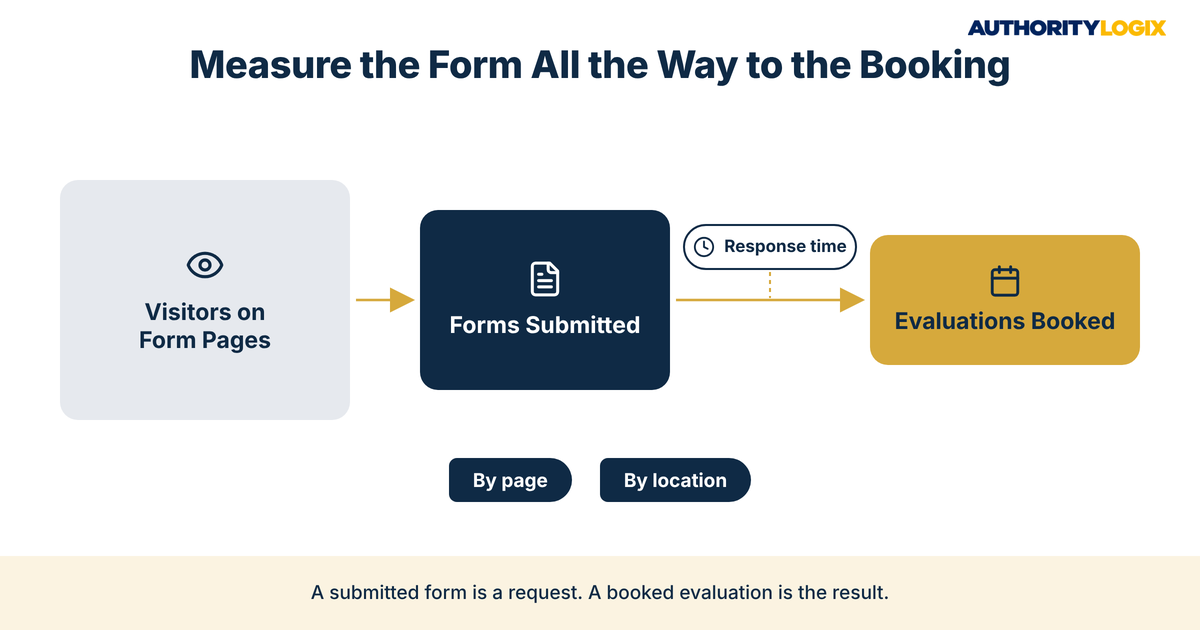
Measuring physical therapy website contact form conversion takes three numbers: visitors who reached a page with the form, forms submitted, and evaluations booked from those submissions. The first two come from website analytics and the third from the scheduling system. The third number is the one that matters, and it is the easiest to leave out.
Traffic sources change what a good rate looks like. A patient arriving from the map pack after reading your reviews is closer to booking than one arriving from a general article, and the local visibility guide covers how those local visits are earned. Comparing physical therapy website contact form conversion by source keeps the practice from fixing the wrong page.
Follow-Up Is Part of Physical Therapy Website Contact Form Conversion
A submitted form is a request, not a patient. If nobody calls back until the next afternoon, the patient may already have booked with the clinic whose phone was answered first. Physical therapy website contact form conversion should be measured to the booked evaluation, which makes response time part of the number.
Location data belongs in the same report. Multi-location practices should tag every form by clinic, because a strong rate at one site can hide a weak one at another, and local search visibility often differs by location as well. The report should show which clinic and which page produced each booked evaluation.
Over time, these numbers become a planning tool rather than a scorecard. The growth blueprint treats conversion data as one input into where a practice invests next. A practice that knows its physical therapy website contact form conversion by page and by location can decide where new content, new reviews or a new clinic will pay off.
What Most PT Practices Get Wrong About Contact Forms (and What Patients Hesitate Over)
Most problems with physical therapy website contact form conversion are not technical. They come from treating the form as a website feature instead of the first conversation with a new patient, and the questions below are the ones patients and practice owners raise most often.
As a patient, why does the form ask for my insurance before I know if I can come in?
Usually because the form was copied from an intake packet. Coverage questions are better answered on the page, with the carrier field left optional, so the patient can ask before committing. Required insurance fields can quietly lower physical therapy website contact form conversion for patients who simply do not have the card at hand.
Should we ask patients to describe their symptoms on the form?
Keep it to a general reason for the visit from a short list. Detailed health information belongs in a HIPAA-compliant intake process, not in a website form that sends an email to a shared inbox.
Is a phone number enough instead of a form?
Some patients will always call, but many search after office hours when nobody answers. Offering both a phone number and a short form means the practice catches the patient either way, and physical therapy website contact form conversion covers the after-hours patients a phone line misses.
Do reviews and mentions affect whether people fill in the form?
They shape the trust a patient brings to the form. A practice with recent reviews and clinicians mentioned in local media gets more patients who arrive ready to book, which is the job of authority distribution working well before the form appears. The form converts trust that was built elsewhere.
Where can practice owners see how forms fit the wider system?
Forms connect to local search, condition pages and education, and the full PT resource library covers each of those pieces in its own guide. Reading them in order makes it clear why physical therapy website contact form conversion rarely improves on form changes alone.
Ready to fix the forms, booking paths and follow-up that decide how many website visitors become evaluations? We build the conversion system that turns your website into a reliable source of new patients.
The Honest Close: A Better Form Fixes the Last Step, Not the Whole Funnel
A shorter, clearer form is one of the fastest improvements a PT practice can make, but it only fixes the last step. If the page above it does not rank, or the patient never trusted the practice in the first place, physical therapy website contact form conversion has nothing to work with. The order of work in how we build puts visibility, trust and the form in place together for that reason.
The expertise behind the practice is already there. That starting point is why AuthorityLogix builds around what your clinicians already know instead of replacing it with generic copy. Physical therapy website contact form conversion simply measures whether the form stops getting in the way of patients who have already decided.
The honest answer is that most PT practices do not lose these patients because of their care. They lose them at the last step, on a form that asks too much and answers too little, and that is one of the easier problems in the whole system to fix.