


Key Takeaways
- A physical therapy website content audit SEO review shows which service, condition, and clinician pages earn patient searches and which sit unseen.
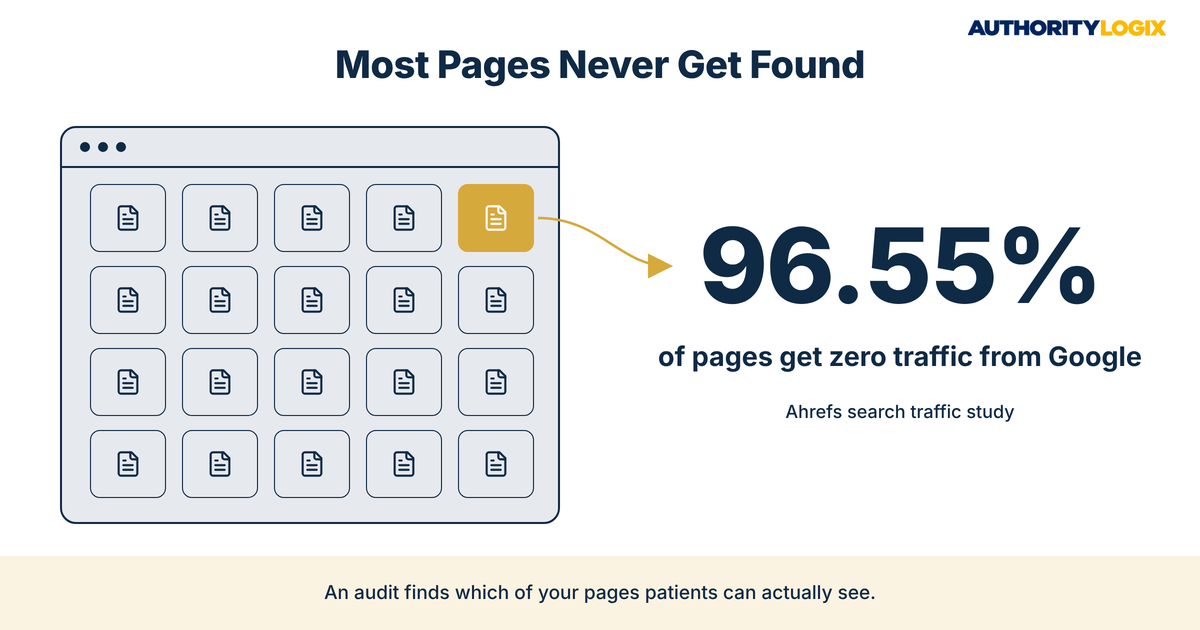
- Ahrefs’ search traffic study found that 96.55% of the roughly 14 billion pages in its index get zero traffic from Google, so a page existing is no guarantee anyone finds it.
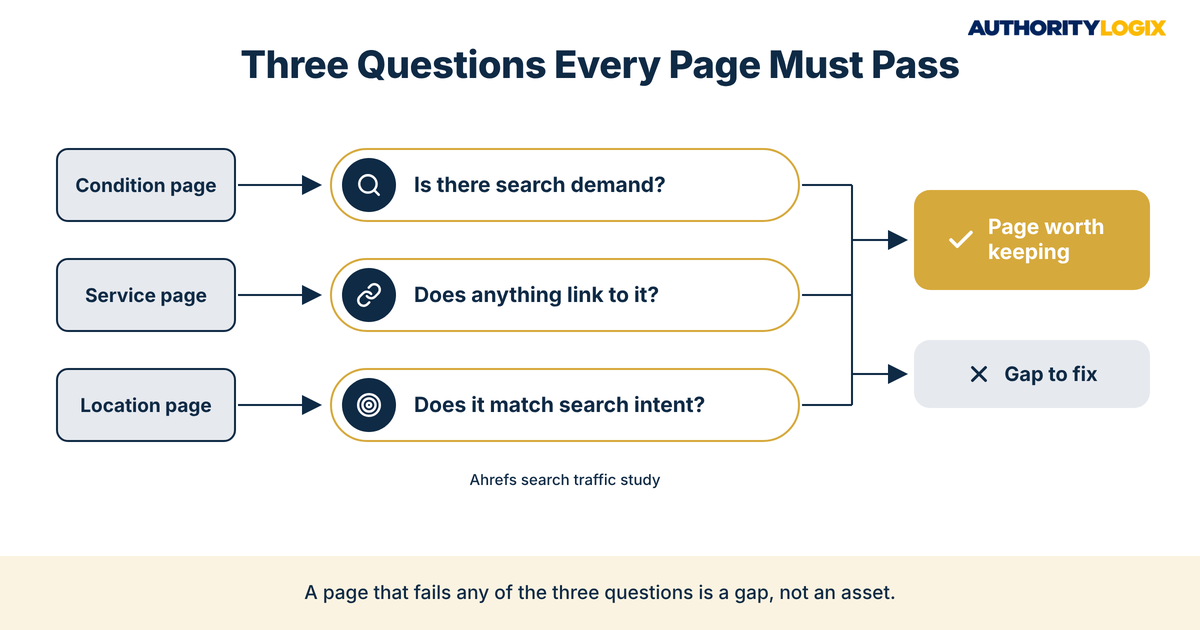
- Ahrefs names three common reasons a page gets no search traffic: the topic has no search demand, the page has no backlinks, or the page does not match search intent.
- Google’s people-first content guidance warns that removing older content mainly to lift rankings will not work, so a physical therapy website content audit SEO review decides what to keep, update, merge, or retire for the reader’s sake.
- A physical therapy SEO content gap analysis compares the conditions and services patients search for against the pages your site actually has.
- A physical therapy website content audit SEO project only pays off when every finding gets an owner, a fix, and a date.
Table of Contents
Why a Physical Therapy Website Content Audit SEO Review Comes Before New Content
A physical therapy website content audit SEO review is the step most practices skip on the way to publishing more. You have clinicians with years of sports, orthopedic, or pelvic health experience, a schedule that fills by word of mouth, and a website built once and left alone. Before anyone writes another post, someone needs to look at what is already there, because without a clear content SEO strategy behind it, every new page joins a pile nobody has measured.
Ahrefs’ search traffic study, published in December 2023, found that 96.55% of all pages in its index — about 14 billion pages — get zero traffic from Google, and another 1.94% get between one and ten monthly visits. Your clinic’s site likely carries pages in that first group, taking up maintenance time without producing evaluation bookings.
That is the credible but invisible pattern in website form: a practice respected by the physicians and patients who know it, and a site that says little a search engine can match to a real query. Direct access raises the stakes: APTA reports that as of July 1, 2025, all 50 states, the District of Columbia, and the U.S. Virgin Islands have either provisional or unrestricted direct access to physical therapist services for evaluation and treatment.
Patients who can book without a referral need a way to find you, which is why the work described across the AuthorityLogix PT industry hub begins with what the site already says. One referring doctor retires and the pipeline dries up overnight, and a physical therapy website content audit SEO review shows how ready your site is to replace that pipeline.
An audit is not a redesign. It is an inventory, a comparison against patient demand, and a ranked list of fixes, and the PT resource library covers the individual pieces those fixes touch.
The Physical Therapy Content & SEO Playbook lays out the content architecture a physical therapy website content audit SEO review measures your site against.
What a PT Website SEO Review Should Inventory: Service, Condition, and Clinician Pages
A PT website SEO review starts with a complete list of every URL the site publishes, not just the pages in the main menu. Most clinic sites carry more than the owner remembers: old event notices, duplicate location pages, bios for clinicians who left, and thin campaign posts. The physical therapy website content audit SEO inventory has to capture all of it before anyone judges what stays.
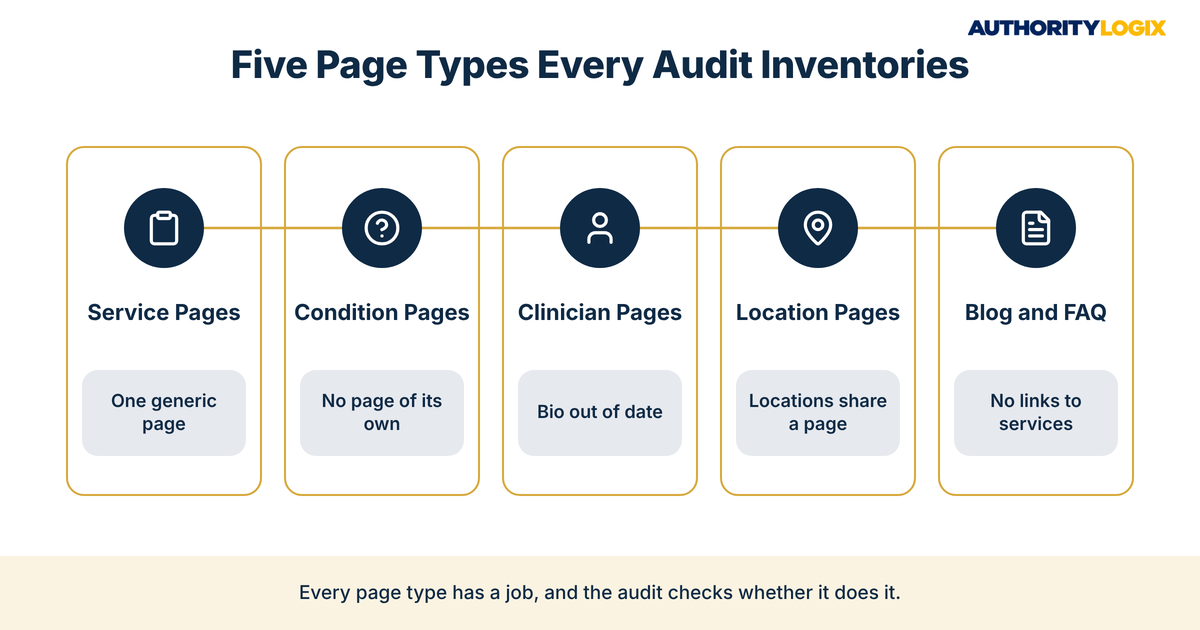
Group the inventory by page type, because each type has a different job in the site’s website structure. Service pages answer what you treat and how patients book, condition pages answer what a patient is experiencing, and clinician pages answer who will be in the room. Blog articles and FAQs support all three, but only when they link back to the pages that convert.
| Page Type | What the Physical Therapy Website Content Audit SEO Review Records | Common Gap Found |
|---|---|---|
| Service pages | Target search, last update, internal links, booking path | One generic services page covering every treatment |
| Condition pages | Condition named, patient questions answered, link to the matching service | Conditions listed in a bullet with no page of their own |
| Clinician pages | Credentials, specialties, photo, link to booking | Bios missing, thin, or out of date |
| Location pages | Address, hours, towns served, services offered at that site | Several locations sharing one page |
| Blog and FAQ content | Clicks, impressions, topic, date, links to services | Posts with no search traffic and no links to services |
Clinician Pages in a Physical Therapy Website Content Audit SEO Review
Clinician pages are where the audit most often finds expertise the market cannot see. A therapist with a board certification and years of sports rehab experience may appear on the site as a first name and a headshot. The trust signals described in the clinical authority guide — credentials, specialties, authorship on educational content — belong on those pages, and the audit should note every one that is missing.
Record each finding the same way across every page type: the URL, its purpose, its current search performance, and a proposed action. That consistency is what makes the later physical therapy website content audit SEO decisions fast instead of a page-by-page debate.
The PT Content Audit Process, Step by Step
The PT content audit process follows the same order every time, which keeps it from turning into an open-ended project. Each step feeds the next, and skipping one means redoing work later.
- Crawl the site and list every indexed URL, including old blog posts and orphaned pages.
- Pull search performance for each page from Google Search Console: clicks, impressions, and the queries it appears for.
- Tag each page by type and by the patient question it answers.
- Compare the inventory against the searches patients run for your services and conditions.
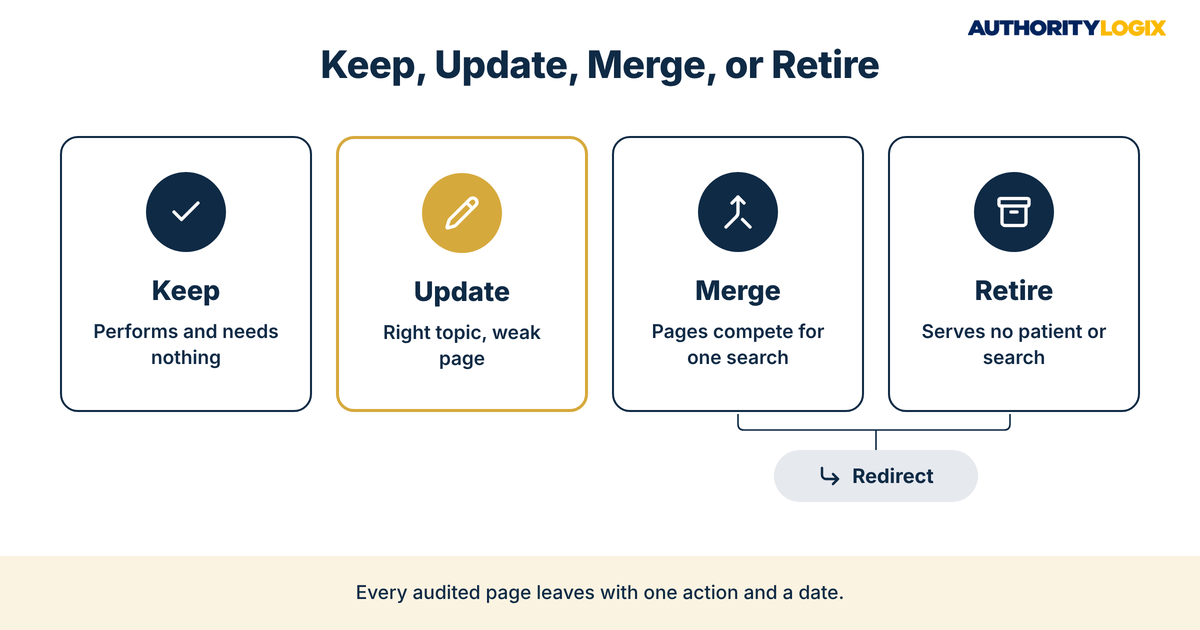
- Assign every page one action: keep, update, merge, or retire.
- Rank the fixes by patient impact and put dates on them.
Google’s Search Console documentation defines the two numbers that matter most in step two. Clicks are the number of times a user clicked your site from Google Search results, and impressions are how many times your site appeared in those results. Impressions with few clicks usually point to a title or description problem, while a page with neither points to a demand, link, or intent problem.
Define the four actions before you start, because the decision step is where most audits stall. Keep means the page performs; update means the topic is right but the page is weak; merge means pages compete for the same search; retire means the page serves no patient and no search. Practices with working content systems treat these labels as a standing queue, not a one-time cleanup.
Why a Physical Therapy Website Content Audit SEO Plan Is Not a Deletion Project
Google’s guidance on people-first content is direct on this point. It warns against removing a lot of older content primarily because you believe it will help your search rankings overall, and says that will not work. The same guidance asks whether a site is changing the date of pages to make them seem fresh when the content has not substantially changed — a shortcut Google calls out by name.
Sequence matters as much as the decisions. Fixes that touch booking paths and service pages go first, condition pages next, and supporting articles after that, which mirrors how we build authority infrastructure for clinics from the foundation outward. A physical therapy website content audit SEO plan that starts with the blog usually spends months polishing pages patients rarely see.
Not sure where your practice stands before a physical therapy website content audit SEO review? The PT Authority Gap Assessment shows which pages, profiles, and trust signals are weakest and what to fix first.
Running a Physical Therapy SEO Content Gap Analysis Against Patient Searches
A physical therapy SEO content gap analysis asks what patients are searching for that your site does not answer. The inventory shows what exists; the gap analysis shows what is missing, and a site can be clean and well organized yet absent from the searches that fill an evaluation schedule.
Start with the conditions and services your clinicians want more of, then list the ways patients describe them. A patient rarely searches for a clinical service name; they search for the problem, the activity they cannot do, or a clinic type near them. Mapping those searches to the stages of the patient journey in the acquisition playbook shows whether the site answers early research questions, comparison questions, and booking questions.
Ahrefs’ study gives the gap analysis its three test questions. According to Ahrefs, the most common reasons an indexed page earns no search traffic are that the topic has no search demand, the page has no backlinks, or the page does not match search intent. Run every existing and proposed page through those three questions, and the physical therapy website content audit SEO findings sort themselves.
Where a Physical Therapy SEO Content Gap Analysis Finds the Biggest Holes
Local searches are usually the largest hole. A patient typing a condition plus a town name expects a result from a clinic nearby, and if no location page names the town and its services, the gap analysis should flag it. That gap connects directly to local search work on the Google Business Profile, because the profile and the page reinforce each other.
The second common hole is education. Many patients read about a problem before they book, and a site with no condition library is invisible during that whole stretch. An educational hub built from the gap list — one page per condition patients ask about, written for patients and linked to the matching service — closes that hole in a planned order.
How to Fix What the Physical Therapy Website Content Audit SEO Review Finds
Every finding from the physical therapy website content audit SEO review falls into one of the four actions, and each action has its own repair pattern. Updates usually come first because they improve pages that already have search history.
An update rewrites the page around its patient question, names the clinician who wrote or reviewed it, and links it to the right service and condition pages. A merge folds competing pages into the strongest one and redirects the rest so search history carries over, and a retirement removes pages that serve no reader.
Location fixes deserve their own pass. Each location needs a page with a consistent name, address, and phone number, its services, and the towns it serves, matched to its Google Business Profile — the full checklist sits in the local visibility guide. Mismatched details are one of the quieter problems a physical therapy website content audit SEO review uncovers.
Then check every page for a next step. A condition page that answers the question well but offers no booking link, phone number, or screening request leaves the patient to find the way alone. The lead generation layer — booking paths and forms matched to each page type — is where the audit’s repairs turn into evaluations on the schedule.
AuthorityLogix applied this discipline to its own proof-of-concept first. BKDSCR.com, built in the NYC outer-borough DSCR real estate niche, runs on 18 pillar pages, 7 interactive investor tools, and 48 SEO-optimized blog posts, each with a defined job, and zero paid ads. The niche is different, but auditing every page against its job is exactly what a physical therapy website content audit SEO review does.
What Most PT Practices Get Wrong About Content Audits (and What Patients Notice)
Most audit mistakes come from treating the audit as a technical exercise. Patients never see a crawl report, but they notice every outdated bio, dead-end page, and conflicting phone number.
Will a prospective patient notice an outdated website?
Often, yes. A patient comparing clinics who finds a bio for a therapist who no longer works there, or a service the clinic stopped offering, starts to doubt the rest of the site before the first call. A physical therapy website content audit SEO review catches these because it reads every page, not just the ones that rank.
Is a physical therapy website content audit SEO review just a tool report?
No. Tools surface broken links, missing titles, and slow pages, but they cannot tell you whether a condition page answers what a worried patient actually asks. Treat the tool report as one input and the patient perspective as the other, which is the same balance the growth blueprint applies to the authority decisions a practice makes.
How often should a practice audit its website?
A full physical therapy website content audit SEO review once a year, plus a lighter quarterly check of top pages, keeps most clinic sites current. Pages tied to staff, hours, insurance, and locations need a check whenever those details change.
Does an audit help beyond the website?
It should. The audit shows which articles and condition pages are strong enough to share, and those become the material for authority distribution through newsletters, referral-partner updates, and professional platforms. Pages that fail the audit get fixed before they are promoted anywhere.
Can we skip the audit and just publish more?
Publishing more onto an unaudited site usually adds pages to the zero-traffic group. A physical therapy website content audit SEO review makes sure the next page fills a real gap.
Ready to turn your content audit findings into service, condition, and clinician pages that patients find and book from?
The Honest Truth: An Audit Only Pays Off If Someone Acts on It
Audits fail quietly. The findings get presented, and months later the same outdated bios and thin condition pages are still live because nobody owned the fixes. A physical therapy website content audit SEO project is only as valuable as the follow-through it produces.
That follow-through is a capacity problem, not a knowledge problem. Owners and clinic directors know their patients better than anyone; what they lack is time to rewrite a site’s worth of pages while running a schedule. Pairing clinician expertise with an outside build team is what we do for practices in that position.
We tested this on our own build before offering it to anyone, which is the short version of why AuthorityLogix works with PT practices on infrastructure instead of one-off content. The physical therapy website content audit SEO review is the map, and the repairs are the work.
The honest answer is that most PT practices already have the expertise patients are searching for. What is missing is a website that shows it, and a physical therapy website content audit SEO review is the clearest way to see exactly where that gap sits and what to fix first.