


Key Takeaways
- Physical therapy website speed mobile local rankings work decides whether a patient who finds your clinic on a phone stays to request an evaluation.
- Google Search Central recommends Core Web Vitals targets of LCP within 2.5 seconds, INP under 200 milliseconds, and CLS under 0.1.
- The HTTP Archive 2024 Web Almanac found 43% of websites had good Core Web Vitals on mobile, compared with 54% on desktop.
- Google data from 2016 found that 53% of mobile site visits abandon a page that takes longer than three seconds to load.
- Google lists relevance, distance, and prominence as the factors behind local ranking, so speed supports physical therapy website speed mobile local rankings but never replaces them.
- Physical therapy website speed mobile local rankings hold only when speed is built into the site as infrastructure.
Table of Contents

Physical therapy website speed mobile local rankings sound like a developer problem, but they show up on your schedule as evaluations that never got booked. You may have experienced clinicians and a solid reputation with local physicians, and still lose the direct-access patient who found you on a phone and gave up while the page loaded. The PT industry hub describes that pattern as credible but invisible: the expertise is real, but the version of the practice the market sees is slow.
How Physical Therapy Website Speed Mobile Local Rankings Connect to Evaluation Bookings
A direct-access patient with a sore shoulder rarely starts on a desktop. They search from a phone, tap a map listing, and land on your site to check insurance, hours, and whether you see their kind of problem. Physical therapy website speed mobile local rankings matter at exactly that moment, because the page either answers fast or the patient taps back to the next clinic on the list.
Google’s own data puts a number on that risk. Google data from March 2016 found that 53% of mobile site visits abandon a page that takes longer than three seconds to load. The data is a decade old and was not specific to healthcare, but it is why the acquisition playbook treats physical therapy website speed mobile local rankings as part of the patient pipeline rather than an IT afterthought.
Many clinics invest in local search through Business Profile work and review requests, then send that traffic to a mobile site that undercuts the profile. The listing earns the tap, and the page throws it away. Physical therapy website speed mobile local rankings work closes the gap between the listing and the page behind it.
Think of it as a chain: the listing earns the tap, the page earns the trust, and the booking path earns the evaluation. A clinic can rank well and still lose patients on the page, which is why the physical therapy website speed mobile local rankings conversation has to include conversion, not only position.
The Physical Therapy Local Visibility Guide maps every layer of local search for PT clinics, from profile and reviews to the technical foundation that physical therapy website speed mobile local rankings depend on.
PT Website Performance Local SEO: Where Clinic Sites Slow Down
Most slow clinic websites got that way one addition at a time: a chat widget, a booking plugin, an embedded map, a hero video, and tracking scripts from past vendors. Patients never see the code, but they feel it, and the pattern behind website abandonment on PT sites usually starts here. Together those add-ons turn PT website performance local SEO into a problem nobody owns.
| Site Element | Why It Slows the Page | The Infrastructure Fix |
|---|---|---|
| Full-width hero video | A large file loads before the headline | A static image sized for phones |
| Uncompressed treatment-room photos | The largest visible element arrives late | Images compressed before upload |
| Third-party booking widget | Extra scripts slow the response to taps | Load it on the booking page only |
| Leftover tracking tags | Code from past vendors runs on every page | A tag audit that removes what nobody uses |
The fix is rarely a single plugin. Speed holds only when the site is built to stay light: a short list of approved tools, images sized before upload, and new pages published from tested templates. That discipline belongs in the same content systems that produce your condition pages and clinician bios, so physical therapy website speed mobile local rankings are protected by one process instead of five vendors.
This is where PT website performance local SEO stops being a one-time cleanup. A site that passes speed tests in March often fails in September after a new widget, so physical therapy website speed mobile local rankings hold up only when every addition is checked first.

Physical Therapy Core Web Vitals: The Three Numbers Google Measures
Google Search Central publishes the targets in its Core Web Vitals documentation, last updated in December 2025: Largest Contentful Paint within 2.5 seconds, Interaction to Next Paint under 200 milliseconds, and Cumulative Layout Shift under 0.1. Google says meeting them, along with other page experience aspects, “aligns with what our core ranking systems seek to reward.” That is as direct as Google gets about physical therapy Core Web Vitals and search.
| Metric | What It Measures | Google Target | Mobile Sites With a Good Score (Web Almanac 2024) |
|---|---|---|---|
| LCP — Largest Contentful Paint | Loading performance | Within 2.5 seconds | 59% |
| INP — Interaction to Next Paint | Responsiveness | Under 200 milliseconds | 74% |
| CLS — Cumulative Layout Shift | Visual stability | Under 0.1 | 79% |
Each number maps to something a patient feels. LCP is how long the main content takes to show up, INP is how quickly the page reacts when someone taps “Request an Appointment,” and CLS is whether the page jumps while it loads. That jump is how a patient aiming for your phone number taps a banner.
The HTTP Archive 2024 Web Almanac found that only 43% of websites had good Core Web Vitals on mobile, compared with 54% on desktop. LCP had the lowest mobile pass rate of the three at 59%, which points to loading as the usual weak spot for physical therapy website speed mobile local rankings. On clinic sites the pages hit hardest are often in the educational hub, where image-heavy articles pile up and nobody rechecks the template.
Speed does not compete with depth. A detailed clinician-written page on running-related knee pain can load as fast as a thin one if images are sized and the template is lean. The clinical authority guide covers what those pages should say; physical therapy Core Web Vitals decide whether patients stay long enough to read them.
Where to Check Your Physical Therapy Core Web Vitals
Google tells site owners to check the Core Web Vitals report in Search Console, which shows how your pages perform. Pull it up for your location pages and booking page first, since those carry the patients closest to calling. A physical therapy website speed mobile local rankings review that starts with the homepage often misses the pages that matter most.
Not sure how your clinic website performs on your patients’ phones? The PT Authority Gap Assessment shows where speed, mobile structure, and local signals may be costing you bookings.
PT Mobile Site Speed Rankings and the Patient on a Phone
Google uses the mobile version of a site’s content, crawled with the smartphone agent, for indexing and ranking. If a page is fast on the front desk computer and slow on an older phone, the slow version is the one being judged. PT mobile site speed rankings are earned on the phone, and physical therapy website speed mobile local rankings should be tested there first.
Why Physical Therapy Website Speed Mobile Local Rankings Problems Hide on Desktop
Practice owners usually review their own site on a laptop over office Wi-Fi, which is the most forgiving test possible. The 2024 Web Almanac concluded that the difference between mobile and desktop experiences remains large, so the version you approve is rarely the version your patients load. These problems stay hidden until someone tests on a phone over a cellular connection.
Mobile speed is partly a structure decision. A clean hierarchy of location pages, service pages, condition pages, and clinician bios lets each page carry only what it needs, while an overloaded homepage makes every visitor download everything. Good site structure keeps physical therapy website speed mobile local rankings manageable because no single page has to do every job.
Structure also shapes how Google reads the site. A location page that answers one local question is easier to keep fast and easier to match to a search than one page aimed at every town. The content SEO playbook covers the keyword side of that architecture, while physical therapy website speed mobile local rankings work keeps each page light.
Then there is the booking path itself. Some clinics route the “Request an Appointment” button to a third-party scheduling page that loads slowly on mobile and asks for too much information. Your lead generation infrastructure is only as fast as its slowest step, so the form and the call button deserve the same testing as the homepage.

A Physical Therapy Website Speed Mobile Local Rankings Checklist for Booking Pages
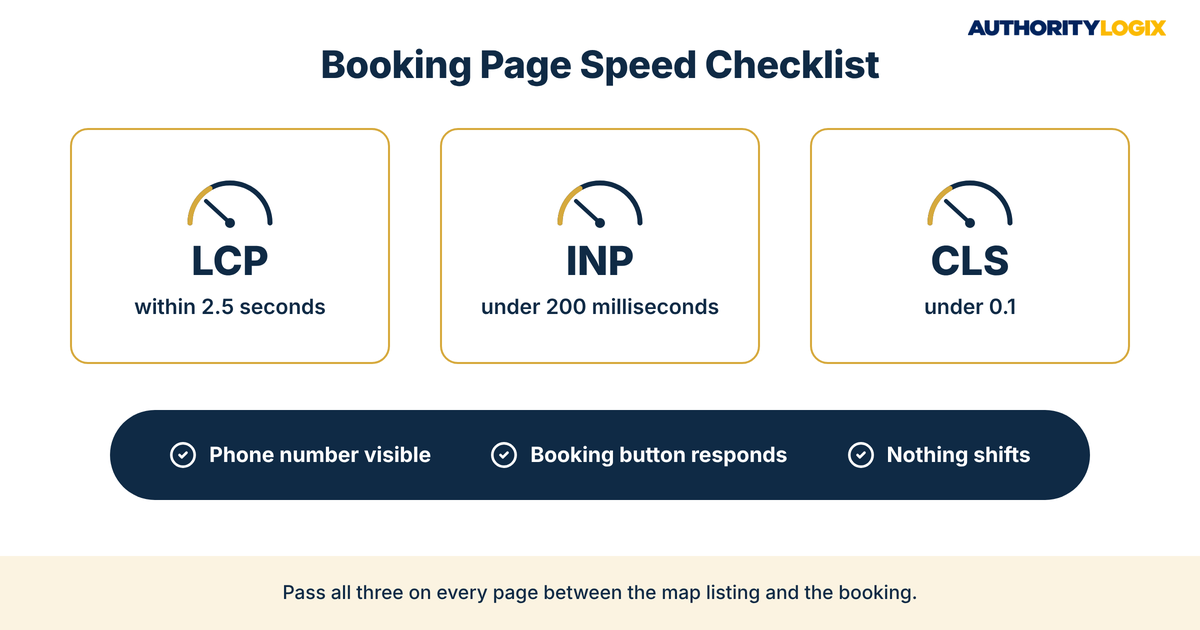
Start with the pages a new patient touches between the map listing and the booking confirmation, because that path is where physical therapy website speed mobile local rankings turn into evaluations or lost calls. Run each check on a phone over a cellular connection.
- The headline and phone number appear within 2.5 seconds, Google’s LCP target.
- Tapping “Request an Appointment” responds inside Google’s INP target of under 200 milliseconds.
- Nothing shifts as the page loads, with CLS under 0.1.
- Address, hours, and accepted insurance are visible without a carousel.
- The click-to-call button works and the form asks only for what the front desk needs.
- No intrusive pop-up covers the content on arrival.
What to Fix First When a Booking Page Fails
If the page fails LCP, start with images and anything that loads above the headline. If it fails INP, look at scripts, because chat tools, booking widgets, and tracking tags usually carry the most code. If it fails CLS, reserve space for images, banners, and embedded maps so nothing pushes the content down.
The checklist applies to more than your own site. Directory listings, partner pages, and articles published through authority distribution all send patients to a landing page, and physical therapy website speed mobile local rankings depend on that page meeting the same standard. A strong mention that lands patients on a slow page wastes the visibility it earned.
Run the checklist every quarter, not once. Each new template, plugin, and tracking tag can move the numbers, and the PT resource library covers the content side of what gets added over time. A physical therapy website speed mobile local rankings audit on a quarterly schedule catches the drift before it shows up in Search Console.
What Most PT Practices Get Wrong About Site Speed
Most practice owners who struggle with site speed are not ignoring it. They are working from assumptions that sound reasonable but cost them quietly. These are the questions owners and prospective patients raise most often.
Will a faster website guarantee more evaluation bookings?
No, and anyone who promises that is guessing. Speed removes a reason to leave; it does not create a reason to book. Your reviews, your clinician credentials, and pages that answer the patient’s question still do that work.
Does a slow website push my clinic out of the map pack?
Google’s Business Profile help page lists relevance, distance, and prominence as the factors that determine local ranking, and page speed is not one of the factors it describes. A slow site hurts physical therapy website speed mobile local rankings in other ways: through the organic results, where Google says Core Web Vitals are used by its ranking systems, and through patients who leave before calling.
Is a perfect PageSpeed score the goal?
No. Google’s targets are thresholds, not a contest, so pass LCP, INP, and CLS on the pages that matter and put the remaining effort into content and reviews. Chasing a perfect lab score on a page nobody visits is time that physical therapy website speed mobile local rankings work should spend on the booking path.
Should we rebuild the whole website or fix the key pages first?
Fix the patient path first: location pages, the booking page, and the top condition pages. A rebuild makes sense when the platform itself is the bottleneck, and the growth blueprint covers how to time that decision against your other visibility investments. Often the culprit is a few heavy plugins rather than a broken platform.
Who should own site speed inside a PT practice?
Not your front desk, and not your clinicians. Physical therapy website speed mobile local rankings need an owner who reviews every new tool, image, and page before it goes live, which is part of what we do for practices with the clinical reputation but not the infrastructure behind it. Your team keeps caring for patients while the system keeps the site fast.
Ready for a fast, mobile-first clinic website built to turn local searches into evaluation requests? Let’s map the pages, speed fixes, and booking path your locations need.
How Much Speed Matters Next to Relevance and Reviews
Here is the honest weighting. Google says Search “always seeks to show the most relevant content, even if the page experience is sub-par,” and that a great page experience can contribute to success when there is lots of helpful content available. Local PT searches often look like that, with several nearby clinics offering similar services.
So speed is a tiebreaker and a conversion tool, not a substitute. A slow site with excellent reviews and strong condition pages can still outrank a fast site with nothing to say, while a fast site with both earns its advantage twice.
That is why physical therapy website speed mobile local rankings work belongs inside the larger build rather than standing alone. In our build process, the technical foundation of templates, image handling, and script limits goes in before content is published, so every page that follows starts fast instead of being repaired later.
AuthorityLogix built BKDSCR.com, its own proof-of-concept platform in the NYC DSCR real estate niche, the same way: 18 pillar pages, 7 interactive investor tools, and 48 blog posts, with zero paid ads, in under 18 months. That build is a large part of why AuthorityLogix talks about infrastructure from experience rather than theory.
The honest answer is that most PT practices already have the clinical expertise patients are searching for. What slows them down is a website that was assembled rather than built, and physical therapy website speed mobile local rankings improve when the site becomes infrastructure instead of a collection of add-ons.