


Key Takeaways
- Physical therapy practice differentiation beyond location and insurance is the strategic work that separates practices patients choose from practices patients settle for — and in a market where most PT clinics accept similar insurance panels, are located within reasonable distance of each other, and offer the same general services, the practice that has built a visible differentiator wins the patient that convenience alone cannot decide.
- Many patients prefer clinicians who specialize in their condition — making clinical specialization the single most powerful differentiator available to an independent PT practice, and the one most directly tied to patient choice at the moment of provider selection.
- Without clear differentiation, independent practices become interchangeable commodities where patients select based primarily on location and insurance acceptance — a race to the bottom that undermines long-term practice sustainability, per healthcare branding research from Helms Workshop.
- The five dimensions of PT practice differentiation are: clinical specialization, brand messaging clarity, patient experience design, community authority signals, and content-based expertise visibility. Each addresses a different stage of the patient’s decision process — from first search through word-of-mouth referral.
- Consumers are 2 to 3 times more likely to trust healthcare ads featuring real, named clinicians over branded creative alone, per Healthcare Success 2026 — which means differentiation through individual clinician expertise is not a soft branding choice but a measurable patient conversion lever.
- Sports and neurologic specialization have both grown steadily in recent years — the specialty areas that practices are building differentiation around are the same areas where patient demand is growing fastest.
- Effective PT practice differentiation is not about claiming to be ‘the best’ — it is about being the most visibly specific choice for a defined patient population in a defined clinical area, communicated consistently across every touchpoint where patients and referral sources evaluate the practice.
Table of Contents
Physical therapy practice differentiation is the strategic process of making a PT practice the obvious choice for a specific patient population — not just a convenient option among several similar clinics. In a market where location, insurance acceptance, and standard PT services are table-stakes that every competing clinic can match, differentiation is what creates patient preference before a phone call is made. The practices that compete on convenience alone are in a permanent race against the clinic that opens next door. The practices that have built genuine differentiation compete on a different dimension entirely — one that neither proximity nor price can displace.
This article covers the five dimensions of physical therapy practice differentiation that move a practice from commodity to clear choice: clinical specialization, brand messaging clarity, patient experience design, community authority signals, and content-based expertise visibility. Each dimension addresses a different stage of how patients evaluate PT practices. The authority growth article covers the five-pillar authority system that underpins differentiation; this article focuses specifically on the differentiation logic — the specific choices that make a practice distinctively positioned in a competitive local market.
Why Physical Therapy Practice Differentiation Is a Structural Requirement in 2026
The commodity trap in physical therapy is well-documented. Without clear differentiation, independent practices become interchangeable in the patient’s perception — selected primarily on location and insurance acceptance. When patients cannot identify a meaningful difference between two PT clinics, they default to whichever is closer, cheaper, or has more recent reviews. That dynamic rewards scale — the multi-location chain with more convenient locations and better name recognition — not clinical quality. Independent practices that have not built a visible differentiator are competing on a dimension they are structurally disadvantaged on.
Many patients prefer clinicians who specialize in their condition. That preference is a choice point — the patient who wants a vestibular specialist will bypass a closer, insurance-matched generalist to find one. Clinical specialization converts the practice from a convenience choice into a preference choice — and preference-driven patients are more likely to complete treatment, refer others, and return for future episodes of care.
Named clinicians featured in healthcare ads make consumers 2 to 3 times more likely to trust the ad than branded creative alone, per Healthcare Success 2026 predictions. AI search systems now consistently favor content attributed to named, credentialed clinicians over anonymous practice-level content.
The acquisition playbook covers how differentiation connects to the full patient acquisition pipeline — this article covers the specific differentiation choices that make that pipeline selective rather than indiscriminate. A pipeline that attracts everyone usually converts no one especially well.

Explore the AuthorityLogix PT Practice Authority & Growth Blueprint.
Dimension 1: Clinical Specialization — The Foundation of Physical Therapy Practice Differentiation
Clinical specialization is the most durable form of physical therapy practice differentiation because it is the hardest for competitors to replicate quickly and the most directly connected to patient preference. Sports and neurologic specialization have both grown steadily in recent years — the specialties that practices are differentiating around are the same areas where patient demand is growing fastest.
Specialization works as a differentiation strategy because it is specific enough to be believable. ‘We treat all conditions’ is not a differentiator — it is a description of every PT clinic. ‘We specialize in vestibular rehabilitation for patients with BPPV, vestibular migraine, and chronic dizziness’ is a differentiator — it is specific enough that the patient who searches ‘vestibular physical therapy [city]’ can immediately identify this practice as the relevant choice. The authority guide covers how condition-specific expertise is expressed through E-E-A-T content — the attribution and evidence standards that make clinical specialization credible to both patients and search engines.
How to Select Specialization for Physical Therapy Practice Differentiation
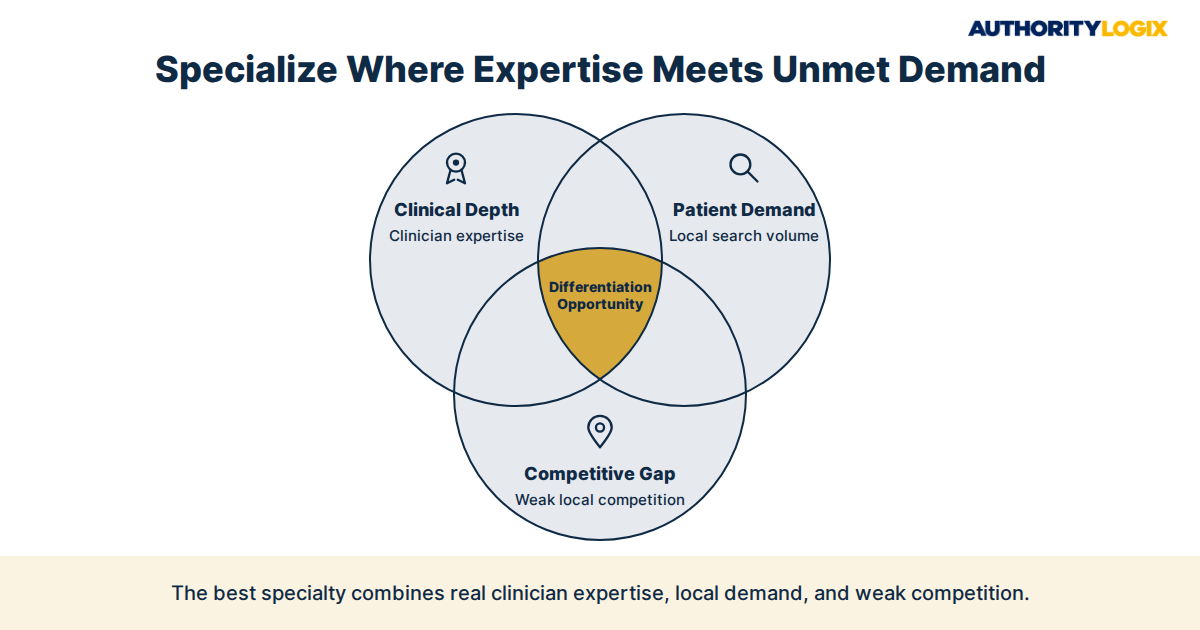
Specialization selection should be driven by three intersecting factors: the conditions the practice’s clinicians have the deepest genuine expertise in, the conditions the local patient population searches for most frequently, and the conditions where local competition is weakest or least differentiated. A practice with a pelvic floor certified PT in a market where no other clinic has published pelvic floor content has found its differentiation.
The specialty the practice already has deep expertise in, combined with the gap in the local market, is the differentiation opportunity. The local authority article covers how specialization is expressed through local search signals — the GBP signals, location page content, and condition queries that make specialty expertise visible to patients searching in the practice’s geography.
Dimension 2: Brand Messaging Clarity — Saying One Thing That Sticks
Brand messaging clarity is the dimension of physical therapy practice differentiation that determines whether a patient who finds the practice can immediately understand why it is the right choice for them. Most PT practice websites communicate the same message in different fonts: ‘We are passionate about helping you reach your goals.’ That message does not differentiate — it describes every PT clinic.
A practice with clear brand messaging communicates a specific value proposition in the first sentence of every patient touchpoint: ‘We specialize in post-surgical shoulder recovery for patients referred by local orthopedic surgeons.’ The content systems built for PT practices organize brand messaging into a consistent voice that appears across every piece of content, every service page, and every patient communication — ensuring the differentiating message is never diluted by generic wellness copy.
The Three Elements of Differentiating Brand Messaging
Differentiating brand messaging for a PT practice has three components: the specialty anchor (what clinical area the practice is specifically known for), the patient definition (who the practice serves most effectively — athletes, post-surgical patients, older adults with balance issues, new mothers), and the outcome promise (what the practice helps its defined patient population accomplish — return to sport, recover from surgery without complications, eliminate chronic pain without opioids). Leaving any one of the three vague is usually enough to make the whole message forgettable.
Each of these three elements should appear in the practice’s headline, meta description, GBP description, and the opening paragraph of every condition page. Consistent repetition across every patient touchpoint is what builds the brand memory that makes the practice the first choice when a patient’s specific situation matches the practice’s specific positioning.
Brand messaging clarity also determines how a practice is described in referral conversations. A physician who refers to a practice as ‘the PT clinic on Main Street’ is delivering a location descriptor, not a differentiator. A physician who refers to a practice as ‘the PT clinic that specializes in rotator cuff rehabilitation — they have a great track record with my post-surgical shoulder patients’ is delivering a differentiated referral. The distribution system amplifies that messaging through external syndication channels — ensuring the practice’s differentiating message reaches physicians, community members, and online audiences beyond the practice’s own website.
Not sure how your practice’s current messaging compares to local competitors?
Dimension 3: Patient Experience Design — Differentiation at Every Touchpoint
Patient experience design is the dimension of physical therapy practice differentiation that operates after a patient has chosen the practice — and that determines whether that patient refers others, leaves a positive review, and returns for future care. A practice that has invested in clinical specialization and brand messaging clarity but delivers a generic patient experience is differentiating at the top of the funnel and losing the benefit at the bottom. The lead generation system connects patient experience design to the conversion infrastructure — ensuring that each stage of the patient journey, from first inquiry through final discharge, is structured to produce the review, the referral, and the rebooking.
The Patient Journey as a Differentiation Asset
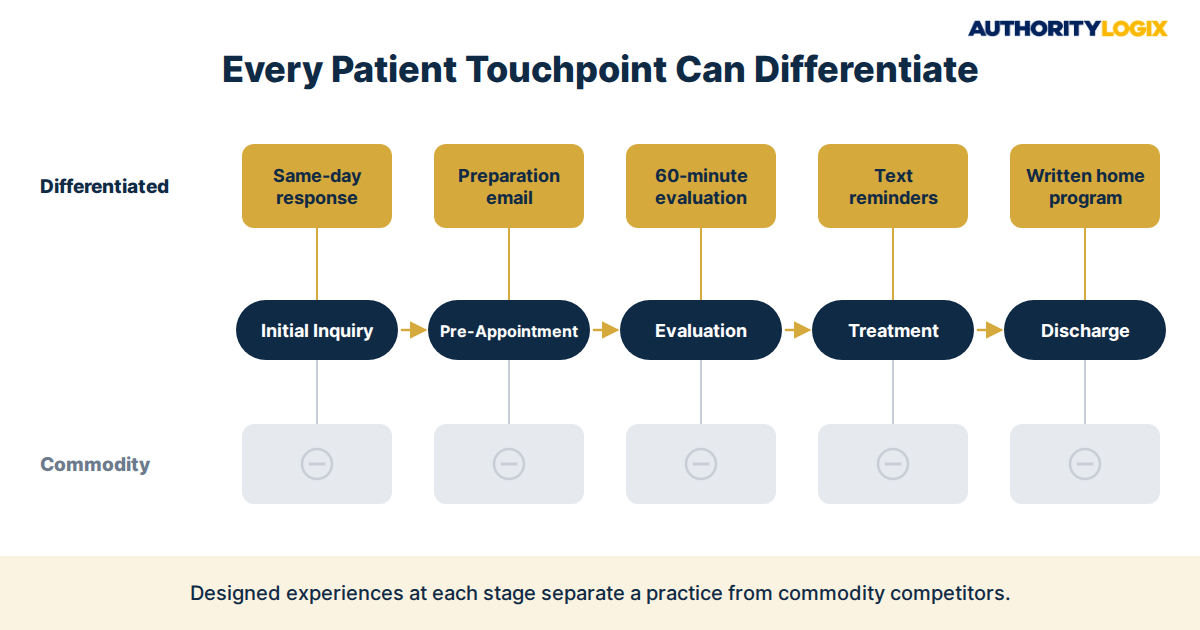
Every touchpoint in the patient journey is a differentiation opportunity: the response time and quality of the initial inquiry (a same-day response with specific clinical information differentiates immediately from a next-day callback with a generic message), and the intake process (a pre-appointment email explaining what the first session will involve and what to bring reduces patient anxiety and signals clinical organization). Patients notice these details even when they can’t articulate why one practice felt more organized than another.
The first session structure matters too — a 60-minute evaluation that ends with a clear written plan differentiates from a rushed 30-minute session with vague next steps — and so does the discharge process: a written home exercise program with video demonstrations and a follow-up call at two weeks differentiates from a verbal summary and a business card. None of these require additional clinical skill — they require intentional design of the patient experience as a system rather than a series of unconnected interactions.
Patient experience differentiation is increasingly connected to digital touchpoints. A practice that provides patients with a secure portal for scheduling, communicates via text with appointment reminders, and follows up after discharge with an educational resource specific to the patient’s condition is delivering a patient experience that the average PT clinic is not. The educational hub organizes the patient education content that makes post-discharge follow-up substantive rather than perfunctory — condition-specific articles, home exercise guides, and progress FAQs that extend the patient relationship beyond the final session.
Dimensions 4 and 5: Community Authority and Content Visibility
Dimension 4: Community Authority Signals
Community authority signals are the external evidence that confirms a PT practice’s differentiation to patients and referral sources who encounter the practice through channels other than its own website. A practice covered in local health publications, listed in the APTA specialist directory, with a named clinician who has presented at a local healthcare event, or referenced in physician communications has built external authority signals that third parties use to validate the practice’s self-described differentiation. Self-reported differentiation is less credible than third-party-confirmed differentiation. The local search system governs the external directory presence and citation consistency that makes community authority signals findable and attributable.
Dimension 5: Content-Based Expertise Visibility
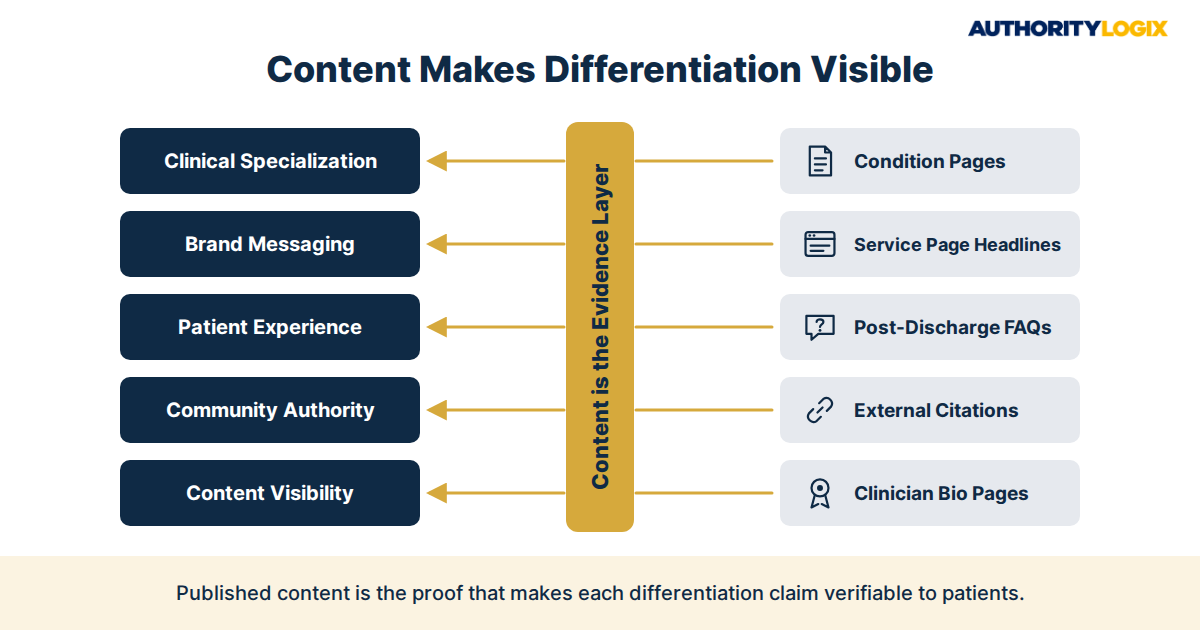
Content-based expertise visibility is the dimension of physical therapy practice differentiation that makes specialization searchable — the condition pages, clinician-authored articles, patient education content, and FAQ sections that allow patients to evaluate the practice’s clinical depth before booking. A practice that specializes in pelvic floor rehabilitation but has no patient-facing content on pelvic floor conditions is invisible to the patients searching for that specialty online.
Content is the evidence layer that proves specialization — not by claiming it, but by demonstrating it at sufficient depth that patients and search engines both recognize it as genuine expertise. The content playbook covers the full content SEO strategy — keyword targeting, pillar-cluster architecture, and the clinician attribution standards that make specialty expertise visible in search results and AI Overview citations.
Content visibility reinforces every other differentiation dimension simultaneously. A specialization-anchored condition page builds the E-E-A-T signal that supports local search rankings. A clinician-authored patient education article builds the brand messaging consistency that makes physician referrals more specific. A post-discharge FAQ section builds the patient experience that generates reviews. The visibility guide covers the local search signals that connect content-based expertise to the geographic patient population it is designed to serve — ensuring content differentiation translates into local patient acquisition.
The PT industry hub demonstrates how the five-system framework — content, local search, patient education, lead generation, and authority distribution — operates as a coordinated system when all five differentiation dimensions are built simultaneously. Each system reinforces the others rather than operating in isolation.
Frequently Asked Questions
Can a PT practice differentiate without changing its clinical services?
Yes — most PT practices already have genuine clinical differentiation that is not visible to patients or referral sources. A practice whose therapists have certifications in sports medicine, pelvic floor therapy, or vestibular rehabilitation but whose website only lists ‘physical therapy services’ has hidden its differentiation. The first step for most practices is not adding new clinical capabilities — it is making existing capabilities visible through condition pages, clinician bio pages, and brand messaging that names the specialty. The authority guide covers the specific content formats that make clinical credentials visible as patient-facing expertise rather than internal HR records.
How does differentiation affect physician referral volume?
Physicians refer to specialists — practices they associate with specific clinical expertise for specific patient types. A physician who perceives a PT practice as a general outpatient clinic sends general outpatient referrals, when they send any at all. A physician who perceives a PT practice as the local specialist in post-surgical shoulder recovery sends shoulder surgery referrals systematically. Differentiation changes the referral relationship from transactional to specialty-matched — and specialty-matched referrals are higher value, higher completion rate, and more likely to generate additional referrals from the same physician over time.
What is the most common differentiation mistake PT practices make?
Claiming differentiation without evidence. A practice that states ‘we provide individualized care’ or ‘our therapists are passionate about your recovery’ has described its intent, not its differentiation. Patients and physicians evaluate differentiation through evidence — credentials listed, conditions named, patient education published, clinician expertise visible, reviews specific to clinical outcomes. The mistake is investing in positioning language without investing in the content, credentials, and visibility that make the positioning credible. Differentiation that patients cannot verify is marketing noise, not competitive advantage.
How does differentiation connect to practice valuation?
A differentiated practice is worth more to acquirers and partners than a generalist practice with equivalent revenue. Specialty expertise, a documented patient population, and content-based visibility create patient acquisition channels that operate independently of the owner — reducing the key-person dependency that PE buyers and strategic acquirers discount heavily. A practice that has built genuine specialty differentiation, documented in content, verified in credentials, and confirmed in patient reviews, is demonstrating the operational durability that commands premium multiples in the current acquisition market.
Should every PT practice try to differentiate on specialty?
Specialty differentiation is the most powerful form, but not the only viable form. A practice in a geography with low PT density can differentiate on access — appointment availability, same-week scheduling, extended hours — because access is genuinely scarce for its patient population. A practice serving a specific community can differentiate on cultural competency and community embeddedness. The differentiator that works is the one that is genuinely true about the practice, genuinely scarce in the local market, and genuinely valued by the patient population the practice wants to attract. The content systems built for PT practices ensure that whichever differentiator the practice chooses is expressed consistently across every content asset and patient touchpoint.
Want to stand out on something other than location, insurance and a list of services?