


Key Takeaways
- A patient who searches what to expect first physical therapy appointment is often past the question of whether to get help and on to the question of where.
- HubSpot’s 2026 State of Marketing reports that consumers reach websites later in the process, better educated and with higher intent.
- APTA reports that as of July 1, 2025, all 50 states have provisional or unrestricted direct access to physical therapist services.
- PT first appointment patient education covers paperwork, timing, clothing, and insurance — the questions that leave patients unsure whether to book.
- PT first visit anxiety reduction content explains the process in plain language and never promises a clinical result.
- A clear what to expect first physical therapy appointment page is infrastructure: it answers the same questions every day and feeds the booking flow.
Table of Contents
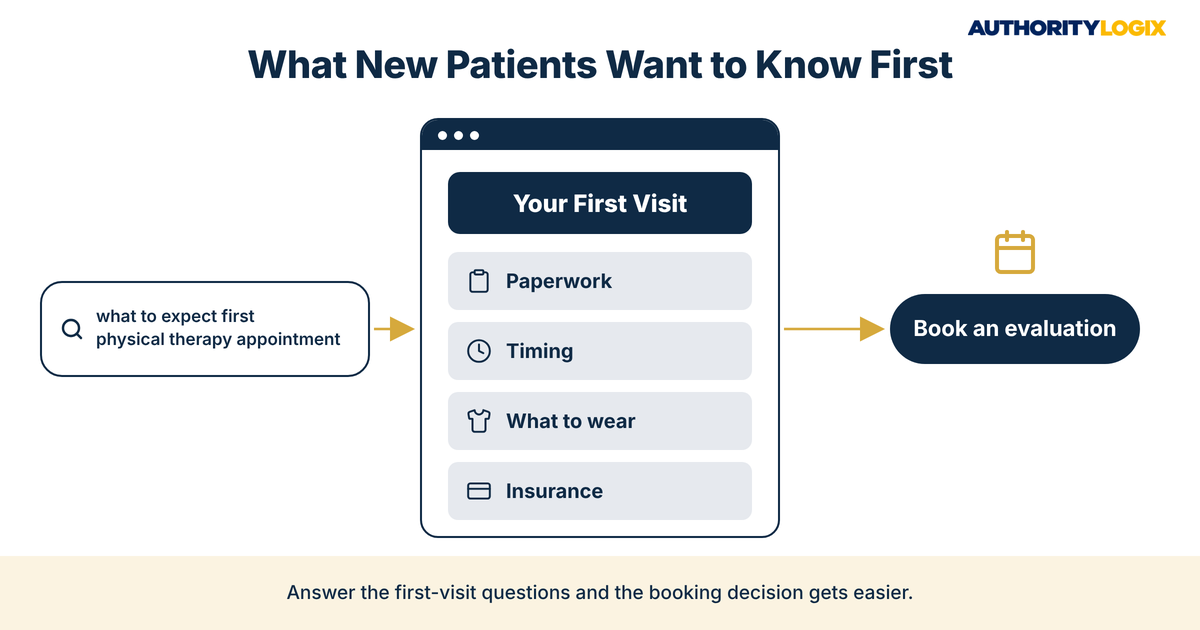
“What to expect first physical therapy appointment” is one of the most practical searches a new patient runs, and many practice websites answer it with one sentence or not at all. The patient typing it has often decided to get help; what they have not decided is where. That decision is the start of the pipeline mapped in the acquisition playbook, and the practice that explains the first visit clearly is the one a patient can picture walking into.
You may have run thousands of evaluations and know exactly how the visit unfolds. The patient does not, and the gap between what you know and what they can see is the credible but invisible problem in its most everyday form. A what to expect first physical therapy appointment page closes that gap before the phone rings.
Why “What to Expect First Physical Therapy Appointment” Searches Decide Evaluation Bookings
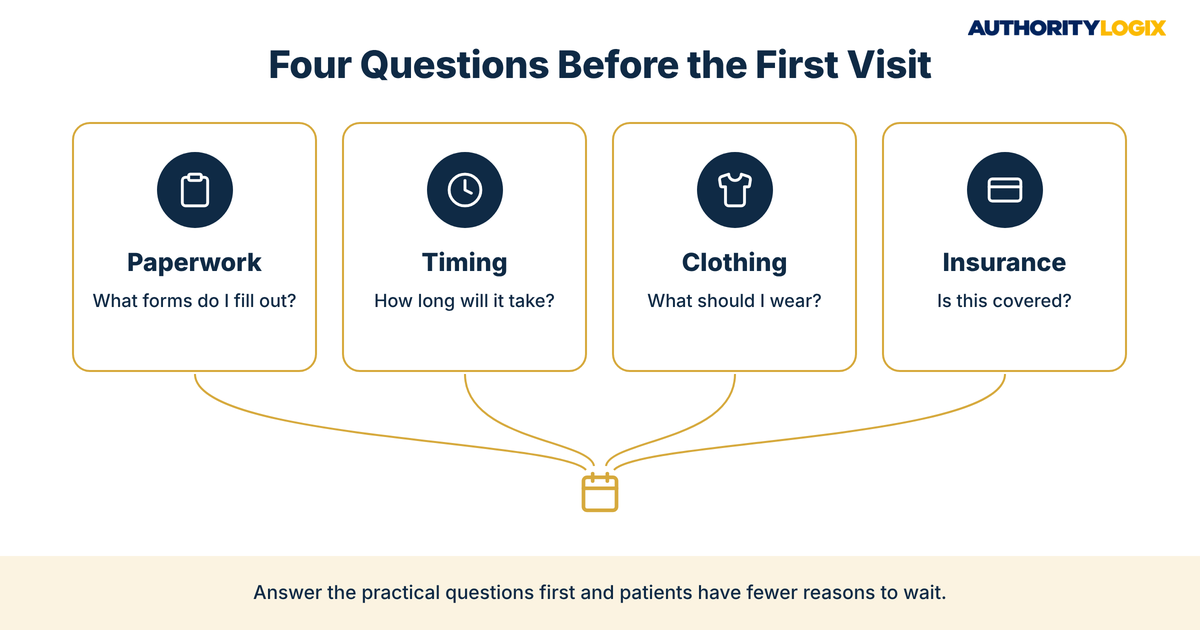
Uncertainty is a quiet reason patients put off booking. They wonder what to wear, how long it takes, whether insurance covers it, and whether they will be asked to do something they cannot do. None of those questions is clinical, but each one can become a reason to wait, and a what to expect first physical therapy appointment page answers them before that happens.
Search behavior makes this page more important. HubSpot’s 2026 State of Marketing report, based on a survey of more than 1,500 marketers, says “Consumers are seeking top-of-the-funnel information in AI search summaries, not your website.” The same report says websites still matter, but consumers will come later in the process, better educated and with higher intent, and the visitor who lands on your what to expect first physical therapy appointment page often fits that description.
That visitor needs the page to do conversion work. A clear explanation of the first visit followed by a booking button is the simplest form of lead generation a practice can build. Without it, the patient goes back to the results and reads another clinic’s version.
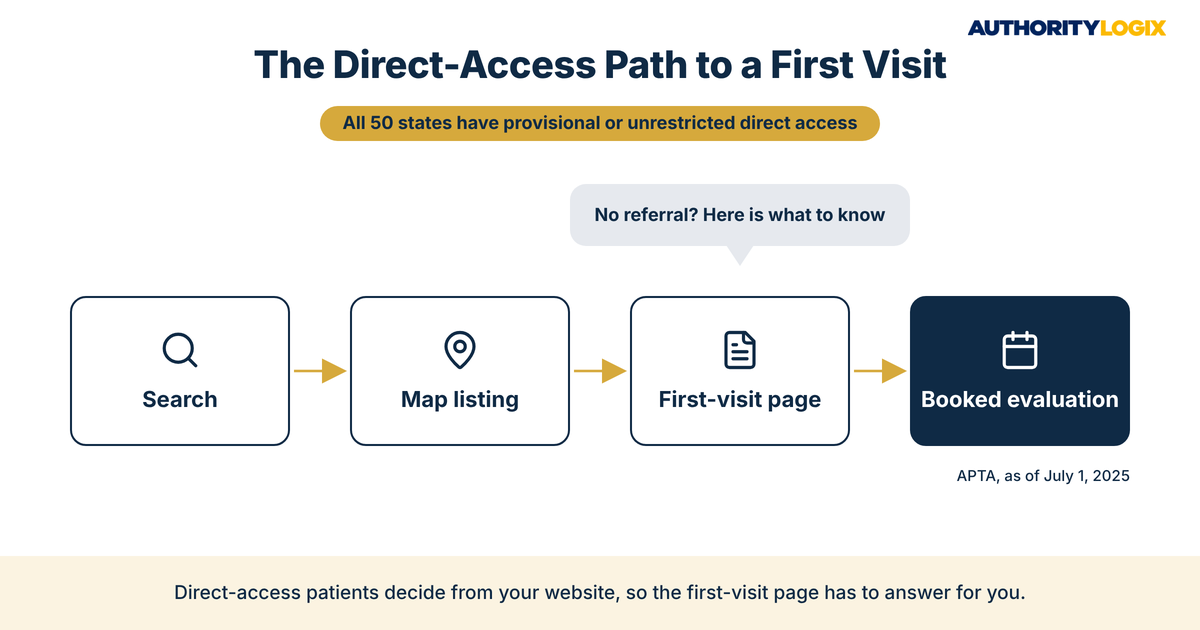
Direct access widens the audience for this page. APTA reports that as of July 1, 2025, all 50 states, the District of Columbia, and the U.S. Virgin Islands have either provisional or unrestricted direct access to physical therapist services for evaluation and treatment, though some states still limit treatment without a referral. Patients who book without a referral rely on your website for answers, which is why the PT industry hub treats first-visit education as part of the core build.
The Physical Therapy Patient Education & Clinical Authority Guide shows how a what to expect first physical therapy appointment page fits with condition pages, clinician bios, and patient FAQs in one trust-building system.
What New Patients Want Explained: Paperwork, Timing, Clothing and Insurance
The questions new patients bring to a what to expect first physical therapy appointment search are practical, and they repeat from clinic to clinic. Front-desk staff hear them every day, which makes the front desk the best research source for this page.
The Questions a “What to Expect First Physical Therapy Appointment” Page Must Answer
Use the table below as the starting list for a what to expect first physical therapy appointment page, then add the questions your own staff hear most. Every answer should be specific to your practice — your forms, your parking, your insurance process — because a generic answer reads like every other clinic.
| Patient Question | What the Page Should Say | Why It Matters for Booking |
|---|---|---|
| Paperwork: “What forms do I fill out?” | Which forms, where to find them online, and whether they can be completed before the visit | Removes a front-desk delay and one more reason to put off booking |
| Timing: “How long will it take?” | The practice’s own typical first-visit length and how early to arrive | Lets the patient fit the visit into a workday |
| Clothing: “What should I wear?” | Plain guidance on comfortable clothing for the body area being evaluated | Answers a question front desks hear often |
| Insurance: “Is this covered?” | Which plans the practice accepts and how verification works | Addresses cost uncertainty before the patient has to call |
| Referral: “Do I need a doctor’s note?” | Your state’s direct access rules in plain terms and when a payer may still require a referral | Opens the door to direct-access patients |
| The visit: “What will happen?” | A general description of the history, movement assessment, and plan discussion | Gives the what to expect first physical therapy appointment page its core answer |
Those answers sit at a specific point in the larger patient journey, after the patient has found you and before they commit to a time. Patients at that point are comparing, and the practice that explains the first visit with specifics reads as the most organized.
The first-visit page should not stand alone. Link it from condition pages, the booking page, and the confirmation email, and connect it to longer explanations in an educational hub where patients can read about specific conditions and insurance questions. One what to expect first physical therapy appointment page serving the whole site is easier to keep accurate than five half-answers scattered across it.
Building PT First Appointment Patient Education Into the Website and Booking Flow
PT first appointment patient education works when it appears at the moments patients need it, not only on one page buried in the main menu. The booking flow is where hesitation shows up, so that is where the answers belong, each one linking back to the full what to expect first physical therapy appointment page.
Where First-Visit Answers Belong in the Booking Flow
Place short versions of the same answers at each step of the path. Each placement links back to the full explanation:
- On condition pages, a short “your first visit” section near the booking button
- On the booking page, a one-line summary of paperwork and timing
- In the confirmation email, the full first-visit explanation and the intake forms
- In the reminder message, parking, arrival time, and what to wear
- On the Google Business Profile, a post that points to the first-visit page
Keeping those placements consistent is a maintenance problem as much as a writing one. When the intake form changes or the practice adds an insurance plan, every version has to change with it, which is why first-visit answers belong in the same content systems that manage the rest of the site. One source of truth keeps the what to expect first physical therapy appointment page and its short versions in agreement.
A first-visit page also addresses a specific leak. A patient can reach the booking step and leave because one question went unanswered, a pattern covered in the piece on website abandonment. Answering that question on the page, instead of making the patient call to ask it, keeps them in the flow.
Not sure whether your website answers the questions new patients ask before booking? The PT Authority Gap Assessment shows where your what to expect first physical therapy appointment content and booking flow are losing patients.
How Physical Therapy New Patient Expectations Content Serves Direct-Access Patients
Physical therapy new patient expectations content matters most for the patient who arrives without a referral. A referred patient may have heard a little about physical therapy from the physician’s office. A direct-access patient often has only your website, and the what to expect first physical therapy appointment page has to explain what that office would have explained.
Many of those patients start with a map search, typing a condition or “physical therapy near me” and comparing the results. A listing and website that feel complete give that patient fewer reasons to keep scrolling, and the local visibility guide covers the profile side of that comparison. The what to expect first physical therapy appointment page is the website side, and it should be one click from the profile.
Location details belong on the page too. Name the address, parking or transit options, and the entrance, because a first-time patient wants to know exactly where to walk in. Those details also reinforce the local search signals that tie your website to a real place.
Physical therapy new patient expectations content for direct-access patients should explain the referral question honestly. State your state’s rules plainly, note when insurance may still require a referral, and explain how your staff can check. That honesty earns more trust than a vague “no referral needed” banner.
Writing PT First Visit Anxiety Reduction Content Without Making Clinical Promises
PT first visit anxiety reduction content is about removing the unknown, not about treating anxiety or predicting outcomes. A new patient may wonder whether they will be judged for being out of shape or whether they will understand what the therapist tells them, and the page can address those worries honestly without saying anything a clinician would not say in the room.
Words That Calm Without Promising
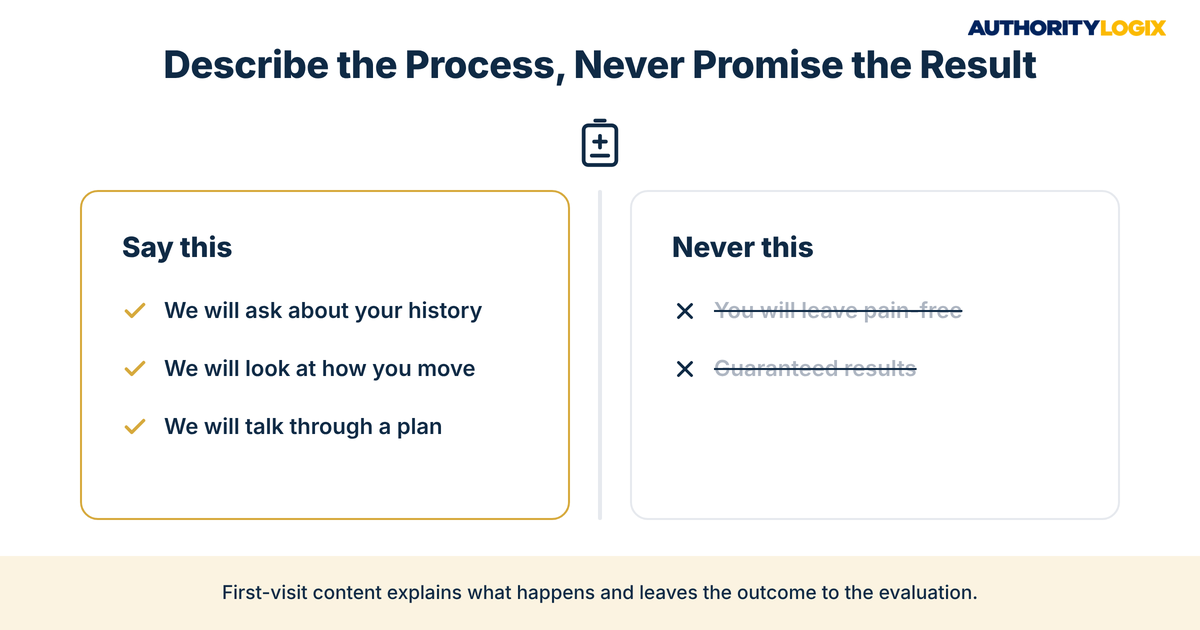
The line to hold is between describing the process and predicting the result. “Your therapist will ask about your history, look at how you move, and talk through a plan with you” describes the process. “You will leave pain-free” predicts a result no practice can guarantee, and it has no place on a what to expect first physical therapy appointment page.
Plain language does double duty here. The same clear phrasing that calms a nervous reader also matches the way patients search, which is why the content SEO playbook treats patient-language headings as a search asset rather than a style choice. A heading such as “What Happens at Your First Visit” serves the reader and the search at once.
Clinician review keeps the page honest. A therapist should read every line describing the visit to confirm it matches what happens in your clinic, which is central to our approach of pairing clinical accuracy with search structure. PT first visit anxiety reduction content that a clinician has checked reads as calm and credible rather than salesy.
Photos help too, as long as they are real. Images of your actual treatment space and entrance on a what to expect first physical therapy appointment page show the patient where they are going without a single promise.
What Most PT Practices Get Wrong About the First-Visit Page
First-visit pages tend to fail in the same few ways. These are the questions patients and practice owners raise, with the honest answer to each.
Why can’t I find what to expect on the clinic’s website?
Because many practices leave the first visit for the front desk to explain on the phone. That works for patients who call, and a missing what to expect first physical therapy appointment page loses the ones who will not call until they know what they are signing up for.
The page says “comprehensive evaluation” but not what that means. Is that normal?
It is common, and it is a missed opportunity. Clinical phrases mean something to your staff and very little to a new patient, so a what to expect first physical therapy appointment page should describe the visit in the words a patient would use.
Do I need to fill out forms before I arrive?
That depends on the practice, which is exactly why the page should say so. Posting forms online and explaining what happens if a patient cannot finish them removes one more reason to delay.
Is one first-visit page enough for a practice with several locations?
One core page can cover the process, but each location needs its own parking, entrance, and hours details. The AuthorityLogix resource library includes related guides on location pages and local search for practices building that out.
Who should write the what to expect first physical therapy appointment page?
The front desk knows the questions, the clinicians know the visit, and someone has to turn both into a page that ranks and converts. Building that page from your team’s knowledge is what we do for practices that already deliver a good first visit and need patients to see it before they book.
Ready to turn your first visit into a what to expect first physical therapy appointment page and booking flow that moves new patients to book?
The Honest Payoff of a Clear “What to Expect First Physical Therapy Appointment” Page
The honest payoff is not a dramatic spike. A clear what to expect first physical therapy appointment page removes small reasons not to book, one patient at a time, and keeps doing it without anyone touching it. That is the kind of durable asset the growth blueprint describes, and the only reliable way to know what it is worth to your practice is to track your own booking rate before and after it goes live.
The page also gives your practice something to share. A short video of a therapist walking through the first visit puts a real face on the process, and authority distribution is how that material reaches patients who have not found your website yet.
We use the same principle on our own proof-of-concept. BKDSCR.com, an AuthorityLogix build in the NYC outer-borough DSCR real estate niche rather than a PT client, runs on 18 pillar pages, 7 interactive tools, and 48 SEO-optimized blog posts with zero paid ads. The industry is different, and the idea is the same: answer the question before the prospect has to ask.
The work is not complicated, but it has to happen in order: collect the questions, write the page with clinician review, place the short versions in the booking flow, and measure. That order is how we build first-visit education into a practice website.
The honest answer is that most practices already run a first visit patients would feel good about if they could see it ahead of time. The missing piece is a what to expect first physical therapy appointment page that shows them. You already earned the credibility. We build the infrastructure that makes the market see it.