


Key Takeaways
- Physical therapy condition treatment content serves three simultaneous functions: it ranks for the condition-specific searches that bring direct-access patients to the practice, it demonstrates clinical expertise through patient-facing educational depth, and it removes the uncertainty that prevents research-phase visitors from converting to booked evaluations.
- The majority of physical therapy patient education materials are written above an 8th-grade reading level, per a 2024 Cureus study — well above the 6th-grade level recommended by the NIH for patient-facing health content. PT practices that write at patient reading levels outperform clinically accurate but inaccessible content in both rankings and conversions.
- Google’s Search Quality Evaluator Guidelines classify PT websites as YMYL content and apply the highest E-E-A-T scrutiny. Condition pages with named clinician authorship, evidence-based treatment descriptions, and patient-accessible language satisfy all four E-E-A-T dimensions simultaneously.
- A condition page that covers symptoms, causes, how PT addresses the condition, what treatment looks like, expected recovery timeline, and a condition-specific FAQ will outrank a 300-word page that simply states “we treat this condition” — and will convert at dramatically higher rates.
- Clinical jargon is the most common condition page failure. A patient searching “physical therapy for shoulder impingement” is not looking for a description of subacromial bursitis — they are looking to understand what is happening in their shoulder and whether PT can help.
- Condition content and treatment content serve different patient needs and should be distinct page types — condition pages answer “what is happening to me and can PT help?” while treatment pages answer “what will PT actually do for this condition and what will it feel like?”
- Per BrightEdge research, AI Overviews now appear for 88% of healthcare-related queries. Condition pages structured with patient question H3s, direct answer-first responses, and condition-specific FAQ sections earn AI Overview citations — extending the practice’s authority beyond patients who click through to the website.
Table of Contents
Physical therapy condition treatment content is the most direct intersection of clinical authority and patient acquisition in a PT practice’s content strategy. A well-built condition page simultaneously earns rankings for the searches that bring direct-access patients to the practice, demonstrates genuine clinical expertise in treating that condition, and provides the educational depth that converts a research-phase visitor into a patient who trusts the practice enough to book.
This article covers the structural and writing principles that make condition and treatment pages earn both rankings and patient trust. The educational hub system is the operational infrastructure that organizes these pages into a permanent knowledge library — this article focuses on building each page to the standard that makes the library valuable.
The Readability Problem in Physical Therapy Condition Content
The most consistent finding in research on healthcare patient education materials is that they are written far above the reading level of the patients they are intended for. A 2024 Cureus study found that the majority of physical therapy patient education materials are written above an 8th-grade reading level — and that even modified versions rarely reached the 6th-grade level recommended by the NIH and the American Medical Association for patient-facing health content. The average U.S. adult reads at an 8th to 9th-grade level, per the AHRQ. About 1 in 5 American adults reads at or below a 5th-grade level, per the National Literacy Institute.
The readability problem is not just a health equity issue — it is a conversion issue. A patient who reads a condition page and does not understand what it says does not book an appointment. A patient who reads a condition page and clearly understands their condition, why PT can help, and what to expect from treatment is one step away from booking. Readability is not a compromise of clinical accuracy — it is a requirement for content that actually serves patients.
Google’s Search Quality Evaluator Guidelines classify PT websites as YMYL content and apply E-E-A-T scrutiny accordingly. The Experience dimension of E-E-A-T specifically rewards content that reflects genuine first-hand clinical engagement — which includes the ability to explain a condition in the language a patient uses, not the language a clinician uses in a clinical note. The clinical authority guide covers the full E-E-A-T framework that condition content contributes to — this article focuses on condition pages specifically.

The Physical Therapy Patient Education & Clinical Authority Guide covers the full framework condition and treatment content is built on, so every page educates and builds trust.
Physical Therapy Condition Treatment Content: Two Different Patient Questions
The most common structural mistake in PT condition content is conflating condition pages and treatment pages into a single page that tries to answer both patient questions simultaneously — and ends up answering neither well.
What Physical Therapy Condition Treatment Content Must Answer on a Condition Page
A condition page answers the patient’s first question: “What is happening to me, and can physical therapy help?” A condition page should cover: what the condition is in patient language, what causes it, how it affects daily function, what physical therapy does to address it, and whether the patient is a good candidate for PT. The patient journey guide maps the specific questions patients are trying to answer at each research stage — condition pages serve the early evaluation stage where patient trust begins to form.
What a Treatment Page Must Answer
A treatment page answers the patient’s second question: “What will physical therapy actually do for this condition, and what will it be like?” A treatment page should cover: what the specific treatment modalities involve, what a typical session looks like, how many sessions are typically needed, what the patient can expect to feel during and after sessions, and what the expected recovery timeline looks like. The acquisition playbook covers how condition and treatment pages connect to the full patient acquisition pipeline.
When One Page Works
For lower-volume conditions where building separate condition and treatment pages is not a priority, a combined page can work — but the structure must clearly separate the two question types within the same page. The lead generation system covers how condition and treatment pages connect to the booking and conversion infrastructure that turns content visitors into scheduled evaluations.

Not sure how your condition content compares to local competitors?
Physical Therapy Condition Treatment Content: Writing in Patient Language
The single most actionable improvement most PT practices can make to their condition pages is replacing clinical terminology with patient-facing language. This does not require dumbing down the clinical content — it requires translating it into the language the patient uses when they think about and search for their condition.
Start With the Patient’s Experience
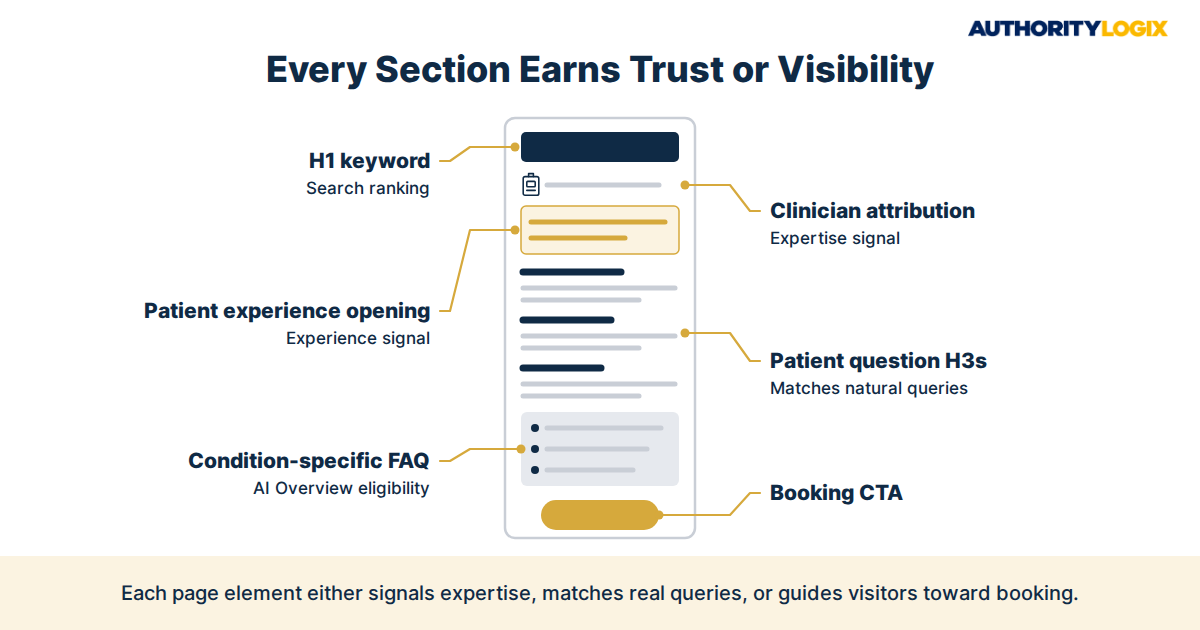
Every condition page should open with the patient’s experience of the condition — not a clinical definition. A condition page that opens with a recognition of the patient’s experience — describing what it feels and looks like to have this condition from the patient’s perspective — immediately signals that the practice understands the patient’s reality. The patient education guide covers the full E-E-A-T patient education framework that condition pages contribute to — including how patient-experience openings build the Experience dimension of E-E-A-T.
Explain Anatomy Only When It Builds Understanding
Clinical anatomy is useful in condition content when it helps the patient understand why they are experiencing what they are experiencing — not as a demonstration of clinical knowledge for its own sake. The test for whether anatomical detail belongs on a condition page is simple: does this help the patient understand their situation or make a treatment decision? The authority distribution system covers how condition content that genuinely serves patient understanding earns the external citations and inbound links that build the Authoritativeness dimension of E-E-A-T over time.
Use Analogies and Comparisons
“The meniscus acts like a shock absorber between your thigh bone and shin bone — when it tears, the bones are less cushioned from each other, which is what causes the pain with weight-bearing activities” is more comprehensible and persuasive than a clinical description of meniscal function. Analogies that connect clinical concepts to objects or experiences the patient is already familiar with build the understanding that makes the patient feel informed rather than confused. The content playbook covers the full content architecture that condition pages fit into.
Calibrate Length to Depth of Information
The target for a comprehensive PT condition page is 800 to 1,200 words of patient-facing body content. Short sentences, short paragraphs, and active voice all improve readability without reducing depth. The clinician trust guide covers how clinician-attributed condition content — written at patient reading level — builds the Experience and Expertise dimensions of E-E-A-T simultaneously.

Structuring Condition Content for AI Overviews and Search Rankings
A condition page built for patient accessibility and E-E-A-T credibility needs a structure that makes both dimensions visible to Google’s quality evaluation systems and AI search tools simultaneously. Google’s Search Quality Evaluator Guidelines specify that YMYL healthcare content should clearly identify the author with their credentials, cite authoritative sources, and present information in a way that serves the patient’s genuine information needs. The local visibility guide covers how condition page content connects to local search signals — condition pages and local search optimization work as a coordinated system, not as independent strategies.
Clinician Attribution
Every condition page should carry a named clinician author with their credentials. The attribution line connects the condition content to the clinician’s expertise and establishes the Expertise dimension of E-E-A-T at the page level. Google’s quality raters specifically evaluate whether YMYL healthcare content has named authorship from credentialed professionals. The local search system ensures the practice’s clinicians are consistently represented across every local search touchpoint — from GBP profiles to directory listings and condition page authorship.
Patient Question H3 Structure
Organizing condition page sections around patient question H3s — “What is [condition]?”, “What causes [condition]?”, “Can physical therapy help?”, “What does treatment look like?”, “How long does recovery take?” — makes the page scannable for patients and matches natural language queries for search engines and AI systems. The PT industry hub demonstrates the full five-system framework — content, local search, patient education, lead generation, and authority distribution — that condition page structure supports across the entire practice’s digital presence.
Condition-Specific FAQ Section
Every condition page should conclude with a condition-specific FAQ section covering four to six questions that patients consistently ask about that condition and its PT treatment. These questions earn eligibility for featured snippets, People Also Ask placements, and AI Overview citations — and they address the specific hesitations that prevent patients from booking. The patient FAQ guide covers the full FAQ content strategy — including how condition-page FAQ sections connect to the standalone FAQ page and the GBP Q&A section.
Frequently Asked Questions
How many condition pages should a PT practice have?
A practice should prioritize condition pages for its highest-volume conditions first — the three to five conditions that represent the majority of its patient caseload. Each of those pages, built to the depth and structure described in this article, will generate more patient acquisition value than twenty thin pages covering every condition the practice has ever treated. The educational hub system covers the full content architecture for prioritizing and scaling condition content — including how to sequence condition page production for maximum early authority gain.
Should condition pages include clinical research citations?
Yes, when the citation supports a claim the patient needs to evaluate — such as “physical therapy achieves similar outcomes to surgery for most rotator cuff tears without the risks of the procedure, per a 2024 systematic review.” A citation that helps the patient make a treatment decision belongs on a condition page. A citation that exists to demonstrate clinical rigor to other clinicians does not. The growth blueprint covers how condition content that earns external citations builds the Authoritativeness dimension of E-E-A-T that compounds over time.
How long should a condition page be?
A comprehensive condition page runs 800 to 1,200 words of body content. Depth matters more than length: a 600-word page that comprehensively answers the patient’s actual questions outperforms a 1,500-word page that covers clinical detail the patient did not ask for.
What is the most common condition page mistake?
Writing for clinical peers instead of patients. The second most common mistake is writing about the condition without explaining what PT specifically does to treat it. A patient who reads a condition page and understands their condition but does not understand what PT treatment involves or what to expect is still not ready to book. Condition understanding and treatment explanation must both be present on the condition page — with the treatment explanation written in the same patient-accessible language as the condition description.
Want condition and treatment pages that explain care clearly and bring in patients searching for answers?