


Key Takeaways
- A physical therapist bio page is the single highest-trust page on a practice website, because it attaches a name and a face to every claim the rest of the site makes.
- Globally, “my doctor” is the single most trusted figure in healthcare, which means a physical therapist bio page that reads as anonymous gives up trust the practice already earned.
- A complete physical therapist bio page needs credentials, licensure, and real outcomes described honestly — never guaranteed.
- A physical therapist bio page written like a resume reads as a compliance document, not a trust signal — tone matters as much as content.
- Schema markup and structured data make a physical therapist bio page machine-readable, which affects how search engines and AI tools surface the clinician’s expertise.
- Bio pages compound when they connect outward — to condition content, to the practice’s broader authority, and to the next step a patient should take.
Table of Contents
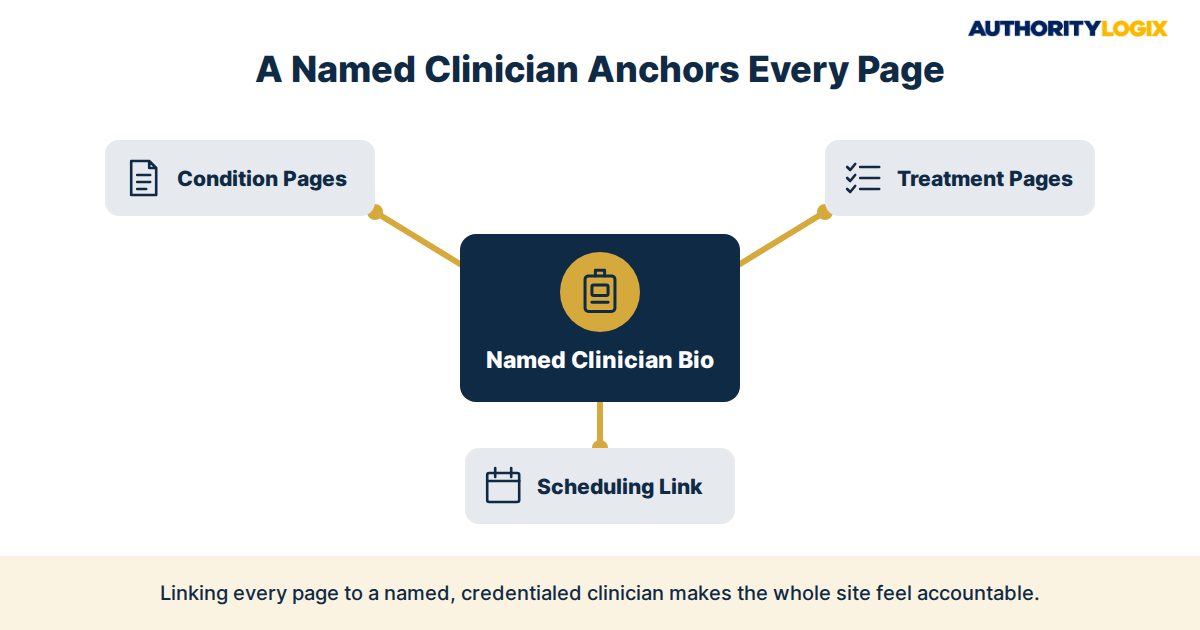
A physical therapist bio page is the page on a practice website that does the most trust-building work per word, because it is the only page that attaches a real name to every claim the rest of the site makes. The PT industry hub treats bio pages as core infrastructure for exactly this reason — a condition page can be well-written and still feel generic, but a physical therapist bio page with a named, credentialed clinician behind it reads as accountable in a way anonymous content never does. That single difference is often what separates a practice patients remember from one they forget within minutes of closing the tab.
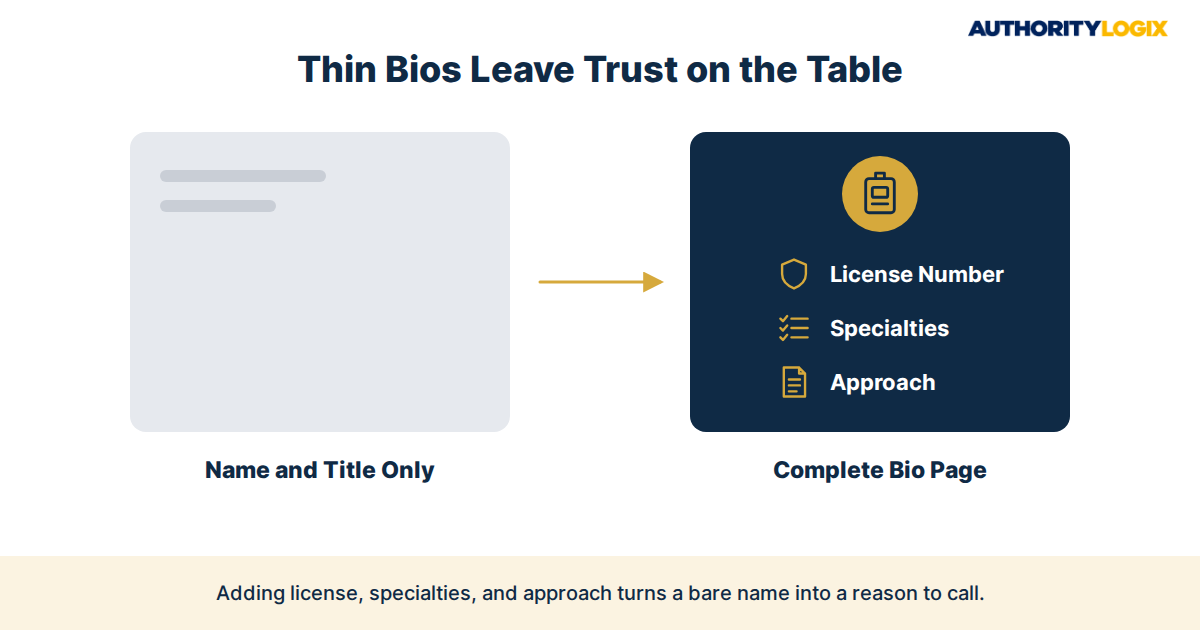
Most PT practice websites still get this wrong. A physical therapist bio page that lists only a job title and years of experience is barely more useful to a prospective patient than no bio page at all. The clinicians who show up specifically — named conditions treated, named credentials, a real description of their approach — are the ones patients remember when deciding who to call. A practice with five clinicians and five nearly identical, interchangeable bios has effectively built one bio page and copied it five times, which defeats the entire purpose of having named individuals on staff in the first place.
Why a Physical Therapist Bio Page Builds Trust Before the First Appointment
Trust in healthcare concentrates around named individuals more than any other factor. The Edelman Trust Barometer‘s 2026 special report on health finds that “my doctor” is the single most trusted figure in healthcare globally — trusted by roughly 80% of people, ahead of medical scientists at 73% and well ahead of institutions. A physical therapist bio page is how that same dynamic plays out online: a named clinician is inherently more trustworthy than an anonymous practice.
The educational hub system depends on this same principle at scale. Every condition page and treatment page in a practice’s library gets stronger when it links to a physical therapist bio page behind it, because the reader can verify that a real, credentialed person stands behind the clinical claims being made. Content without that attachment reads as generic no matter how accurate it is.
The clinician expertise framework covers why this matters most for a first-time visitor who has never met the practice’s staff. A physical therapist bio page is often the last thing a prospective patient reads before deciding to call, which makes it one of the most consequential pages on the entire site relative to how little time most practices spend building it.
The Physical Therapy Patient Education & Clinical Authority Guide covers the full E-E-A-T framework bio pages are built on.
What a Complete Physical Therapist Bio Page Actually Includes
A complete physical therapist bio page has three required components, and most existing bio pages are missing at least one. Credentials establish that the clinician is legally qualified to practice. Specialties establish what they are specifically good at, beyond the general license. Outcomes — described honestly, never guaranteed — establish that the clinician’s approach actually works for real patients.
Credentials and Licensure Display
Every physical therapist bio page needs the clinician’s license number or a clear reference to it, their degree, and any board certifications or specialty credentials, displayed prominently rather than buried in a paragraph. The clinician authority signal this creates matters for two audiences at once: a patient deciding whether to trust the practice, and a search engine trying to verify that the content on a health-related page comes from someone qualified to write it. Placement matters as much as content — a license number in the final line of a long paragraph does far less work than the same number displayed near the top, where a skimming visitor will actually see it before deciding whether to keep reading.
Real Patient Outcomes on a Physical Therapist Bio Page
A physical therapist bio page can describe the kinds of patients a clinician typically treats and the general approach they take, without ever promising a specific result. “Works primarily with post-surgical knee patients and runners returning from injury” is honest and specific. “Guarantees full recovery” is neither honest nor allowed. The education library this bio page supports depends on that same discipline — specific claims about process, never promises about results. A clinician bio that names the exact patient population they work with most, whether that is post-surgical recovery, sports rehabilitation, or chronic pain management, gives a prospective patient a concrete reason to believe this specific person understands their exact situation.
Writing PT Clinician Profile Content That Reads Like a Person, Not a Resume
PT clinician profile content fails the moment it reads like a CV pasted onto a webpage — degree, year, certification, year, in a flat list with no voice behind it. A physical therapist bio page should sound like the clinician actually talking: why they got into the field, what kind of patient they enjoy working with most, what a first session with them typically looks like. That tone is what separates a bio page a patient actually reads from one they skim past.
The patient education authority framework treats voice as a trust signal in its own right, separate from the credentials themselves. Two clinicians with identical degrees and licenses can produce very different levels of patient confidence depending on whether their physical therapist bio page sounds like a real person or a form letter.
The content systems that produce this kind of writing at scale use a short structured interview with each clinician rather than asking them to write their own bio from a blank page. Most clinicians are better at describing their work out loud than drafting marketing copy, and a physical therapist bio page built from an actual conversation reads more authentically than one assembled from a template.
Physical Therapist Credentials Page SEO: Structure and Schema
Physical therapist credentials page SEO is a distinct discipline from writing the bio copy itself. Each physical therapist bio page needs its own dedicated URL — never a shared “our team” page with every clinician crammed onto one scroll — because a dedicated page is what allows the page to rank for a patient searching a specific clinician’s name or a specific specialty. A shared team page forces every clinician to compete against their own colleagues for the same search terms, which produces a worse outcome for the practice than simply giving each person the dedicated page their expertise already earns.
Schema Markup and Structured Data for Clinician Bios
Person schema is what turns a physical therapist bio page from a page a human can read into data a search engine can verify — name, credentials, affiliation, and specialty all marked up in a format Google and AI search tools can parse directly. The SEO playbook covers the full schema implementation, but the specific requirement for a physical therapist bio page is Person schema linked to the practice’s Organization schema, so the two reinforce each other rather than existing as separate, unconnected entities.
A physical therapist bio page also benefits from the same FAQ treatment used elsewhere in a practice’s content. The patient FAQs approach applies directly here: a short “what to expect in your first session with Dr. Smith” block answers a specific question a prospective patient is actually asking, and it gives the page additional structured content beyond the credentials list alone.
Not sure where your practice’s content actually stands.
PT Staff Bio Trust Signals Beyond Credentials
PT staff bio trust signals extend past the credentials themselves into smaller details that make a clinician feel real rather than staged. A specific mention of how long they have practiced in the local area, a professional association membership, or continuing education they have completed recently all function as trust signals a physical therapist bio page can carry without needing a single new credential. None of these signals require a marketing budget to produce — most of them already exist somewhere in a clinician’s own professional history and simply need to be written down and published where a prospective patient can actually find them.
These signals matter most where a practice competes on more than clinical skill alone. The visibility guide covers how a well-built physical therapist bio page contributes directly to local search performance, since Google’s local ranking systems weight the depth and specificity of staff information as part of evaluating a healthcare business listing.
A physical therapist bio page is also one of the more overlooked pieces of a practice’s acquisition playbook, since a prospective patient who reaches a bio page has already engaged deeply with the site and is close to a decision. A page that fails to close that trust gap at the last step wastes everything the rest of the site built to get the visitor there.

Where Bio Pages Fit Inside the Practice Website
A physical therapist bio page should never exist in isolation. It needs to be linked from every condition and treatment page the clinician is associated with, and it needs to link back out to the content that demonstrates their expertise in practice. The authority distribution layer extends that same connection beyond the website — a clinician’s bio becomes the anchor point for how their expertise gets referenced across LinkedIn, press mentions, and other channels a practice uses to build reach.
A physical therapist bio page also connects directly into conversion. The lead generation system should place a clear scheduling link on every bio page, since a patient who has just decided they trust a specific clinician is at exactly the moment they are most likely to book — and the page should make that action require the fewest possible steps.
What Most PT Practices Get Wrong About Clinician Bio Pages
They build one shared team page instead of individual bio pages
A single “meet our team” page with six clinicians stacked on top of each other means none of them gets a dedicated physical therapist bio page that can rank for their own name or specialty. Splitting the page into individual URLs is a small technical change with an outsized effect on both search visibility and how seriously each clinician’s expertise reads to a visitor. It also makes updating one person’s credentials far simpler, since a change to one clinician’s page no longer requires editing a shared block of text that six other staff members also depend on.
They let the bio page go stale after the initial build
A physical therapist bio page written once and never updated eventually lists credentials the clinician has outgrown and omits ones they have since earned. The growth blueprint treats staff bios as living infrastructure that needs a review cadence, not a one-time project finished at launch.
The why us page makes the same point about every piece of authority infrastructure a practice builds. An asset that needs maintenance to keep compounding is not a task that gets marked complete and forgotten, and a bio page is no exception to that rule.
Patient Questions a Physical Therapist Bio Page Should Answer
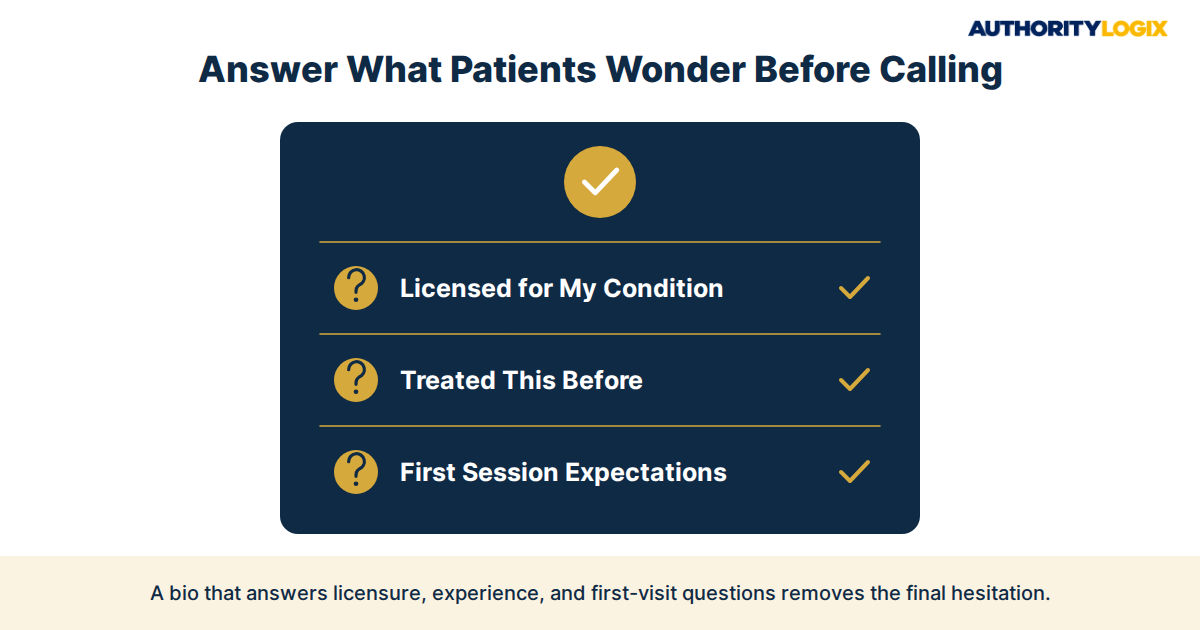
The our approach page covers the measurement side of authority content in more depth, but a physical therapist bio page earns its keep by answering the specific questions a prospective patient is actually holding when they land on it.
Is this clinician actually licensed to treat my condition?
A visible license number or a clear statement of licensure, paired with any relevant specialty certification, answers this directly without requiring the patient to look it up elsewhere.
How do I know this clinician has treated my specific condition before?
A specialties list naming actual conditions and patient populations, not just a generic job title, is what answers this — vague descriptions leave the patient guessing.
What happens in a first session with this specific clinician?
A short, honest description of a typical first evaluation reduces the uncertainty that keeps many prospective patients from booking at all.
Ready to rebuild your clinician bios so every credential works as a reason to book?
Building Your First Round of Bio Pages: Where to Start
Start with a short structured interview for each clinician — credentials, specialties, why they got into PT, what a first session looks like — and build one dedicated physical therapist bio page per clinician from that material rather than a shared team page. That first round does not need to be elaborate to work; it needs to be specific, honest, and attached to a real name. The what we do page outlines how bio pages fit into the larger system a practice is building, alongside condition content and local visibility.
The honest answer is that most practices already have clinicians whose experience would support a strong physical therapist bio page — the credentials and the outcomes already exist. What is usually missing is the fifteen minutes it takes to ask the right questions and the discipline to publish the answers as their own page instead of one more line on a shared team roster. A practice that treats this as a one-afternoon project for its most experienced clinician, then repeats the process for each additional staff member over the following weeks, ends up with a complete set of pages faster than one that waits for a single perfect batch effort that never quite gets scheduled.