


Key Takeaways
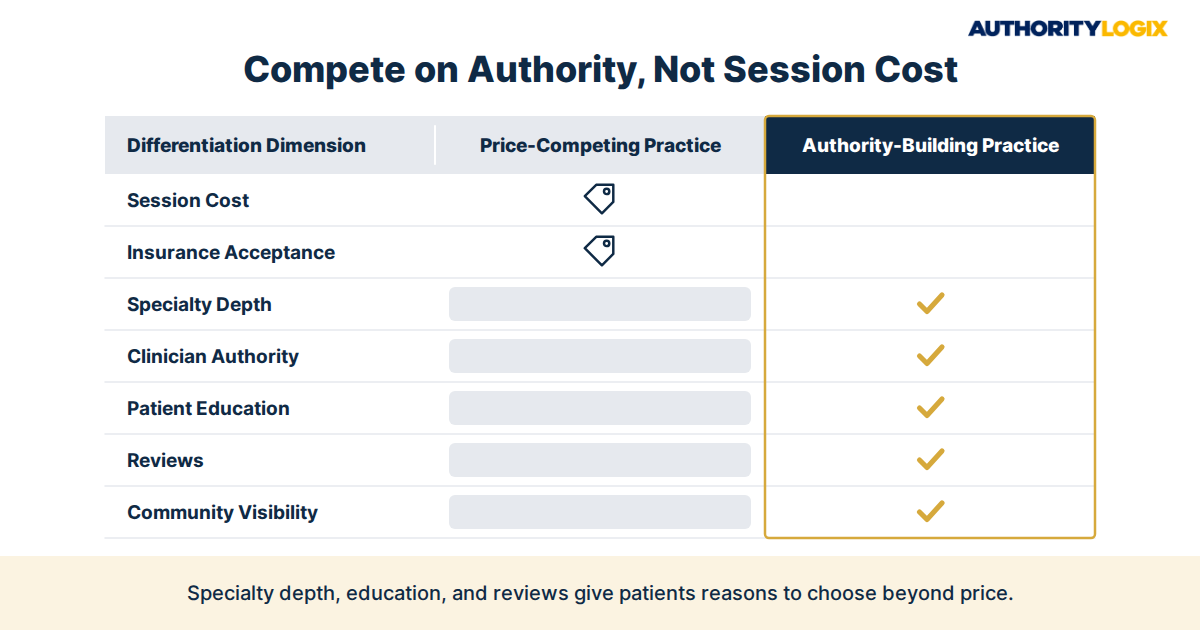
- Building a recognizable physical therapy brand without competing on price requires differentiation on clinical specialty depth, named clinician expertise, patient education quality, and community authority — not session cost or insurance acceptance.
- Competing on price in physical therapy is a structural trap. The Medicare Physician Fee Schedule conversion factor dropped 2.83% in 2025 while operational costs continue rising.
- Many patients prefer healthcare providers with transparent pricing information online — but transparent pricing is not the same as low pricing.
- The most durable physical therapy brand is built on clinical authority — the perception that this practice is the most knowledgeable, most experienced, and most trustworthy source of PT for a specific patient population.
- Branding helps create meaningful differentiation by answering the question every prospective patient is asking: ‘Why this clinic?’
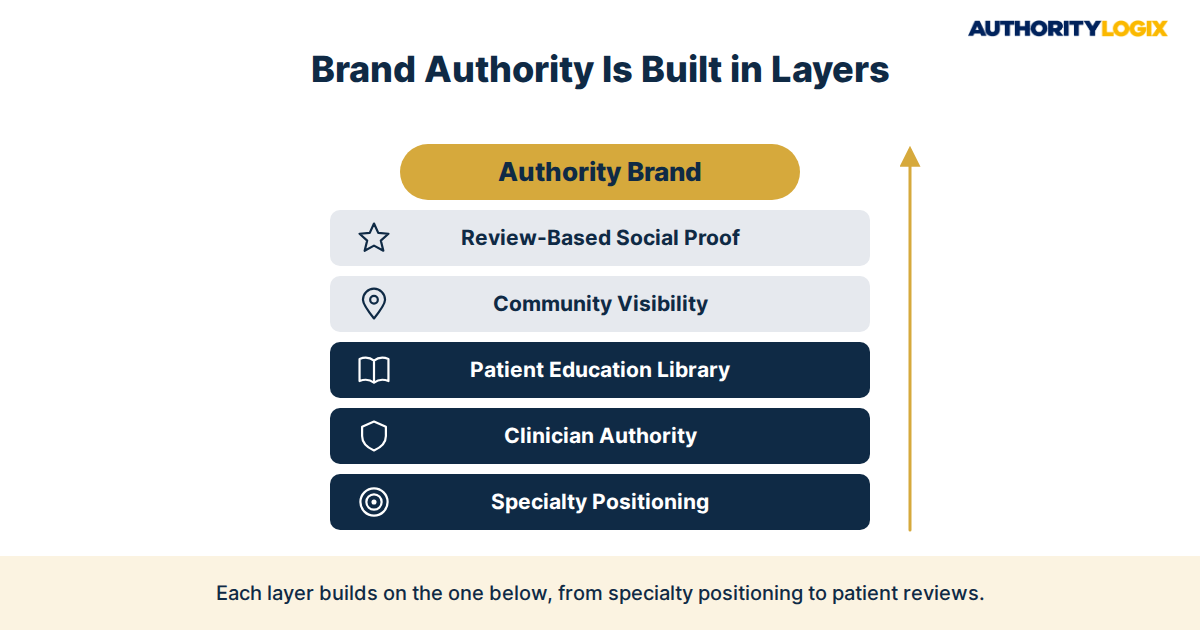
- The 5 strategies for building a physical therapy brand without competing on price: specialty positioning, clinician authority, patient education publishing, community visibility, and review-based social proof.
- Patients tend to place more trust in providers with consistent branding.
Table of Contents
Building a recognizable physical therapy brand without competing on price is the central brand strategy challenge for independent PT practices in 2026 — at a moment when Medicare reimbursement continues to decline and corporate PT chains are competing on price and access. The practices that build durable brands are not the ones offering the lowest session rates. They are the ones that have built clinical authority, patient education depth, and community trust.
This article covers the 5 strategies that build a recognizable physical therapy brand without competing on price. The authority guide covers the full clinical authority and E-E-A-T framework — this article focuses on the brand differentiation strategies that make clinical authority visible to patients who are not yet in the practice’s door.
Building a Physical Therapy Brand Without Competing on Price: Why Price Wars Lose
Competing on price in physical therapy is structurally unwinnable for independent practices. As reimbursement pressure grows, the profession is asking whether it can differentiate on value rather than access — and the practices that build clinical authority and patient education brands are best positioned to sustain margins in the 2026 reimbursement environment. The visibility guide covers how local search authority is built alongside the brand differentiation strategies described in this article.
The patient trust data supports value-based brand positioning. Strong branding builds top-of-mind awareness when patients consistently see the same impactful messaging across all practice touchpoints — and that top-of-mind awareness translates into greater trust and increased referral opportunities. The local search system connects brand consistency to the local authority signals that make the practice the first choice for patients searching for PT in its specialty areas.
Explore the AuthorityLogix PT Practice Authority and Growth Blueprint for physical therapy practices.
Building a Physical Therapy Brand Without Competing on Price Strategy 1 — Specialty Positioning
Building a Physical Therapy Brand Without Competing on Price Through Specialty Positioning
Specialty positioning defines the practice’s authority territory in a way that price cannot touch. A practice that positions itself as the orthopedic rehabilitation specialist for competitive athletes in its market is not competing with a corporate PT chain — it is the only logical choice for a patient who identifies as a competitive athlete with a sports-related injury. The educational hub organizes specialty positioning into the navigable knowledge library structure — specialty-specific condition pages, treatment explainers, and clinician bio pages that make the practice’s specialty authority legible to both patients and referring physicians.
How to Communicate Specialty Positioning
Specialty positioning is communicated through the practice’s H1 headings, GBP primary category, clinician bio pages, and condition page library. The content systems built for PT practices include the specialty positioning content architecture — the service page, condition page, and clinician bio page structure that makes specialty authority visible to patients, referring physicians, and search engines simultaneously.
Strategy 2 — Clinician Authority
Clinician authority is the brand differentiation strategy most directly tied to patient trust. Per healthcare marketing research, patients favor providers that show photos and staff bios — and practices with named clinician bio pages earn patient trust that generic team pages cannot.
The authority distribution system amplifies each clinician’s authority through external syndication, extending that trust beyond the practice’s own website. A clinician known outside that website carries more weight when a patient finally lands there.
Strategy 3 — Patient Education Publishing
Patient education publishing converts the practice’s clinical knowledge into a permanent, patient-visible authority asset. Smarter marketing for PT practices is about visibility, trust, convenience, and clear communication that reflects the quality of care already being delivered — and patient education publishing makes clinical quality visible before patients experience it. The content calendar article covers the editorial planning process that keeps the patient education library growing consistently.
The content playbook covers the full content systems infrastructure that supports that calendar. Without that infrastructure, even a well-planned calendar tends to stall after the first few months.
Strategy 4 — Community Visibility
Community visibility builds the practice’s authority in the physical spaces where its patients live, work, and exercise — making the practice’s brand recognizable before a patient ever searches for PT online. Community visibility includes: sports team PT partnerships, employer wellness programs, school and youth sports programs, and local media presence. The lead generation system connects community visibility events to the digital lead capture infrastructure.

Strategy 5 — Review-Based Social Proof
Review-based social proof converts the practice’s clinical outcomes into patient-visible authority signals in the moment of provider selection. Per 2026 medical marketing data, 89% of patients look for online reviews before booking. The acquisition playbook covers how the review generation workflow connects to the full patient acquisition pipeline.
Not sure how your PT brand compares to the competition in your market?
Frequently Asked Questions
How do I communicate value to patients who are asking about price?
Answer the question transparently, then reframe around value. A practice that answers “our initial evaluation is $X, which includes a 60-minute one-on-one with Dr. [name], DPT, who specializes in [condition]” is delivering price information while positioning the practice as an authority investment, not a commodity expense. The AI search article covers how FAQ content structured around patient questions — including cost and value questions — earns AI Overview citations.
How long does it take to build a recognizable PT brand?
Brand recognition in a local PT market is built over 12 to 36 months of consistent specialty positioning, patient education publishing, community visibility, and review generation. The first 90 days produce infrastructure. Months 3 to 12 produce the first measurable brand signals. Months 12 to 36 produce the brand recognition that converts into unprompted referrals and physician recognition of the practice’s specialty authority.

Should a PT practice ever mention price in its marketing?
Yes — transparently and in the context of value. The brand strategy question is not whether to mention price but whether price is the lead message or a subordinate message. The PT industry hub demonstrates how the five-system framework coordinates brand positioning into a unified patient acquisition infrastructure that makes price a secondary consideration in the patient’s provider-selection decision.
Ready to build a recognizable practice brand that wins patients on trust instead of price?