


Key Takeaways
- The Google helpful content system physical therapy owners heard about in 2022 is no longer a separate system: Google says it became part of its core ranking systems in March 2024.
- Google said the March 2024 core update and its earlier efforts would collectively cut low-quality, unoriginal content in search results by 40%, and later reported 45% less once the rollout finished.
- Google gives more weight to strong E-E-A-T on topics that could significantly impact people’s health, which puts physical therapy websites squarely in scope.
- Of experience, expertise, authoritativeness, and trust, Google’s guidance says trust is most important.
- PT helpful content update compliance today means answering Google’s who, how, and why questions on every condition page, service page, and clinician bio.
- Google helpful content system physical therapy guidance rewards pages written for patients first; padding word counts or changing dates does not help.
Table of Contents
Google Helpful Content System Physical Therapy Basics: What Changed in March 2024
The Google helpful content system physical therapy practices were warned about in 2022 no longer exists as a separate system, and that change matters more than most practice websites realize. You may have clinicians with years of experience and a reputation that fills the schedule through physician referrals, yet a site built on template copy that shows none of it. That is the credible but invisible gap, and the clinical authority guide explains why patient trust online depends on the expertise a site shows, not the expertise a practice has.
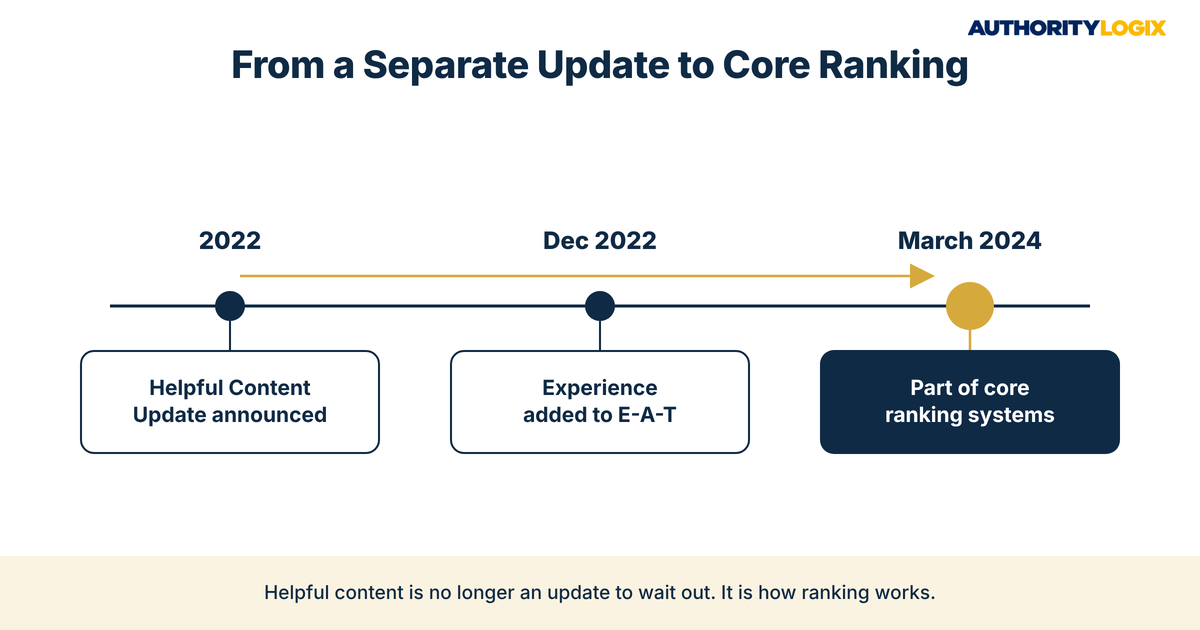
Google’s own documentation settles what the system is today. Google’s ranking systems guide, last updated in December 2025, lists the helpful content system among its retired systems and states that in March 2024 it evolved and became part of Google’s core ranking systems. The principles did not go away; they now sit inside the systems that rank every page.
Google Helpful Content System Physical Therapy Timeline, 2022 to Today
Google announced the system in 2022 as the “Helpful Content Update,” describing it as a system designed to better ensure people see original, helpful content written by people. In December 2022, Google updated its search quality rater guidelines so that E-A-T gained an extra E for Experience. On March 5, 2024, Google’s Elizabeth Tucker wrote that the March 2024 core update and earlier efforts would collectively reduce low-quality, unoriginal content in search results by 40%.
Google later added a note that the rollout finished on April 19, 2024, with 45% less low-quality, unoriginal content in search results. For a physical therapy practice, the lesson is direct: Google helpful content system physical therapy guidance is now part of everyday ranking rather than a periodic update to wait out. The PT industry hub lays out how the AuthorityLogix systems are built around that reality instead of around algorithm chasing.
The Physical Therapy Content & SEO Playbook shows how to build a site architecture that meets Google helpful content system physical therapy standards from the first page to the last.
Physical Therapy Google Content Quality Signals: Experience, Expertise, and Trust
Google’s guidance on helpful content describes a framework called E-E-A-T: experience, expertise, authoritativeness, and trustworthiness. Of these, Google says trust is most important, and it adds that E-E-A-T itself isn’t a specific ranking factor. The physical therapy Google content quality signals that matter are the ones that let a visitor — and Google’s systems — see who wrote a page and why it can be trusted.
Health topics raise the stakes. Google says its systems give more weight to content with strong E-E-A-T for topics that could significantly impact the health, financial stability, or safety of people. A page explaining what to expect at a first physical therapy evaluation sits close to that line, which is why Google helpful content system physical therapy guidance deserves more care on a practice site than on a page selling furniture.
The distinction Google draws between people-first and search engine-first content maps closely onto the difference between education vs marketing on a practice website. Education answers the patient’s question with first-hand knowledge; keyword-driven marketing copy repeats claims any clinic could make. Patients feel the difference within a paragraph, and the physical therapy Google content quality signals that build trust come almost entirely from the first kind.
Experience is the signal most PT sites underuse. A clinician who has spent years evaluating running injuries can describe what patients usually ask at the first visit in a way no outside copywriter can. Capturing that perspective is what an educational hub is designed to do, so each condition and service page carries the clinic’s real experience and meets Google helpful content system physical therapy standards on substance, not on formatting tricks.

PT Helpful Content Update Compliance: A Self-Assessment for Practice Websites
PT helpful content update compliance no longer means bracing for a named update. It means checking your site against the questions Google publishes in its helpful content guidance, which now describe what the core ranking systems reward. Run every important page through them, starting with the pages that bring in new patients.
The Who, How, and Why Questions Google Asks
Google organizes its self-assessment around three questions: who created the content, how it was created, and why it exists. Google calls the “why” perhaps the most important question to ask about content. For a practice site, the honest answer should be that the page exists to help a prospective patient, not to rank for a keyword.
| Google’s Self-Assessment Question | What Passing Looks Like on a PT Site | Warning Sign |
|---|---|---|
| Is it self-evident who authored the content? | A named clinician with credentials on each condition page | Unsigned pages credited to “Admin” |
| Does the content show first-hand expertise and depth of knowledge? | Explanations drawn from real evaluations, with no patient details | Copy that could describe any clinic in any city |
| Will a reader leave having learned enough to reach their goal? | The patient knows what happens next and how to book | The page never answers the question in its title |
| Is the page mainly summarizing others without adding value? | Original explanations in the clinic’s own words | Paragraphs reworded from other health sites |
| Is the page written to a particular word count? | Length set by the question being answered | Padding that Google helpful content system physical therapy guidance does not reward |
Most practices fail parts of this table because their pages were written once and never tied to a process. Content systems that assign every page an author, a clinician reviewer, and a review date turn PT helpful content update compliance into a routine instead of a scramble. Google helpful content system physical therapy guidance is easier to meet when the process meets it by default.
Google’s “how” question asks whether you provide background about how automation or AI generation was used to create content. A practice using AI drafting tools still needs a clinician to supply the expertise and review the result, which is the order of operations described in how we build. A tool can speed up a draft, but it cannot supply experience the clinic never shared. That is the practical meaning of Google helpful content system physical therapy guidance for AI-assisted pages.
Score the pages in order of patient value. Your highest-traffic condition pages, your main service pages, and your clinician bios come first, because those are the pages where Google helpful content system physical therapy standards and a patient’s booking decision meet. Blog posts from years ago can wait until the core pages pass.
Not sure how your practice website measures up against Google helpful content system physical therapy standards? The PT Authority Gap Assessment shows which pages fall short and what to fix first.
Applying Google Helpful Content System Physical Therapy Guidance to Condition and Service Pages
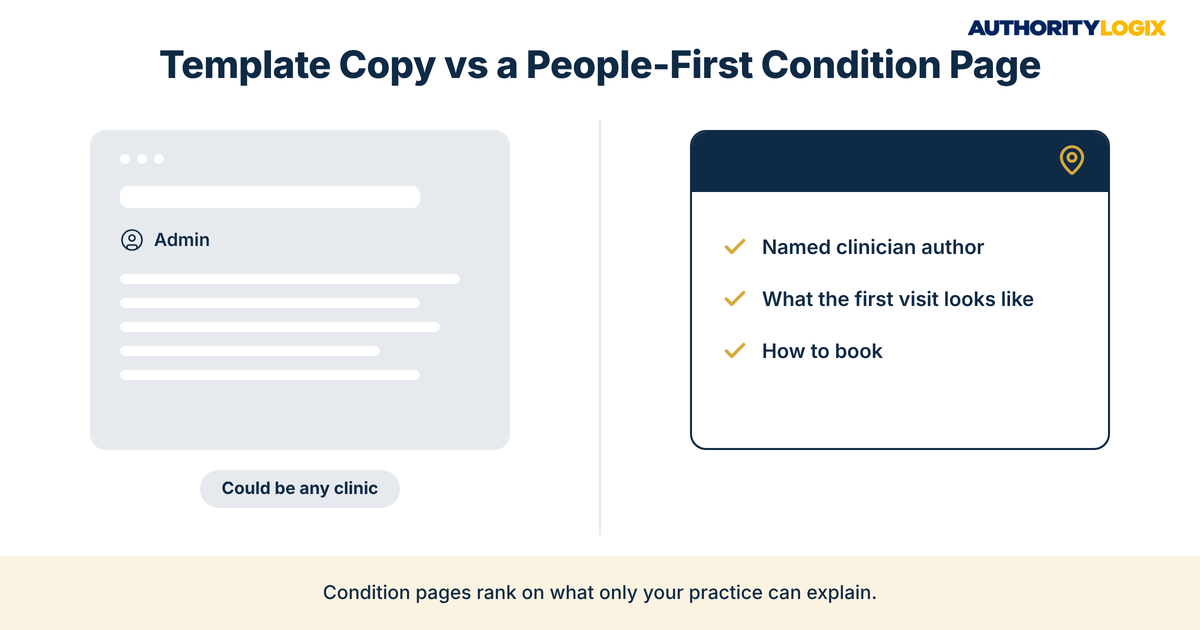
Condition and service pages are where Google helpful content system physical therapy guidance does most of its work, because they are the pages a prospective patient finds first. A condition page listing symptoms copied from a medical reference adds nothing Google cannot find elsewhere. A condition page that explains how your clinic evaluates that problem, what the first visit looks like, and how to book adds something only your practice can offer.
Condition Pages That Answer the Patient’s Real Question
Patients rarely search for the clinical name of a condition. They search for what they feel and what they want to know — whether a referral is required, what a first visit involves, whether their insurance applies. Practices that study the questions covered across the physical therapy resource library tend to build condition pages around those questions, which is the people-first approach Google describes.
Service pages carry a second job: they connect expertise to place. A page about sports rehabilitation should name the clinic, the clinicians who provide the service, and the location where it happens, so the same trust signals support local search visibility in the map results. On these pages, Google helpful content system physical therapy guidance and local relevance work together rather than competing for space.
Location pages are where the most templated copy hides. Ten location pages with the same three paragraphs and a different town name are exactly the kind of search engine-first content Google’s guidance warns against, and the local visibility guide covers how to give each location genuinely local substance. Every page should earn its place by answering something a nearby patient needs, and Google helpful content system physical therapy guidance applies to each of them, not just the homepage.
PT Website Content Quality Google Looks For in Clinician Bios and Credentials
PT website content quality Google can evaluate often comes down to authorship. Google’s guidance asks whether pages carry a byline where one might be expected and whether bylines lead to further information about the authors involved. On a physical therapy site, the clinician bio is that further information, and it is often the weakest page on the site. Google helpful content system physical therapy guidance treats that page as evidence, not decoration.
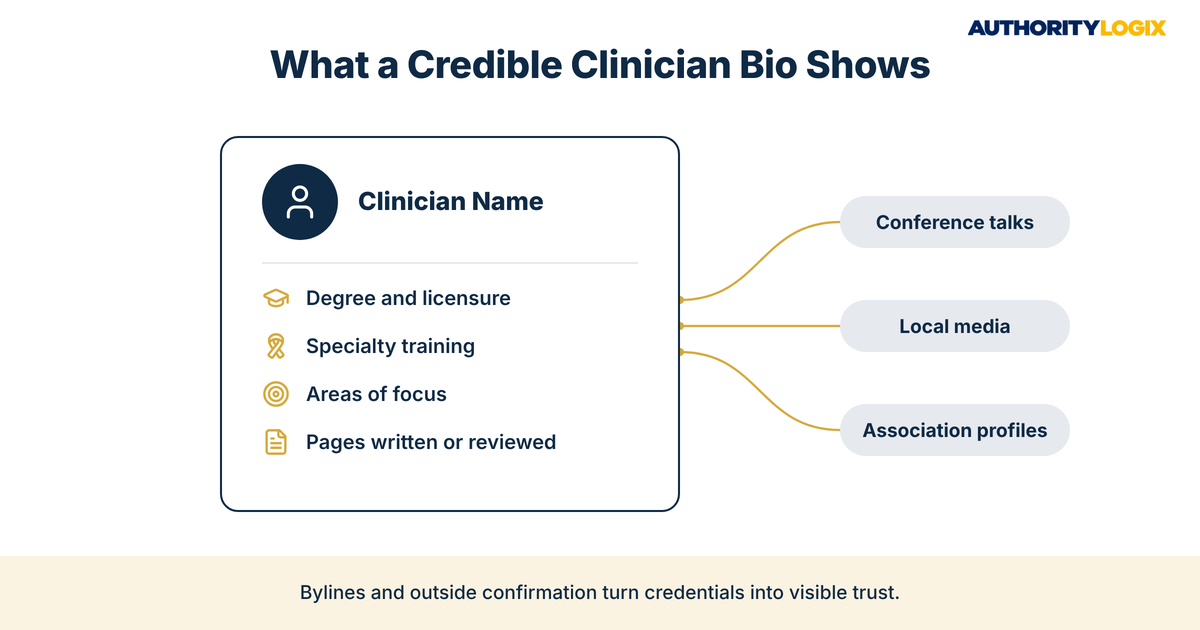
A strong bio lists the clinician’s degree, licensure, specialty training or certifications, and areas of focus. It links to the condition pages that clinician wrote or reviewed, so authorship is visible in both directions. The broader case for clinician expertise as a patient trust signal applies here directly, because patients want to know who they will see before they book.
Credentials also gain weight when they appear beyond your own site. Conference presentations, local media interviews, professional association profiles, and guest articles all confirm that your clinicians are who your site says they are. Placing that expertise in the right outside channels is the job of authority distribution, and it gives Google helpful content system physical therapy signals independent confirmation.
The same principle runs through BKDSCR.com, the proof-of-concept authority platform AuthorityLogix built in the NYC outer-borough DSCR real estate niche. Its 18 pillar pages and 7 interactive investor tools were built to show first-hand knowledge of one market rather than generic advice, and it ranks for competitive DSCR and NYC real estate terms with zero paid ads. Different industry, same standard: show the expertise, then let search find it.
What Most PT Practices Get Wrong About Helpful Content, From a Patient’s Perspective
Most mistakes come from writing for an algorithm the practice imagines rather than for the patient reading the page. Patients notice those mistakes before Google does. The questions below are the ones practice owners and prospective patients raise most often about Google helpful content system physical therapy standards.
Is the helpful content update still something my practice needs to worry about?
Not as a separate event. Google says the system became part of its core ranking systems in March 2024, so the same standards now apply continuously rather than during a named rollout. That makes PT helpful content update compliance an everyday habit rather than a one-time project.
Why does a patient care who wrote a condition page?
A page from a named clinician reads as guidance from a person the patient might actually see. Unsigned pages feel like advertising, and a patient comparing three clinics has more reason to trust the one that shows its people. That trust is the first step in the patient journey mapped in the acquisition playbook.
Can we use AI to write our condition pages?
Google helpful content system physical therapy guidance focuses on whether content is helpful and on being open about how it was created. The risk is publishing pages with no clinic experience in them, which read as generic however they were drafted. A clinician should supply and review the substance of every health page.
Does a longer page rank better?
Google’s guidance says it has no preferred word count. A page should be as long as the patient’s question requires and no longer. Under Google helpful content system physical therapy guidance, a complete answer matters more than a long one.
What should a patient be able to do after reading our page?
They should understand their next step and be able to take it without hunting. A helpful page that ends without a booking path wastes the trust it built, which is why lead generation paths such as online scheduling, a call button, or a short evaluation request belong on every condition and service page.
Ready for condition pages, service pages, and clinician bios that show patients and Google the expertise your practice already has? AuthorityLogix builds the content system that makes it visible.
The Honest Takeaway: Write for Patients First, Rankings Second
The Google helpful content system physical therapy owners worried about in 2022 was never a trick to outsmart. It was Google saying in public that it wanted original, helpful content written by people, and since March 2024 that standard has been part of core ranking. The growth blueprint shows how that standard fits into the longer work of building a practice’s authority.
None of this requires a practice to become a publisher overnight. It requires the expertise your clinicians already have to show up on the pages patients read, with names, credentials, and real answers attached. That translation from expertise to page is what we do for physical therapy practices, and it is the most direct route to meeting Google helpful content system physical therapy standards without guesswork.
Practices sometimes ask whether the work is worth it when rankings move slowly. Our approach starts from the answer Google itself gives: people-first pages earn patient trust first and visibility second, and a page built that way keeps its value through every core update that follows.
The honest answer is that Google helpful content system physical therapy guidance asks for nothing your clinicians cannot already provide. Most practices already have the expertise. What is missing is the infrastructure that puts it on the page where patients and Google can see it.