


Key Takeaways
- Physical therapy FAQ page patient conversion is the work of answering the questions that stand between a prospective patient and a booked evaluation.
- Insurance, direct access, cost and visit length are the first questions physical therapy FAQ page patient conversion should answer, because they decide whether a patient calls at all.
- A 2021 Harris Poll survey for ATI Physical Therapy found 33% of U.S. adults named physical therapy among the outpatient services they would be most likely to pay a co-pay of $40 or less for without hesitation.
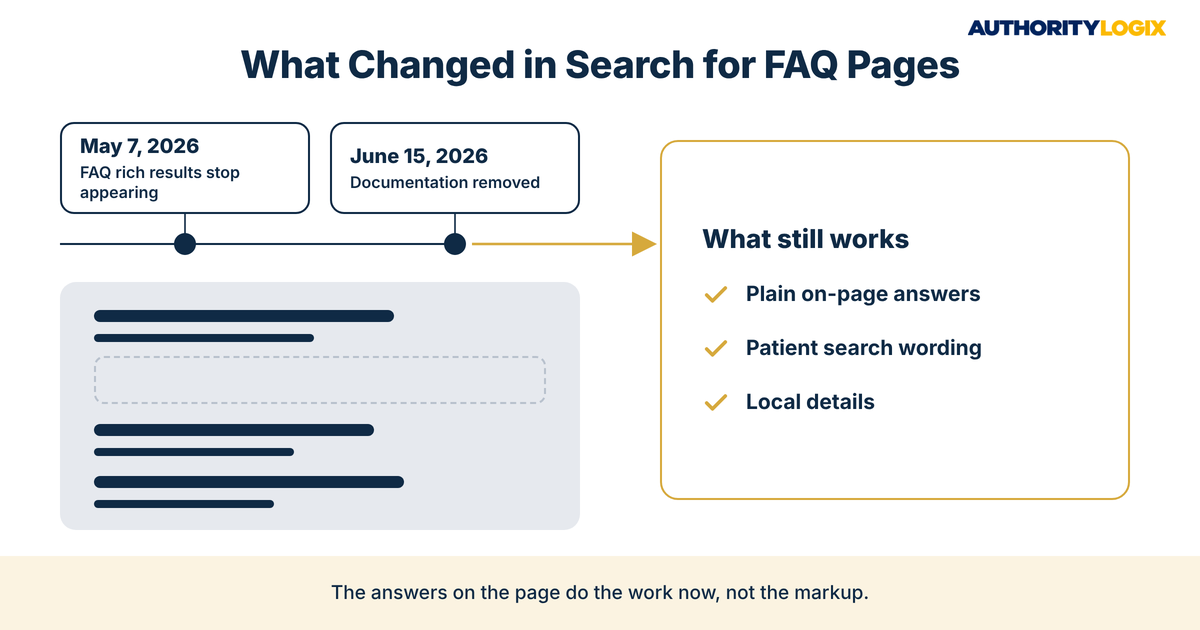
- Google’s FAQ rich result feature stopped appearing in Search on May 7, 2026, so FAQ value now comes from the answers on the page, not from markup.
- The PT FAQ page trust conversion formula is simple: a direct answer, a specific detail, an honest limit and a next step.
- Physical therapy FAQ page patient conversion is measured by booking actions and fewer repeat phone questions, not by page views.
Table of Contents

What a Physical Therapy FAQ Page Patient Conversion Strategy Actually Does for Evaluation Bookings
Physical therapy FAQ page patient conversion is the work of turning a page of answers into booked evaluations. Most practices treat the FAQ page as housekeeping, a list someone wrote years ago that nobody has opened since. Yet it can be the last page a careful patient reads before deciding to call, which makes it part of your lead generation path whether you planned it that way or not.
Think about who actually opens an FAQ page. It is usually the patient who already likes what they saw and now wants to know whether you take their insurance, whether they need a referral and what the first visit will cost. That patient is close to booking, and every vague answer on the page works against physical therapy FAQ page patient conversion.
This is the credible but invisible problem in a small, specific form. Your front desk answers these questions well on the phone every week, and that knowledge rarely makes it onto the website. Physical therapy FAQ page patient conversion moves the front desk’s best answers onto the page, so the patient who would never call to ask still gets the answer and books.
The FAQ page also sits inside a bigger pipeline. The acquisition playbook maps the full path from search to scheduled evaluation, and the FAQ page is where a patient can clear a last objection. Treating physical therapy FAQ page patient conversion as part of that path, rather than as a standalone page, changes what you write and where you put it.
That pipeline thinking is how the AuthorityLogix PT industry hub frames every page a practice publishes. Each page has a job, and the job of physical therapy FAQ page patient conversion is to remove doubt at the moment it matters most. The sections below cover which questions to answer first, how to write answers patients believe, what changed in search and how to measure the results honestly.
The Physical Therapy Patient Education & Clinical Authority Guide shows how physical therapy FAQ page patient conversion fits inside a complete patient education and clinical authority system.
Which Questions to Answer First: Insurance, Direct Access, Cost and Visit Length
Not every question deserves the top of the page. The first answers should cover the questions that decide whether a patient calls at all, and in physical therapy those are almost always insurance, referrals, cost and time. A broader list of the questions patients ask is useful for planning, but physical therapy FAQ page patient conversion starts with the four that block bookings.
Cost hesitation is real. A 2021 survey of 2,099 U.S. adults by The Harris Poll for ATI Physical Therapy found that 33% named physical therapy among the outpatient services they would be most likely to pay a co-pay of $40 or less for without hesitation, well behind urgent care visits at 55%. Most did not list physical therapy, which is why a clear cost answer sits near the top of any physical therapy FAQ page patient conversion plan.
Referral questions come next. APTA’s 2025 report on the state of direct access states that patients in all 50 states, the District of Columbia and the U.S. Virgin Islands have either provisional or unrestricted direct access to physical therapist services. Not every patient knows that, and an answer that explains your state’s rules plainly opens the door to direct-access patients who assumed they needed a physician first.
| Question | Why Patients Ask It | What the Answer Must Include |
|---|---|---|
| Do you take my insurance? | Coverage decides whether they can afford to start | Named plans you accept, plus what to do if theirs is not listed |
| Do I need a referral? | Many assume a physician visit comes first | Your state’s direct access rules in plain words and any plan exceptions |
| What will my visit cost? | Price uncertainty delays the first call | Typical self-pay rates or how you estimate a co-pay before the visit |
| How long is a visit? | Work and childcare schedules are tight | Length of the first evaluation and of follow-up visits at your clinic |
| How many visits will I need? | They want to plan time and money | That the plan of care is set after the evaluation, with no promised number |
A good answer to “how many visits” explains how a plan of care is built after the evaluation; it never promises a number of visits or a result. Physical therapy FAQ page patient conversion depends on answers that are specific about policy and honest about what only an evaluation can tell a patient.

How to Write Answers That Earn Belief: The PT FAQ Page Trust Conversion Formula
Patients can tell a real answer from a deflection. “Please call our office for details” is a deflection, while “We accept most major plans, including the five listed below” is an answer. PT FAQ page trust conversion comes from writing every answer the way your best front-desk coordinator would say it to a nervous first-time caller.
The Four-Part Answer Behind Physical Therapy FAQ Page Patient Conversion
Every strong answer in physical therapy FAQ page patient conversion follows the same shape, and it keeps answers short enough to scan on a phone. Each part has a job, and skipping one is usually where trust leaks out:
- A direct answer in the first sentence, yes or no where possible
- One specific detail that proves you mean it, such as a named plan, a visit length or a self-pay rate
- An honest limit, stating what depends on the evaluation or the patient’s plan
- A next step, such as a booking link, a phone number or a short form
Writing answers this way across every page is a systems job rather than a one-time edit. The same content systems that produce condition pages and service pages should own the FAQ, so a change in accepted plans or visit policy updates everywhere at once. Physical therapy FAQ page patient conversion falls apart the moment an answer on one page contradicts another.
Tone matters as much as content. Answers written in legal language read like a disclaimer, and answers stuffed with clinical terms read like a textbook. The standard laid out in why AuthorityLogix is to write the way clinicians speak to new patients, warm, plain and exact, which is the register that turns physical therapy FAQ page patient conversion from a theory into booked evaluations.
Not sure whether your FAQ page answers the questions that stand between a patient and a booked evaluation? The PT Authority Gap Assessment shows where your physical therapy FAQ page patient conversion is losing people and what to fix first.
Physical Therapy Frequently Asked Questions SEO After Google Retired FAQ Rich Results
For years, many practices added FAQ markup hoping for expandable answers under their search listing. That feature is gone. Google’s Search Central documentation changelog states in its May 8, 2026 entry that the FAQ rich result feature “will no longer appear in Google Search starting May 7, 2026,” and its June 15, 2026 entry states that “the FAQ rich result feature is no longer shown in Google Search results.”
That changes the job of physical therapy frequently asked questions SEO, not its value. Do not add FAQ markup expecting a special search feature, because that feature no longer exists. The value now comes from the answers themselves: plain text, written in the words patients type, sitting on pages that already rank for the services and conditions you treat.
What FAQ Content Still Does for Search Without Rich Results
Well-written answers still give search engines clear, relevant text tied to real patient questions. The content SEO playbook explains how question-based content supports pillar and cluster pages, and FAQ answers are the smallest unit of that structure. A question like “Do I need a referral for physical therapy in New Jersey?” is a real search, and a page that answers it plainly has a reason to appear for it.
Local details belong in those answers too. Parking, the neighborhoods you serve, accepted local plans and directions from the nearest landmark all tell a patient, and a search engine, where the clinic actually is. That is where physical therapy frequently asked questions SEO overlaps with local search, and it is one of the few places a small practice can be more specific than a regional chain.
The broader lesson is that search features come and go while useful pages last. Physical therapy FAQ page patient conversion never depended on a rich result; it depended on whether the patient who landed on the page found an honest answer and a clear way to book.
Turning Answers Into Appointments: Building a PT FAQ Content Booking Driver
An FAQ page that sits alone in the footer converts poorly no matter how good the answers are. A PT FAQ content booking driver works when the right answers appear where the decision happens: on service pages, condition pages, location pages and the booking page itself.
Location pages are the clearest example. A patient comparing your clinics wants parking, hours and accepted plans for that specific address, and the local visibility guide explains why each location deserves its own page. Placing a short, location-specific FAQ on each one turns physical therapy FAQ page patient conversion into a local advantage rather than a generic list.
Condition pages need their own short FAQ as well. A patient reading about low back pain wants to know whether they can book directly, what the first visit involves and how long it takes, and an educational hub that links condition pages to those answers keeps the patient moving toward a decision instead of back to the search results.
Every answer should end with a next step that matches its question. An insurance answer links to the verification form, a referral answer links to the booking page and a cost answer links to the self-pay rates. That small habit is what separates a PT FAQ content booking driver from a reference page nobody acts on.

What Most PT Practices Get Wrong on Their FAQ Pages (Seen From the Patient Side)
The fastest way to audit physical therapy FAQ page patient conversion is to read the page as a patient who has never been to your clinic. The guides across the physical therapy resource library cover the page types where these answers live, and the failures below are the common ones. Each is framed as the question a frustrated patient is actually asking.
Why can’t I tell whether you take my insurance?
Because the page says “we accept most insurance” and stops. Name the plans, say what happens if a plan is out of network and link to a verification form. A patient who has to call just to learn whether they can afford to start often does not call.
Why does every answer say “it depends”?
Some answers do depend on the evaluation, and saying so is honest. The problem is stopping there. A useful answer explains what it depends on, gives the range of what usually happens at your clinic and tells the patient the next step to get a real answer.
Why does the FAQ read like a legal disclaimer?
Usually because it was written to protect the practice rather than to help the patient. Compliance language belongs in your policies, while the FAQ should sound like a friendly, exact conversation with your front desk.
Can I just book online, or do I have to call?
If online booking exists, every relevant answer should link to it. If it does not, the answer should give the phone number, the hours someone answers and what information to have ready, so the call feels easy rather than uncertain.
As a practice owner, who should keep the FAQ current?
The front desk knows the questions, and someone else should own the system that turns them into pages. That split, your team’s knowledge with an outside build, is what we do for practices that are trusted in their community but hard to evaluate online. Without an owner, physical therapy FAQ page patient conversion quietly decays as plans and policies change.
Ready to turn your front desk’s best answers into a physical therapy FAQ page patient conversion system that moves patients from questions to scheduled evaluations?
Measuring Physical Therapy FAQ Page Patient Conversion Honestly
Page views are the wrong scoreboard for an FAQ page. The measures that matter are clicks from answers to the booking page, form submissions started from an FAQ link and a drop in the same questions reaching the phone. The growth blueprint frames measurement around actions like these, and physical therapy FAQ page patient conversion should be judged the same way.
The front desk is your best measurement tool. Ask the team to log the questions callers ask for one month, compare the log with the FAQ and fill the gaps. The same answers can then be reused in new-patient emails, on social channels and in referral-partner materials through authority distribution, so one well-written answer does its job in several places.
Rebuilding for physical therapy FAQ page patient conversion is a short project when it follows a clear sequence, the one laid out in how we build practice content: gather the real questions, write the four-part answers, place them on the pages where decisions happen and measure the booking actions. No one can promise a specific booking lift from an FAQ rewrite, and anyone who does is guessing.
The honest answer is that most physical therapy practices already know exactly what patients need to hear before they book; the front desk says it every day. Physical therapy FAQ page patient conversion simply puts those answers where the next patient can find them. Volume without infrastructure is just noise, and a short page of honest, specific answers does more work than a long page of vague ones.