


Key Takeaways
- Physical therapy niche marketing focuses a practice’s visibility on one condition, population or activity, so the patients who need that focus recognize the practice as the right fit before they call.
- A physical therapy specialty practice signals expertise through visible clinician credentials, condition pages and patient education, not through a longer list of services.
- According to ABPTS, as of July 2026, 45,398 individuals have achieved board certification as clinical specialists in physical therapy, across 10 specialty areas.
- PT condition focused targeting means building search pages and supporting content around the exact problems and situations your chosen patients type into Google.
- Physical therapy niche marketing should be tested against local demand first: what people search, which competitors already own the focus, and whether your team can back it up.
- A clear focus supports PT niche practice growth without turning away general patients, because the specialty earns attention and the whole practice shares the trust it creates.
Table of Contents
Why Physical Therapy Niche Marketing Beats Being Everything to Everyone
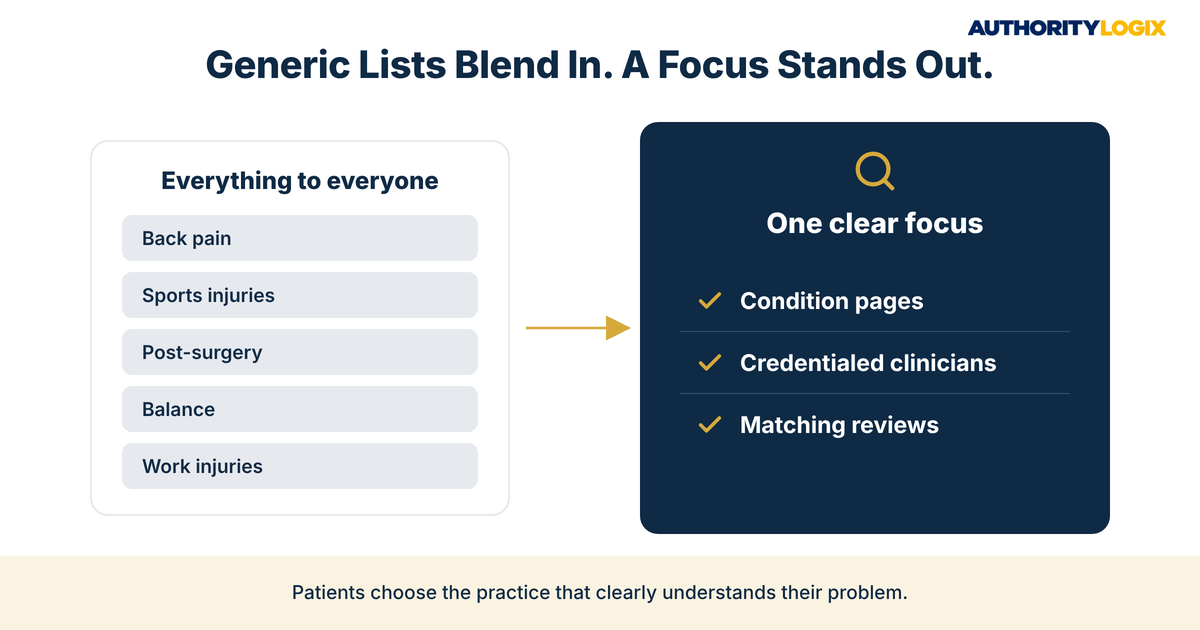
Physical therapy niche marketing starts from a simple observation: a practice that says it treats everyone gives no one a specific reason to choose it. Most PT practices list the same services in the same order, from back pain to sports injuries to post-surgical rehab, and to a prospective patient they look interchangeable. The clinical skill behind those lists may be excellent, but the market cannot see the difference.
That is the credible-but-invisible problem in its plainest form. Your clinicians may have years of experience with runners or older adults, yet your website and Google profile describe a generic clinic. Physical therapy niche marketing closes that gap, because a patient searching for help with a particular problem looks for a practice that clearly understands it.
Real differentiation comes from focus, not from adding more services to the list. When a practice chooses a condition, a population or an activity to lead with, every part of its visibility gets sharper: the headline on the home page, the condition pages, the reviews it asks for and the partners it approaches. Physical therapy niche marketing does not shrink the practice. It gives the market a clear reason to remember it.
This is also where most owners get stuck, because choosing a focus feels like a risk. The worry is that naming a specialty will push away the general patients who pay the bills today. A system-first view of physical therapy niche marketing, which is central to our approach, treats the focus as the front door rather than the whole building, so general patients still find their way in while the specialty does the heavy lifting in search.
The Physical Therapy Patient Acquisition Playbook shows how a focused new-patient pipeline is built, and where physical therapy niche marketing fits alongside referrals, direct access and local search.
How a Physical Therapy Specialty Practice Signals Expertise Before the First Call
A physical therapy specialty practice wins trust before the phone rings. Prospective patients compare practices quickly and look for proof that a clinic understands their exact problem. In physical therapy niche marketing, the signals they notice are concrete: clinician bios that name relevant training, pages that describe their situation in plain language, and reviews from people like them.
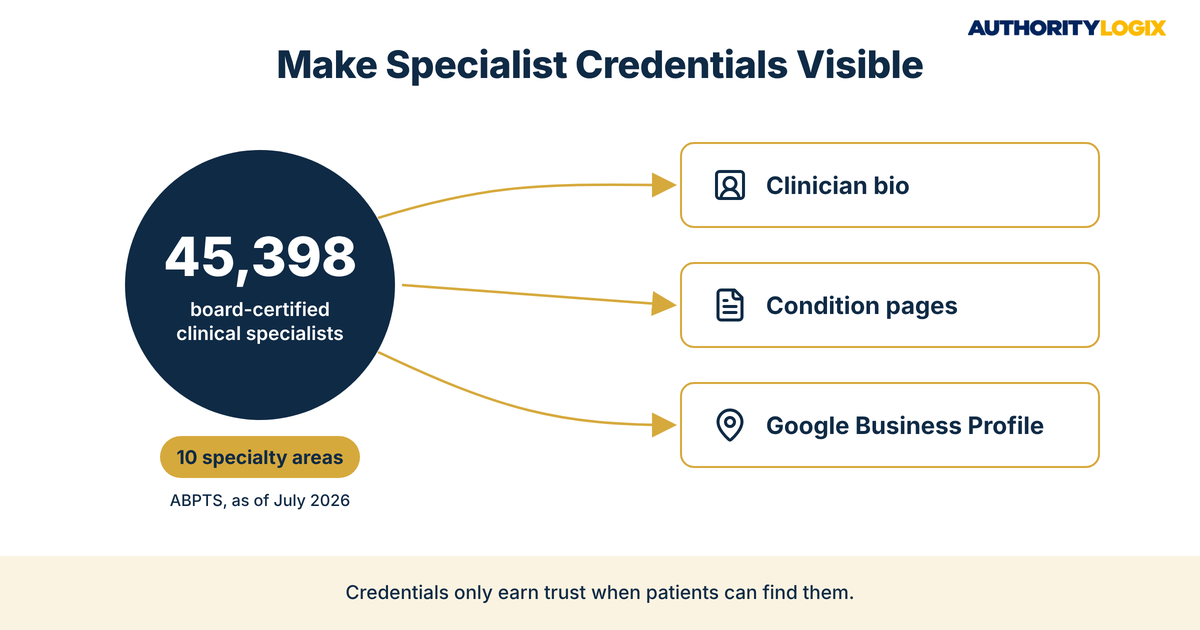
Credentials carry more weight when patients can actually see them. Many people do not know what a credential means until a practice explains it, which is why pages about specialty certifications and what they signal can do real marketing work. A physical therapy specialty practice that explains its training in patient language turns a line in a staff bio into a reason to book.
Board Certification as a Visible Trust Signal
Board certification gives physical therapy niche marketing something verifiable to point to. According to the American Board of Physical Therapy Specialties’ specialist statistics, as of July 2026, 45,398 individuals have achieved board certification as clinical specialists in physical therapy, across 10 specialty areas. When a clinician on your team holds one of those certifications, it belongs on the clinician bio, the matching condition pages and the Google Business Profile, not buried in a staff list.
The same ABPTS figures show how unevenly those specialists are spread across the specialty areas, which matters when you decide what to lead with. Orthopaedics is the largest of the 10 areas by a wide margin, while several areas have only a few hundred certified specialists or fewer. A credential that few local competitors hold is a strong anchor for physical therapy niche marketing, provided there is patient demand behind it.
| Specialty area | Board-certified specialists (ABPTS, as of July 2026) | What it can anchor in physical therapy niche marketing |
|---|---|---|
| Orthopaedics | 25,306 | Condition pages for joint, spine and post-surgical rehab |
| Neurology | 5,768 | Pages for patients and families navigating neurologic conditions |
| Geriatrics | 4,665 | Content for older adults about balance and staying active |
| Sports | 4,153 | Pages and partnerships aimed at athletes, clubs and coaches |
| Pediatrics | 3,219 | Parent-facing education about children’s movement and activity |
| Pelvic & Women’s Health | 1,055 | Discreet, plain-language pages on topics many patients hesitate to ask about |
Credentials are only one layer of trust. The rest comes from clinical authority built through content: clear explanations of the conditions you focus on, honest descriptions of what an evaluation involves, and answers to the questions patients ask before they commit. A physical therapy specialty practice that publishes that material steadily gives search engines and patients the same message, which is how a focus becomes a reputation.
Choosing Your Focus: Conditions, Populations or Activities
Physical therapy niche marketing can be organized around three kinds of focus. A condition focus centers on a problem, such as low back pain or pelvic health. A population focus centers on a group, such as older adults or young athletes. An activity focus centers on what people do, such as running, golf or physically demanding work.
The right choice usually sits where three things overlap: the patients your clinicians already serve well, the credentials and interests on your team, and real demand in your area. A focus that only reflects the owner’s interest will struggle, and a focus with local demand but no clinician to stand behind it will not survive the first phone call. Four questions help narrow the options.
- Which conditions or patient groups already show up most often in your schedule?
- Which clinicians hold credentials or training that support a focus?
- Which focus would give referral partners a clear reason to send people to you?
- Which focus could you write about every month without running out of material?
Testing Local Demand Before Committing
Before you rebuild your website around a focus, check whether people near you are looking for it. Search the condition plus your town and note which practices appear in the map results. If no nearby practice owns the focus, the opening is real, and the local visibility guide shows how to claim it in maps and local results.
Then test with content before you test with a rebrand. Publish two or three pages on the focus, add the specialty to your Google Business Profile services, and watch how many calls and form submissions mention it over the following months. Physical therapy niche marketing works best as a measured commitment, not a leap of faith.
If the early signals are weak, adjust the focus rather than abandon the idea. A broad population focus can narrow later to a condition inside it once the data shows where demand sits. Building those tests into a repeatable plan is part of our services for practices that want a focus chosen on evidence rather than instinct.
Not sure which focus your practice already has the credibility to own? The assessment shows where your physical therapy niche marketing would stall today and what to build first.
PT Condition Focused Targeting in Search and Content
PT condition focused targeting is how a chosen focus shows up where patients actually look. People rarely search for a practice type. They search for their problem, their situation and their town, and a practice that wants to own a focus needs pages that match those searches closely and a site structure that makes the connection obvious to Google.
Physical Therapy Niche Marketing on Condition Pages
Condition pages are the working core of physical therapy niche marketing. Each one should explain the condition in plain language, describe how the practice approaches an evaluation without promising outcomes, introduce the clinicians who focus on it, and make booking easy. Dedicated landing pages built for one condition each give both patients and search engines a clear answer to the question that brought them there.
Around each condition page sits supporting content: answers to the questions patients ask, articles about getting back to the activities they care about, and guides for family members. The structure behind that work, covered in the content SEO playbook, links supporting articles to the main condition page so the whole cluster builds authority together. PT condition focused targeting depends on that structure, because a single page with nothing around it has little to work with.
Local signals complete the picture. The focus should appear in your Google Business Profile services and description, in the categories you choose, and in the way you ask patients for reviews, without scripting what they say. Strong local search foundations make sure the people searching for your focus near you see the practice in the map results, which is where physical therapy niche marketing turns into booked evaluations.

How Physical Therapy Niche Marketing Supports PT Niche Practice Growth Without Losing General Patients
The worry that physical therapy niche marketing will scare off general patients is understandable, but a focus does not have to close any doors. A patient with a common problem who sees deep expertise in a related area can read that as a sign of quality. PT niche practice growth comes from that halo: the specialty earns attention, and the general services share the trust it creates.
The practical answer is structure. Keep a clear general services section on the site, keep your Google Business Profile accurate for everything you treat, and let the specialty lead the home page headline, the featured content and the partnerships. Physical therapy niche marketing then works as a spotlight on one part of the practice while the rest stays easy to find.
Measurement keeps the balance honest. Track how many new evaluations come from the focus, how many come from general searches, and whether the mix changes after the specialty pages go live. That tracking is the measurement layer of the authority growth blueprint, and it shows whether physical therapy niche marketing is pulling its weight or needs a different focus.
A focus also sharpens every path from inquiry to visit. Booking forms can ask about the specific condition, and follow-up emails can speak to that situation. Purpose-built lead generation around a niche is designed to turn more of those inquiries into scheduled evaluations, because each step speaks to the person’s actual concern.

Physical Therapy Niche Marketing FAQ
These are the questions prospective patients and practice owners ask most often when a practice narrows its focus. The answers stay on choosing a practice and on visibility, not on clinical care.
Will a practice that specializes still see me for a different problem?
Often, yes. Many practices with a clear specialty also treat a wide range of common problems, and the quickest way to know is to check the services page or call the front desk. A good practice will tell you plainly if another clinic is a better fit.
What does board certification mean when I compare physical therapists?
Board certification means a physical therapist has been certified by the American Board of Physical Therapy Specialties as a clinical specialist in one specialty area. It is one helpful signal among several, alongside experience, reviews and how clearly the practice explains its approach. Practices that publish a patient educational hub usually explain their clinicians’ credentials in plain language, which makes that comparison easier.
How do I specialize in a niche population without losing current patients?
Start by adding the focus rather than replacing anything: new condition pages, a specialty section on the home page and a steady flow of articles for that population. Repeatable content systems keep that flow going without pulling clinicians away from patients for hours each week. Your existing service pages stay in place, so current patients still find what they need.
How long does physical therapy niche marketing take to show results?
It depends on local competition and on how much relevant content the practice already has. Judge new specialty pages over months rather than weeks, which is why testing a focus with a few pages first is a sensible starting point.
Ready to build the condition pages, credential signals and local search structure that make your practice the recognized name for its specialty?
Turning a Narrow Focus Into a Recognized Local Specialty Brand
Physical therapy niche marketing becomes a local specialty brand when the market hears the same message everywhere it looks. The website, the Google Business Profile, clinician bios and partner materials all need to say the same thing about who you serve best. Expertise is the asset, and the brand is what happens when that expertise is visible and consistent.
Consistency across channels takes a deliberate plan for distribution, so each new condition page or article reaches partners, past patients and local audiences instead of sitting unread on the site. Over time, that repetition makes local referrers think of your practice first for one kind of patient. Physical therapy niche marketing is a repetition game played over years, not a single launch.
AuthorityLogix built its own proof of this approach in a very different niche. BKDSCR.com serves one narrow audience, real estate investors using DSCR loans in New York City’s outer boroughs, and was built with 18 pillar pages, 7 interactive investor tools and 48 blog posts, with zero paid ads. The lesson for a PT practice is the same: a narrow focus served deeply is easier for the market to recognize than a broad one served thinly.
The work itself follows a sequence: choose the focus on evidence, build the condition pages and credential signals, connect them to local search, then publish and distribute steadily. That sequence is our process with practices that want a focus to turn into a reputation rather than a slogan.
Each step of that build is covered in more depth across the PT resources, from condition pages to local visibility. The honest assessment is that most practices already have a specialty hiding inside their schedule. The missing piece is not more expertise but the infrastructure that makes that expertise visible to the patients who need it.