


Key Takeaways
- Physical therapy video marketing lets prospective patients see and hear your clinicians before they book, which closes the trust gap that a text-only website leaves open.
- In Wyzowl’s 2026 State of Video Marketing survey, 63% of people said they would most like to learn about a product by watching a short video.
- The strongest PT video content ideas answer questions patients already ask: who will I see, what happens at the first visit, and what does it cost.
- A physical therapy YouTube channel supports local search when every video carries a patient-friendly title, a local description and a full transcript.
- PT website video conversion depends on placement: put each video on the page where its decision happens, right beside a clear booking step.
- Physical therapy video marketing fits a small-practice budget when filming is batched and scripts come from real front-desk questions.
Table of Contents

Why Physical Therapy Video Marketing Builds Trust Faster Than Text Alone
Physical therapy video marketing solves a problem most owners feel but rarely name: prospective patients cannot see who you are before they book. Your clinicians have years of training, your front desk is warm, and your patients know the care they receive inside the clinic. On a text-only website almost none of that comes through, and your practice looks much like every other listing in town. That gap is common among PT practices that are credible but invisible to anyone outside their referral network.
A person in pain who is choosing a physical therapist is making a personal decision. They want to know who will listen to them, what the clinic looks like, and whether the first visit will feel rushed or careful. A short video answers those questions in a way paragraphs cannot, because tone of voice, body language and the space itself all show up on screen. Physical therapy video marketing turns those signals into something a stranger can check at midnight from a phone.
Broad consumer research points the same way. In Wyzowl’s 2026 State of Video Marketing survey, 63% of people said they would most like to learn about a product by watching a short video, and 85% said they had been convinced to buy by watching a video, according to its video statistics. Those figures describe consumers in general rather than physical therapy patients, but they reflect the same viewing habit your prospective patients bring to your website.
The goal is not to film more for its own sake. Physical therapy video marketing earns its place when each video has a specific job inside a connected system, which is how our services are structured for PT clinics: content, local search, patient education and lead capture built to work together. A video that sits alone on a social feed is a post. A video that answers a real question on the right page, with a clear next step, is infrastructure.
Physical therapy video marketing also does something reviews cannot. A review tells a stranger that someone else liked your practice, while a video lets that stranger form a first-hand impression of the clinician they will meet. When both appear together on your site, the visitor gets proof from other patients and a direct sense of your team, and that combination is what builds trust before the first phone call.
The Physical Therapy Patient Acquisition Playbook shows where physical therapy video marketing fits inside a complete new-patient pipeline, from the first search to a booked evaluation.
PT Video Content Ideas That Answer Patient Questions Before They Call
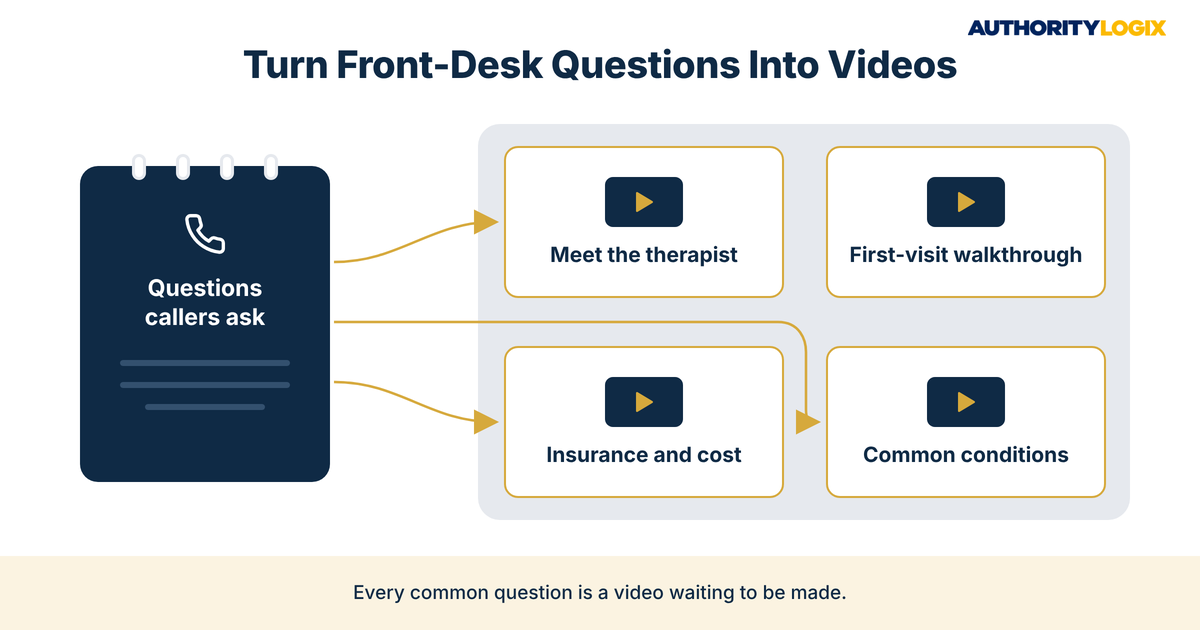
The most useful PT video content ideas do not come from trend lists. In physical therapy video marketing, they come from your front desk, where the same questions arrive every week. Do I need a referral? How long is the first visit? What should I wear? Every one of those questions is a video that saves a phone call and removes a reason to hesitate.
Ask your front desk to write down every question callers ask for two weeks, then group the questions into themes: first-visit logistics, insurance and cost, the clinicians, and common conditions. Condition explainers deserve their own track, and the approach to video education about conditions and treatment explains how to keep those videos clear, accurate and focused on helping patients decide whether to book.
Meet-the-Therapist and First-Visit Walkthroughs
Two formats tend to carry the most weight in physical therapy video marketing because they answer the most personal questions. A meet-the-therapist video, sometimes called a physical therapy welcome video, lets each clinician introduce themselves, their training and the kinds of patients they enjoy working with. A first-visit walkthrough follows the path a new patient takes, from parking and check-in to the evaluation room, so nothing about the first appointment feels unknown.
Keep both formats about people and process, not clinical promises. A therapist can explain how they approach a first evaluation without suggesting any result, and that restraint is part of responsible patient education. Never film patients or show anything that could identify them, because staff, empty treatment areas and the front entrance tell the story without any privacy risk.
Once your physical therapy video marketing has its first videos, give them a permanent home. A set of short answers grouped by topic and embedded beside written explanations on an educational hub lets visitors find the exact question they came with and watch the answer in a minute or two. That structure also gives search engines a clear map of what your practice knows and who it serves.
Short-form videos have a place in physical therapy video marketing too. A 30-second clip cut from a longer walkthrough works on social channels, in reminder emails and on your Google Business Profile, and it points viewers back to the full version on your site. That reuse is one of the most practical physical therapy social media tips for a busy clinic: film once, then publish the pieces wherever patients already look.
Building a Physical Therapy YouTube Channel That Supports Local Search
A physical therapy YouTube channel is less about subscribers than about being findable. They will find one video through a search, a Maps listing or your website, and that single video has to answer their question and tell them where you are. Treat the channel as a searchable archive of your practice’s answers rather than a media brand.
Each video should name your town or neighborhood naturally in the spoken introduction and in the description. The description should also include your practice name, address and booking link exactly as they appear everywhere else, because that consistency ties the channel to the rest of your local search footprint and keeps your details matching on Maps, on your website and on every video.
Titles, Descriptions and Transcripts
Titles should match how patients phrase a question, not how clinicians label a condition. A nervous first-time patient understands a title about what to expect at a first physical therapy visit in their town, while a clinical term may mean nothing to them. Descriptions should summarize the answer in two or three sentences and link to the matching page on your site.
Transcripts deserve the same care in physical therapy video marketing. A full transcript makes each video usable for people who watch without sound, and when the same text appears on the page where the video is embedded, it gives search engines the full substance of the answer. That is the discipline behind sound content SEO across a practice site: every page and every video built around one clear question and one clear next step.
A physical therapy YouTube channel also needs playlists that mirror your site structure, such as first visit, meet the team, conditions and patient questions. Playlists keep viewers moving to the next relevant answer.
Not sure whether your website and videos are earning trust or losing visitors before they book? The assessment shows where physical therapy video marketing would close the biggest gaps in your practice today.
PT Website Video Conversion: Where Videos Belong on Your Pages
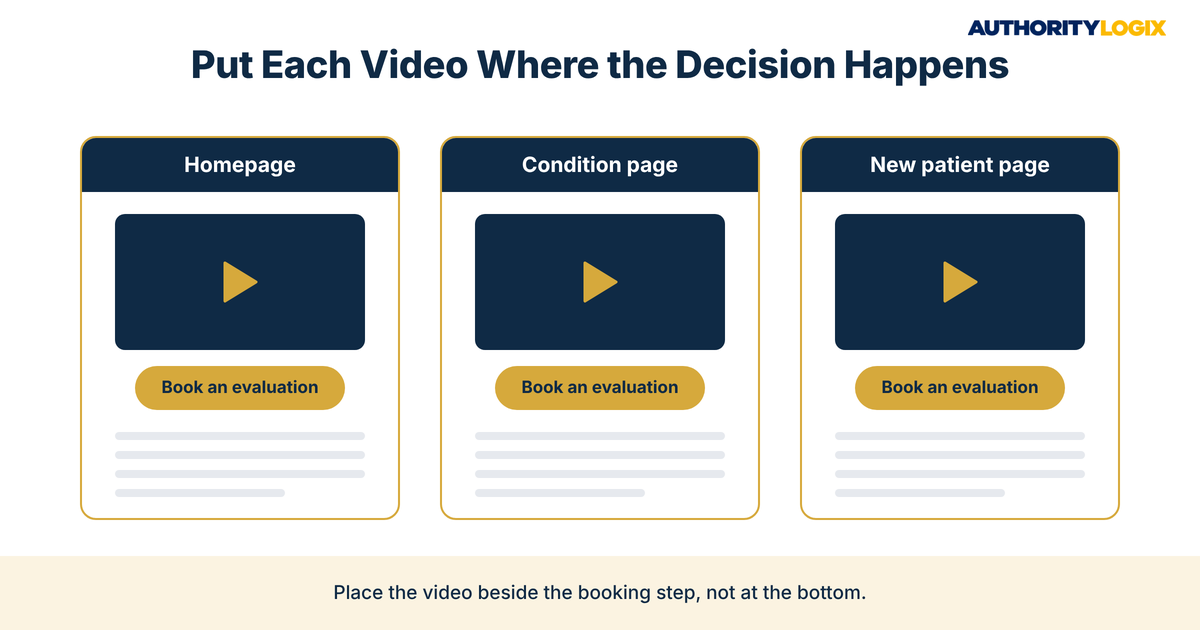
PT website video conversion depends more on placement than on production quality. A polished video buried on an about page does little, while a plain, honest video beside the booking button on a condition page can be the reason a visitor finally calls. Match each piece of physical therapy video marketing to the page where the decision it supports actually happens.
Many visitors leave a practice site without acting, usually because a question went unanswered or the booking path felt like work. Placing the right video at the moment of doubt is one of the most direct fixes for website abandonment, because it answers the question in the visitor’s own time instead of asking them to pick up the phone.
| Page | Video that belongs there | Job it does |
|---|---|---|
| Homepage | Short practice welcome video | Shows the team and the space in about a minute |
| Clinician bio pages | Meet-the-therapist video | Puts a face and a voice to each name |
| Condition pages | Short condition explainer | Explains how an evaluation looks at the problem |
| New patient page | First-visit walkthrough | Removes uncertainty about the first appointment |
| Insurance and cost page | Front-desk explainer | Answers coverage questions before the call |
| Booking or contact page | What-happens-next clip | Shows what happens after the form is sent |
Length matters as well. In the same Wyzowl survey, 71% of video marketers said videos between 30 seconds and 2 minutes work best, and 82% said video had increased dwell time, meaning the time visitors spend on their pages. For a practice website, that points physical therapy video marketing toward short, single-question videos rather than long overviews that try to cover everything at once.
Physical Therapy Video Marketing Calls to Action
Every video should end with one clear step, spoken aloud and shown on screen: book an evaluation, call the front desk, or read the full answer on the page. Physical therapy video marketing that ends without an ask leaves the visitor to work out what to do next. Many of them will simply close the tab and move to the next listing.
Put the booking button or a short form directly beneath each embedded video, not at the bottom of a long page. When the call to action, the form and the follow-up email all connect, video becomes part of your lead generation system rather than a nice extra.
Producing Physical Therapy Video Marketing on a Small-Practice Budget
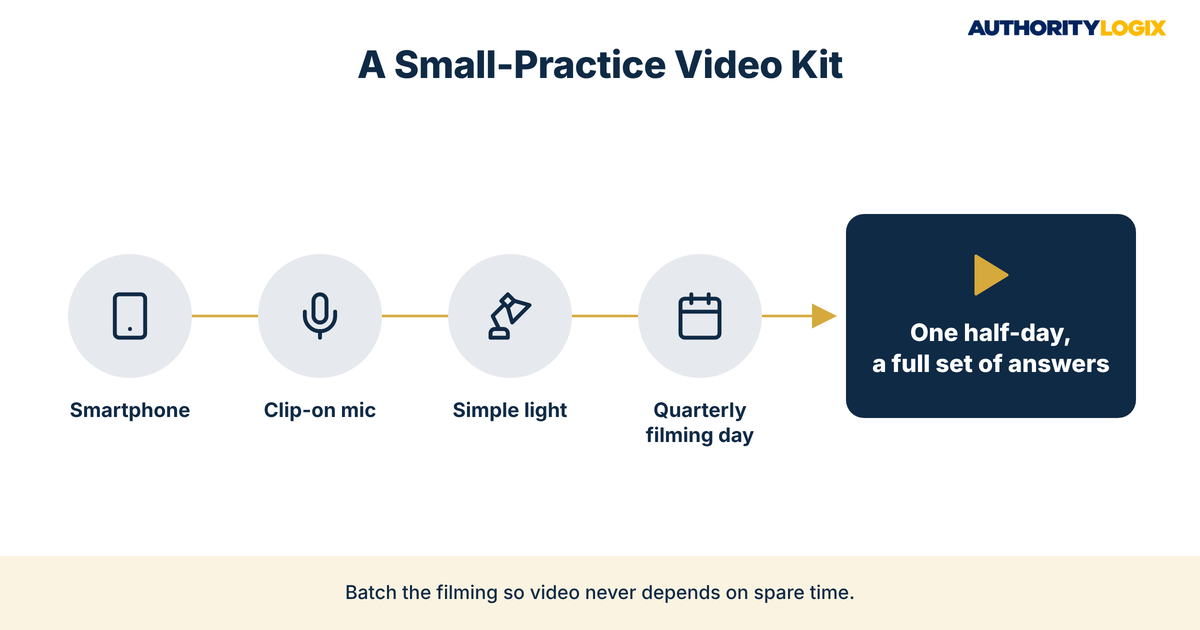
Physical therapy video marketing does not require a production company. A recent smartphone, a clip-on microphone, a simple light and a quiet treatment room are enough for most practice videos. Patients are not judging cinematography. They are judging whether the clinician seems knowledgeable, calm and easy to talk to.
The cost that sinks most physical therapy video marketing efforts is time, not equipment. Owners film a few clips, the schedule fills up, and the project stalls for months. Repeatable content systems fix that by batching the work: one half-day each quarter to film a set of scripted answers, with editing, captions and publishing handled on a schedule afterward.
Scripts should be short outlines, not word-for-word text. Give each clinician three or four points to cover, let them speak naturally, and keep the best take. That approach mirrors our process with every practice: the clinician supplies the knowledge, and the system handles structure, production and publishing.
AuthorityLogix built the same kind of infrastructure for its own proof-of-concept, BKDSCR.com, a real estate investor education platform with 18 pillar pages, 7 interactive tools and 48 blog posts, built in under 18 months with zero paid ads. The market is different, but the lesson carries over: a small operation can build real authority when every asset is planned to support the next one. Every piece has a job. Every piece feeds the next.
Physical Therapy Video Marketing FAQ
Practice owners and prospective patients ask many of the same questions about video. The answers below cover the ones that come up most often when a practice starts physical therapy video marketing.
How many videos does a practice need to start?
Most practices can start with a small set: a welcome video, one meet-the-therapist video per clinician, a first-visit walkthrough and two or three answers to the most common front-desk questions. Add more as new questions come in.
Should a practice post videos on social media or only on its website?
Both, but the website comes first because that is where visitors book. Clips cut from website videos work well on social channels and in emails, and a planned approach to distribution makes sure each video reaches patients in more than one place.
Can a video tell me whether physical therapy will help my condition?
No video can tell you how your own condition will respond to care. A good practice video explains what an evaluation involves and what the therapist will ask, so you can decide whether to book and arrive prepared.
Will I appear in a practice video if I become a patient?
Responsible practices do not feature patients or any detail that could identify them. Videos built around staff, the clinic space and general education protect patient privacy and still show newcomers what to expect.
Where can I see physical therapy website examples that use video well?
Look for practice sites that answer questions in plain language and make booking easy from every page, then compare them with your own. The articles in our PT resources library cover the pages, content and local search work that video supports.
Ready to build the physical therapy video marketing system, from filming to page placement and booking, that turns website visitors into evaluations?
Turning Video Views Into Evaluation Requests
Physical therapy video marketing is not a shortcut, and views alone do not fill a schedule. What it does is let a stranger see the people and the care inside your clinic before they commit to a call. Paired with accurate listings and strong local visibility, that first-hand impression turns a search result into a practice the patient already feels they know.
Measure what matters in physical therapy video marketing: which videos sit on pages that produce booking requests, which questions patients mention when they call, and which clips bring people back to your site. Those signals show where to film next and how video fits a longer plan for authority growth across the practice.
The honest assessment is that most practices already have what patients are looking for: skilled clinicians, a welcoming team and a careful way of working. The missing piece is a physical therapy video marketing system that puts all of that on screen, on the right pages, with a clear next step, so the market can see what you have already built.