


Key Takeaways
- Physical therapy specialties build trust when they are presented as proof of the whole practice’s quality, not as the practice’s only identity.
- A practice-first homepage with a clear specialty layer beneath it serves general patients and specialty patients at the same time.
- Navigation labels in plain patient language, such as Services and Specialty Programs, keep general visitors oriented while still giving physical therapy specialties a visible home.
- Physical therapy niche content works best when it is balanced with general content and linked back to core services and the booking page.
- Under APTA policy, only physical therapists who have completed the ABPTS certification process may use the title board-certified clinical specialist, so credentials on specialty pages must be stated precisely.
- PT specialty page conversion depends on plain-language copy, accurately stated credentials and one clear request for an evaluation.
Table of Contents
Why Physical Therapy Specialties Can Attract or Repel the Patients You Want
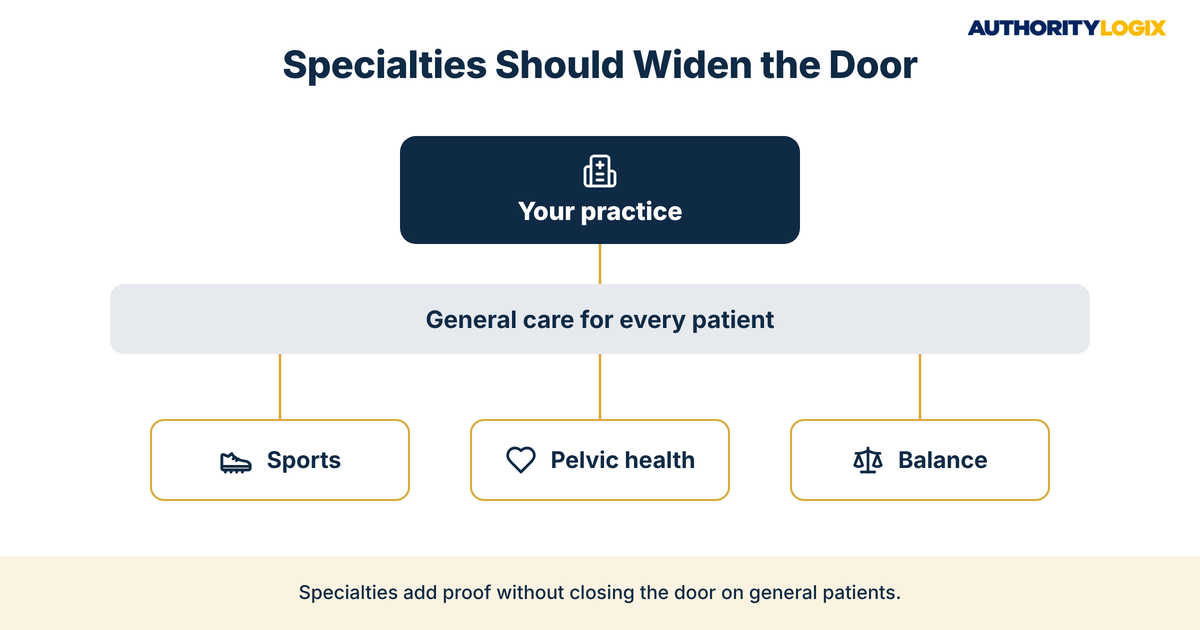
Physical therapy specialties are one of the clearest trust signals a practice can show, and one of the easiest ways to tell general patients they are in the wrong place. A clinic with a pelvic health program, a sports clinician and a balance program has real depth, but a homepage that leads with all three can read like a specialty center that does not see everyday back pain. Good patient acquisition widens the pipeline, and a specialty presented badly quietly narrows it.
Most practice owners add specialties for sound reasons. The website then gets a new banner, a new menu item and a new page, often without anyone asking how a first-time visitor with a sore shoulder will read the change. That is how physical therapy specialties end up competing with the general care the practice still provides every day.
The expertise behind those programs is real, yet the market sees either nothing or the wrong thing. Specialty patients cannot find the program, and general patients assume the practice is not for them. Effective PT marketing treats physical therapy specialties as proof of quality for every patient, so the specialty raises confidence across the whole practice instead of sorting visitors into yes and not for me.
Specialties are also among the few honest ways to stand apart in a crowded local market. Every clinic in town claims personalized care, but far fewer can show a clinician who completed a board certification process or a program built around one patient group. Used well, physical therapy specialties become the backbone of differentiation, because they give patients a concrete reason to choose you that a competitor cannot copy overnight.
The risk runs both ways. Hide your specialties and you lose the patients searching for them; over-feature them and general patients quietly book elsewhere. Practices that handle physical therapy specialties well treat them as one layer of a planned authority growth system, where the specialty pages, the general service pages and the homepage each have a defined job.
The Physical Therapy Patient Education & Clinical Authority Guide shows how clinician expertise becomes visible patient trust, including where physical therapy specialties fit inside a practice’s wider patient education.
PT Specialty vs General Care: How Patients Read Your Homepage
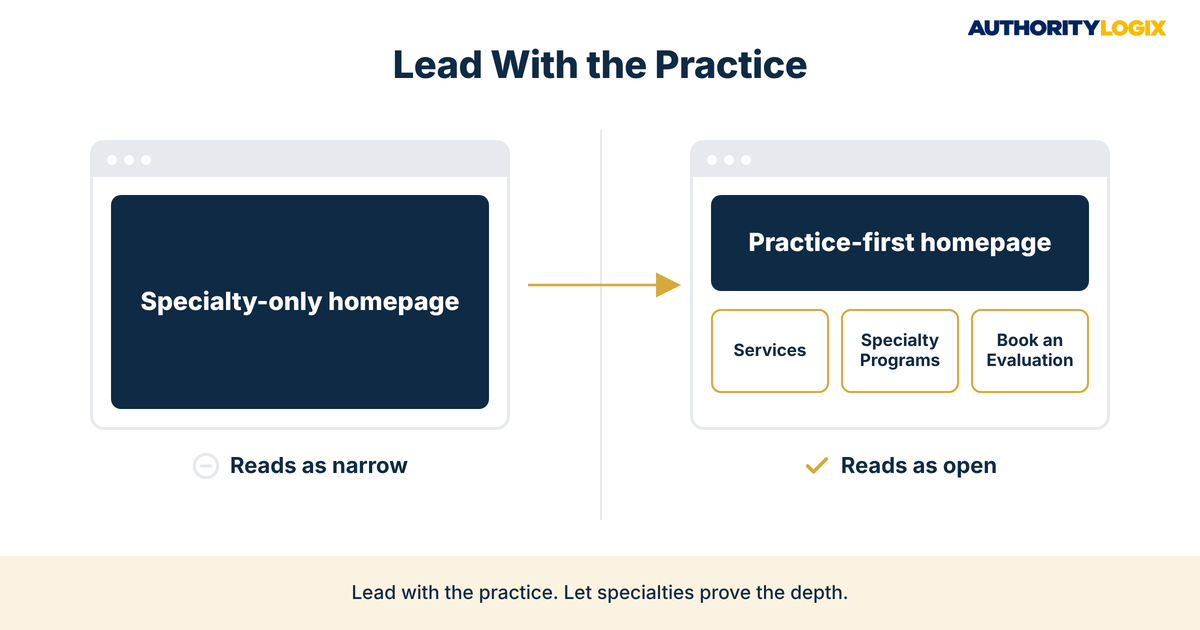
The PT specialty vs general tension plays out in the first few seconds on your homepage. A visitor arrives with one question: can this practice help someone like me? If the headline, the hero image and the first three menu items all point to one specialty, a general patient answers no and leaves, even when your team treats their problem every week.
Specialty patients read the same page differently. A runner, a new parent or an older adult worried about balance is looking for evidence of depth, and a homepage that never mentions physical therapy specialties gives them nothing to hold on to. The page has to serve both readers at once, which is a structure problem, not a copywriting trick.
Most of these visitors arrive from a search, so the homepage is rarely the first impression on its own. The Google Business Profile, the map listing and the review snippets have already framed your practice before the click, and that framing should match what the homepage says. Consistent categories and service descriptions across your local visibility footprint keep a general patient from feeling misled when the site opens on a specialty banner.
The fix is a hierarchy. Lead with the practice and the everyday problems it solves, then present physical therapy specialties as a second layer that proves the depth behind that promise. That ordering is one of the first things AuthorityLogix reviews on a PT website, because it shapes how every other page on the site is read.
How to Structure Physical Therapy Specialties on Your Website
Structure decides whether physical therapy specialties support the practice or split it. The cleanest model has three levels: a homepage that speaks to every patient, general service pages for the common reasons people seek care, and dedicated specialty pages beneath them. Each level links to the others, so no visitor hits a dead end.
| Page level | Main job | Primary reader |
|---|---|---|
| Homepage | Show who the practice helps and how to book | Every first-time visitor |
| General service pages | Explain everyday care for common concerns | Patients with ordinary aches and injuries |
| Physical therapy specialties pages | Show the program, the clinicians and who it serves | Patients looking for a specific kind of care |
| Clinician profiles | State credentials and certifications accurately | Patients comparing therapists |
| Booking page | Make the first evaluation easy to request | Every patient ready to act |
This structure also matches how search engines read a site. A clear parent-child relationship between general service pages and specialty pages tells Google what the practice covers and how the topics relate, which is the foundation of content SEO for a clinic. Specialty pages buried three clicks deep, or orphaned with no links pointing to them, struggle to earn visibility for the searches they were built for.
Navigation Labels That Keep General Patients Oriented
Navigation is where many practices lose general patients without noticing. A top menu that reads Sports Rehab, Pelvic Health, Vestibular and Concussion tells a visitor with knee pain that the practice is a collection of specialty programs. A menu that reads Services, Specialty Programs, Our Team and Book an Evaluation keeps everyone oriented and still gives physical therapy specialties a visible home.
Location matters as well. A practice with several clinics should state which specialties are offered at which location, on both the specialty page and each location page, so a patient never books a sports evaluation at a site without a sports clinician. Accurate location details also strengthen local search signals, because the services listed on the site match the services listed on each map profile.
Not sure whether your website presents physical therapy specialties in a way that welcomes every patient? The assessment shows where your structure, navigation and specialty pages are holding back new evaluations.
Creating Physical Therapy Niche Content Without Narrowing Your Brand
Physical therapy niche content is where specialties earn search visibility. Articles, guides and FAQ pages written for one patient group answer the specific questions those patients search, and they show the depth behind each specialty program. The risk is that a library full of niche topics can make the whole site look like it serves only those groups.
The answer is balance by design, not by accident. For every cluster of physical therapy niche content, publish matching general content on the everyday problems most patients bring through the door. Repeatable content systems make that balance practical, because the publishing plan assigns topics across specialty and general care instead of following whichever clinician has the most enthusiasm that month.
Organization matters as much as volume. Group niche articles under their specialty, group general articles under their service area, and give patients one place to browse all of it. A well-built educational hub does that job, letting a general patient find answers about everyday care while a specialty patient goes straight to the program that fits.
AuthorityLogix uses the same architecture on its own proof-of-concept build. BKDSCR.com, a real estate investor education platform AuthorityLogix built from scratch, runs 18 pillar pages and 48 SEO-optimized blog posts, with narrow topics sitting under broad pillars so no single niche defines the whole site. The subject is different, but the structure transfers directly to physical therapy specialties.
Linking Niche Content Back to Core Services
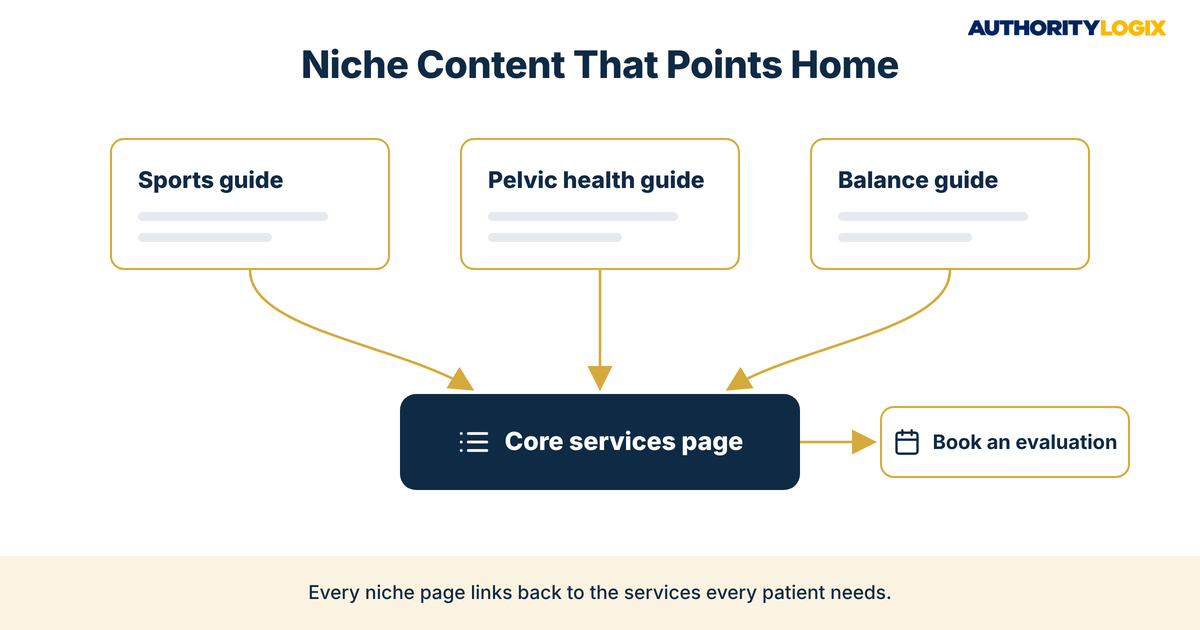
Every niche article should point readers back to the general services and the booking page, not only to its own specialty. A post written for runners can link to the sports program and to general orthopedic care, so a reader whose problem turns out to be ordinary still finds a clear next step. Practices that publish this way end up with a resource library that serves the whole community rather than a single segment.
Internal links also protect search performance. When niche pages link up to core service pages, they pass relevance to the pages that matter most for general patients, and the core pages link back down to the specialties. Physical therapy niche content then strengthens the whole site instead of competing with it.
What Drives PT Specialty Page Conversion
PT specialty page conversion depends on whether a visitor quickly sees three things: this program is for someone like me, the clinician is qualified, and booking is simple. Specialty pages that open with a wall of clinical terminology, or that end without a clear booking step, lose the patients they were built to attract.
Strong physical therapy specialties pages work like focused landing pages. They name who the program serves in plain language, describe what a first visit looks like, introduce the clinicians by name and credential, answer common questions, and end with one clear request for an evaluation. Each page also states that the practice treats general concerns, so a visitor who lands in the wrong place is redirected rather than lost.
Specialty pages also need a conversion path that suits the patient’s stage. Some visitors are ready to book, while others want a free guide, a short call or an answer to one question before they commit. Building those options into each page is part of lead generation, and tracking which specialty pages produce evaluations shows where a program needs clearer copy or a better offer.
Explaining Board Certification Accurately on Physical Therapy Specialties Pages
Board certification is one of the strongest credentials a specialty page can show, and it carries rules. Under the APTA clinical specialization policy, clinical specialization in physical therapy is a voluntary and unrestricted process, and only physical therapists who have completed the ABPTS certification process may use the title board-certified clinical specialist. Pages should use that exact title only for clinicians who hold it and describe other advanced training in plain, accurate terms.
The same policy states that no attempt is made to prohibit others from practicing in a specified area, and that certified physical therapists are not required to restrict their practice. That point is useful on a specialty page, because it lets you say honestly that a board-certified specialist on your team also sees general patients.
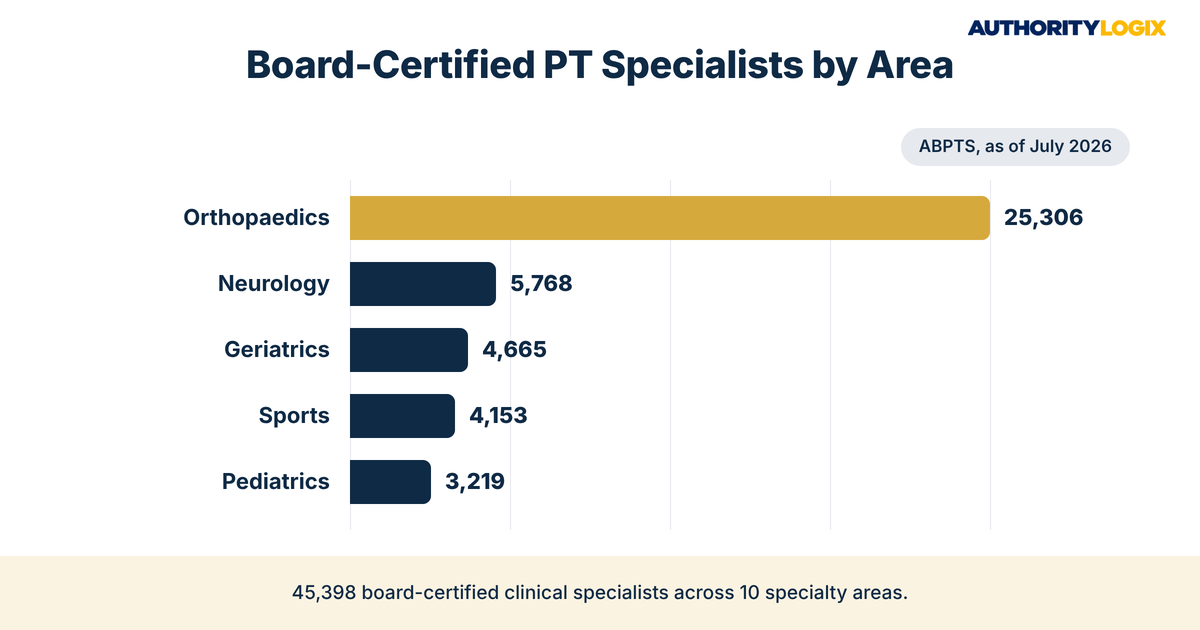
The scale of certification is worth knowing too. According to the American Board of Physical Therapy Specialties, as of July 2026, 45,398 individuals have achieved board certification as clinical specialists in physical therapy, across 10 specialty areas. Orthopaedics is by far the largest group, as the table below shows.
| Specialty area | Board-certified specialists (ABPTS, as of July 2026) |
|---|---|
| Orthopaedics | 25,306 |
| Neurology | 5,768 |
| Geriatrics | 4,665 |
| Sports | 4,153 |
| Pediatrics | 3,219 |
| All 10 specialty areas combined | 45,398 |
Those figures belong in your planning, not as filler on a patient page. They show which physical therapy specialties are common credentials and which are rare, which helps you decide how much explanation a certification needs when patients may never have heard of it.
Physical Therapy Specialties FAQ for Practice Owners
These questions come up whenever a clinic starts promoting physical therapy specialties. The answers focus on presentation and visibility, not on clinical decisions, which always belong to the treating therapist.
Will promoting a specialty make general patients think we only treat that condition?
It can, if the specialty dominates the homepage and the main menu. Keep the homepage practice-first, give specialties their own section, and state on every specialty page that the practice also treats everyday concerns.
What does a board-certified physical therapist mean for patients?
It means the therapist completed the certification process run by the American Board of Physical Therapy Specialties in a specific area. How patients weigh credentials like this when choosing a practice is covered in our article on specialty certifications. Your pages should explain the credential in plain words rather than relying on initials.
Can a small practice present specialties without a large website?
Yes. A small practice can start with one specialty page per real program, one profile per clinician and a short set of FAQ pages, then add content over time. That staged approach mirrors how our services are sequenced for PT clinics: structure first, volume second.
Can we call a clinician a specialist if they are not board-certified?
Be careful with the wording. APTA policy reserves the title board-certified clinical specialist for therapists who completed the ABPTS process, so describe other advanced training by its actual name and let the patient weigh it.
Ready to build a website structure that presents your physical therapy specialties as proof of quality while keeping every general patient welcome?
Positioning Specialty Expertise as Proof of Quality for Every Patient
Physical therapy specialties are not a separate audience strategy. They are evidence that the whole practice holds itself to a higher standard, and that message can reach the patient with ordinary back pain as clearly as the athlete or the new parent. Presenting them that way comes down to hierarchy, accurate credentials and connected content, the same order of work that defines our process.
Once the pages are right, specialty expertise deserves to travel. Clinician spotlights, short educational posts and community talks each carry the specialty to people who have never visited your site, and consistent distribution keeps those messages pointing back to a practice that welcomes everyone. Expertise is the asset; the system decides who sees it.
The honest assessment is that most practices with strong physical therapy specialties are not short on expertise. They are credible but invisible to part of their market, because the site either tells general patients they are in the wrong place or hides the depth specialty patients want to see. Fix the structure, and the same expertise starts working for every patient who finds you.