


Key Takeaways
- Post-surgical physical therapy patients can start comparing practices as soon as surgery is scheduled, so the content that reaches them must exist before the procedure.
- PT prehab content answers the practical questions patients ask while they wait: when to book, what the first visit covers and how scheduling and insurance work.
- Surgical patient education content after discharge, from the discharge sheet to opted-in follow-up emails, keeps your practice in view while patients choose where to rehab.
- Surgeon relationships still matter, but a practice that depends on one or two surgical groups for post-surgical physical therapy patients carries the risk that a single change empties the schedule.
- Post surgery rehab marketing works when each channel matches a stage of the recovery timeline, from the day surgery is scheduled to the first weeks of care.
- A before-and-after content set for every common procedure turns scattered handouts into a lasting asset.
Table of Contents

Why Post-Surgical Physical Therapy Patients Start Searching Before Their Procedure
Post-surgical physical therapy patients rarely wait for a discharge packet to decide where they will rehab. Once a date is set, they have time to read about recovery, check which clinics are close to home and ask friends who went through the same procedure. If your practice is invisible during that window, your patient acquisition depends on whatever list the surgeon’s office happens to hand out.
You already have the clinical experience these patients need. Your therapists have treated knees, shoulders and hips after surgery for years. What the patient planning a procedure next month sees, though, is a website with a generic services page and nothing about their surgery. Closing that gap is the work of PT marketing built around the way surgical patients actually decide.
The volume of planned surgery makes this window worth owning. The American Joint Replacement Registry’s 2025 Annual Report includes an analysis of more than 4.4 million hip and knee arthroplasty procedures collected from 2012 through 2024, and the AAOS announcement notes that this represents an 8.8% increase in procedure count compared to the previous year. Joint replacement is only one category of planned surgery, and every scheduled procedure gives a patient time to look for a physical therapist before the operation.
Search is where much of that looking happens. A patient who types the name of their procedure, the words physical therapy and their town into Google is ready to choose, and the practices that appear in local search with clear procedure pages are the ones that get the call.
Visibility before surgery also protects the practice from a quieter risk. When post-surgical physical therapy patients reach you only through one orthopedic group, a single retirement or partnership change can empty the schedule: one referring doctor retires and the pipeline dries up overnight. Building local visibility that patients find on their own means the schedule no longer rests on one office’s handout.
The Physical Therapy Patient Education & Clinical Authority Guide shows how to build the patient education that earns trust, including the pre-surgery and post-discharge pages that reach post-surgical physical therapy patients at the right moment.
What PT Prehab Content Should Explain to Patients Weeks Before Surgery
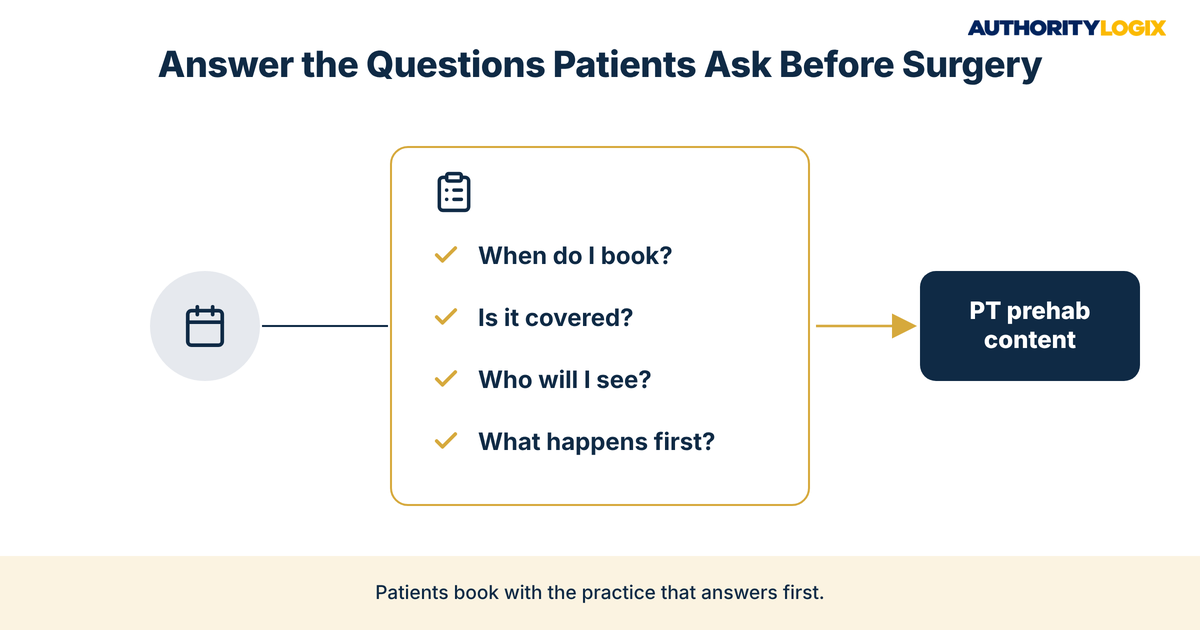
PT prehab content is the set of pages, guides and messages a patient reads between the day surgery is scheduled and the day of the procedure. Its job is not to give clinical instructions, which belong to the surgeon and the treating therapist. Its job is to answer the practical questions that decide where post-surgical physical therapy patients book: who you are, how soon they can be seen, and how the first weeks are scheduled.
Start with the visit itself. Post-surgical physical therapy patients planning ahead want to know what happens at the first session after the operation, how long it lasts and what to bring, and a clear page about the first appointment removes much of the uncertainty that makes people default to whichever clinic the surgeon’s office mentions. Explain who they will meet and how your team communicates with their surgeon, without promising any recovery timeline.
Then organize everything by procedure. Knee replacement, ACL reconstruction, rotator cuff repair, hip replacement and spine surgery each raise a distinct set of questions, and post-surgical physical therapy patients search for their own procedure by name. When every procedure has a home inside a patient educational hub, the practice looks like the obvious place for that surgery rather than a general clinic that also takes post-op cases.
Questions to Answer About Scheduling and Insurance
The questions that most often stall a booking are practical ones. When should I call to schedule? Will my plan cover the visits, and do I need a referral or a prescription? Can I book my first visit before the surgery date so a time is held for me? PT prehab content that answers these directly, in plain language, gives post-surgical physical therapy patients a reason to call you first.
Be careful with insurance details. Coverage rules differ from plan to plan, so the honest approach is to explain the process, such as verifying benefits, confirming any referral requirement and calling the patient back with what you find, rather than promising coverage. Mapping questions like these to pages before anything is written is how our process starts with every practice, because the patient’s questions decide which pages get built.
How Surgical Patient Education Content Reaches Patients After Discharge
Discharge is the second decision point. Post-surgical physical therapy patients leave the hospital or surgery center with a folder of paperwork, a list of instructions and, often, a short list of nearby practices. Surgical patient education content that is already on their phone or in their inbox gives your practice a place in that moment that a business card at the front desk never will.
This material has to be produced as a set, not one page at a time. A practice that writes a post-op article whenever someone has a free afternoon ends up with gaps for half its procedures, while a practice that runs repeatable content systems publishes a matching before-and-after set for each surgery it treats.
Discharge Packet and Email Follow-Up Content
The discharge packet is the one piece of print many post-surgical physical therapy patients keep. Work with the surgical offices you already know to include a one-page sheet with your locations, hours, booking number and a short web address for the procedure page. Keep it about access and scheduling, never about clinical care, so the surgeon’s team is comfortable passing it along.
Email follow-up works for post-surgical physical therapy patients who booked ahead or asked to be contacted. A short message after the expected discharge date, a reminder before the first visit and a note pointing to the relevant procedure page keep the relationship active without asking much of a patient who is tired and sore. Send these only to people who opted in, and keep health details out of subject lines and preview text.
The same material should also live where any patient or family member can find it. Collecting procedure guides, first-visit pages and recovery FAQs in one place, the way a resource library organizes them, gives post-surgical physical therapy patients a reason to read a second page before they pick up the phone.
Not sure whether post-surgical physical therapy patients can find your practice before and after their procedure? The assessment shows where your pre-surgery and discharge content leaves gaps and what to build first.
Building Surgeon Relationships That Send Post-Surgical Physical Therapy Patients Your Way
Surgeons remain one of the most important sources of post-surgical physical therapy patients. What changes is how you support them. A surgeon’s office is more comfortable recommending a practice whose website already explains its approach to each procedure, because the patient who checks that site finds answers that match what the office told them.
Treat each surgical practice the way you would treat any partner who sends you patients. Learn which procedures they perform most, ask how their team prefers to receive updates, and give them materials that make their own jobs easier, such as procedure-specific handouts their staff can share. The structure behind lasting referral partnerships applies here too: an owner on your team, a regular touchpoint and a way to see what comes back.
Still, do not let surgeon referrals become the whole plan. A practice that receives most of its post-op cases from one or two surgical groups is exposed to every change inside those groups, whether that is a retirement, a merger or a new in-house therapy department. Spreading new-patient sources across search, education and several referral relationships is the foundation of long-term authority growth, and it lets each surgeon relationship grow without carrying the whole schedule.

Post Surgery Rehab Marketing Channels That Fit the Recovery Timeline
Post surgery rehab marketing works when each channel matches what post-surgical physical therapy patients are doing at that moment. Weeks before surgery, they are researching. In the days after discharge they are choosing and scheduling, and during the first weeks of care they are deciding whether to stay.
| Recovery stage | What the patient is doing | Channel that fits | Content to have ready |
|---|---|---|---|
| Surgery scheduled | Researching recovery and nearby practices | Local search, procedure pages | Procedure prehab page and first-visit page |
| Weeks before surgery | Comparing practices and checking coverage | Opted-in email, booking ahead | Scheduling and insurance FAQ |
| Discharge day | Choosing where to rehab | Discharge packet, surgeon office handout | One-page access sheet with booking link |
| First week home | Booking and confirming the first visit | Phone, text reminders, email | Follow-up email, map and parking details |
| First weeks of care | Deciding whether to stay | In-clinic materials, patient portal | Recovery-stage FAQ for post-surgical physical therapy patients |
Every channel in that table needs a way to capture interest when the patient is ready. A booking link on each procedure page, a short form for patients who want a call back before surgery and a clear phone number on the discharge sheet are simple pieces of lead generation, and each one should be checked on every procedure page. Each missing piece is a point where post-surgical physical therapy patients drift to the clinic the surgeon’s office listed first.
Local Search Pages for Post-Surgical Physical Therapy Patients
Search runs before, during and after every other channel. Post-surgical physical therapy patients search for the procedure, the town and the words physical therapy together, so each location needs a page that names the procedures it treats, the clinicians who treat them and the steps to book. A generic services page cannot answer that search the way a dedicated procedure page can.
Build these as dedicated landing pages rather than paragraphs buried in a long services list. Each page should carry the procedure name in the title, a short explanation of how the practice works with the surgeon’s plan, answers to the scheduling questions from the prehab stage and a booking link near the top. Keep the copy educational and avoid any language that promises a result or a recovery timeline.

FAQ: Reaching Post-Surgical Patients Online
FAQ: Can I choose where I go for physical therapy after surgery?
In many cases, yes. Your surgeon may recommend a practice, but the final choice is usually yours, so ask your surgeon’s office and your insurance plan which options are open to you. Practices that explain this clearly on their website make the choice easier for post-surgical physical therapy patients.
FAQ: What is prehab, and should I ask my surgeon about it?
Prehab is physical therapy that starts before a planned surgery. Whether it fits your situation is a decision for you, your surgeon and your physical therapist, so the simplest first step is to ask at your next pre-surgery appointment.
FAQ: How important is physical therapy before and after surgery?
That depends on your procedure and your surgeon’s plan, which is why the surgeon’s instructions always come first. A good practice will explain how it coordinates with that plan, what the first visit covers and how scheduling works, without promising a specific outcome.
FAQ: When should my practice start reaching post-surgical physical therapy patients?
As soon as the surgery is scheduled, because that is when patients have time to start looking. Pre-surgery pages, a way to book ahead and clear discharge materials cover the full window, and building them as one connected set is part of our services for physical therapy practices.
FAQ: How do post-surgical physical therapy patients find a practice online?
Usually through a mix of a personal recommendation and a search for the procedure and the town. A practice that appears in those searches with a procedure page, recent reviews and clinician bios gives the patient a reason to call, and building that visibility for physical therapy practices is the focus of AuthorityLogix.
Ready to build the pre-surgery pages, discharge materials and procedure pages that bring post-surgical physical therapy patients to your practice before and after their operation?
Creating a Before-and-After Content System for Every Common Procedure
Post-surgical physical therapy patients make two decisions, one before the operation and one after discharge, and a practice that has content for only one of those moments loses patients at the other. The fix is a simple set for every common procedure you treat: a prehab page, a first-visit page, a discharge sheet, a short follow-up email sequence and a recovery-stage FAQ, each pointing to the next.
Build the set once for your highest-volume procedure, review it with your clinicians for accuracy, and then repeat the pattern for each surgery on your list. Every page should follow the search discipline described in the content SEO playbook, so the procedure name, the location and the patient’s real questions appear where search engines and readers expect them.
Then put the set where patients and referral partners will see it. Discharge sheets go to surgical offices, follow-up emails go to opted-in patients, and procedure pages are shared through your newsletter, social channels and partner updates, which is the job of distribution. Authority compounds: every procedure set you add makes the practice easier to find for the next one.
AuthorityLogix built this kind of connected infrastructure first for its own proof-of-concept, BKDSCR.com, a real estate investor education platform with 18 pillar pages, 7 interactive tools and 48 blog posts, built with zero paid ads. The industry is different, but the principle carries over: pages built around the questions people actually ask keep working long after they are published.
The honest assessment is that most practices already have the clinical experience post-surgical physical therapy patients are looking for. What is missing is content that reaches those patients at the two moments they choose, before the procedure and after discharge. Build it once, procedure by procedure, and the schedule stops depending on whichever list the discharge folder happens to contain.