


Key Takeaways
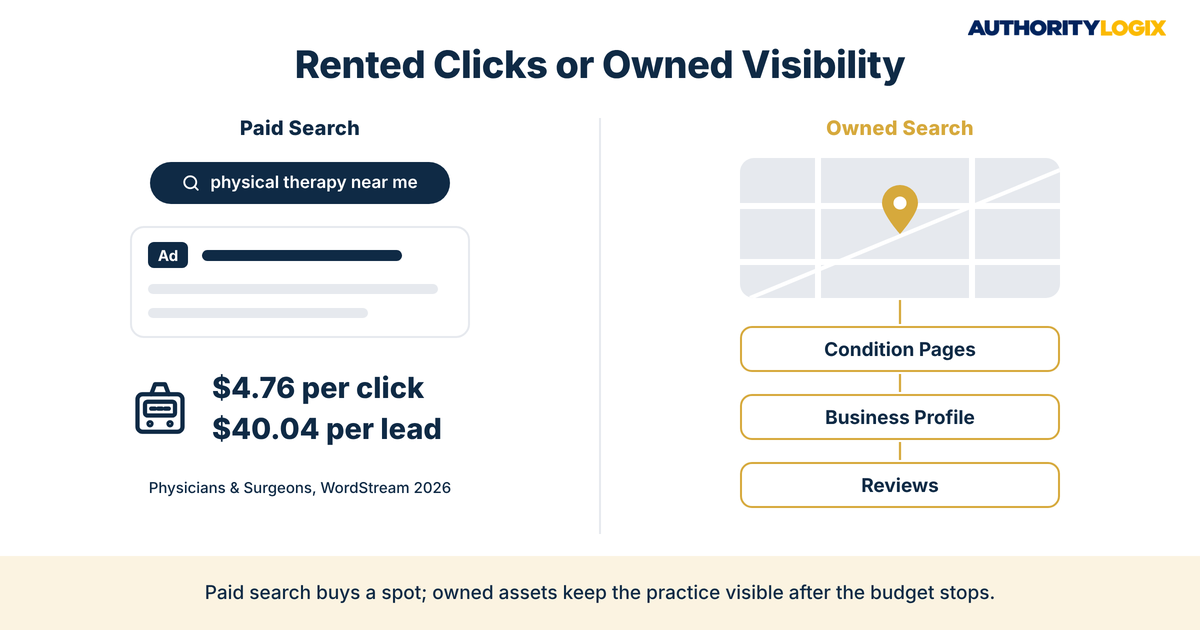
- A Google Ads physical therapy practice campaign rents the top of the results page, and it stops producing evaluation bookings the day the budget stops.
- WordStream’s 2026 benchmarks put Physicians & Surgeons search campaigns at a $4.76 cost per click and a $40.04 cost per lead — the closest healthcare category to PT, not a PT-specific figure.
- Google Ads Help states that location targeting accuracy is not guaranteed in every situation, so radius settings and the search terms report in a Google Ads physical therapy practice account need regular review.
- Physical therapy Google Ads targeting works best when every ad points to a matching condition page and a clear evaluation booking path.
- Google’s Health in personalized advertising policy does not allow advertiser-curated audiences such as Customer Match for health-category ads, which limits PT retargeting.
- A sound Google Ads physical therapy practice plan treats paid search as a bridge while the practice builds organic authority it owns.
Table of Contents
Google Ads physical therapy practice spend usually starts with a reasonable idea: if patients are searching for help with knee pain or a shoulder injury right now, pay to be the first name they see. The trouble is that most clinics launch campaigns before the foundations exist — the right search keywords, pages that match each search, and a booking path that turns a click into an evaluation. Without those pieces, the budget pays for clicks the practice was never set up to convert.
That is the credible but invisible problem showing up in paid form. Your clinicians may have years of experience and a strong reputation with local physicians, yet a searching patient sees only the ad and the page behind it. Below is how a Google Ads physical therapy practice strategy should be built so every dollar has a job.
Is Google Ads Physical Therapy Practice Spend Worth It Next to Organic Search?
Paid search and organic search answer the same patient question in different ways. A Google Ads physical therapy practice campaign buys a position at the top of the results for as long as the bids are funded, while organic rankings — the map pack and the condition pages below it — are earned over time and keep working without a per-click charge. Both can bring in direct-access patients, and that matters, because APTA reported in June 2025 that patients in all 50 states, the District of Columbia and the U.S. Virgin Islands have either provisional or unrestricted direct access to physical therapist services.
Cost is where the comparison gets concrete. WordStream’s 2026 Google Ads benchmarks, based on 13,474 U.S. search advertising campaigns that ran between April 1, 2025 and March 31, 2026, put the average cost per click at $5.42 and the average cost per lead at $66.69 across all industries. WordStream notes that those averages are technically medians. Physical therapy is not broken out as its own category, so the nearest healthcare row is the useful reference point.
| Benchmark (WordStream 2026) | All Industries | Physicians & Surgeons |
|---|---|---|
| Click-through rate | 6.64% | 6.61% |
| Cost per click | $5.42 | $4.76 |
| Conversion rate | 8.18% | 12.43% |
| Cost per lead | $66.69 | $40.04 |
| What it means for a Google Ads physical therapy practice | A broad baseline | The closest healthcare context — not a PT benchmark |
Those numbers explain why a Google Ads physical therapy practice budget can look efficient on paper and still disappoint. A lead is not an evaluation, and an evaluation is not a completed plan of care. The useful question is not whether ads work, but whether the practice has the lead generation infrastructure — intake, call handling, follow-up — that turns a paid lead into a scheduled patient.
The Physical Therapy Patient Acquisition Playbook shows where paid search sits inside a full patient pipeline, so a Google Ads physical therapy practice campaign supports the system instead of replacing it.
Physical Therapy Google Ads Targeting: Radius, Location and Search Terms
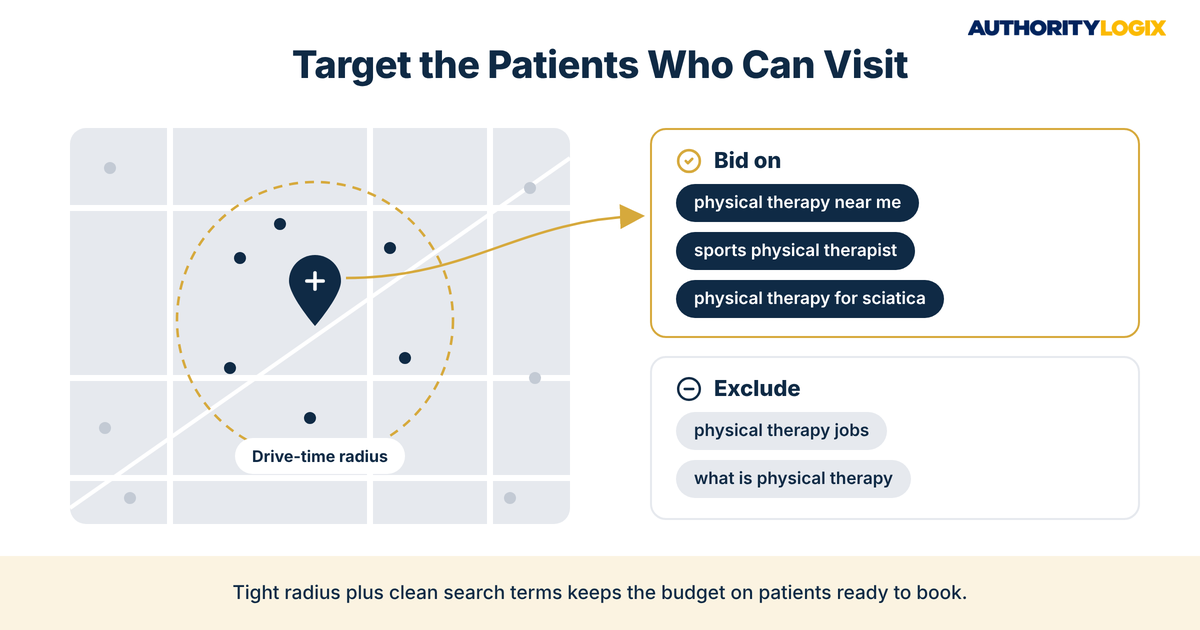
Physical therapy Google Ads targeting starts with geography, because a plan of care usually means repeat visits close to home or work. Google Ads Help explains that location targeting lets you select specific locations where you want your ad to be shown, and it states that 100% accuracy is not guaranteed in every situation because the signals behind targeting vary. In practice, a radius setting is a starting point, not a guarantee, and the location report deserves a monthly look.
Most Google Ads physical therapy practice accounts do better with a tight radius drawn around each location’s realistic drive time than with a whole metro area. If your practice runs several clinics, each one deserves its own campaign or ad group so budgets and bids reflect local demand. The PT industry hub lays out how AuthorityLogix approaches PT visibility location by location, and the same logic applies to paid search.
Search Terms That Signal an Evaluation Booking
Keyword intent matters more than keyword volume. Searches such as “physical therapy near me”, “sports physical therapist” or “physical therapy for sciatica” signal a patient close to booking, while “what is physical therapy” or “physical therapy jobs” signals research or a career search. A Google Ads physical therapy practice account should bid on the first group and add the second to a negative keyword list.
The search terms report shows the exact phrases that triggered your ads. Job seekers, students and patients looking for a different specialty can all trigger broad keywords. Reviewing that report every week in the first months of a Google Ads physical therapy practice campaign is the cheapest fix available.
Paid targeting also borrows from organic signals. The same elements that shape local search rankings — a complete Business Profile, recent reviews, consistent clinic details — shape how patients judge an ad once they see your listing beside it.
Ads and the map pack sit on the same screen, so the two should be planned together. The local visibility guide covers the Business Profile, review and location page work that makes a paid click more likely to become a call.
Building a PT Paid Search Strategy Around Condition Pages and Evaluation Bookings
A PT paid search strategy is only as strong as the page each ad sends patients to. A patient who searches for help with a rotator cuff injury and lands on a generic homepage has to hunt for proof that your clinic treats shoulders. Condition pages fix that mismatch, and they are the same pages that earn organic rankings, which is why the content SEO playbook treats them as the core of a PT site.
What a Condition Landing Page Needs Before It Gets Ad Spend
Each page needs to answer the patient’s next question before they ask it. Before a condition page receives a single paid click, it should carry these elements:
- A headline that repeats the condition named in the ad
- Plain-language education on how physical therapy approaches that condition, with no outcome promises
- Clinician credentials and specialties relevant to the condition
- Insurance, direct-access and first-visit information
- Practice-level trust signals such as reviews — never patient details
- One clear booking action near the top, plus a click-to-call phone number
Building those pages one campaign at a time is slow and expensive. Practices that publish condition pages through content systems — a planned library rather than one-off landing pages — end up with assets that serve both the PT paid search strategy and organic search. That shared use is what lowers the long-run cost of every Google Ads physical therapy practice campaign.
Ad copy has its own guardrails. PT ad copy should describe services, specialties and access, not promise recovery timelines or results. Google’s Health in personalized advertising policy also lists physical or mental health conditions as a sensitive category and does not allow advertiser-curated audiences, such as Customer Match lists, for ads in that category, so a Google Ads physical therapy practice plan should not depend on retargeting past patients.
Not sure whether your condition pages, Business Profile and booking path are ready for paid traffic? The PT Authority Gap Assessment shows where a Google Ads physical therapy practice budget would leak today.
PT PPC Patient Acquisition: Landing Pages, Calls and Follow-Up
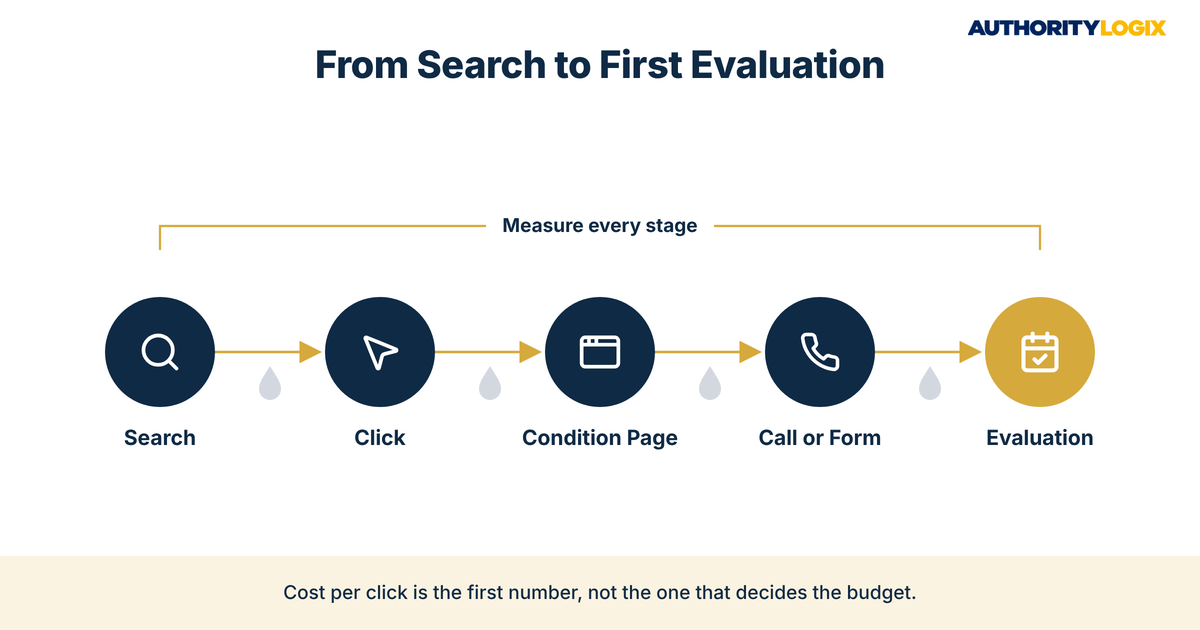
PT PPC patient acquisition does not end at the click. The path runs from search to ad to page to call or form, then to intake, scheduling and the first evaluation, and every handoff loses some patients. A Google Ads physical therapy practice report that stops at cost per click hides most of that path.
| Stage | What to Measure | Common Leak |
|---|---|---|
| Search to click | Click-through rate and the search terms report | Broad keywords pulling job seekers and students |
| Click to page | Whether the page matches the ad; mobile load speed | Homepage used as the landing page |
| Page to call or form | Calls, form fills and booking requests | No click-to-call button; long forms |
| Call to scheduled visit | Answered calls and callback time | Voicemail during treatment hours |
| Scheduled to evaluation | Show rate for first visits | No confirmation or reminder |
Tracking each stage separately is how you find the real acquisition cost of a paid patient rather than the cost of a click. As a hypothetical example, a clinic paying $40 per lead that books one in four leads as an evaluation is paying $160 per evaluation before a single visit is billed. That is the number a Google Ads physical therapy practice owner should compare against other channels.
Phone calls deserve special attention, because a patient searching on a phone is one tap away from calling. Call tracking that records whether each call was answered and booked turns PT PPC patient acquisition from guesswork into a measurable pipeline.
Follow-up closes the loop. Form leads need a response the same business day, callers who reach voicemail need a callback, and booked patients need confirmation and reminders. Building intake and follow-up systems that turn paid and organic leads into scheduled evaluations is a core part of what we do for PT practices.
Where Google Ads Physical Therapy Practice Budgets Leak
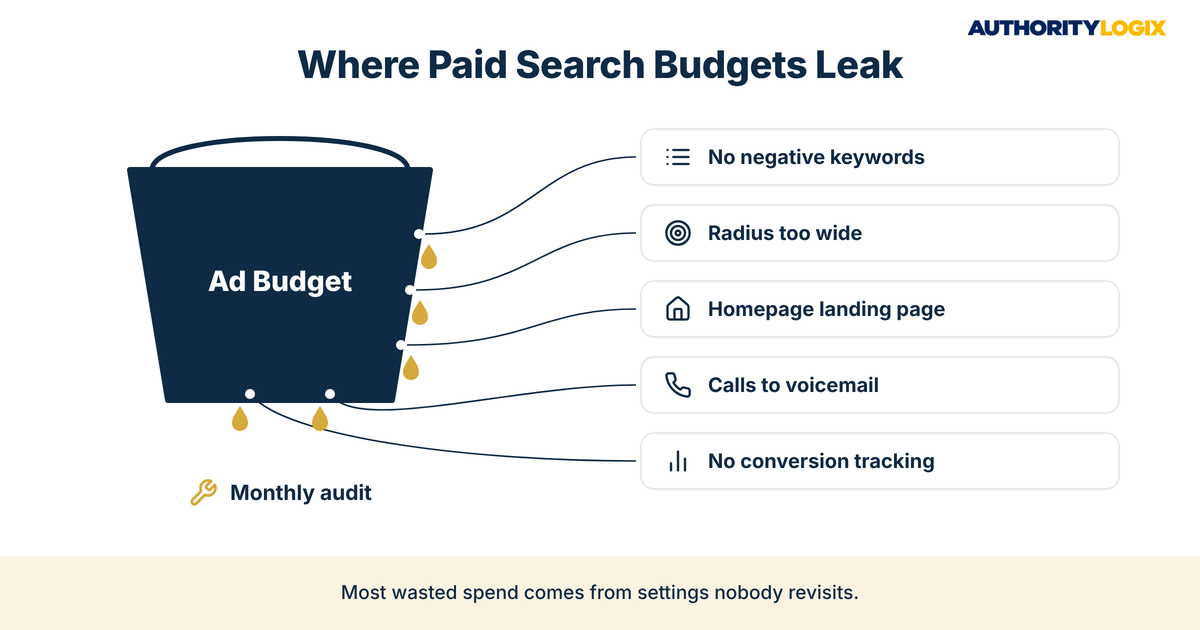
Most Google Ads physical therapy practice budgets do not fail all at once. They leak a little at a time through settings nobody revisits, keywords nobody prunes and pages nobody tests. The table below lists the leaks to check first and the fix for each.
| Leak | What It Looks Like | Fix |
|---|---|---|
| Broad keywords with no negatives | Clicks from job, school and definition searches | Weekly search terms review and a shared negative list |
| Radius too wide | Clicks from people beyond a realistic drive | One radius per location and a monthly location report check |
| Homepage as the landing page | Clicks with no bookings | Condition-specific landing pages |
| Ads running when nobody answers | Calls going to voicemail | Ad schedule matched to front-desk hours |
| No conversion tracking | Spend judged by clicks | Track calls, forms and booked evaluations |
| One budget for every clinic | Busy locations capped while quiet ones overspend | Separate budgets by location |
Leaks are rarely a bidding problem. They are a measurement problem, and the growth blueprint treats measurement as part of the practice’s authority infrastructure. When the practice tracks booked evaluations by source, the Google Ads physical therapy practice account can be judged against organic search, physician referrals and reactivation on equal terms.
Auditing a Google Ads Physical Therapy Practice Account Every Month
A monthly audit is short once tracking is in place. Review the search terms report, the location report, call answer rates and cost per booked evaluation by campaign. Pause anything that has spent without producing bookings, and move that budget to the condition pages that are converting.
Over time the audit also shows which condition searches are expensive enough to justify organic pages instead. The PT resource library on AuthorityLogix covers the organic side of that decision. When a condition page starts ranking on its own, the paid budget for that condition can often shrink while the page keeps bringing patients in.
What Most PT Practices Get Wrong About Google Ads (and What Searching Patients Click)
Most Google Ads physical therapy practice mistakes come from treating ads as a switch rather than a system. These are the questions practice owners ask, along with what a searching patient actually responds to.
Will Google Ads replace our physician referrals?
No, and it should not try to. Paid search reaches patients who are already searching, while physician referrals reach patients before they search at all. A sound Google Ads physical therapy practice plan adds a direct-access channel alongside referrals so the practice is less exposed when one referral source slows down.
What does a searching patient actually click?
Patients look for ads and listings that match their exact problem and show visible proof — specialties, credentials, reviews and clear access information. The trust signals described in the clinical authority guide are what make a paid visitor comfortable enough to book. An ad without that proof asks the patient to take the clinic on faith.
Can ads work without condition pages?
They can produce clicks, but they struggle to produce bookings at a cost the practice can sustain. A patient who searches for a specific condition expects a page about that condition, and an educational hub gives every ad a relevant destination while building organic rankings at the same time.
How do we stay visible when the ad budget pauses?
Plan for that day from the start. Reviews, Business Profile activity, condition pages and authority distribution across local publications and directories keep your practice visible after a campaign ends. Infrastructure compounds. Ads stop.
Want a Google Ads physical therapy practice campaign that sends every paid click to a condition page and a booking path built to convert it? Let’s build the paid and organic system around your clinics.
The Honest Close: Paid Search Rents Attention; Authority Content Owns It
A Google Ads physical therapy practice campaign has a real place in a growth plan. It can fill a new clinic’s schedule while organic rankings mature, test which conditions bring in direct-access patients, and protect your name from competitors. What it cannot do is keep working after the budget stops.
The sequence in how we build puts the owned assets first — condition pages, the Business Profile, reviews and intake — so that any Google Ads physical therapy practice spend lands on infrastructure ready to convert it. AuthorityLogix proved the owned side of that model on BKDSCR.com, its own proof-of-concept build in the NYC DSCR real estate niche, with 18 pillar pages, 7 interactive investor tools and 48 SEO-optimized blog posts generating inbound leads with zero paid ads.
That is our approach for PT practices as well: use paid search deliberately, measure it by booked evaluations, and keep building the assets the practice owns. The honest answer is that most PT practices already have the clinical expertise patients are searching for. What is missing is the infrastructure that makes the market see it.