


Key Takeaways
- Practices that try to increase physical therapy patients usually hit a ceiling set by how many physicians refer to them, not by the quality of their care.
- According to APTA’s 2025 report, patients in all 50 states, the District of Columbia and the U.S. Virgin Islands have provisional or unrestricted direct access to physical therapist services.
- Physical therapy beyond referrals depends on being found where self-directed patients look first: search results, map listings, reviews and clear condition pages.
- PT owned marketing channels such as your website, educational content and patient referral program keep working after you build them, while paid ads stop when the spending stops.
- PT patient volume growth is most stable when physician relationships stay in place and owned channels are added alongside them.
- The practical way to increase physical therapy patients is a connected system that tracks every new-patient source, so you can see what actually fills the schedule.
Table of Contents
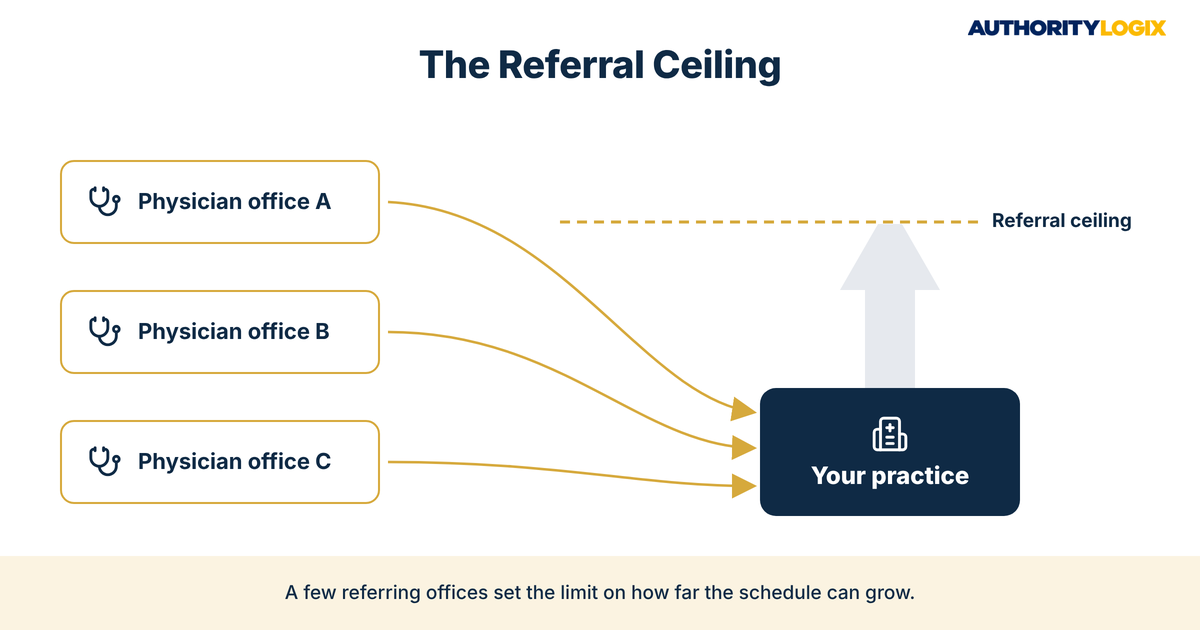
Most owners who want to increase physical therapy patients already run a good clinic, with strong clinicians, loyal patients and a few physicians who trust the team. The problem is that the schedule still rises and falls with those few offices. If you have ever watched a slow month follow a referring doctor’s vacation, you have seen the ceiling up close, and it is the same ceiling that holds back many PT practices.
This article explains why that ceiling exists and what it takes to grow past it. The short version is that patients can already find and book a physical therapist without a prescription, but most practices have never built the channels that let them do it. The fix is infrastructure you own, built alongside the physician relationships you already have, so you can increase physical therapy patients without betting the practice on any single referral source.
Why Practices Trying to Increase Physical Therapy Patients Hit a Referral Ceiling
Physician referrals are valuable, and nothing here argues for walking away from them. The issue is structural. A referral stream depends on decisions you do not control: a physician’s habits, a new employment contract with a health system, a partner’s retirement, or an in-house therapy department that opens down the hall. One referring doctor retires and the pipeline dries up overnight.
That exposure is what referral dependence looks like day to day. When most new evaluations come from a handful of offices, every effort to increase physical therapy patients turns into another round of lunches, faxes and follow-up calls with the same small group. The work feels productive, yet the ceiling stays where it was, because the number of physicians who know your name changes slowly.
There is also a visibility gap. Your clinicians may be among the most experienced in the area, but a person with knee pain who never sees a physician has no way to know that.
Growing past that point is less about effort than about what the practice owns. Owners who reach steady authority growth treat search visibility, educational content and patient referrals as assets that build on each other. Once those assets are in place, the plan to increase physical therapy patients stops depending on whoever happened to refer this month.
The Physical Therapy Patient Acquisition Playbook lays out the full new-patient pipeline, from physician relationships to direct-access channels, for practices that want to increase physical therapy patients beyond their referral network.
What Direct Access Means for PT Patient Volume Growth
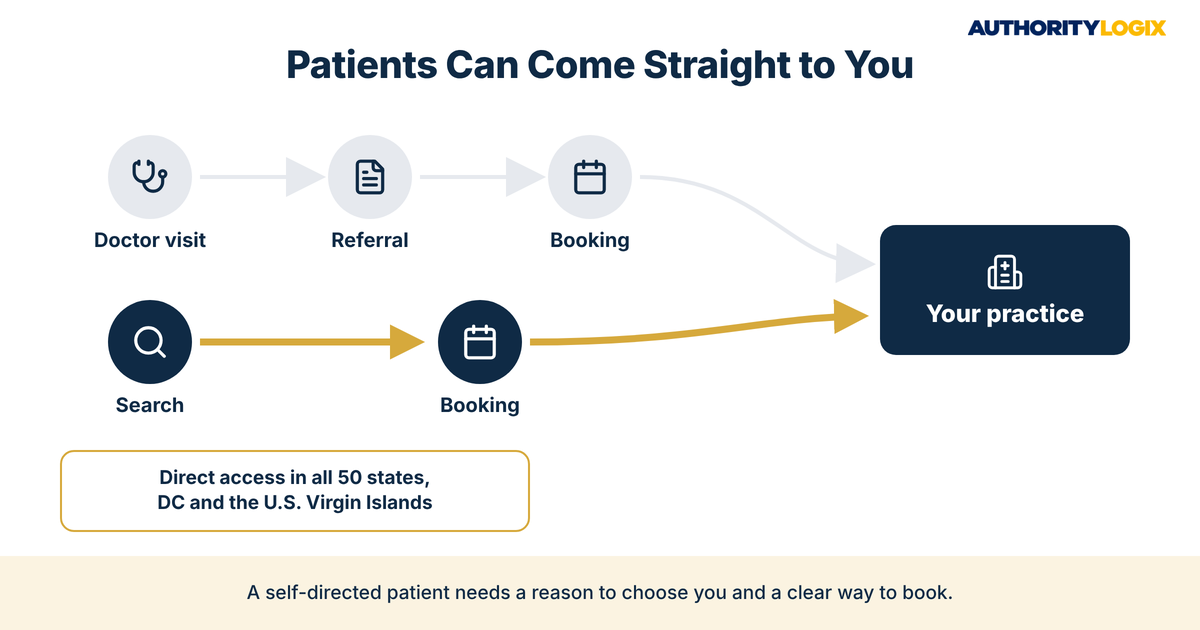
Direct access is the legal foundation for PT patient volume growth outside the physician office. According to APTA’s 2025 direct access report, patients in all 50 states, the District of Columbia, and the U.S. Virgin Islands have either provisional or unrestricted direct access to physical therapist services. The word provisional matters, because some states attach conditions to treatment without a referral, so your patient-facing pages should explain your own state’s rules in plain language.
Direct access means a patient can come to you for an evaluation without first seeing a physician, and what that patient needs from you is a reason to choose your team and a clear way to book. Practices that build direct access messaging into their website and listings give self-directed patients that reason, which is where efforts to increase physical therapy patients start to work without a fax machine.
Many practices still market as if a prescription were required. Their websites tell visitors to ask their doctor, their intake forms open with a referring-physician field, and their front desk asks callers to come back once they have a referral. Each of those habits quietly turns away people who could help you increase physical therapy patients.
Closing that gap is a systems problem, not a messaging tweak. It means aligning pages, listings, phone scripts and booking so a self-referring patient gets the same confident answer everywhere. That end-to-end view is central to our approach, because a direct-access message on the website does little if the phone script contradicts it.
Physical Therapy Beyond Referrals: Where Self-Directed Patients Look First
Physical therapy beyond referrals starts with understanding how a self-directed patient behaves. Someone with shoulder pain or a stiff back rarely starts by searching for a clinic name. They search the problem, look at the map results that appear, compare a few listings, and read whatever pages explain their situation clearly.
The map and listing step decides more than most owners expect. A complete Google Business Profile with accurate services, recent reviews and real photos of the clinic is often the first impression a patient has of your team. Building that local visibility is one of the most direct ways to increase physical therapy patients who live and work near your doors.
Map rankings respond to signals a practice can influence: accurate and consistent listings, service pages that match what people search, and a steady flow of genuine reviews. Strong local search foundations make sure that when a nearby patient searches the problem you treat, your practice is one of the few options they see.
After the map comes the page. A self-directed patient wants to know whether your team treats their problem, what a first visit involves and whether they can book without a prescription. Pages built around clear patient education answer those questions in plain language, without promising outcomes, and they give a hesitant reader enough confidence to call.
None of this replaces physicians. It means that when you set out to increase physical therapy patients, you are competing for attention in search results as well as on referral pads. The practices that show up clearly in both places simply have more doors into the schedule.

Not sure where self-directed patients lose track of your practice between the search, the listing and the booking page? The assessment shows which gaps hold back your plan to increase physical therapy patients and what to fix first.
How PT Owned Marketing Channels Compound Over Time
PT owned marketing channels are the assets your practice controls: the website, the condition and service pages on it, the Google Business Profile you manage, your email list and your patient referral program. Paid ads and directory placements are rented. They can bring patients in, but when the payments stop, so do the inquiries. Infrastructure compounds. Ads stop.
Owned channels behave differently because each piece keeps working after it is built. A condition page published this year can still bring in evaluations years from now, and every past patient who refers a friend adds to a base that grows. When you increase physical therapy patients through owned channels, the gains tend to stay with the practice.
Website, Content and Google Business Profile as Owned Assets
The website is the hub. It needs a page for each condition and service you want to be known for, written for patients rather than for other clinicians, and it needs to make booking obvious. Producing those pages on a schedule, instead of in occasional bursts, is the job of repeatable content systems that turn your clinicians’ knowledge into material patients can find.
Search discipline decides whether those pages are seen. Each page should target the words patients actually type, connect to related pages, and answer the questions people ask before booking, which is the work covered in the content SEO playbook. A practice that wants to increase physical therapy patients through search needs that structure more than it needs a higher volume of posts.
Content also has to travel. Sharing condition guides through your email list, social profiles, partner newsletters and local community channels puts the same expertise in front of people who are not searching yet. Consistent distribution keeps the practice familiar between the moment someone first notices you and the moment they need care.
The difference shows up clearly when you compare channels side by side. The table below sorts the most common sources practices use to increase physical therapy patients by who controls them and what happens when investment stops.
| Channel | Who controls it | What happens when you stop investing |
|---|---|---|
| Physician referrals | Each referring office | Volume rises and falls with decisions made outside the practice |
| Paid search ads | Rented from the ad platform | New inquiries stop when the budget stops |
| Website and condition pages | Your practice | Published pages keep answering patient searches |
| Google Business Profile and reviews | Your practice, on Google | Earned reviews keep reassuring new patients |
| Patient referral program | Your practice | Past patients can keep sending friends and family |
| Email list | Your practice | You can still reach past patients without paying per message |
AuthorityLogix tested this model on its own build first. BKDSCR.com, a real estate investment education platform in a competitive New York City niche, was built with 18 pillar pages, 7 interactive tools and 48 posts in under 18 months, and it generates inbound leads with zero paid ads. It is not a physical therapy client. It is the proof-of-concept that owned infrastructure keeps producing after the build is done.
A Practical Plan to Increase Physical Therapy Patients Without Abandoning Physician Relationships
The goal is addition, not replacement. Physicians who already send you patients deserve the same attention they get today: timely progress notes and a practice that is easy for their patients to reach. Protecting those relationships while you build owned channels means you increase physical therapy patients from both directions at once.
Your past patients are an overlooked source in that mix. People who finished a plan of care with you already trust your team, and many know someone with a similar problem. A structured referral program gives them an easy, appropriate way to pass your name along, and it stays within your control no matter what happens with any physician office.
First Moves to Increase Physical Therapy Patients This Quarter
Start with the steps that fix leaks before you add new ways to increase physical therapy patients. None of these steps requires a large budget, and each one makes the next more effective.
- Tag every recent new patient by source: physician, self-referral, past patient or other.
- Complete your Google Business Profile, including services, hours, photos and review requests.
- Publish clear condition pages, each with a direct-access note and a booking option.
- Update phone scripts and intake forms so self-referring callers are welcomed, not redirected.
- Add a simple past-patient referral request at discharge, and track every referral it produces.
Tracking ties the plan together. When every inquiry is tagged by source and followed through to a booked evaluation, you can see which channels actually help you increase physical therapy patients and which only feel busy. That measurement sits at the core of practical lead generation: capturing inquiries, responding quickly and knowing what each source is worth.

Increase Physical Therapy Patients FAQ
These questions come from both sides of the front desk. Some come from patients deciding whether they can book directly, and some come from owners deciding how to increase physical therapy patients without straining physician ties.
Do you need a referral for physical therapy?
In many cases you can contact a practice directly and book an evaluation. APTA reports that every state allows some form of direct access, but some states attach conditions, so ask the practice how the rules apply where you live.
How do I know a practice treats my problem before I call?
Look for a page that explains your condition, what a first visit involves and who on the team handles it. Practices that organize this guidance into an educational hub make that check easy before booking, and a good practice will still explain your options clearly at the first visit.
How do I get more physical therapy patients without more physician referrals?
Build the channels self-directed patients use: a complete Google Business Profile, clear condition pages, a past-patient referral program and tracking for every source. Then keep improving whichever channel produces booked evaluations, while physician relationships continue as before.
How long does it take owned channels to increase physical therapy patients?
There is no fixed timeline, and anyone who promises one is guessing. Listing fixes can help early, while condition pages and search visibility build gradually.
Will marketing to self-referring patients hurt my physician relationships?
It should not, as long as you keep physicians informed and continue the communication they value. For more detail on balancing both, the PT resources library covers referral relationships, local search and patient education in depth.
Ready to build the condition pages, local search, patient referrals and source tracking that take your pipeline past the limits of your referral network?
Building a Patient Pipeline Your Practice Controls
The honest assessment is that most practices that struggle to increase physical therapy patients do not have a patient problem so much as an ownership problem. The clinical quality is already there, and physicians refer because they trust it. What is missing is a set of channels that let patients who never see a physician find that same quality, check it and book.
Building those channels is steady work rather than a campaign: correct listings, clear pages, a referral request at discharge and honest tracking, each connected to the next. That sequence is our process with practices that want to increase physical therapy patients without trading one dependency for another.
If you build it yourself, start with tracking and your Google Business Profile, because they show where you stand soonest. If you would rather have it built, our services cover the full system. Either way, the practices that grow past their referral network are the ones that decide the pipeline should belong to them.