


Key Takeaways
- Physical therapy Ask Maps answers will be written by Gemini, not by your front desk, and they will draw on your Google Business Profile, your reviews and your website.
- Google retired the Q&A API on November 3, 2025, and the Google Q&A replacement is an AI answer, so a practice can no longer post its own answers to patient questions.
- BrightLocal reports that Ask Maps pulls first from the Business Profile, including descriptions, services, attributes, hours, photos and posts, before it looks anywhere else.
- Gemini reads Google reviews and cites them, so reviews that mention services and staff shape what a physical therapy Ask Maps response says about your clinic.
- Ask Maps is still rolling out: as of March 2026 it was limited to the U.S. and India on Android and iOS, and one early analysis found it not yet showing for healthcare providers, so this is preparation work.
- The fix is infrastructure, not a workaround: a complete profile, a steady flow of detailed reviews, and website FAQs and service pages that answer what patients ask.
Table of Contents
What Physical Therapy Ask Maps Means for How Patients Find Your Clinic
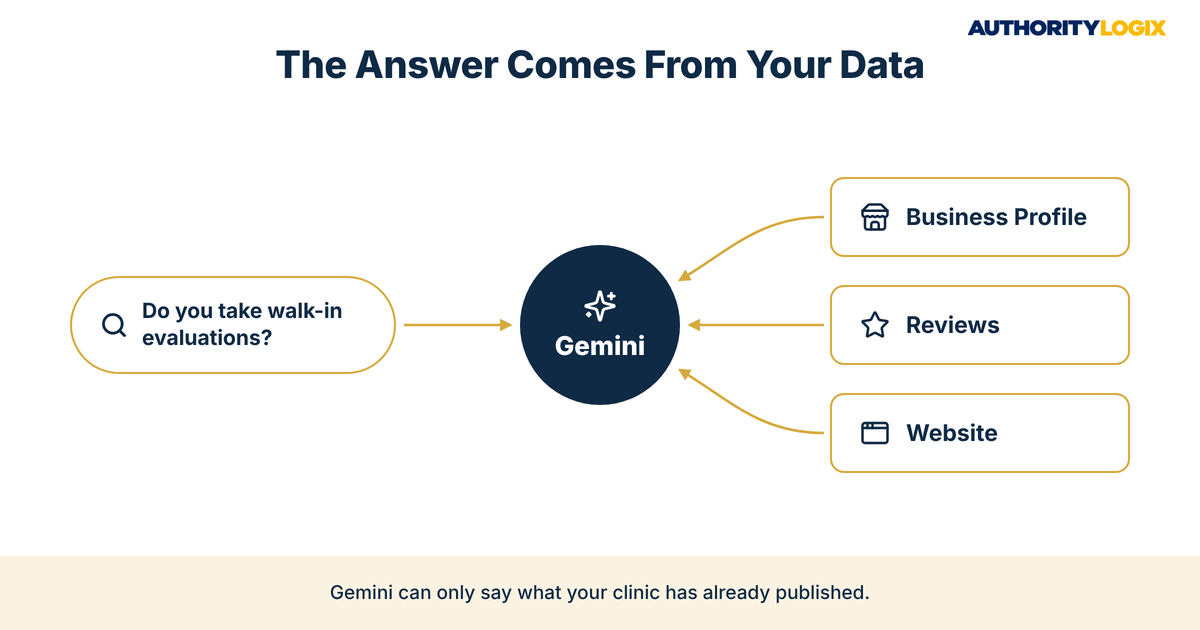
Physical therapy Ask Maps is the change that will put Google’s Gemini between your clinic and the patient who is deciding whether to call. Early testing found it not yet showing for healthcare providers, so this guide is about getting ready. Once it does, a prospective patient can type a plain question, such as whether a clinic sees people without a physician referral, and Gemini writes the answer from what it can find about you. That answer starts with your Business Profile, which means the profile is no longer a listing you set up once and forget.
You already have the clinical credibility. Your therapists hold the credentials and your reputation is why physicians kept referring for years. A physical therapy Ask Maps answer, though, shows only what Google can read. If your services are missing from the profile, your reviews are three words long and your website never names the conditions you treat, Gemini has nothing specific to say.
The scale explains why Google built it this way. According to Google figures reported by The Associated Press on March 12, 2026, Gemini’s recommendations in Maps draw on a database spanning more than 300 million places and reviews from more than 500 million contributors. Your clinic is one entry in that database, competing on the quality of its data for a place in the answer, which makes this a local search problem before it is an AI problem.
It matters most for direct-access patients, who want a short answer before they book and often never speak to your staff before choosing. Practices that already run a deliberate patient acquisition system will recognize the pattern: the first conversation is moving inside Google, and the physical therapy Ask Maps answer will become the first impression of your practice.
The Physical Therapy Local Visibility Guide covers the full profile, review and location-page system behind every physical therapy Ask Maps answer, so Gemini has accurate, specific information to say about your clinic.
How the Google Ask Maps Feature Replaced Profile Q&A
For years, the Q&A section on a Business Profile let anyone ask a question and anyone answer it. BrightLocal notes that the open format led to inappropriate or inaccurate answers, and that answers could go stale. Practices could at least post their own replies, which gave owners some control.
That control is gone. Google said in September 2025 that it planned to discontinue the Q&A API, the API was retired on November 3, 2025, and in December 2025 Google confirmed that customers can ask their question directly in Google Maps. The Google Ask Maps feature took the place of the old section: instead of a stored list of questions and replies, Gemini writes a fresh answer each time a patient asks.
What the Google Q&A Replacement Changes for Practice Owners
The Google Q&A replacement changes who writes the answer. Under the old system, a practice manager could answer a question about weekend hours once and leave it there. With physical therapy Ask Maps, nobody at the clinic types anything, because Gemini assembles a response from the profile, the reviews and the website every time someone asks.
It also removes the safety valve. BrightLocal reports that, unlike Q&A, there is currently no way to correct or report an inaccurate Ask Maps response. If the answer is wrong, the only fix is to change the information Gemini reads, which is why consistent details across every channel, the core job of authority distribution, now matters inside Maps as well.
The practices that adapt fastest treat physical therapy Ask Maps as a data job, not a campaign. They audit what Google can read and keep the details current, the same discipline that sits behind long-term practice authority. Done well, it gives Gemini accurate material for every question a patient types.

Where Gemini Google Maps Answers Pull Their Information
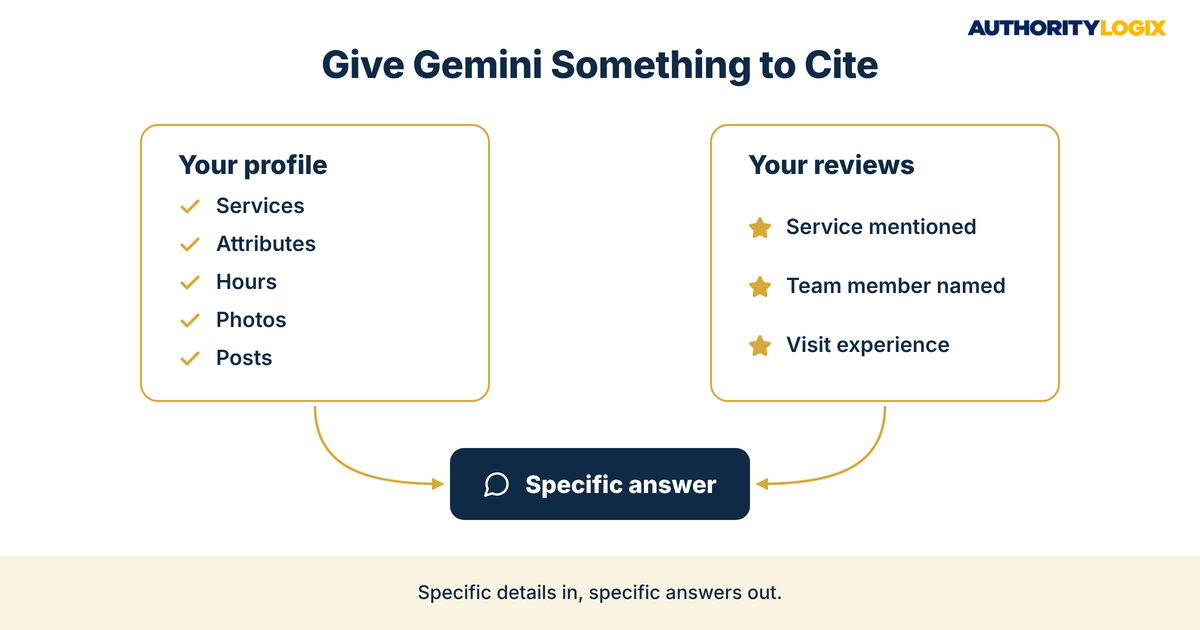
Gemini Google Maps answers follow an order of sources. According to BrightLocal’s breakdown, Ask Maps pulls first from the GBP, meaning the descriptions, services, attributes, hours, photos and posts on your profile, and Gemini reads Google reviews and actively cites them in Ask Maps responses. Website content comes next, and outside sources are used only when the answer is not found in those places.
| Source Gemini reads | What it uses | What a PT practice should check |
|---|---|---|
| Business Profile | Descriptions, services, attributes, hours, photos and posts | Every service listed, current and holiday hours, recent photos |
| Google reviews | Mentions of services, experiences and team members | Recent, detailed reviews that describe the visit and the team |
| Reviews on other sites | Reviews outside Google | Accurate listings on the directories patients use |
| Your website | Service pages, FAQs and contact information | Pages that answer hours, services and pricing in plain language |
| Third-party sources | Used only when the answer is not found above | Wrong details corrected at the source |
When Gemini cannot find an answer, BrightLocal reports that it replies: “There’s not enough information to answer your question, but you can ask another question.” For a physical therapy Ask Maps search, that sentence is a lost evaluation. Sources appear below each answer, so a patient who wants to check can see whether the information came from your profile, a review or a page on your site.
Why Reviews Mentioning Services and Staff Carry Weight
BrightLocal reports that Gemini pulls mentions of services, experiences and team members out of reviews. A review that names the therapist a patient worked with and describes the scheduling and the front desk gives Gemini several useful details, while a review that says “great place” gives it almost nothing. That is why a deliberate review generation process matters more for physical therapy Ask Maps than it did when reviews mainly fed a star rating.
Your website is the next layer. Service pages and FAQs that name the conditions you treat, the visit types you offer and how booking works give Gemini Google Maps answers a source beyond the profile. They should be built with the same search discipline described in the content SEO playbook, so a page that plainly answers a common patient question is a page Gemini can find and cite.
None of this works as a one-time cleanup. Hours change, therapists join and services expand, and every change has to reach the profile and the website together. Repeatable content systems keep those sources in agreement, so each physical therapy Ask Maps answer reflects the practice you run today.
Not sure what Gemini would say about your clinic today? The assessment shows where your profile, reviews and website leave gaps in physical therapy Ask Maps answers, and what to fix first.
Preparing Your Profile and Reviews for Physical Therapy Ask Maps Questions
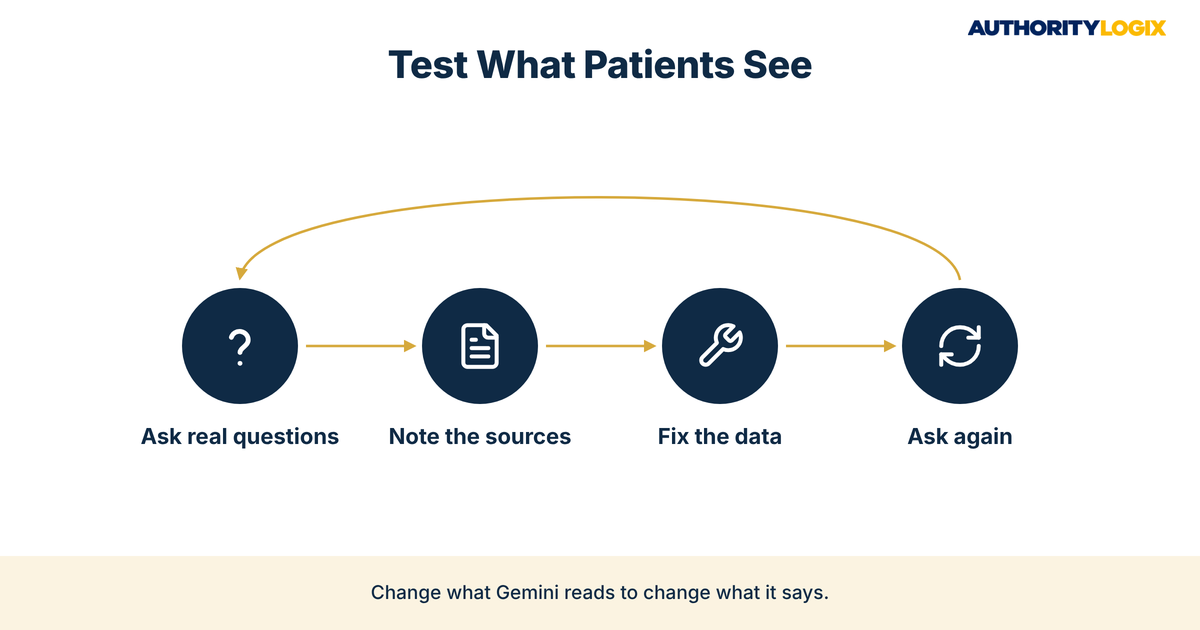
Preparation starts with testing. BrightLocal recommends asking Ask Maps the questions your customers ask, noting the answers and the cited sources, and asking again in different phrasings. Where the feature appears on your phone, type the physical therapy Ask Maps questions your front desk hears every week and record what comes back.
Then work through the profile itself. Each item below gives Gemini something specific to repeat, and each one is a field the practice controls:
- List every service you offer, using the words patients use to describe them.
- Fill in every attribute that applies, such as accessibility and appointment options.
- Confirm regular hours and add holiday hours before each holiday.
- Replace outdated photos of the clinic, the team and the treatment areas.
- Write a description that names your specialties and the patients you serve.
- Publish a post whenever something changes, such as a new therapist or extended hours.
The profile tells Gemini what you offer, and your content tells it why patients trust you. A clinic that publishes plain-language patient education about the conditions it treats gives Gemini context it can match to a patient’s question. It also gives the patient something to read after the physical therapy Ask Maps answer appears.
Review Language That Helps Physical Therapy Ask Maps Responses
BrightLocal suggests encouraging detailed, recent reviews and giving customers gentle prompts about useful details. In a physical therapy practice, a prompt can invite patients to mention, only if they want to, the therapist they saw, how easy scheduling was and what the visits felt like. Keep it voluntary and general: never ask for health details, and never reply to a review in a way that confirms someone is your patient.
Review requests work best as part of the discharge workflow rather than an occasional push. A request sent when a plan of care ends, with a short prompt about service and staff, adds the kind of language a physical therapy Ask Maps response can cite. It also feeds the same lead generation pipeline that turns a search into a booked evaluation, because every detailed review strengthens the answer the next patient reads.
Aligning Website FAQs and Service Pages With AI Answers
Your website is where you still control every word. BrightLocal recommends keeping the site current with detailed service pages and an FAQ that covers hours, services and pricing. For a clinic, that FAQ should answer the questions that used to sit in the old profile Q&A section and the ones your front desk still answers by phone.
Start by collecting real patient questions from calls, emails and intake forms over a month. Group them by theme, such as booking, insurance and direct access, and answer each one in two or three plain sentences. Those answers are what a physical therapy Ask Maps response can draw on when the profile alone is not enough.
Service pages carry the detail an FAQ cannot. Each page should name the service, who it is for, what a first visit involves in general terms and how to book. Organizing those pages inside one educational hub makes the site easier for Gemini to read and for patients to explore, which strengthens every physical therapy Ask Maps answer.
Consistency across all three sources is the real goal. When the profile says one set of hours, the website another and a review mentions a third, Gemini has to choose, and it may choose wrong. Audit, build, publish and maintain is the sequence behind our process, and it applies here because every physical therapy Ask Maps answer depends on all three sources telling the same story.
AuthorityLogix built this layered approach on its own proof-of-concept platform, BKDSCR.com, in real estate investing rather than physical therapy: 18 pillar pages, 7 interactive tools and 48 posts, with zero paid ads. The same principle applies to physical therapy Ask Maps readiness.
Physical Therapy Ask Maps FAQ: What Practice Owners Ask
These answers reflect what has been reported so far. The physical therapy Ask Maps rollout may change as Google expands it.
Is the Q&A feature coming back?
Plan as if it is not. The Q&A API was retired on November 3, 2025, and Google has pointed customers to asking their questions directly in Google Maps, so the safer path is to prepare for Ask Maps now.
Can I still answer customer questions on Google?
Not in the old way. A practice can no longer post its own answer under a question on the profile, so physical therapy Ask Maps work means making sure the profile, reviews and website already hold the right answer. Our PT resources collect the guides that cover each of those sources in more depth.
Where is Ask Maps available right now?
As of March 2026, BrightLocal reports that it was available only in the U.S. and India on Android and iOS, with desktop support promised later. The same report cites an analysis by Mike Blumenthal in Search Engine Journal that found Ask Maps missing for healthcare providers, so check on your own phone, in your own area, before assuming patients see it for your clinic.
Will Ask Maps hurt my local rankings?
Ask Maps is about the answer a patient reads, not a separate ranking you can lose. The profile completeness, review detail and website quality that support Map Pack visibility also feed the answer, so treat physical therapy Ask Maps preparation and local rankings as one job. That combined job is part of our services for physical therapy practices.
How do I know an Ask Maps answer about a clinic is accurate?
Check the sources listed below a physical therapy Ask Maps answer, which show whether it came from the clinic’s profile, a review or its website. BrightLocal recommends fact-checking those sources, and calling the clinic directly is the surest way to confirm hours, services and booking options.
Ready to build the profile, review and website system that gives Gemini accurate answers about your clinic every time a patient asks a question in Google Maps?
Building a Profile That Answers Patient Questions Before They Ask
Physical therapy Ask Maps rewards the practice that has already published the answer. The information Gemini needs is information you already have. The work is putting it where Google can read it and keeping it current, as part of your wider PT marketing infrastructure rather than a separate project.
This is a system build, not a quick fix. A complete profile, a steady flow of detailed reviews and a website that answers real patient questions reinforce each other, and each one makes the other two more useful to Gemini. That connected view is our approach to physical therapy visibility.
The honest answer is that most practices already have the expertise and the patient trust that a good physical therapy Ask Maps answer should reflect. The missing piece is the infrastructure that lets Gemini see it, and that is something a practice can build, test and keep accurate starting this month.