


Key Takeaways
- Physical therapy content clusters join one pillar page and its supporting articles around a single specialty or condition.
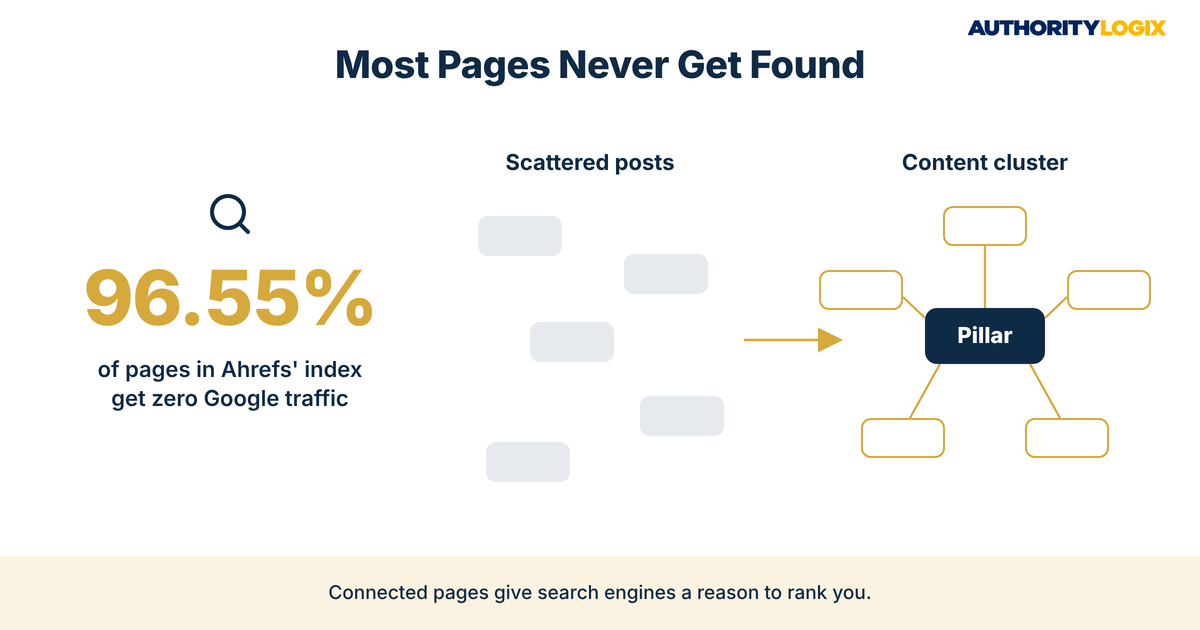
- According to Ahrefs, 96.55% of all pages in its index get zero traffic from Google, so unconnected one-off posts rarely bring in patients.
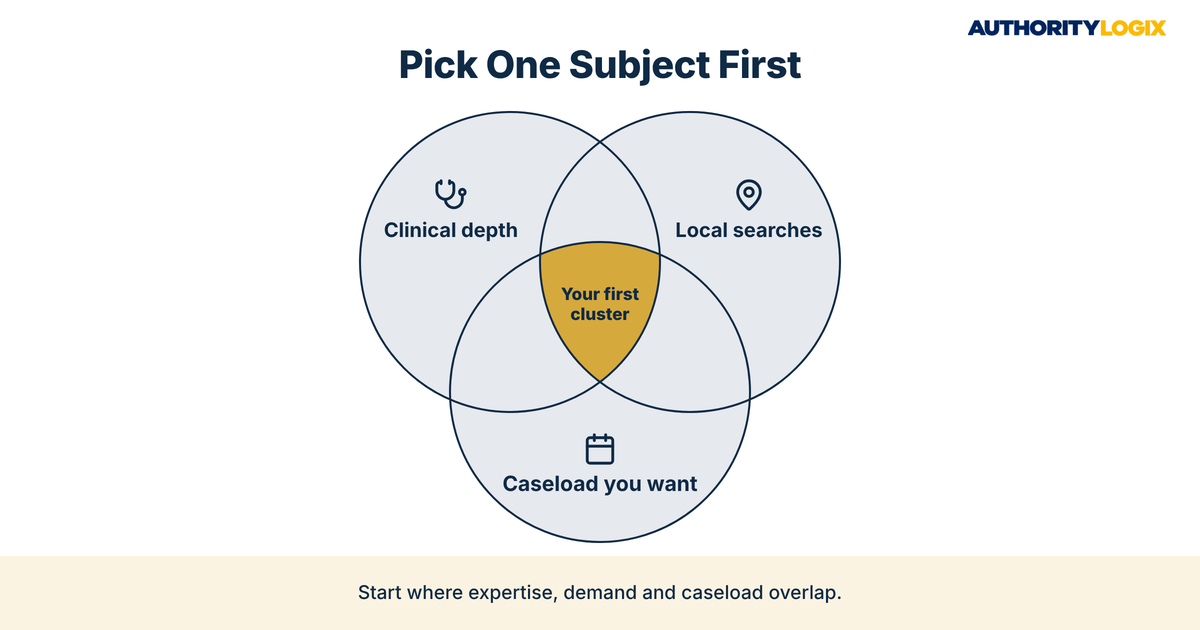
- Build the first of your physical therapy content clusters where clinical depth, local search demand and the caseload you want to grow overlap.
- A PT pillar page strategy gives the cluster one complete, clinician-reviewed resource that every supporting article links back to.
- Condition cluster SEO works when each article answers one real patient question, and specialty cluster internal linking connects them.
- There is no fixed timeline for physical therapy content clusters; track rankings, pillar visits and booking clicks before expanding.
Table of Contents
What Physical Therapy Content Clusters Are and Why Google Rewards Them
Physical therapy content clusters are the difference between a website that publishes articles and a website that owns a subject. Most practices already have the clinical depth to own a specialty — your therapists answer the same knee, shoulder and back questions every week. What the market sees instead is a blog with a dozen unrelated posts, none of them connected and none of them ranking.
That gap is structural, not a writing problem. Physical therapy content clusters are sets of pages built around one topic: an in-depth pillar page covering the subject broadly, and supporting articles that each answer one narrower question and link back to it. When they are planned together and produced through repeatable content systems, each new article strengthens the others.
The cost of skipping that structure is clear. According to Ahrefs’ search traffic study, 96.55% of all pages in its index get zero traffic from Google, and pages with more referring domains tend to get more traffic and rank for more keywords. The same study names three reasons most pages get nothing: the topic has no search demand, the page has no backlinks, or the page does not match search intent.
Physical therapy content clusters answer all three. Each supporting article targets a question patients actually search, internal links pass authority between pages, and the pillar earns outside links as the most complete local resource on its subject. That is why search engines tend to reward clusters: they show depth instead of scattered one-off posts.
Physical therapy content clusters also change how a practice publishes. Instead of asking what to post this month, the team asks which question is still unanswered, a shift at the center of long-term authority growth. Authority compounds when every page has a clear job.
If the pillar-and-cluster model is new to you, the broader mechanics of pillar pages are covered in a separate guide. This article goes one step further and shows how physical therapy content clusters work when they are built around a single specialty or a single condition, which is where most practices should start.
The Physical Therapy Content SEO Playbook shows where physical therapy content clusters fit inside a complete content and search system.
Choosing One Specialty or Condition to Build Around First
The most common mistake with physical therapy content clusters is trying to build five at once. A practice that writes two articles on knees, two on shoulders, one on vertigo and one on pelvic health has six orphaned posts, not a cluster. Pick one subject, cover it completely, and only then move to the next.
The right first subject sits where three things overlap: what your clinicians are known for, what local patients search for, and the evaluations your schedule needs most. A strong sports team might start with ACL recovery questions; a vestibular specialist might start with dizziness and balance. Either way, the cluster should grow out of the patient education your therapists already deliver in the treatment room.
Matching Clusters to the Patients You Want More Of
A cluster is a patient acquisition decision as much as a content decision. If your schedule is full of post-surgical referrals but light on direct-access patients with running injuries, a running-injury cluster pulls in the patients you want more of. Physical therapy content clusters work best when the topic matches a caseload you want to grow, not simply a topic that is easy to write about.
Before committing, list the questions patients ask most often at evaluations for that condition or specialty. If the list runs well past a handful of distinct questions, the subject is wide enough for a cluster. Those questions become the backbone of your condition education pages, and they are more useful than keyword tools alone because they come from real conversations.
How a PT Pillar Page Strategy Anchors the Cluster
A PT pillar page strategy starts with one page that covers the whole subject at a level a patient can use. For a sciatica cluster, the pillar explains what sciatica is, how a physical therapist evaluates it, the care options and when to book, linking out to each supporting article for detail. It is the page you want ranking for the broad search, and every other article points back to it.
The pillar is not a long blog post. It is a structured resource with clear sections, a short answer near the top and a path to booking, which is why many practices place pillars inside a dedicated educational hub rather than the blog feed.
This is the same architecture AuthorityLogix used to build BKDSCR.com, its own proof-of-concept platform in the NYC real estate investment niche: 18 pillar pages supported by 48 blog posts and 7 interactive tools, built with zero paid ads. The market is different; the principle is identical.
You can see the same pattern in the PT resources section of this site, where each cornerstone guide anchors a group of narrower articles. Physical therapy content clusters follow that logic at the level of a single condition: one pillar, many supporting pages and every page connected.
Physical therapy content clusters also need a clinical owner. A therapist should review the pillar for accuracy, and the page should name that clinician and their credentials, because patients want to know who stands behind the information.
Not sure whether your site has the pillar pages and connected articles that physical therapy content clusters need? The assessment shows where your content structure has gaps and which cluster to build first.
Planning Supporting Articles for Condition Cluster SEO
Condition cluster SEO depends on supporting articles that each answer one specific question well. Each goes deep on a single angle — a symptom, an everyday activity, a stage of care or a comparison patients make before booking — and links back to the pillar.
Supporting articles are where many new visitors arrive, because narrow questions are easier to rank for than broad ones. A person searching a specific question about running with knee pain is often closer to booking than someone searching the condition name alone, which makes these pages a quiet but steady part of patient acquisition for the practice.
Mapping Physical Therapy Content Clusters to Patient Questions
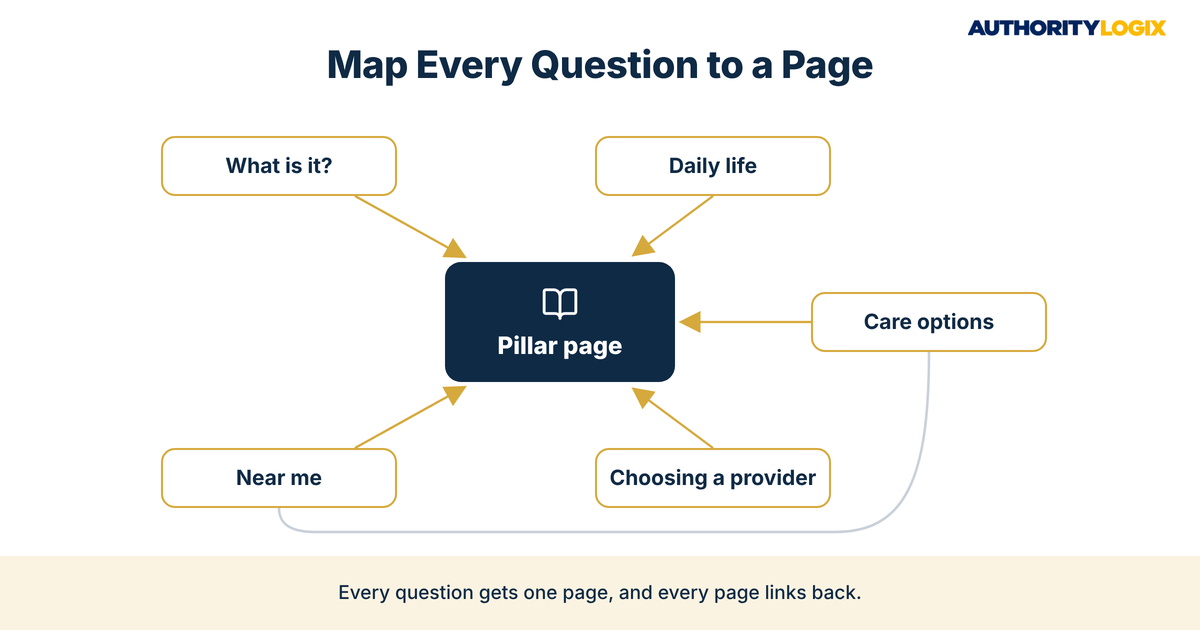
Mapping physical therapy content clusters starts with the question list from your evaluations. Group the questions by intent: what is this, what can I do about it, what does care involve, and how do I choose a provider. The map then shows which questions are covered and which are still open.
| Question type | Example for a sciatica cluster | Where it lives in the cluster |
|---|---|---|
| The whole subject | Sciatica: what it is and when to get help | Pillar page |
| Understanding the condition | What causes sciatica pain? | Supporting article |
| Daily life | Can I keep exercising with sciatica? | Supporting article |
| Care options | What does physical therapy for sciatica involve? | Supporting article linked to the service page |
| Choosing a provider | Do I need a referral to see a physical therapist? | FAQ section or supporting article |
| Local intent | Sciatica physical therapy near me | Location or service page |
The last two rows matter most. Questions with local intent belong on location and service pages that are tied into your local search setup, so a patient who reads a supporting article can move straight to a page that shows where you are and how to book. Condition cluster SEO without that bridge brings in readers who never become patients.
Specialty Cluster Internal Linking That Passes Authority
Specialty cluster internal linking is what turns a set of related pages into a cluster. Without links, search engines see separate articles that happen to share a topic; with links, they see a connected body of work where the pillar is clearly the main page.
The basic pattern is simple. Every supporting article links up to the pillar, the pillar links down to every supporting article, and sibling articles link to each other where a reader would naturally want the next answer — the full mechanics are covered in the guide to PT internal linking.
Anchor Text and Link Placement Rules
The words you link matter as much as the links themselves. Short, descriptive anchor text tells readers and search engines what the next page covers, and a link inside a relevant sentence does more work than a list at the bottom of a page.
- Link every supporting article to the pillar early in the body, inside a relevant sentence.
- Use short anchor text that describes the destination page, never a generic phrase.
- Link each destination once per page so every link has a clear purpose.
- Connect sibling articles only where a reader would want the next answer.
- Send readers from every cluster page to a service or booking page.
- Review the cluster links each time a new article is published.
Internal links move authority inside your site; outside signals bring new authority in. Sharing cluster articles through email, social channels and community partners — the job of authority distribution — earns the referring links that, in the Ahrefs data, tend to go with more traffic. Specialty cluster internal linking and distribution work best as one system.
Audit the links in physical therapy content clusters on a regular schedule. Pages get renamed and new articles get added, and a cluster with broken links slowly turns back into separate posts.
How Long Do Physical Therapy Content Clusters Take to Show Results?
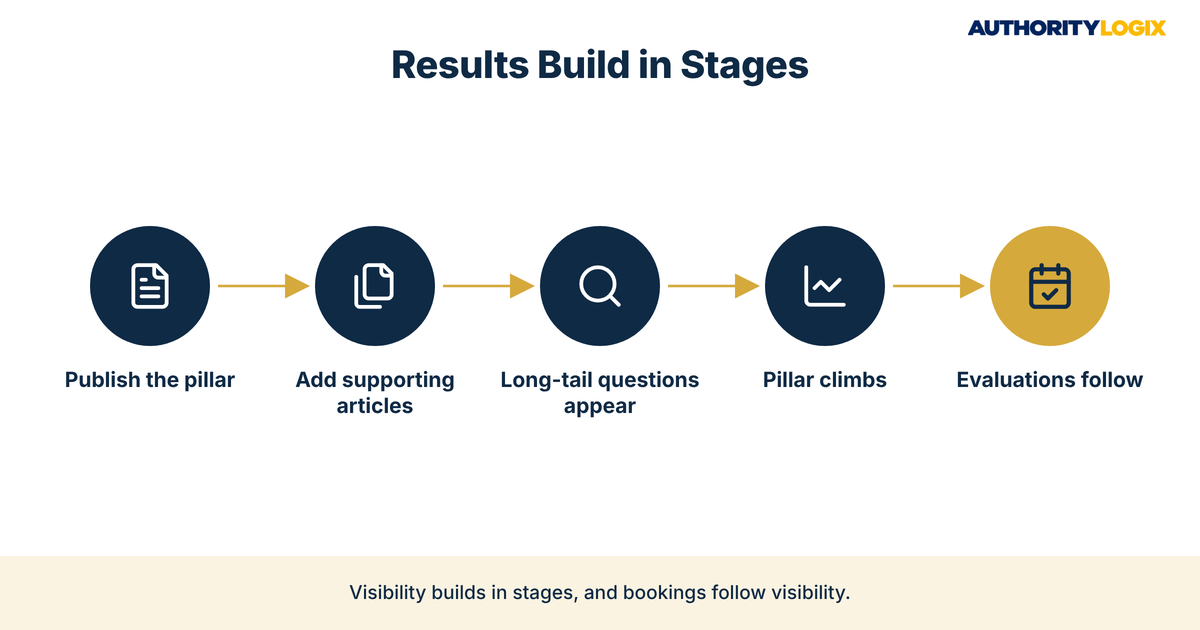
There is no honest fixed timeline for physical therapy content clusters, and any promise of rankings by a specific date should make you skeptical. Results depend on local competition, the strength of your site, and how complete the cluster is. A less contested specialty can show early movement sooner than a condition every clinic in town writes about.
What you can expect is a pattern rather than a date. Supporting articles that answer narrow questions often appear for long-tail searches first; the pillar tends to climb later as the cluster fills in and earns links. Calls and evaluation requests follow visibility, not the publishing date, which is why measuring too early leads practices to abandon physical therapy content clusters just before they start to work.
Physical therapy content clusters also do not work in isolation. A practice with an incomplete Google Business Profile or inconsistent listings will see cluster readers drop off when they look up the clinic, so content results are tied to your broader local visibility as much as to the articles themselves.
Track the right signals while you wait: rankings for the cluster’s questions, pillar visits, clicks to booking pages and new-patient forms that mention the condition. Reviewing those numbers on a regular schedule is built into our process, because it shows which articles to strengthen and which questions the cluster has not yet answered.
Frequently Asked Questions About Topic Clusters for PT Practices
What are topic clusters and why do they matter for a PT practice?
A topic cluster is a group of pages on one subject, a pillar page and several supporting articles, joined by internal links. For a practice, physical therapy content clusters matter because they let the website show depth on the conditions you treat, which helps patients and search engines see the expertise you already have.
How many supporting articles does one pillar page need?
There is no fixed number. A cluster is complete when it answers the questions patients actually ask about that subject, so your evaluation question list is a better guide than a target count. Start with the most common questions and add articles as new ones come up.
What pages does a physical therapy website need before building clusters?
Physical therapy content clusters sit on top of the basics, not in place of them. A practice should already have clear service pages, location pages, clinician bios and an easy booking path, which form the foundation of any PT marketing system. Without those pages, cluster readers have nowhere useful to go next.
Can a practice owner build physical therapy content clusters in-house?
Many owners start the question list and review content for accuracy, which is the part only clinicians can do. The planning, writing, linking and measuring take steady time each month, and that is the work our services are designed to take off the owner’s desk. Either way, the cluster should carry your clinicians’ expertise, not generic copy.
Ready to build a condition or specialty cluster, with the pillar page, supporting articles and internal links that show patients and search engines the expertise your clinicians already have?
Expanding From One Cluster to a Full Authority Library
Once the first cluster is complete and showing movement, the next one is easier. The question map, the pillar template, the linking rules and the clinical review step are already in place, so a second specialty or condition becomes a repeatable build rather than a new project. Over time, physical therapy content clusters grow into an authority library, with clusters supporting each other wherever conditions overlap.
Each new cluster should connect to how the practice turns readers into patients. Booking calls to action, condition-specific forms and follow-up emails tie the library to lead generation, so visibility becomes evaluations instead of page views.
Choose the order of future physical therapy content clusters the same way you chose the first: clinical depth, local search demand and the caseload you want to grow. Every piece has a job. Every piece feeds the next.
The honest assessment is that most practices already have the expertise a strong cluster needs; it lives in every evaluation and every patient question. What is missing is the structure that puts that expertise on the page in a connected, findable way, and that is a large part of why practices choose to build it with a partner who has done it before. Physical therapy content clusters are not a shortcut; they are infrastructure, and infrastructure keeps working long after an article is published.