


Key Takeaways
- A physical therapy content writer does not need clinical training to produce strong articles, but the writer does need a brief, a clinician’s input and a review step before anything publishes.
- A PT content writer briefing hands a physical therapy content writer the patient reader, the search target, the clinical talking points, the words to avoid, the links and the name of the person who signs off.
- Paid test assignments reveal more about a physical therapy content writer than a portfolio, because they show how fast the writer absorbs your practice’s way of explaining care.
- Outsource physical therapy blogging when drafting time is the bottleneck, and keep clinical judgment, final accuracy review and the practice’s voice in-house.
- According to Content Marketing Institute, 33% of B2B marketers said accessing subject matter experts was a challenge, which is why a short clinician interview works better than asking therapists to write.
- PT outsourced content quality holds only when every article from a physical therapy content writer passes clinical accuracy, compliance and search checks before it goes live.
Table of Contents

Why Most Physical Therapy Content Writer Relationships Disappoint
Hiring a physical therapy content writer usually ends one of two ways: the articles come back generic enough to fit any clinic in the country, or they come back clinically shaky and the owner spends a Sunday rewriting them. Most practices hand over a topic and a word count without the content systems that tell the writer who the reader is, what the article must do and who checks it.
You already have the clinical credibility. Your therapists explain the same conditions to patients every day, and that explanation is exactly what a good article needs. None of it reaches the writer, so a physical therapy content writer fills the space with general health copy that every other clinic in your area already publishes. Expertise is the asset, and the writer’s job is to carry it onto the page.
The fix is structural, not personal. When writing is one part of a larger content strategy, with a defined reader, a keyword target and a review owner for every piece, the writer stops guessing. The same physical therapy content writer who produced forgettable drafts can produce useful ones once the inputs match what the practice expects.
This matters because articles are supposed to bring in patients, not just fill a blog. A condition article that answers a real question, names your clinicians and points to a clear next step supports patient acquisition directly. A vague one does very little, no matter how often it is published, because volume without infrastructure is just noise.
The Physical Therapy Content SEO Playbook shows where writer briefs, keyword targets and review steps fit inside a complete content and search system, so every physical therapy content writer you hire works from the same plan.
What Should a PT Content Writer Briefing Include?
A PT content writer briefing is the one document that turns a topic into an article your practice can stand behind. It answers what a physical therapy content writer who does not know PT would otherwise guess at: who is reading, what they searched for, what your clinicians want said, and what must never be said.
Start with the reader. A runner after a weekend race, a parent researching a child’s sports injury and a desk worker with a stiff neck need different words, so the brief names which one this article serves.
The clinical section is where most briefs fall short. List the points your therapists always make about this condition or service, the questions patients ask most at the first visit, and the claims to avoid. Those points come from your everyday patient education conversations, so the physical therapy content writer translates what your clinicians already say rather than inventing it.
A One-Page PT Content Writer Briefing Template
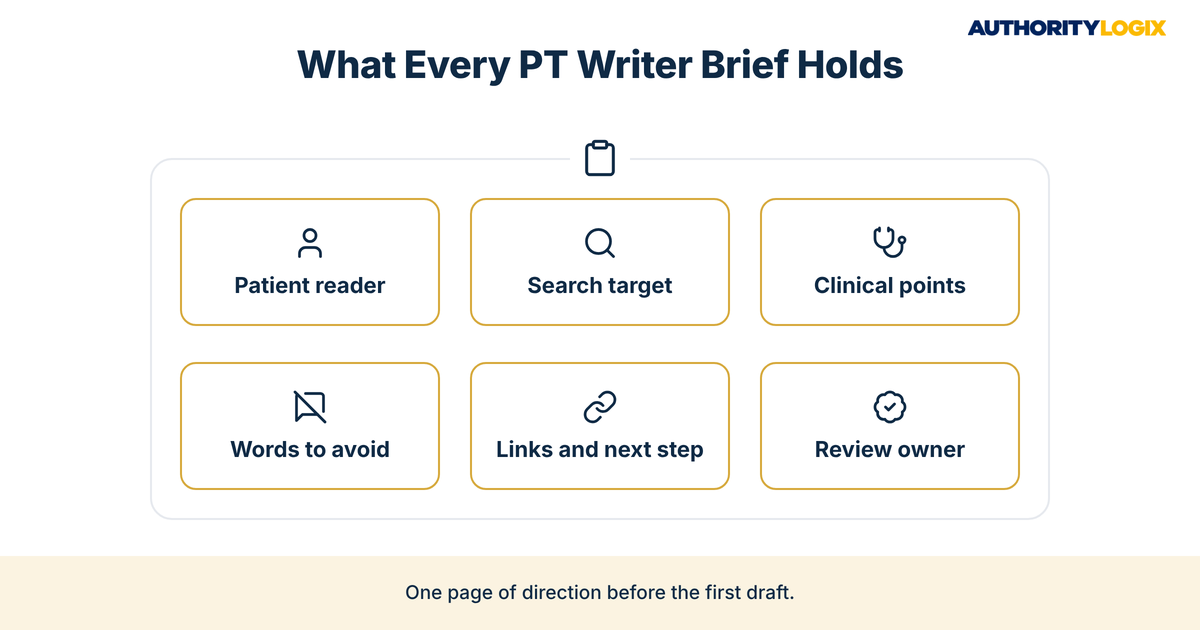
Keep the brief to one page so it actually gets filled in. The table below covers what every physical therapy content writer needs before the first draft, and who in the practice supplies each part.
| Brief section | What the writer needs | Who supplies it |
|---|---|---|
| Patient reader | Who the article is for and their situation | Practice owner or marketing lead |
| Search target | Primary keyword, main question and related phrases | Marketing lead or SEO partner |
| Clinical talking points | What therapists always say, in plain language | Treating clinician |
| Words to avoid | Outcome promises, jargon and any patient details | Practice owner |
| Links and next step | Pages to link and the reader action | Marketing lead |
| Review owner and date | Who signs off and the publish deadline | Practice owner |
A template only works when it is used every time. Attach the brief to each topic on your content calendar so the writer receives it with the assignment, not after the first draft. Completed briefs also become a record of your practice’s positions on each condition, which makes later articles faster to brief and review.
How to Find a Physical Therapy Content Writer Who Learns Fast
The right physical therapy content writer is rarely the one with the longest list of healthcare clients. Healthcare samples prove someone can write about medicine, not that they can learn how your clinic explains care. You want a writer who asks good questions, follows a brief closely and improves between the first draft and the second.
Look for writers who have produced structured patient material, such as FAQ pages, condition guides or service pages, because they understand that each article sits inside a larger educational hub and links to the pages around it. Ask how they handle a topic they know nothing about. Strong candidates describe research, interviews and verification, while weaker ones describe writing quickly.
Be clear about the limits of the role. A physical therapy content writer should never diagnose, recommend treatment or decide what the practice believes clinically. The job is structure, clarity and search discipline, and good candidates readily ask a therapist to confirm a point before it goes in.
Test Assignments That Reveal a Good Physical Therapy Content Writer
A paid test assignment shows more than any portfolio. Give two or three candidates the same real brief and a recorded clinician interview, then compare the drafts. You are looking for accurate use of the interview, sensible structure, plain language and honest flags on anything the physical therapy content writer was unsure about.
Score each draft against the brief, send one round of feedback and see how each writer revises. The revision shows whether a writer can absorb your standards, and repeatable steps like this one are what our process is built on. A physical therapy content writer who fixes every note in one pass is worth more than one whose first draft was slightly better.
When to Outsource Physical Therapy Blogging and When to Keep It In-House
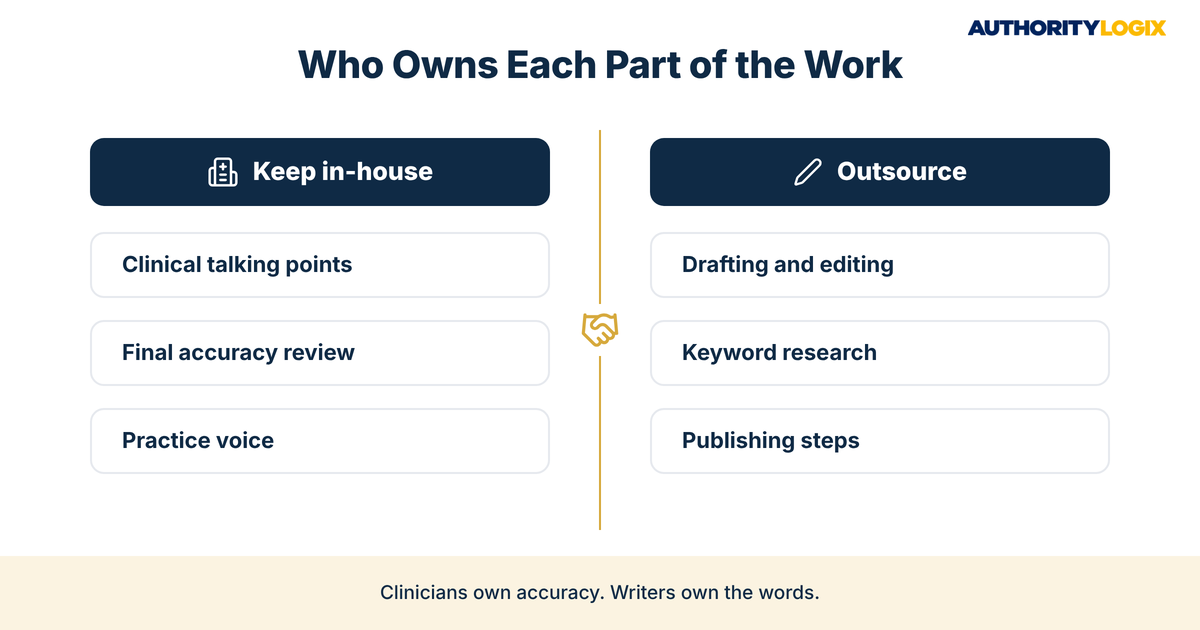
The decision to outsource physical therapy blogging is a decision about where the bottleneck sits. If your clinicians have plenty to say but no hours to write, drafting is the bottleneck, and a physical therapy content writer solves it. If nobody can say clearly what the practice stands for, a writer will only produce polished versions of that confusion. Most practices land on a split between work that stays inside and work that goes out.
- Keep in-house: clinical talking points, the final accuracy review and decisions about what the practice will and will not claim.
- Outsource: drafting, editing and formatting articles from the brief and the clinician interview.
- Outsource: keyword research, headings, internal linking and the technical publishing steps.
Outsourcing works best when the outside team handles more than the words. A writer who only drafts leaves the practice managing keyword research, publishing and promotion, which is where many programs quietly stall. That is why our services pair writing with planning, review and distribution, so the practice supplies expertise and approvals rather than project management.
Location shapes the decision too. A practice with several clinics needs articles that mention the right neighborhoods, clinicians and services at each site, and a physical therapy content writer needs that detail spelled out. When the brief covers it, each article supports local search as well as education, which a generic freelance piece rarely does.
Not sure whether your current articles are building patient trust or just filling a blog? The assessment shows where your outsourced content is falling short and what to fix first.
How Clinicians Can Supply Expertise Without Writing Every Word
Therapists are rarely short on knowledge. They are short on time, and asking a clinician to write a full article after a full caseload usually means it never gets written. Ask for a short conversation instead, and let the physical therapy content writer do the rest.
The same constraint shows up well beyond physical therapy. According to Content Marketing Institute’s outlook research for 2025, based on a 2024 survey, 33% of B2B marketers said accessing subject matter experts was a challenge, down from 39% the year before, and 27% said creating quality content was a challenge, down from 44%. Those respondents were B2B marketers rather than clinics, but the lesson carries over: expert access is the constraint to design around.
A simple interview routine solves most of it. The writer sends a handful of questions from the brief, the clinician answers them in a short recorded call, and the writer drafts from the transcript. The therapist’s own phrasing, examples and cautions end up in the article, and the only other clinician task is the final review.
In search, content built from a named clinician’s input can carry a byline, a reviewer note and credentials, all of which are E-E-A-T signals that help patients judge whether the advice comes from someone qualified. A physical therapy content writer can format those signals, but only the clinician can supply them.
One interview can feed more than one piece. The same conversation can supply an FAQ answer, a short video script and a newsletter tip, and spreading that material across channels is the job of authority distribution. The clinician talks once, and the practice publishes many times.
Protecting PT Outsourced Content Quality With a Review Process
PT outsourced content quality does not depend on finding a perfect physical therapy content writer. It depends on a review process that catches problems before patients see them, and on a clear owner for every step. Without one, the practice either publishes drafts nobody checked or lets finished articles sit in an inbox for weeks.
Set up two reviews per article. The first is an editorial review by whoever manages the brief, checking that the draft follows it and reads in plain language. The second is a clinical review by the therapist who gave the interview, focused only on accuracy. Keeping that review narrow keeps it fast and gives every physical therapy content writer a predictable path to approval.
Compliance and Accuracy Checks Before Publishing
Before anything goes live, check it against a short, fixed list. The article should make no promises about recovery or results, contain no patient names or identifying details, avoid advice that belongs in an evaluation, and say plainly when a reader should see a professional. Every claim with a number needs a named source, and any testimonial needs the right consent.
Accuracy checks extend to practical details too. Addresses, hours, clinician names and insurance information must match your Google Business Profile and website, because mismatched details weaken local visibility and confuse patients who are ready to book. A physical therapy content writer can verify these against a reference sheet, but someone in the practice should own that sheet.
Finally, record what passed review and who approved it. A dated reviewer note shows patients that a clinician stood behind the article, and a folder of approved work gives every new physical therapy content writer examples of finished articles. For more models of structured patient articles, browse the PT resources library.

Frequently Asked Questions About Hiring PT Writers
Does my PT clinic website need a blog?
In most cases, yes, if the articles answer the questions your patients actually ask. It only pays off when the articles are accurate, linked to the right service pages and published on a steady schedule.
Can a physical therapy content writer without clinical training write accurate articles?
Yes, when the clinical content comes from your therapists and a clinician reviews every draft. The writer supplies structure, clarity and search discipline, which is the division of labor behind strong PT marketing content. Writers who try to fill clinical gaps on their own are the ones who create risk.
How do I start a physical therapy blog if nobody on staff writes?
Start with the questions patients ask most at first visits and turn each one into an article. Brief a physical therapy content writer on each topic, record a short clinician interview, and publish only after review. A handful of accurate articles that answer real questions does more than a long list of generic posts.
As a patient, how can I tell whether a practice’s articles are trustworthy?
Look for a named clinician as the author or reviewer, a recent review date and plain explanations that encourage an evaluation rather than promising results. Trustworthy articles say when you should see a professional and avoid guarantees. Signals like these are part of why practices choose reviewed content over anonymous blog posts.
Ready to have briefs, clinician interviews, writing and review run as one system that publishes accurate PT articles without taking over your schedule?
Turning a Physical Therapy Content Writer Partnership Into a Reliable Content Engine
A physical therapy content writer becomes a long-term asset when the work around the writer is systematized. Briefs, interviews, reviews and publishing dates turn one writer’s output into a library that grows every month, and that library is what authority growth is built on. Each new article strengthens the ones already published.
AuthorityLogix runs on the same principle. BKDSCR.com, its own proof-of-concept build in the NYC DSCR real estate niche, carries 48 SEO-optimized blog posts and 18 pillar pages and generates inbound leads with zero paid ads. Output at that scale only stays consistent when every piece starts from a defined structure rather than a writer’s guess.
Content also has to connect to booking. Every article should end with a clear next step, a link to the relevant service page and an easy way to request an evaluation. That connection between articles and lead generation is what turns a writer partnership into a source of new patients rather than a line item.
The honest assessment is that writers who don’t know PT are rarely the real problem. The missing piece is usually the brief, the clinician’s input and the review step that let any capable physical therapy content writer carry your practice’s expertise onto the page.