


Key Takeaways
- Physical therapy marketing outsourcing works best when the owner keeps the parts only the clinic can supply — clinical voice, patient consent and local relationships — and delegates the technical, repeatable work.
- Practice owner marketing time is the hidden cost of doing it yourself: every hour spent on website edits and posting schedules is an hour not spent on patients, staff or referral relationships.
- Content Marketing Institute found that 9 in 10 B2B marketers already use AI to churn out content, but fewer than 4 in 10 say it has actually improved performance, so more volume is not the goal of physical therapy marketing outsourcing.
- In-house vs agency marketing is a channel-by-channel decision, not an all-or-nothing choice between doing everything yourself and handing everything away.
- PT marketing agency hiring should start with questions about account ownership, clinical review, reporting and healthcare guardrails — before price.
- The strongest physical therapy marketing outsourcing arrangements are partnerships with a written split of roles, so the system keeps running without daily attention from the owner.
Table of Contents

What Physical Therapy Marketing Outsourcing Really Means for a Practice Owner
Physical therapy marketing outsourcing is the decision to hand specific parts of your visibility work to outside specialists while your own team keeps the parts only it can do. Most owners reach it tired: they treat patients all day, and the website, the Google profile and the blog still sit untouched for months. The goal is to build a dependable system for patient acquisition that does not depend on the owner’s evenings and weekends.
The clinicians are skilled, patients leave with clear explanations, and referring providers trust the team. Yet a prospective patient who searches online sees a thin website, a handful of reviews and nothing that shows how the practice thinks. The practice is credible but invisible, and the gap is structural. It comes from missing infrastructure, not missing talent.
Physical therapy marketing outsourcing done well closes that gap without asking the owner to become a marketer. It treats PT marketing as a set of connected jobs: some require the clinic’s knowledge and voice, and others require technical skill, tools and steady production. Sorting those jobs is the first decision, and it shapes every decision that follows.
The range of outsourced work is wide. One partner might handle only search, while another runs content, listings, email and reporting as one build, the model described in our services. Neither model fits every clinic. What matters is that each piece of physical therapy marketing outsourcing has a clear owner, a clear purpose and a way to measure what it produces.
It is also a budget question. Before signing anything, know what you can commit each month and for how long, because visibility work builds over quarters, not weeks. A written marketing budget lets you compare an agency proposal against the cost of an in-house hire and decide which mix gives the practice more capacity for the money.
The Physical Therapy Practice Authority Growth Blueprint lays out the full growth system behind this choice, so you can see where physical therapy marketing outsourcing fits next to the work your own team should keep.
Practice Owner Marketing Time: What It Actually Costs to Do It Yourself
Practice owner marketing time is the cost nobody puts on the spreadsheet. An owner who spends Sundays rewriting service pages pays for that work, just not in dollars. The real price is hours taken from patient care, staff and referral relationships.
The second cost is inconsistency. Owner-run marketing tends to happen in bursts: a strong month when the schedule is light, then nothing for a quarter when the clinic is full. Stop-and-start effort rarely builds momentum with search engines or patients. That pattern is the most common reason owners start looking at physical therapy marketing outsourcing in the first place.
There is also a cost in how inquiries are handled. When nobody owns follow-up, web forms and voicemails sit unanswered, and the true acquisition cost of each new patient rises because effort leaks before it converts. An owner doing everything rarely sees those leaks.
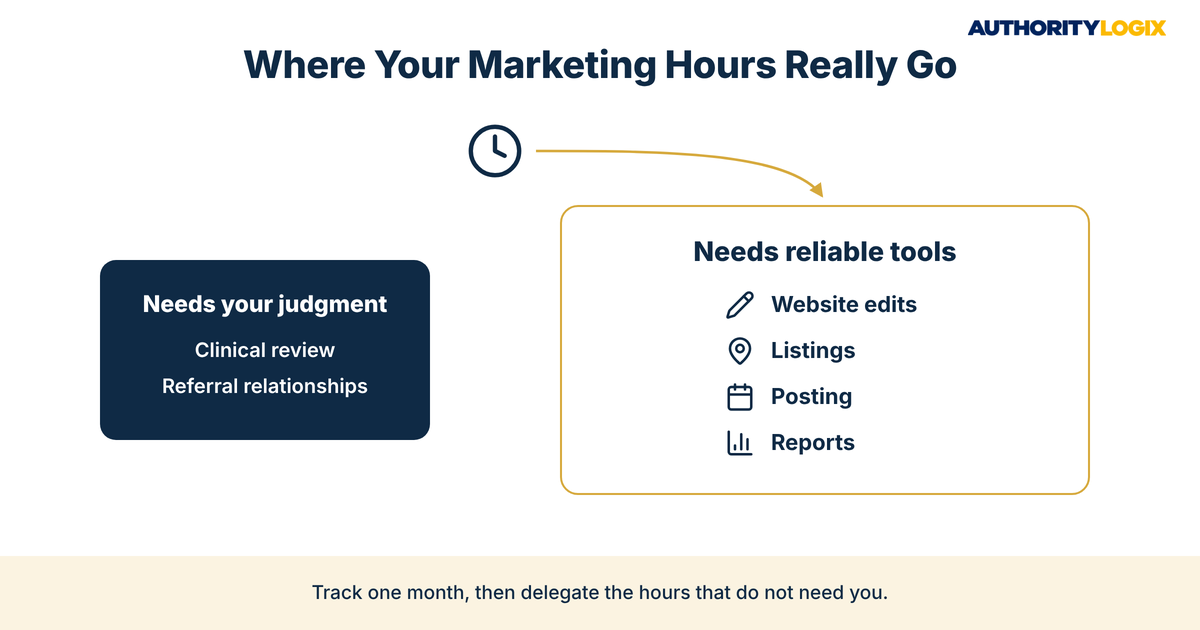
A useful exercise is to track one month honestly. Log every hour spent on website edits, social posts, review requests, listings and reports. Then ask which of those hours required clinical judgment and which only required someone reliable with the right tools. The second group is where physical therapy marketing outsourcing usually starts.
Most owners find that the technical and repetitive work — page updates, tracking, listing management, routine publishing — takes the bulk of the hours. Those are the pieces physical therapy marketing outsourcing hands to a structured lead generation system that runs on a schedule. Handing them off frees the owner to contribute what only the owner can: expertise, judgment and the relationships that make the practice trusted.
What to Keep In-House: The Parts Only Your Clinic Can Own
Some marketing work should never leave the clinic, no matter how capable the agency is. Physical therapy marketing outsourcing fails most often when a practice hands over the parts that depend on its own knowledge, people and patient relationships. An outside team can shape, publish and distribute that material, but it cannot invent it.
The first thing to keep is the clinical substance. Your therapists know which questions new patients ask, which conditions bring people in each season and how the team explains a plan of care. That knowledge is the raw material of clinical authority, and no physical therapy marketing outsourcing partner can supply it secondhand.
Clinical Voice and Patient Stories Stay With the Team
Clinical voice is the way your clinicians explain problems, set expectations and talk about care without overpromising. In physical therapy marketing outsourcing, the agency should interview your team, draft from those conversations and send the work back for clinical review before anything goes live. That review step protects accuracy and keeps every page inside the guardrails a healthcare practice must respect.
Patient stories stay with the team for a different reason: consent and privacy. Any testimonial must come with the patient’s written permission and must never include health details the patient did not agree to share. Your staff can ask at the right moment, so collection stays in-house even when a partner publishes the result.
Owners should also keep their own public voice. Community talks, referral-provider conversations and the owner’s view of the profession are the foundation of thought leadership, and they carry weight because they come from a working clinician. A good physical therapy marketing outsourcing partner can turn a short interview into an article or a LinkedIn post, but the ideas have to be yours.
Not sure which parts of your visibility system are working and which are being neglected? The assessment shows where physical therapy marketing outsourcing would help most and what your team should keep doing itself.
What to Delegate in Physical Therapy Marketing Outsourcing
The work that belongs outside the clinic shares three traits: it is technical, it is repetitive and it depends on tools most practices do not own. Website structure, search work, listing management, analytics and publishing schedules all fit that description. This is where physical therapy marketing outsourcing earns its fee.
Technical SEO and Distribution Belong With Specialists
Technical search work — site speed, page structure, internal linking, schema markup and keyword mapping — changes constantly and punishes guesswork. A specialist team that follows content SEO discipline can build condition pages and service pages that search engines understand, while your clinicians review the substance.
Production is the second piece to delegate. Turning clinician interviews into a steady flow of articles, condition pages and patient guides takes editors, schedules and quality checks. Repeatable content systems carry that load, so publishing continues through the busy months when nobody on staff has time to write.
Distribution is the third. Publishing a page is only half the job, because the material also has to reach patients and referral sources through email, social channels and syndication. That is the work of authority distribution, and a physical therapy marketing outsourcing partner can run it on a schedule far more reliably than an owner can remember it between appointments.
Be careful about buying volume for its own sake. According to Content Marketing Institute’s B2B marketer survey, 9 in 10 marketers already use AI to churn out content, but fewer than 4 in 10 say it has actually improved performance. The survey covered more than 1,000 B2B marketers. Physical therapy marketing outsourcing should buy structure, accuracy and clinical review, not just more pages. Volume without infrastructure is just noise.

In-House vs Agency Marketing: How to Decide for Each Channel
In-house vs agency marketing is rarely an either-or choice. Most practices do best with a split: the clinic owns the inputs that need clinical knowledge and patient contact, and an outside team owns the channels that need technical skill and steady output. Deciding channel by channel keeps physical therapy marketing outsourcing focused on what it does well.
| Channel | Keep in-house | Delegate |
|---|---|---|
| Google Business Profile | Real photos of the team and clinic, answers to patient questions | Category setup, posting schedule, listing monitoring |
| Reviews | Asking patients for a review at the right moment | Request automation, draft responses for staff approval |
| Website and condition pages | Clinical review and final approval | Page structure, writing from interviews, technical SEO |
| Patient education | Topics, clinician interviews, clinical sign-off | Editing, formatting, publishing schedule |
| Email and social channels | Practice news and community events | Scheduling, distribution, reporting |
| Reporting | Business decisions based on the numbers | Tracking setup and monthly dashboards |
Local channels deserve special attention because they reach the patients closest to your door. A strong local search foundation depends on accurate listings, consistent categories and steady review activity, which physical therapy marketing outsourcing can maintain. It also depends on real photos and real answers that only your team can provide.
The same split applies to the wider picture of local visibility across maps, directories and neighborhood pages. Let the specialist handle citations and location pages, and keep community presence — events, talks and partnerships — with the people patients will actually meet. That combination turns in-house vs agency marketing into a partnership instead of a handoff.
PT Marketing Agency Hiring: Questions to Ask Before You Sign
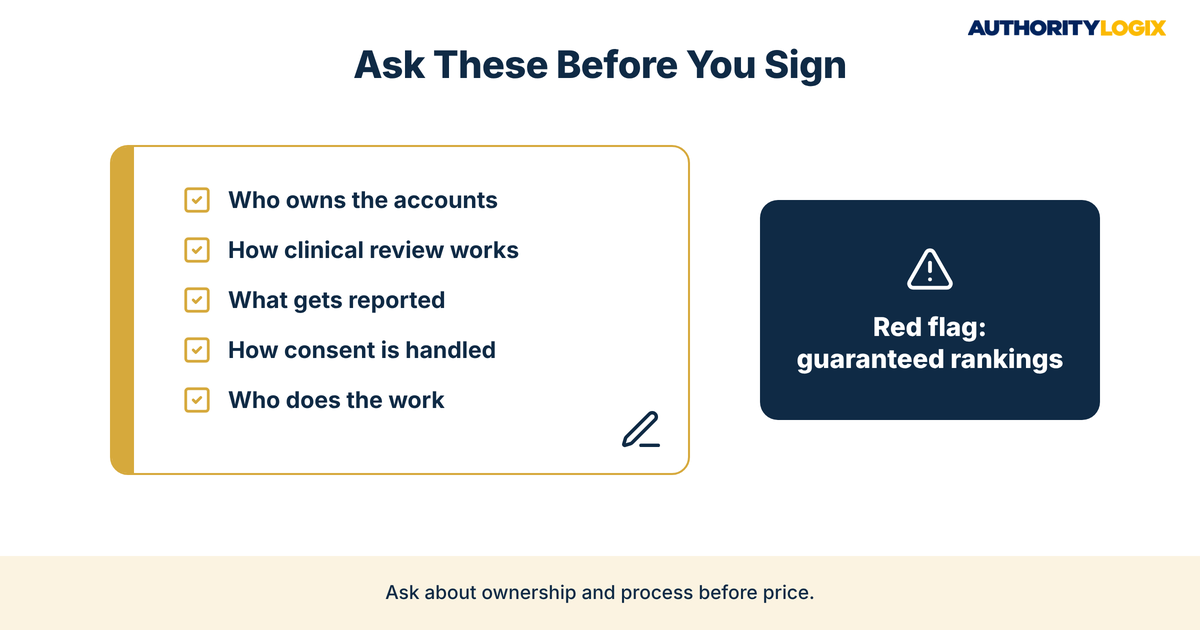
PT marketing agency hiring goes wrong when the conversation starts with price. Price matters, but the questions that protect you are about ownership, process, reporting and healthcare experience. Physical therapy marketing outsourcing is a long relationship, so the partner’s habits matter more than the first proposal.
- Who owns the website, domain, content and accounts if we part ways?
- Who interviews our clinicians, and how does clinical review work before publishing?
- What will you report each month, and which numbers connect to evaluations booked?
- How do you handle patient privacy, testimonials and written consent?
- Which work does your own team do, and which work is subcontracted?
- What does the first quarter look like, and what should we expect to see by then?
Ask to see how a physical therapy marketing outsourcing partner works, not only what it has produced. A written sequence of discovery, planning, production, review, publishing and reporting tells you whether the partner runs a system or improvises each month. Set any proposal beside our process and you will see quickly which steps are missing.
Red Flags in a Physical Therapy Marketing Outsourcing Proposal
Watch for proposals that promise rankings or patient numbers by a date. Nobody controls search results, and a healthcare practice should never market guaranteed results. Treat any guarantee as a sign the agency does not understand your field.
Other red flags in physical therapy marketing outsourcing include long contracts with no performance review, accounts registered in the agency’s name, content written without clinician input and reports full of impressions with no link to evaluations. Several together usually mean the arrangement will cost more owner time than it saves.
FAQ: Outsourcing Questions From Physical Therapy Practice Owners
These are the questions owners ask most often when they weigh physical therapy marketing outsourcing against doing the work themselves. The answers assume a single-location or small group practice.
What are the pros and cons of outsourcing PT clinic marketing?
The main advantage is capacity: specialists handle technical and repetitive work on a schedule, and the owner gets time back. The main drawbacks are cost, less day-to-day control and the risk of generic content if the agency never talks to your clinicians. Good physical therapy marketing outsourcing reduces those risks with clinical review and clear ownership terms.
How do I know it is time to hire a new PT marketing agency?
If reports do not connect to evaluations booked, if content goes live without clinician review, or if you cannot get into your own accounts, it is time to look elsewhere. A new partner should start with an audit of what already exists before it proposes anything.
What should stay in-house if we outsource most of our marketing?
Keep clinical review, patient consent for stories, the owner’s public voice and final decisions on services and locations. Patient education topics should also come from your team, because a useful educational hub is built from the questions your clinicians hear every week, even when an agency writes and publishes the pages.
How do I choose a marketing agency for a physical therapy practice?
Choose the physical therapy marketing outsourcing partner that understands direct-access patients, physician referral relationships and healthcare guardrails, and that can show you a written process. Before you take sales calls, reading practical PT resources written for practice owners will sharpen your questions and make weak proposals easier to spot.
Ready to split the work so your clinicians supply the expertise while a dedicated team runs the content, search and distribution system behind your practice?
Building a Marketing Partnership That Frees Up Owner Time
Physical therapy marketing outsourcing works when it gives the owner time back without taking the practice’s voice away. The clinic keeps clinical substance, patient consent, community relationships and decisions. The partner runs the technical, repetitive and distribution work on a schedule, and both sides review the same numbers every month.
That is the model AuthorityLogix proved on its own build first. BKDSCR.com, our proof-of-concept platform in the NYC real estate investment niche, carries 18 pillar pages, 7 interactive tools and 48 blog posts, built in under 18 months with zero paid ads. It is not a physical therapy practice; the point is that a structured system keeps producing after the foundation is built, which is why AuthorityLogix starts every engagement with infrastructure rather than tactics.
The honest answer is that most practice owners do not need to become marketers, and they should not try. You already have the expertise patients are looking for. The missing piece is a clear division of work, with the right parts kept in-house and the rest handed to a physical therapy marketing outsourcing partner that runs it as a system.