


Key Takeaways
- Physical therapy practice owner thought leadership means the market can see the clinical judgment you already use every day — in search, on condition pages, and in the answers patients read before booking.
- The 2024 Edelman-LinkedIn B2B Thought Leadership Impact Report, citing the Ehrenberg-Bass Institute, says 95% of business clients are not actively seeking goods or services at any given moment — business-buyer data, but a reminder that most future patients are not searching yet.
- Physical therapy practice owner thought leadership does not require writing: a recorded conversation, edited by someone who understands search, produces condition pages and FAQ answers in your voice.
- Google’s helpful content guidance asks whether pages show first-hand expertise and carry a byline where readers expect one.
- APTA reports that patients in all 50 states, the District of Columbia, and the U.S. Virgin Islands have provisional or unrestricted direct access to physical therapist services.
- Physical therapy practice owner thought leadership is an infrastructure build, not a writing habit: capture, edit, publish, distribute, and connect it to local search.
Table of Contents
Physical therapy practice owner thought leadership sounds like a luxury for owners who already carry a full caseload, run payroll, and chase authorizations. You have spent years forming clear views on what new patients worry about and which questions come up at every first visit — yet none of that shows up when someone in your town searches for help. That gap is not a talent problem. It is the credible but invisible problem, and it is almost always an infrastructure problem rather than a writing problem.
The usual advice is to blog more, which assumes you have free evenings. Practices that make owner expertise visible usually rely on content systems that pull ideas out of the owner through conversation and turn them into published pages, so the owner reviews instead of drafting. This article covers how physical therapy practice owner thought leadership works that way, what it produces, and what it honestly costs in time.
What Physical Therapy Practice Owner Thought Leadership Looks Like While You Still Treat Patients
In practical terms, physical therapy practice owner thought leadership is a library of pages and posts that carry your name, your reasoning, and your way of explaining things to patients. It is not a book or a weekly column. It is condition pages that sound like you, FAQ answers drawn from questions you hear every week, and short articles that explain how your clinic approaches a problem — all attributed to a real clinician with real credentials.
Attribution matters more in healthcare than in most fields. Google’s guidance on creating helpful content asks whether pages carry a byline where readers would expect one and whether the content shows first-hand expertise, and it says Google’s systems give extra weight to strong E-E-A-T on topics that could significantly affect people’s health. The trust signals laid out in the clinical authority guide build on that same foundation, and an owner’s name on the page is a signal that a national chain’s anonymous copy cannot match.
What Physical Therapy Practice Owner Thought Leadership Is Not
It is not a social feed of motivational quotes or a newsletter you feel guilty about skipping. Volume is not the goal. A modest set of pages that answer real patient questions in your voice does more for physical therapy practice owner thought leadership than a year of generic posts written by someone who has never stood in your clinic.
The point is positioning, not publicity. When a prospective patient compares three clinics, the one whose owner has explained the clinic’s approach in plain language feels less like a stranger. That positioning work sits inside the broader visibility systems described on the PT industry hub, where owner expertise feeds every other channel instead of living in a separate silo.
The Physical Therapy Practice Authority & Growth Blueprint shows where physical therapy practice owner thought leadership fits inside a complete growth system.
Why a PT Owner Thought Leadership Strategy Belongs in Your Patient Pipeline
A PT owner thought leadership strategy earns its place by what it does for the patient pipeline, not by how it looks on a website. Some of the clearest data comes from business buying rather than healthcare. The 2024 Edelman-LinkedIn report on B2B thought leadership, citing the Ehrenberg-Bass Institute’s 95:5 rule, says that at any given moment 95% of business clients are not actively seeking goods or services.
Those are business buyers, not patients, and the finding should not be stretched further than that. The pattern still applies in a clinic: most people who will eventually need physical therapy are not looking for it today. Physical therapy practice owner thought leadership reaches them before that day comes, so your name already feels familiar when the need arrives.
Familiarity alone does not book an evaluation. Pages that carry your expertise need clear next steps — a request form, a direct-access explainer, a phone number that is easy to tap — which is the job of lead generation infrastructure built around the content rather than bolted on afterward. Without that path, an owner’s best explanation becomes a dead end.
Direct Access Raises the Stakes for Owner Visibility
APTA’s 2025 report on the state of direct access says patients in all 50 states, the District of Columbia, and the U.S. Virgin Islands have either provisional or unrestricted direct access to physical therapist services for evaluation and treatment. APTA notes some provisions tied to treatment without a referral still persist in a number of states. Either way, many patients can choose a clinic without a physician choosing for them, and that choice is made by someone who has never met you.
That is why physical therapy practice owner thought leadership belongs in the same plan as referral diversification. The acquisition playbook treats physician referrals, direct-access patients, and reactivation as separate streams, and owner-led content is one of the few assets that supports all three. One referring doctor retires and the pipeline dries up overnight — a library of owner expertise does not retire with them.

Capturing Your Clinical Point of View Without Sitting Down to Write
The bottleneck in physical therapy practice owner thought leadership is almost never knowledge. It is the blank page at the end of a full clinic day. Owners who draft everything themselves usually find that writing loses to every other job they hold.
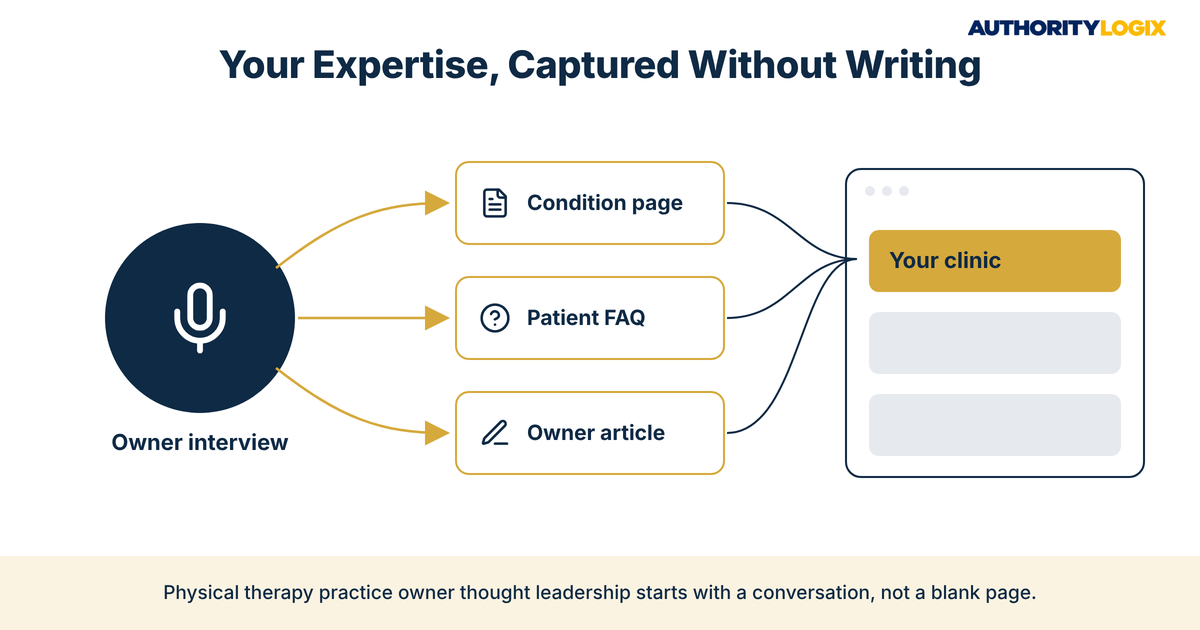
The fix is to separate expertise from production. You talk, and someone else writes. A recorded conversation like the ones you already have with new patients and staff contains more usable material for physical therapy practice owner thought leadership than most owners would ever type.
A workable capture process has three parts: a short list of topics agreed in advance, a recorded interview with someone who knows search and asks good follow-up questions, and a transcript that becomes the raw material for every draft. That sequence is the core of how we build owner-led authority, because it keeps the clinician’s voice intact while taking the writing out of the owner’s week.
Good topics come from the front desk and the treatment floor. These prompts produce usable material:
- The question new patients ask most often before their first visit
- What you wish people knew before choosing a physical therapy clinic
- How you explain direct access to someone who assumes they need a referral
- The misconception you correct most often, framed as general education
- Why your practice is set up the way it is
Topics work best when they are planned a quarter at a time, so each interview feeds a specific set of pages. The publishing schedule approach maps interview themes to the condition pages, FAQ answers, and articles they will become, which keeps a PT owner thought leadership strategy from drifting toward whatever felt interesting that month.
None of this requires the owner to learn SEO. The interviewer handles keywords, structure, and linking; the owner handles accuracy and voice. That division of labor is what we do for practices whose clinicians are respected locally but missing from search results, and it is the version of physical therapy practice owner thought leadership a busy owner can actually sustain.
Not sure where your practice stands on physical therapy practice owner thought leadership? The PT Authority Gap Assessment shows where your expertise is missing and what to build first.
Turning Interviews Into Physical Therapy Expert Positioning Content and Condition Pages
One good interview becomes several assets. Physical therapy expert positioning content works best when each asset has a defined job — a condition page that ranks, an FAQ answer that removes a pre-booking worry, a short article that explains your approach — and every piece links to the next. The table shows how one conversation breaks down.
| Interview Segment | Asset It Becomes | Job It Does |
|---|---|---|
| First-visit questions | FAQ answers on service pages | Removes hesitation before a patient books |
| How you explain a common condition | Condition page in the owner’s voice | Ranks for condition-plus-location searches |
| Your direct-access explanation | Direct-access explainer page | Explains how direct access works in your state in plain terms |
| Your clinic’s approach to care | Owner-bylined article | Carries physical therapy practice owner thought leadership into search |
| Corrections of common misconceptions | Educational posts and Business Profile updates | Keeps the website and local listing current |
Those assets need a home. Scattered posts are hard to follow, while a structured educational hub groups condition pages, FAQ answers, and articles so patients and search engines see one connected body of knowledge. Physical therapy practice owner thought leadership becomes visible at scale only when that structure sits underneath it.
Keeping the Owner’s Voice Through Editing
Editing is where most outsourced writing loses the clinician. A good editor keeps your phrases, examples, and directness, then adds structure and search targeting around them. The same applies to your staff, since clinician expertise is most convincing when each bio and article reads like the person a patient will actually meet.
Every draft should go back to the owner for a factual review before it publishes. The review is short but non-negotiable in healthcare, where physical therapy expert positioning content must never promise outcomes or drift into clinical advice.

Where PT Practice Owner Authority Building Meets the Map Pack and Direct-Access Patients
PT practice owner authority building pays off most clearly where patients search with local intent. Someone looking for a physical therapist nearby usually sees a map of local clinics first. Owner-led condition pages and FAQ answers give your local search signals something substantial to point to, so a top listing leads to a site that sounds like a clinician rather than a template.
The Google Business Profile is a natural outlet for physical therapy practice owner thought leadership. Short posts adapted from interviews, answered questions in the owner’s voice, and photos of the actual treatment space keep the profile active without new writing. Each one gives a direct-access patient another reason to call your clinic instead of the one down the street.
Reviews close the loop. A patient who reads an owner’s explanation of how the clinic works, then sees reviews describing the same experience, has two signals pointing the same way. The local visibility guide covers the profile, review, and citation work in detail, and physical therapy practice owner thought leadership makes each of those pieces more convincing.

What Most PT Practices Get Wrong About Physical Therapy Practice Owner Thought Leadership
Owners who give up on physical therapy practice owner thought leadership rarely lack ideas. They start with the wrong assumptions about time, format, or who does the work, and these are the questions that come up most.
Do I need to be a good writer to do this?
No. The interview model exists because most clinicians explain things better out loud than on a page. Your job is to talk the way you already talk to patients and to review drafts for accuracy.
Will patients actually read content written by the clinic owner?
Patients read whatever answers their question, and an owner’s plain explanation of a first visit does exactly that. The byline tells them a real clinician stands behind the words. No content can promise a patient a particular result, and good owner content never tries.
Can my office manager or a freelancer just write it for me?
They can produce words, but physical therapy practice owner thought leadership depends on the owner’s actual reasoning, and a writer working without it fills the gaps with generic copy. The content SEO playbook explains how keyword research and page architecture shape each draft, which is skilled work separate from both clinical expertise and general writing.
Should I share my articles on social media too?
Yes, but as a distribution step rather than the main event. Publishing on your own site first, then adapting pieces for LinkedIn and local publications, is the work of authority distribution, and it extends the life of every interview. A social post fades from feeds quickly, while a page on your site stays findable.
How soon will owner content bring in new patients?
Nobody can honestly promise a timeline or a patient count. Search visibility for new pages builds over months, while activity on your Business Profile can show up sooner. The fair expectation for physical therapy practice owner thought leadership is a growing library, measured by evaluation requests from people who mention something the owner wrote.
Ready to turn the explanations you already give patients into owner-bylined pages that bring direct-access patients to your clinic, without adding writing to your week?
The Honest Time Commitment Behind Owner-Led Authority
Here is the real cost of physical therapy practice owner thought leadership done this way. You give one recorded conversation a month, a review pass on each draft before it publishes, and a quarterly check on which topics come next. Everything else sits with the team that runs the system.
That model is not theoretical. AuthorityLogix built BKDSCR.com, its own proof-of-concept platform in the NYC outer-borough DSCR real estate niche, with 18 pillar pages, 7 interactive investor tools, and 48 SEO-optimized blog posts, drawn from one founder’s expertise with zero paid ads. It is a real estate build, not a PT client, but the mechanics are the same.
What separates a sustainable program from an abandoned one is structure. Programs last when the owner never has to face a blank page, which is the thinking behind our approach to physical therapy practice owner thought leadership. PT practice owner authority building works when the owner’s time goes only to the part nobody else can do.
If you want to see how the pieces connect first, the PT resource library covers local search, patient education, and acquisition in the same systems-first way. The honest answer is that most practice owners already have the expertise patients are searching for. What is missing is physical therapy practice owner thought leadership built as infrastructure, so the market can finally see it.