


Key Takeaways
- Physical therapy meta titles descriptions SEO controls the two lines a patient reads before deciding whether your practice earns the click.
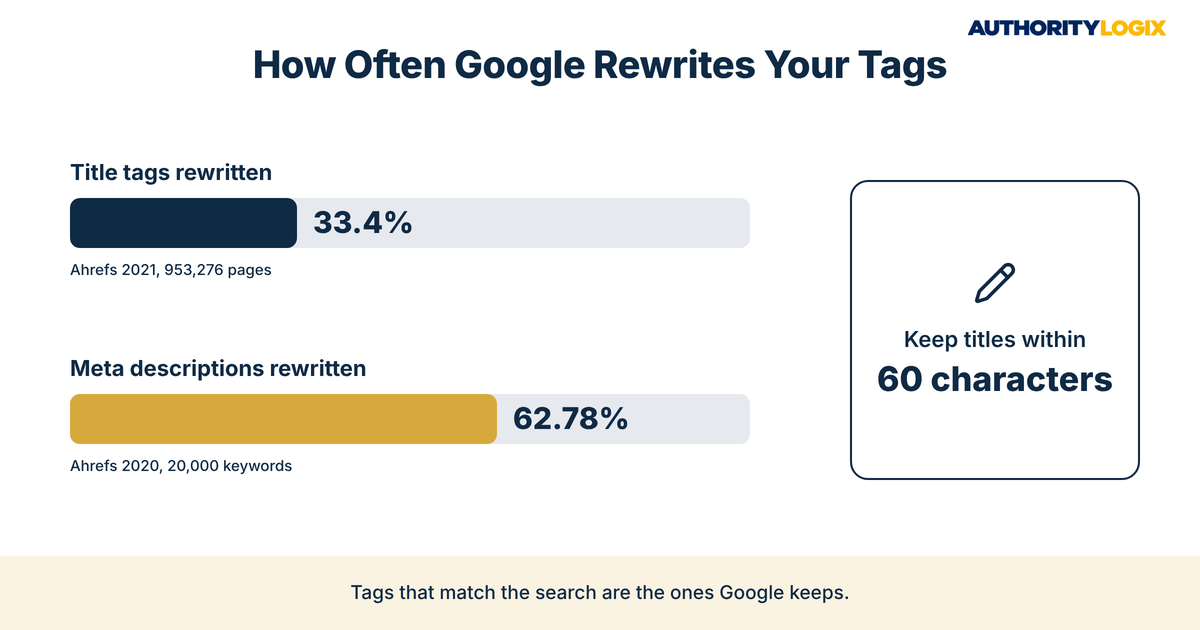
- Ahrefs’ 2021 study of 953,276 top-10-ranking pages found Google rewrites title tags 33.4% of the time.
- Ahrefs’ 2020 study of 20,000 keywords found Google rewrites meta descriptions 62.78% of the time.
- Backlinko’s click-through rate study found the top three organic results earn 54.4% of all clicks, so ranking and clicks go together.
- Every service, condition, and location page needs its own title and description.
- Physical therapy meta titles descriptions SEO earns the click; the page behind it still has to earn the evaluation booking.
Table of Contents
Why Physical Therapy Meta Titles Descriptions SEO Decides Who Gets the Click
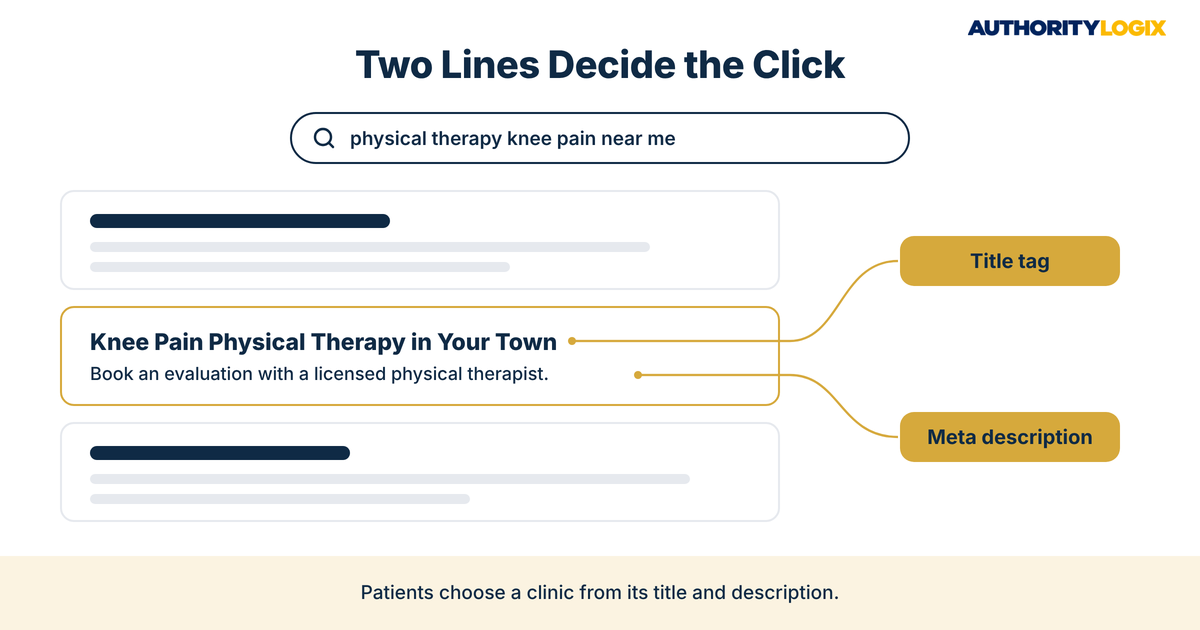
Physical therapy meta titles descriptions SEO is the work of writing the blue headline and the short summary Google shows for each page on your site — the only part of your practice most searching patients see before they choose. You may have experienced doctors of physical therapy and a front desk patients like, and still lose the click to a clinic whose listing simply reads better. Strong local search visibility gets your pages onto the results screen, but the title and description decide whether anyone opens them.
That is the credible but invisible problem at its smallest scale. A patient scans the listings in seconds and taps the one that sounds written for them, and a listing that reads “Home | Services | Contact” never gives your expertise a chance to show.
Direct access raised the stakes. APTA’s June 2025 report found that patients in all 50 states, the District of Columbia, and the U.S. Virgin Islands have either provisional or unrestricted direct access to physical therapist services for evaluation and treatment, so more first impressions now happen inside a search result instead of on a referral slip.
Physical therapy meta titles descriptions SEO is not a one-time copywriting task, because every service, condition, and location page needs tags written for the patient who searches for it. The rest of the page build — content, local signals, booking paths — is covered across our PT resource library, and this article focuses on the two lines that sit on top of all of it.
The Physical Therapy Content & SEO Playbook lays out the full page and content architecture that physical therapy meta titles descriptions SEO sits on top of.
PT Meta Tag Optimization: What Google Actually Shows in Search Results
PT meta tag optimization starts with an uncomfortable fact: Google treats your title tag and meta description as suggestions. Google’s Search Central documentation says title links are generated automatically from several sources, including the title element, the H1, and the text of links pointing to the page. Its snippet documentation says Google only sometimes uses the meta description, when it describes the page more accurately than the on-page text would.
Ahrefs measured how often that happens. Its title tag study, published in November 2021 and covering 953,276 top-10-ranking pages, found Google rewrites title tags 33.4% of the time, and titles over 600 pixels went from being rewritten 29.45% of the time to 46.12%. The study’s author offers a simple rule of thumb from that work: keep titles within 60 characters.
Meta descriptions get rewritten even more often. Ahrefs’ 2020 meta description study, which compared written descriptions with Google’s desktop snippets for 20,000 keywords, found Google rewrites them 62.78% of the time. That does not make descriptions pointless; it means a description has to match the search closely enough that Google prefers it, which is the core of physical therapy meta titles descriptions SEO.
The Rewrite Problem Inside Physical Therapy Meta Titles Descriptions SEO
Rewrites are a signal, not a penalty. Google’s documentation names the usual causes directly: titles that are half-empty, inaccurate, or full of boilerplate, and pages with an unclear main heading. Physical therapy meta titles descriptions SEO that keeps the title, the H1, and the opening paragraph telling the same story gives Google fewer reasons to replace any of them.
The other half of the fix is writing tags around the words patients actually use. If your title says “orthopedic rehabilitation services” and the patient searched “physical therapy for knee pain near me,” Google will reach for something closer to the query. Building tags on real local search keywords — the condition, the service, the town — closes that gap before Google has to.
Titles and descriptions also play a different role in the map pack, where Google draws from the Business Profile rather than your page tags. That side of the screen is covered in the local visibility guide, while physical therapy meta titles descriptions SEO covers the organic listings below it. A practice needs both, because the same patient sees both on one screen.
Physical Therapy Title Tag Click Through Rate: Writing Titles Patients Choose
Physical therapy title tag click through rate is where ranking turns into patients. Backlinko’s click-through rate study, first published in 2019, found the number one organic result earns an average click-through rate of 27.6%, the top three results take 54.4% of all clicks, and moving from position two to position one brings 74.5% more clicks. A strong title cannot replace ranking, but in a close race physical therapy meta titles descriptions SEO helps decide which listing the patient opens.
A Title Formula for Physical Therapy Evaluation Pages
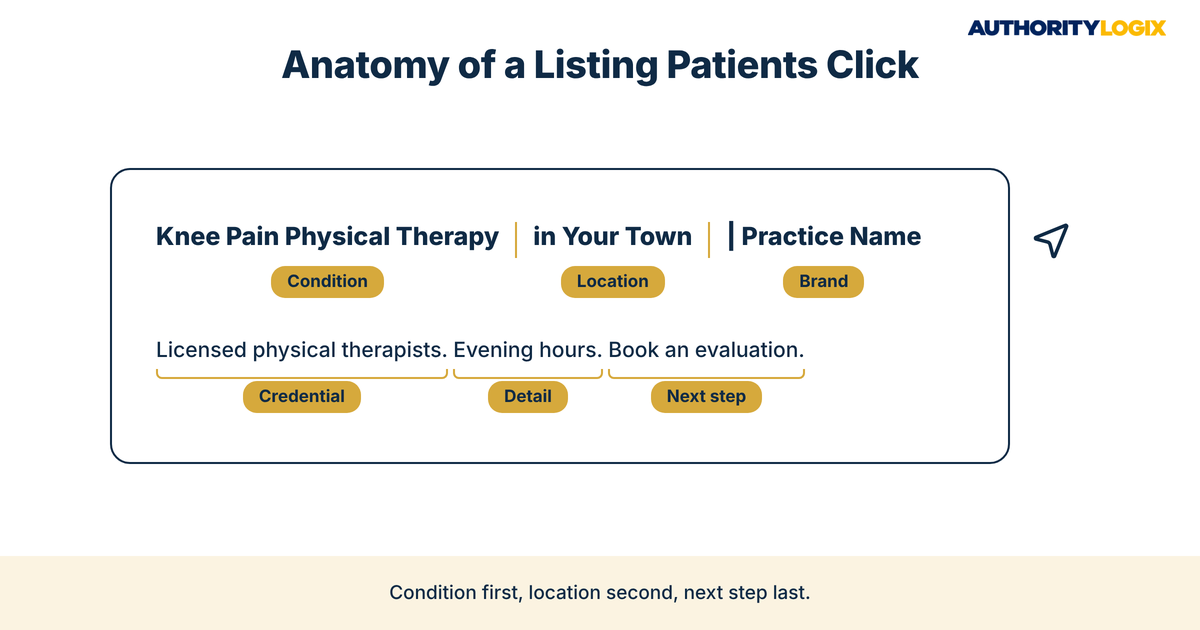
Most practice titles fail for one of three reasons: they lead with a clinic name nobody searched for, they list every service at once, or they say nothing a patient would recognize. A title that earns the click usually follows a simple order — what the page covers, where, and who you are:
- Lead with the condition or service the patient searched
- Add the town or neighborhood the page serves
- Add one access or trust detail if it fits your state’s direct access rules
- End with the practice name, separated by a pipe or a hyphen
- Stay within the 60-character rule of thumb
Put together, a knee pain page might read “Knee Pain Physical Therapy in [Town] | [Practice Name],” and a sports page might read “Sports Injury Physical Therapy in [Town] | [Practice Name].” Each one names the patient’s problem first, which is the strongest lever on physical therapy title tag click through rate that you control. That pattern is the backbone of physical therapy meta titles descriptions SEO on every service page.
Writing fifty of these once is manageable; keeping them accurate as services, locations, and clinicians change is the harder job. That upkeep belongs inside content systems that treat every new page as unfinished until its title, description, and H1 are written together. Physical therapy meta titles descriptions SEO done this way stays consistent across the site instead of drifting page by page.
Testing matters too. Google’s documentation notes that changes can take a few days to a few weeks to appear, since the page has to be recrawled, so the process behind how we build PT page libraries times title and description rewrites against Search Console click data.
Not sure where your practice stands on physical therapy meta titles descriptions SEO? The PT Authority Gap Assessment shows which pages are losing clicks and what to fix first.
PT Meta Description Guidelines for Evaluation Bookings
PT meta description guidelines start from the same place as titles: write for the patient’s search, not for the practice. Google’s snippet documentation asks for descriptions that are unique to each page, summarize the page accurately, and include relevant details rather than strings of keywords. It also says there is no length limit on a meta description, but Google truncates snippets as needed to fit the device width, so the most important words belong at the front.
A description has one job: confirm that this page answers the patient’s question and make the next step obvious. That next step is the first stage of the patient pipeline described in the acquisition playbook, and physical therapy meta titles descriptions SEO sits at the very top of that pipeline. A description that promises nothing specific leaves the patient to keep scrolling.
Within those limits, a strong description is built from a short set of parts. Each part has to be true for that specific page:
- The condition or service in plain language, matching the title
- The town or area the clinic serves
- One accurate detail, such as evening hours or accepted insurance
- A next step, such as “Book an evaluation”
- No outcome promises — describe the care, never guarantee the result
The last item matters for more than compliance. A description that promises recovery in a set number of visits makes a claim no practice can stand behind, and it reads like an ad. Calm, specific wording is how physical therapy meta titles descriptions SEO earns the click, and the lead generation path on the page — a clear booking form, a phone number, an evaluation request — turns that click into a conversation.
Physical therapy meta titles descriptions SEO also depends on the two lines agreeing. A knee pain title paired with a description about wellness memberships feels mismatched, and the patient keeps scrolling.
Applying Physical Therapy Meta Titles Descriptions SEO to Service, Condition, and Location Pages
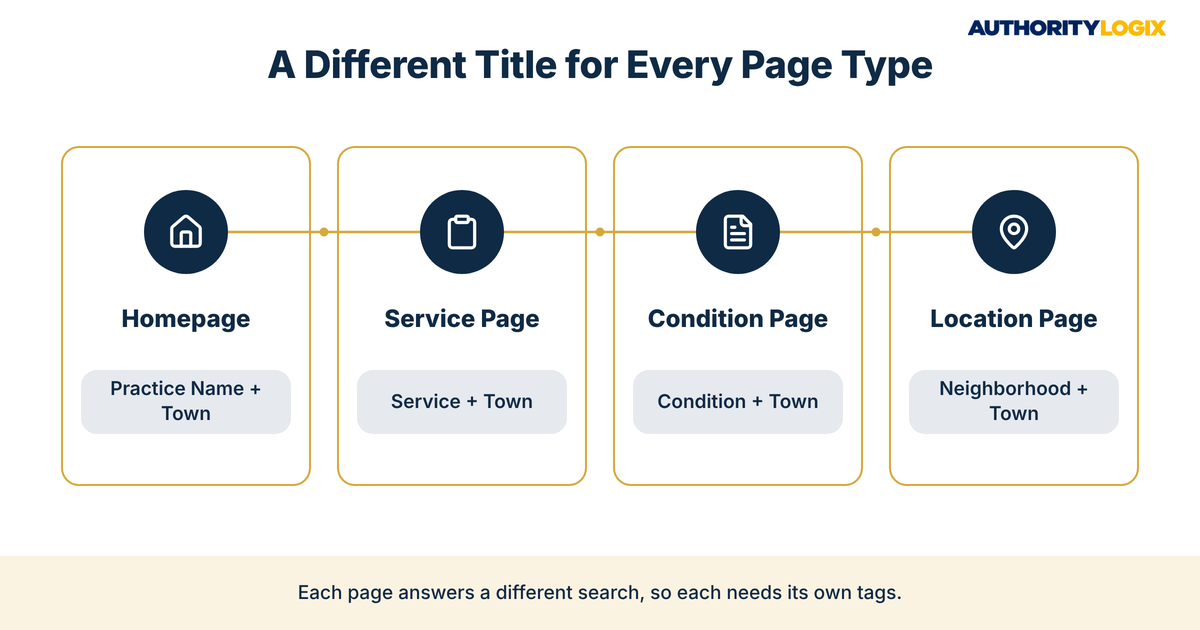
Different page types answer different searches, so physical therapy meta titles descriptions SEO cannot run on one template across the whole site. A homepage answers branded searches, a service page answers treatment searches, a condition page answers symptom searches, and a location page answers “near me” searches. The table shows how each one shifts.
| Page Type | Title Pattern | Description Focus |
|---|---|---|
| Homepage | [Practice Name] — Physical Therapy in [Town] | Who you treat, where, and how to book |
| Service page | [Service] Physical Therapy in [Town] | [Practice Name] | What the service involves and who it is for |
| Condition page | [Condition] Physical Therapy in [Town] | [Practice Name] | The problem in patient language and the evaluation step |
| Location page | Physical Therapy in [Neighborhood], [Town] | [Practice Name] | Area served, hours, parking or transit, and how to book |
| Educational article | The patient’s question, in plain words | A one-sentence answer and what the article covers |
Why Condition Pages Earn the Most Specific Clicks
Condition searches are where patients describe their problem in their own words — “sciatica physical therapy,” “frozen shoulder physical therapy near me” — and where a matching title stands out most. Building dedicated condition pages gives each of those searches its own title and description, which is where physical therapy meta titles descriptions SEO pays off most. A single “Conditions We Treat” page cannot carry twenty different titles.
Location pages need the same discipline. Identical titles on every clinic page force Google to choose between them, and Google’s documentation warns against repeated boilerplate and asks for distinct text that describes each page. The PT industry hub shows how service, condition, and location pages fit together so each one has its own search job.
Educational articles round out the set. A patient searching a plain-language question about their pain is not ready to book, but a title that repeats the question and a description that answers it builds familiarity early. Over time, an educational hub of those answers gives physical therapy meta titles descriptions SEO many small entry points instead of a handful of service pages.
What Most PT Practices Get Wrong About Meta Tags, From the Patient’s Side of the Screen
Most practices with weak tags are not careless. They inherited a template or plugin default and never looked at their listings the way a patient does. These are the questions owners ask once they do.
Why does my clinic show up as “Home” in Google?
The homepage title was left at the template default. Google either shows that title or pulls something else from the page, and neither tells a patient what you treat or where. Rewrite it with the practice name, the core service, and the town.
Will a patient trust a description that sounds like an ad?
Patients comparing clinics look for signs of real expertise, and slogans rarely provide them. Naming clinician credentials, the conditions you see most, and a clear evaluation step does more than adjectives, and the trust signals in the clinical authority guide carry that same tone onto the page itself.
Can I just let Google write my descriptions?
You can, and Ahrefs’ 2020 data shows Google rewrites most of them anyway. The risk is that a missing description leaves Google to pick a sentence that may not mention your town, your services, or how to book. Writing one is basic physical therapy meta titles descriptions SEO, and it gives Google a better option.
Do meta tags matter anywhere besides Google search?
They do, because a page title often travels with the page when it is shared or referenced elsewhere. When articles go out through authority distribution, a clean title and an accurate description travel with them and keep the message consistent. Sloppy tags travel too.
Want physical therapy meta titles descriptions SEO done right across every service, condition, and location page on your site? Let’s build the page and tag system your practice needs.
The Honest Limit: Meta Tags Earn the Click, the Page Earns the Booking
Physical therapy meta titles descriptions SEO has a ceiling, and it is better to be plain about it. A great title on a thin page earns a click and then a quick exit, and a great description cannot rescue a page that never ranks. Tags are the front door of a page library, not a substitute for one.
The practices that get the most from this work treat tags as one layer in a longer build. The growth blueprint lays out how pages, local signals, reviews, and distribution add up over time, and physical therapy meta titles descriptions SEO is the layer that makes each of those pages readable at a glance in search.
That build is what we do for PT practices that are credible in their community but missing from its search results. Your clinicians supply the expertise; the page library, the tag work behind physical therapy meta titles descriptions SEO, and the upkeep come from the infrastructure side.
BKDSCR.com, AuthorityLogix’s proof-of-concept platform in the NYC outer-borough DSCR real estate niche, runs on 18 pillar pages, 7 interactive investor tools, and 48 SEO-optimized blog posts with zero paid ads, and it is a large part of why AuthorityLogix works from systems rather than one-off fixes. It is not a physical therapy site, but the page-by-page discipline is the same.
The honest answer is that most PT practices already have the expertise patients are searching for. What is missing is a page library whose titles and descriptions let patients see it in two lines — and a page that earns the booking once they click.