


Key Takeaways
- Physical therapy patient satisfaction data is a marketing asset most practices already own, yet most of it never leaves an internal report.
- The most useful surveys ask a few specific questions at set points in the plan of care, so results can be compared month to month.
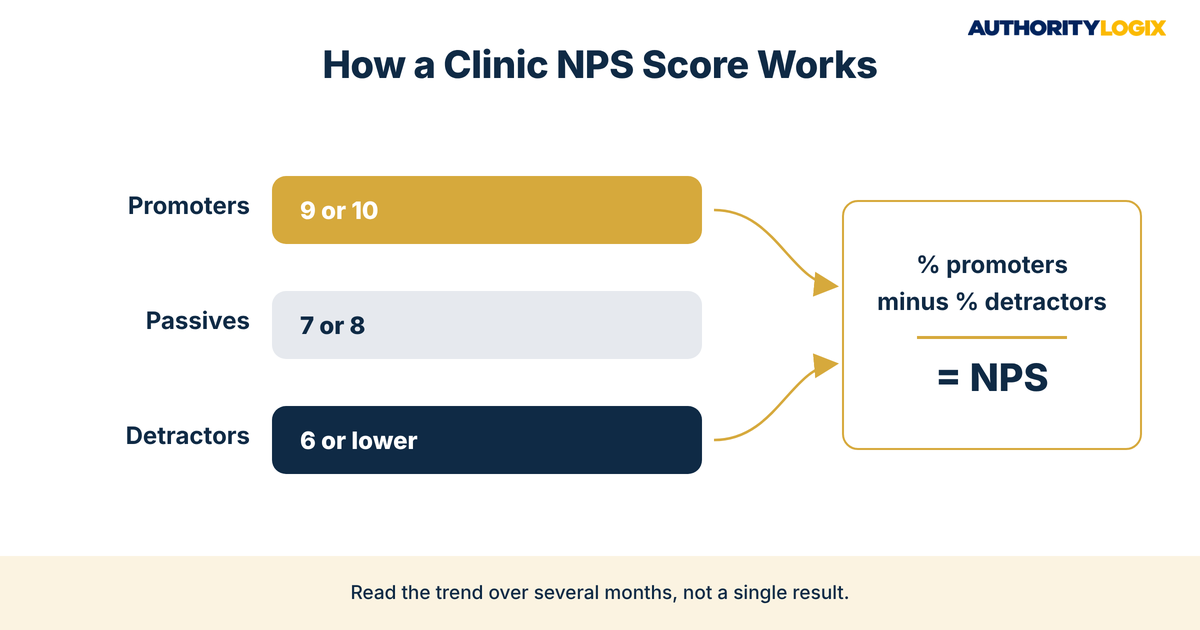
- A clinic NPS score is the percentage of promoters (scores of 9 or 10) minus the percentage of detractors (scores of 6 or lower), and it is most useful as a trend.
- PT patient survey marketing turns aggregate results into public proof on service pages, clinician bios and partner materials, without any patient health information.
- Patient feedback marketing works when every patient is invited to post a review and critical feedback is answered with care, in public and in private.
- Physical therapy patient satisfaction trends also point to operational fixes, from booking friction to front-desk handoffs, that help every marketing channel convert.
Table of Contents

Why Physical Therapy Patient Satisfaction Data Is a Marketing Asset
Physical therapy patient satisfaction scores sit in most practice management systems right now, collected after discharge and rarely used beyond a staff meeting. That is a missed opportunity, because satisfaction data is evidence the market cannot see unless you show it. A practice with an excellent patient experience and no system for publishing the proof is credible but invisible, and the gap shows up in patient acquisition long before anyone traces it to unread survey results.
Prospective patients are comparing several clinics on a phone screen, reading star ratings and short comments, and deciding in minutes which one to call. Public patient reviews carry much of that decision, and they are only one slice of what your physical therapy patient satisfaction program already captures.
Physical therapy patient satisfaction surveys add something reviews cannot: structured, repeatable feedback from the whole caseload, not just the patients motivated enough to post. When you track the same questions over time, you can describe the experience with specifics instead of adjectives. That turns a scattered feedback habit into a working part of your PT marketing infrastructure, where every result has a place to go and a reason to be published.
Physical therapy patient satisfaction data also supports your clinicians. A patient who says the therapist explained the plan clearly, answered every question and set honest expectations is describing the same qualities that build clinical authority online. Physical therapy patient satisfaction results tell you which of those qualities patients notice most, so your website, condition pages and clinician bios can lead with them.
The Physical Therapy Practice Authority Growth Blueprint shows how measurement, reputation and authority signals fit together, and where physical therapy patient satisfaction data belongs in a long-term growth plan.
Choosing Survey Questions That Produce Usable Insight
The value of physical therapy patient satisfaction data depends on the questions behind it. A long survey tends to produce tired, vague answers, while a short one with a few specific questions produces feedback you can act on and publish.
Good questions separate the parts of the experience you control. Ask about scheduling, the front desk, wait times, how clearly the plan was explained and whether the patient would recommend the practice. Keep the care questions to what the patient experienced, such as feeling heard, rather than asking them to judge treatment. One open-ended question at the end often produces the most useful line in the survey.
| Survey question | What it measures | How marketing can use it |
|---|---|---|
| How easy was it to schedule your first visit? | Booking friction | Booking-page copy and intake fixes |
| Did your therapist explain your plan of care clearly? | Communication | Clinician bios and condition pages that stress clear explanations |
| How likely are you to recommend us to a friend or family member? | Loyalty, reported as a clinic NPS score | Trend reporting and aggregate proof points |
| How was your experience with our front desk? | Service at check-in and on the phone | Staff training and review-request timing |
| What is one thing we could do better? | Open feedback | Operational fixes and new FAQ topics |
Scheduling feedback shapes booking pages, communication feedback shapes clinician bios, and the open-ended answers become FAQ topics. That routing is what well-built content systems handle, so physical therapy patient satisfaction results flow into pages instead of sitting in a spreadsheet.
Timing Surveys Around the Plan of Care
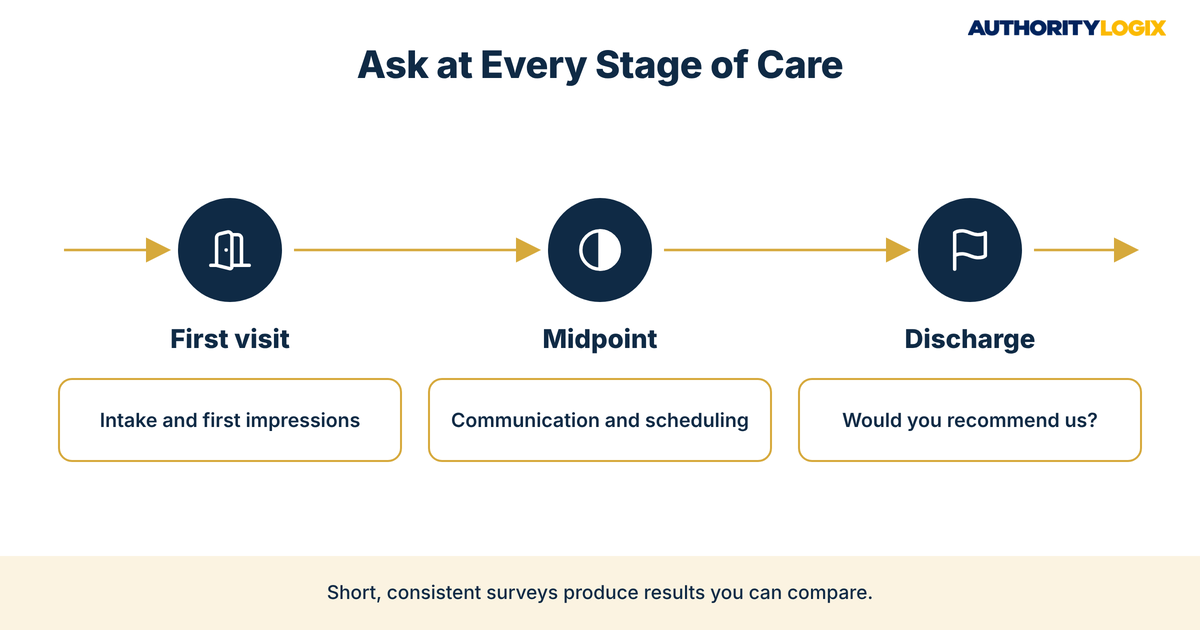
Timing shapes physical therapy patient satisfaction results as much as wording. A survey sent only at discharge misses every patient who stops attending early, and those patients often hold the most useful feedback. A simple schedule, with a check-in after the first visit, at the midpoint of the plan of care and at discharge, captures the experience at each stage and shows where it changes.
Each touchpoint should be short, automated and sent the same way every time, so results stay comparable month to month. Building that cadence once and letting it run mirrors our process for every system we set up: design it carefully, automate it, and review the output on a fixed schedule.
How to Read a Clinic NPS Score Without Overreacting
Net Promoter Score was created by Fred Reichheld at Bain & Company and Satmetrix and introduced in a 2003 Harvard Business Review article. Patients say how likely they are to recommend you, and those who answer 9 or 10 are promoters, 7 or 8 are passives, and 6 or lower are detractors. Your clinic NPS score is the percentage of promoters minus the percentage of detractors.
The calculation is simple, which is why a single month can mislead you. A small practice with a modest number of responses can swing sharply because a handful of patients had a bad week with parking or scheduling. Read the clinic NPS score as a rolling trend over several months, and read it alongside the comments that explain it.
Some providers treat the number as a public headline. U.S. Physical Therapy, which says it operates nearly 800 locations in 44 states, reports a Net Promoter Score of 93 on its own website. A figure like that only means something when it is measured consistently, so a smaller practice should publish its own score only after it has a steady method and enough responses to stand behind it.
Avoid two overreactions: panic over one low month, and complacency after a high score that hides the passives who may quietly try another clinic. Giving every number context before it drives a decision is part of why AuthorityLogix builds measurement into each system rather than reporting a score once and moving on.
The recommendation question measures loyalty, while the rest of your physical therapy patient satisfaction survey explains it. A falling score with comments about wait times calls for a different fix than a falling score with comments about billing. Pair the number with the reasons, and the clinic NPS score becomes a planning tool instead of a grade.
Not sure whether your patient feedback shows up anywhere prospective patients can see it? The assessment shows where your physical therapy patient satisfaction results, reviews and authority signals stand today and what to fix first.
PT Patient Survey Marketing: Turning Results Into Public Proof
PT patient survey marketing is the step most practices skip. The data exists, the results are often good, and none of it appears on the website, the Google profile or the materials referral partners hand out. Moving physical therapy patient satisfaction results from internal reports into public proof is what turns a good experience into a reason to book.
Aggregate results work best when they sit next to the decision they support. A booking page can note how patients rated scheduling, a clinician bio can share what patients say about clear explanations, and a service page can include a short, permissioned patient quote. Pages built this way carry the trust signals that content SEO depends on, because they answer what every prospective patient asks: what is it like to be treated here.
Physical therapy patient satisfaction results also give you a steady stream of publishable material. A quarterly summary of themes, covering what patients praised and what you changed in response, works as a newsletter item, a social post and a partner update at once. Sharing it across every channel is the role of authority distribution, and it shows the market a practice that listens and improves.
Sharing Physical Therapy Patient Satisfaction Results Without Patient Health Information
Every piece of PT patient survey marketing has to protect patient privacy. Publish aggregate results and themes, never individual responses tied to a condition, a date of care or any detail that could identify someone. Survey comments that mention an injury, a surgery or a diagnosis stay internal unless the patient has given written permission for that specific use.
Testimonials follow the same rule with an extra step. Ask the patient directly, explain where their words will appear, and get written permission before publishing a name, photo or quote. A short, permissioned quote about the front desk or the way a therapist explained the plan conveys the experience without carrying any health information, and it keeps the focus on the practice rather than on a clinical result.
Patient Feedback Marketing Through Reviews and Testimonials
Patient feedback marketing matters because people increasingly trust those closest to them more than distant institutions. The 2026 Edelman Trust Barometer, which surveyed nearly 34,000 respondents across 28 countries, found net trust gains of 11 points for neighbors, family and friends and 11 points for coworkers, while national government leaders fell 16 points and major news organizations fell 11. A review from a local patient carries that close-to-home trust.
Your survey is a natural moment to ask for a review. Every patient who finishes it can be invited to share the experience on Google, right after they have reflected on their visits. Built into the survey flow, review generation stops depending on whether the front desk remembers to ask.
Reviews and physical therapy patient satisfaction surveys reinforce each other. Survey data tells you what patients value most, and reviews put that language in front of people searching nearby. When the same themes appear in your reviews, on your Google Business Profile and on your site, they strengthen your local search signals and give searchers a consistent picture of the practice.
Responding to Critical Feedback in Public
Critical feedback will arrive, in surveys and in public. Answer every public review calmly, thank the reviewer, and invite them to contact the practice directly, without confirming they were a patient or mentioning any detail of their care. A careful reply to negative reviews often does more for prospective patients than another glowing rating, because it shows how the practice behaves when something goes wrong.
Using Physical Therapy Patient Satisfaction Trends to Fix Operations
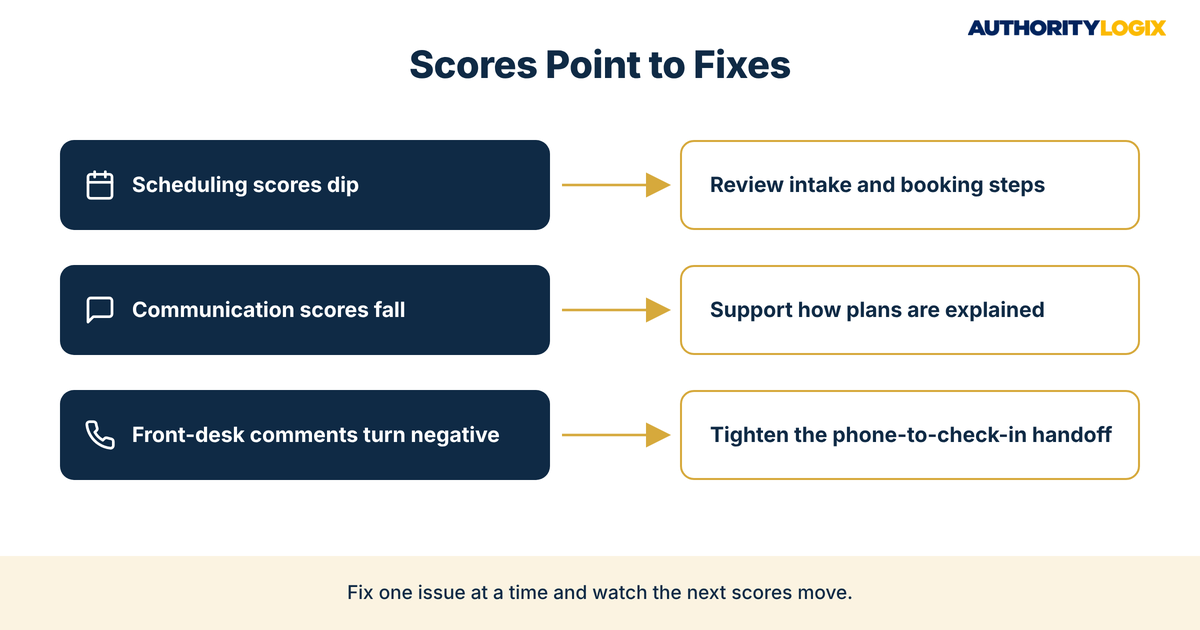
Physical therapy patient satisfaction trends are an operations report in disguise. When scheduling scores dip, the cause is often intake capacity or confusing booking steps. When communication scores fall, a newer clinician may need support with how plans of care are explained. When front-desk comments turn negative, the handoff between phone, check-in and billing is usually worth a closer look.
Fixing them matters to marketing too. Every inquiry you generate passes through the same phone line, booking page and first visit that patients rate in your survey, so friction there wastes the effort upstream. A practice that tightens those steps gets more from its lead generation without spending more, because more of the people who reach out actually book and attend.
Build a simple monthly review. Pull the physical therapy patient satisfaction scores by question, read every comment, pick one issue to fix, and check whether the next round of scores moves. One fix at a time keeps cause and effect visible.
If one clinic trails the others on physical therapy patient satisfaction, its reviews often trail too, and that weakens how it compares with nearby competitors in the map results. Fixing the experience at that location protects its local visibility, which in turn protects the referrals and direct-access patients who search before they call.
FAQ: Survey and Satisfaction Questions From Clinic Directors
How many questions should a physical therapy patient satisfaction survey include?
Enough to cover the parts of the experience you control, and no more. A short survey that patients can finish quickly is easier to complete and easier to compare over time.
How do I respond to patient reviews without breaking privacy rules?
Thank the reviewer, keep the reply general, and move any detail to a private conversation. Never confirm that the person is a patient or refer to their care, even if they described it themselves.
Should we publish our clinic NPS score on the website?
Publish it once you have a consistent method and enough responses to make the number stable. Present it with context on how it is measured, ideally inside an educational hub that also explains what patients can expect at each visit.
What is the difference between patient testimonials and reviews?
A review is a patient’s own opinion posted on a public platform, while a testimonial is a quote the practice publishes with the patient’s written permission. Both matter for patient feedback marketing, and both should describe the experience rather than promise a result.
As a patient, how can I tell whether a practice takes feedback seriously?
Look for recent reviews with thoughtful replies, clear information about what to expect, and signs that the practice explains changes it has made. Practices that publish useful patient guides, like the ones collected in our PT resources library, make that check easier before you even call.
Ready to build the survey cadence, review flow and results pages that turn physical therapy patient satisfaction into proof prospective patients can see before they book?
Closing the Loop Between Patient Feedback and Practice Growth
Physical therapy patient satisfaction data is only valuable when it moves. Collected and filed, it is a report. Routed into reviews, pages and operational fixes, it becomes one of the most credible marketing assets a practice owns, because it comes from patients themselves.
A physical therapy patient satisfaction system is not complicated: consistent questions, trends over months, aggregate proof, review requests and one fix at a time. AuthorityLogix applies the same discipline on its own proof-of-concept platform, BKDSCR.com, a real estate investment site built with 18 pillar pages, 7 interactive tools and 48 posts that generates inbound leads with zero paid ads.
Building that feedback-to-content loop is part of our services for physical therapy practices that want their reputation to work as hard as their clinicians do. Every piece has a job. Every piece feeds the next.
The honest answer is that most practices already deliver an experience patients would recommend. The missing piece is the physical therapy patient satisfaction system that captures that feedback, protects patient privacy and shows it to the people deciding where to book.