


Key Takeaways
- Physical therapy podcast marketing turns what your clinicians already explain in the treatment room into searchable proof of expertise.
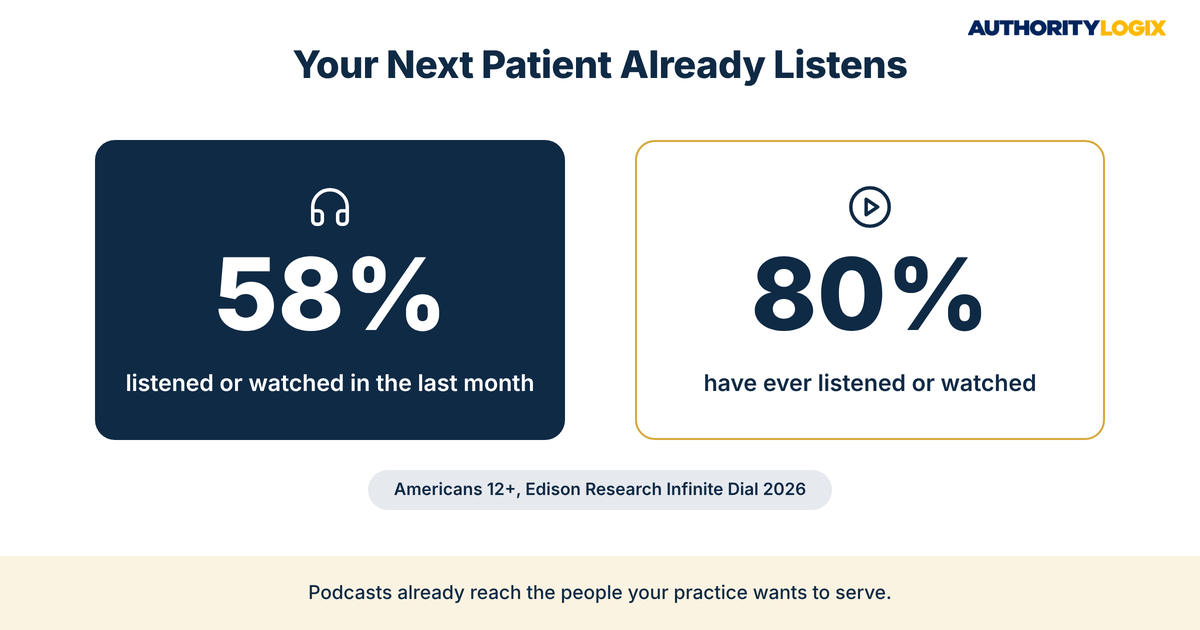
- According to Edison Research’s Infinite Dial 2026, 58% of Americans age 12 and older, an estimated 167 million people, listened to or watched a podcast in the last month.
- A realistic PT podcast launch plan is one owner, one format, batch recording and a fixed publishing day.
- PT podcast patient education explains conditions in general terms and sends every personal question to an evaluation.
- Every episode should become show notes, a transcript and supporting website pages, so physical therapy podcast marketing builds search visibility instead of disappearing into a feed.
- Measure physical therapy podcast marketing by what it feeds, such as page visits, questions and evaluation requests, not downloads alone.
Table of Contents
Why Physical Therapy Podcast Marketing Builds Clinician Authority Over Time
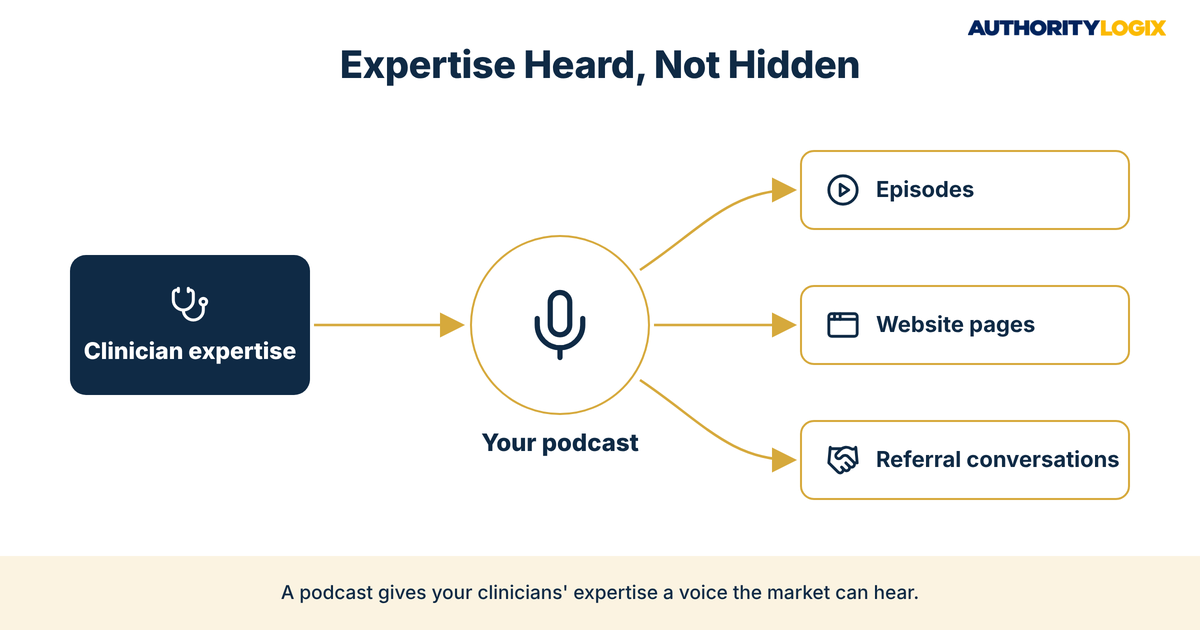
Physical therapy podcast marketing gives your clinicians a way to be heard by the patients and physicians who have never met them. Your therapists already explain the same conditions, the same recovery questions and the same “should I get this looked at” decisions many times a week, but that expertise stays inside the treatment room. A podcast records it, and a well-built system turns those recordings into lasting authority growth that the market can see.
The problem is rarely credibility. Most practices are credible but invisible: skilled therapists and loyal patients, yet almost nothing online that shows how those therapists think. Physical therapy podcast marketing closes that gap, because a listener who hears a clinician explain a problem for twenty minutes forms a trust that a service page rarely creates.
That trust matters for patient acquisition because people increasingly size up a physical therapist before they ever call. When a prospective patient has already heard your clinician answer the question they are worried about, the first phone call starts from familiarity instead of comparison shopping. Physical therapy podcast marketing does that work quietly, one episode at a time.
Audio also keeps working in a way that ads do not. An episode published this month can still be found, played and shared next year, and every new episode adds to a library that shows depth over time. That library is the raw material for genuine thought leadership, because it proves your team has explained a topic thoroughly and consistently rather than once.
The catch is that a podcast on its own is just another channel. Physical therapy podcast marketing works when the show is connected to your website, your local listings and your referral relationships, which is how it fits inside a complete PT marketing system. Without those connections, even a good show reaches only the people who already know you.
The Physical Therapy Patient Education & Clinical Authority Guide shows how to turn clinician expertise into patient-facing education that builds trust, and where physical therapy podcast marketing fits inside that authority system.
Who Listens and What They Want From Physical Therapist Audio Content
The audience for physical therapist audio content is larger than most practice owners assume. According to Edison Research’s Infinite Dial 2026, 58% of Americans age 12 and older, an estimated 167 million people, listened to or watched a podcast in the last month. The same study found that 80% of Americans 12 and older, an estimated 230 million people, have listened to or watched a podcast at some point.
Edison Research also reported that 45% of Americans 12 and older, an estimated 130 million, consumed a podcast in the last week, and that 57% of Americans have both listened to and watched one. For physical therapy podcast marketing, that last number is a reason to record video, because one episode can serve listeners and viewers.
Your listeners should be local, not national: active adults with a nagging problem, parents of young athletes, older adults deciding whether to try therapy, and the physicians and coaches who refer them. They want plain answers to the questions they would ask at an evaluation, such as what the options usually are and what a first visit looks like.
Hearing one clinician answer those questions week after week builds the kind of personal brand that makes a patient ask for that therapist by name. That is valuable for the practice, as long as the system around the show keeps the practice, not just one person, at the center of physical therapist audio content.
Local listeners also need to find the show where they already search. Episode pages on your website, a post on your Google Business Profile for each new episode and mentions on partner sites connect the audio to your local visibility, so a person who hears about the show at a gym or a physician’s office can find it, and your practice, in seconds.
A PT Podcast Launch Plan for a Small Practice Team
A PT podcast launch plan for a small practice has to respect one fact: nobody on your team has spare hours. The plan should fit a normal clinic week, with one owner, one recording block and one publishing day. Physical therapy podcast marketing that depends on heroic effort stops the first busy month.
| Launch phase | What happens | Who owns it |
|---|---|---|
| Before launch | Choose the audience, the format and the first six episode topics from real patient questions | Owner and lead clinician |
| Recording | Record two or three episodes in one block so the schedule never runs dry | Clinician host |
| Production | Edit lightly, add a short intro and outro, export audio and video | Staff member or outside editor |
| Publishing | Post the episode, show notes and transcript on the same day each cycle | Marketing owner |
| Sharing | Send clips to patients, partners and referring physicians | Front desk and marketing owner |
| Review | Check physical therapy podcast marketing signals: page visits, questions and evaluation requests | Owner, monthly |
That structure is a small version of the repeatable content systems a practice uses for every other kind of patient education. The goal is not to produce more; it is to make each episode easy to make, easy to publish and easy to reuse. A PT podcast launch plan built this way also survives staff changes, because the steps live in a process instead of one person’s head.
Equipment, Format, and Episode Length
You do not need a studio. A quiet treatment room, a USB microphone for each speaker, headphones and simple recording software are enough, and a phone or webcam can capture video at the same time. Spend the effort on preparation, not gear.
Pick one format and keep it. A solo episode answering one patient question, a conversation between two therapists or a monthly guest interview can all work, as long as listeners know what to expect. Keep each episode long enough to answer its question and short enough to finish on a commute.
Guest Episodes With Local Physicians and Coaches
Guest episodes are where physical therapy podcast marketing starts to support referral relationships directly. Inviting a local orthopedic surgeon, a primary care physician, a strength coach or a running club organizer onto the show gives them a reason to share the episode with their own audience, and it shows them how your clinicians think. A physician who has talked with your therapist for half an hour knows exactly who they are referring to.
Plan guest episodes with the same care as any professional introduction. Send questions in advance, keep it educational, and give the guest a finished clip to post. That give-first approach is central to our process for building authority, and it keeps guests willing to come back.
Not sure your practice is ready to turn a podcast into new evaluations? The assessment shows where physical therapy podcast marketing would stall today and what to fix first.
How PT Podcast Patient Education Stays Helpful Without Crossing Into Advice
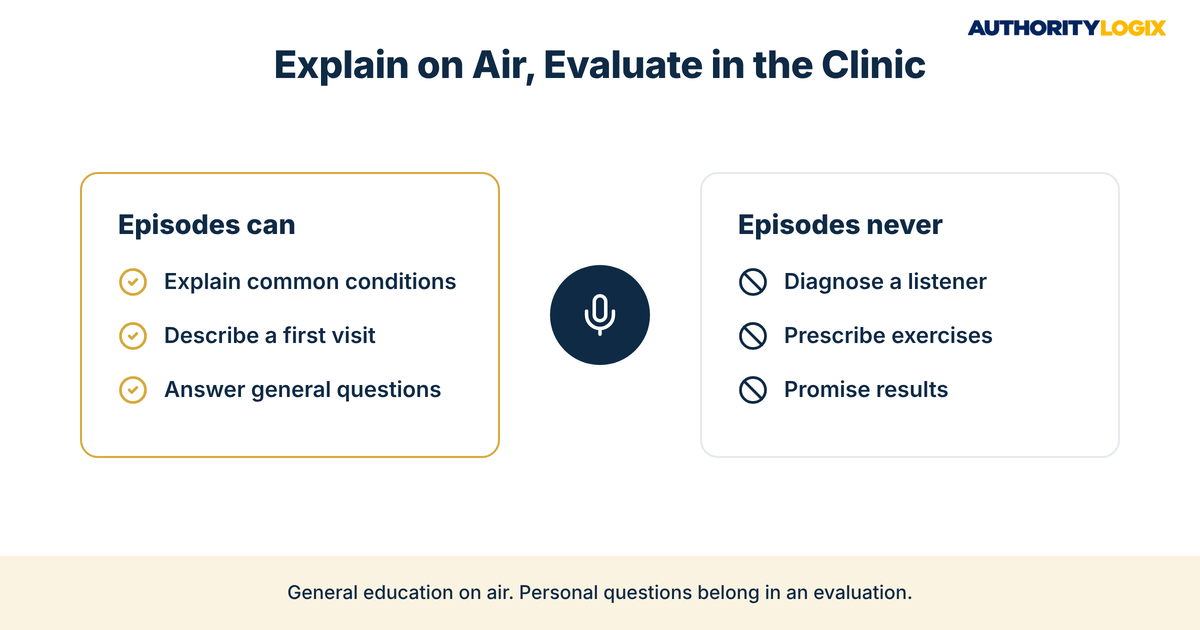
PT podcast patient education has one firm boundary: an episode can explain, but it cannot evaluate. A listener with knee pain is not your patient until a clinician has examined them, and nothing in an episode should suggest a diagnosis, a specific exercise program or an expected result for that listener. Keeping the show general protects listeners and protects the practice.
Helpful episodes stay educational: how a first evaluation works, what direct access means in your state and what to ask when choosing a therapist. Each should end with the same honest line, that the episode is general information and a personal question deserves a personal evaluation. That consistency is what makes physical therapy podcast marketing trustworthy rather than salesy.
Patient privacy needs the same discipline. Never discuss an identifiable patient, and never share a recovery story without written permission and a careful review. A general description of a common situation works better than a story about one person.
Episodes should also point somewhere useful. Each topic belongs to a page in your patient educational hub, where the listener can read the same explanation, see related questions and book an evaluation when they are ready. The podcast becomes the voice of that hub rather than a separate project, and PT podcast patient education stays consistent across audio and text.
Over time, the episodes and pages form a body of education listeners can explore on their own schedule. Collecting guides in one organized place, the way our PT resource library groups topics by category, keeps listeners learning after an episode ends.
Local listeners searching for a nearby clinic should land on the same answers. Mentioning your neighborhoods, the conditions you see most and your clinicians’ names in episode titles and pages supports your local search foundation, so physical therapy podcast marketing and map visibility reinforce each other.
How to Turn Each Episode Into Search-Friendly Website Content
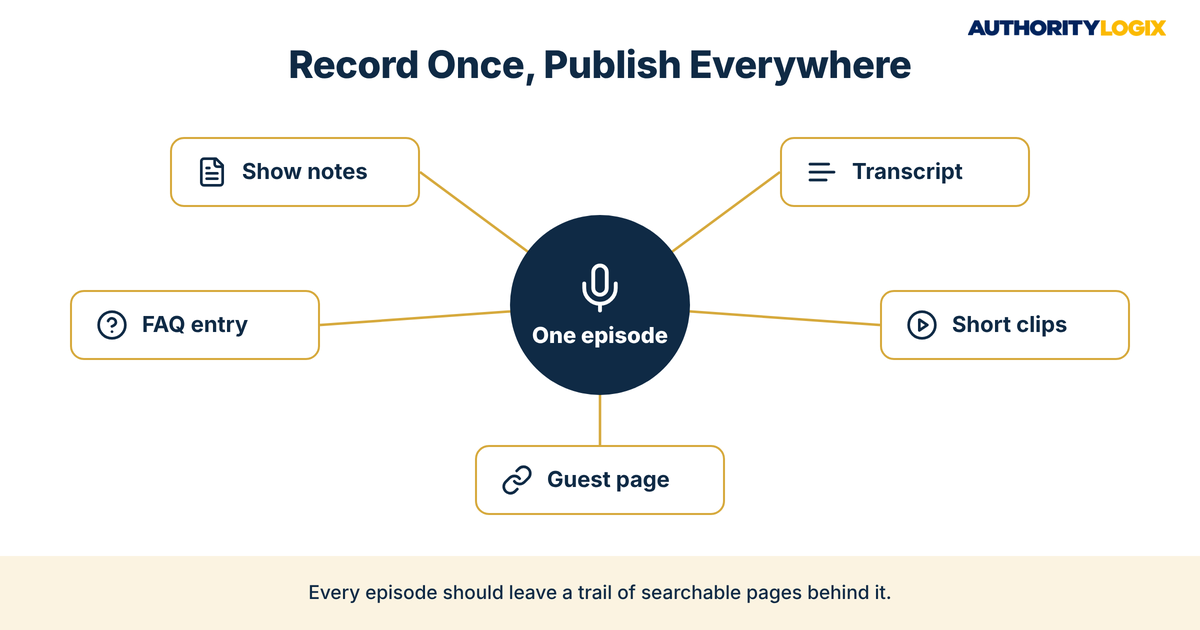
An episode that lives only on a podcast app does little for your website’s search visibility. The fix is to publish every episode on your own site with written content around it, so physical therapy podcast marketing builds pages that can rank long after the release date. Each episode becomes a small cluster of searchable assets.
Show Notes and Transcripts for Physical Therapy Podcast Marketing
Show notes are a short written summary of the episode: the question it answers, a few key points, the clinician’s name and credentials, and a clear next step. A transcript adds the full text, which helps listeners who prefer to read and gives search engines the complete language of the conversation. Together they turn a recording into a page built on sound content SEO principles.
| From one episode | What it becomes | Where it works |
|---|---|---|
| The full recording | An episode page with show notes and a transcript | Your website and podcast apps |
| The main question | A patient FAQ entry or a section on a condition page | Your patient education pages |
| Two or three strong moments | Short audio and video clips | Social channels, partner newsletters, patient email |
| A guest conversation | A page the guest can link to and share | The guest’s website and network |
| Listener questions | Topics for future episodes and pages | Your physical therapy podcast marketing plan |
That table is the practical side of repurposing: one recording session can feed weeks of useful material instead of a single post. It also keeps physical therapy podcast marketing tied to the questions patients actually ask, because every piece starts from one real question.
AuthorityLogix built the same discipline into BKDSCR.com, its own proof-of-concept platform in the NYC real estate investment niche, where 48 SEO-optimized blog posts and 18 pillar pages work as one connected library. The lesson carries over directly to physical therapy podcast marketing: content earns visibility when every page answers a specific question.
Physical Therapy Podcast Marketing FAQ
These are questions prospective patients and practice owners often ask about physical therapy podcast marketing and the shows practices produce. The answers stay general, the same way a good episode should.
Can I get advice about my own injury from a physical therapy podcast?
A podcast can help you understand a condition and the questions worth asking, but it cannot assess your situation. Anything specific to your body belongs in an evaluation with a licensed physical therapist, who can examine you and explain your options.
What do the best physical therapy podcasts have in common?
They answer real questions clearly, keep a consistent format and are hosted by clinicians who sound like themselves. They also make the practice behind the show easy to find and book.
Is a clinic marketing podcast worth it for a small practice?
It can be, when the show is part of a system rather than a side project. A small team that records in batches, publishes on a schedule and turns each episode into website content gets far more from the same effort, which is why a podcast usually sits inside our services rather than standing alone.
How is a healthcare podcast different from other business podcasts?
A healthcare podcast carries extra responsibility: it must stay educational, protect patient privacy and avoid promising results. Practices that treat those limits as part of the format build more trust, and working with a partner like AuthorityLogix that already knows healthcare marketing boundaries helps keep every episode within them.
How long does it take a practice podcast to bring in new patients?
There is no fixed timeline, and any honest answer depends on how well the show is connected to your website, listings and referral partners. Episodes gain value as the library grows, so the practices that keep publishing are the ones that give physical therapy podcast marketing time to work.
Ready to build the episode pages, transcripts and distribution system that turn your clinicians’ podcast into lasting patient trust and new evaluations?
Measuring Whether Your Podcast Is Building Authority and Referrals
Download counts are the easiest number to watch and the least useful on their own. Measure what the show feeds: episode page visits, questions that mention an episode, evaluation requests from listeners, and physicians or coaches who bring up the show. Ask every new patient how they found you, with the podcast as one option.
Reach also depends on distribution. Clips sent to referring physicians, links in patient emails and posts on partner channels reach people who would never browse a podcast app.
Connect those signals to your lead generation system so a listener who is ready can book without friction. A clear invitation to book on every episode page, a short form and a fast response from the front desk are what turn interest from physical therapy podcast marketing into an evaluation.
The honest assessment is that a podcast will not rescue a practice with no website foundation, no local listings and no follow-up. Physical therapy podcast marketing works when your clinicians’ expertise has a voice inside a system that captures what it creates. Your therapists already have the knowledge patients want; the missing piece is the infrastructure that lets the market hear it and act on it.