


Key Takeaways
- A physical therapy SEO audit compares what patients and Google see about your practice with what your local competitors show, then ranks each gap by how much it costs you.
- Whitespark’s 2026 Local Search Ranking Factors survey of 47 local search experts put “Primary GBP Category” at the top of its local pack factors, so your Google Business Profile is the first place to look.
- The same survey scored a dedicated page for each service as the top local organic factor, which makes missing service pages one of the most common PT local SEO gaps.
- Google states that there is no way to request or pay for a better local ranking, so every fix in a physical therapy SEO audit works on relevance, distance or prominence.
- Sort PT local SEO fixes by impact and effort: profile and listing corrections first, service and neighborhood pages next, reviews and links as steady ongoing work.
- A physical therapy SEO audit is not a one-time project; a set review schedule keeps new gaps from piling up as the practice changes.
Table of Contents

What a Physical Therapy SEO Audit Should Uncover
A physical therapy SEO audit answers a question many practice owners eventually ask: why does a clinic with experienced clinicians and loyal patients still sit below page one when someone nearby searches for care? The answer is rarely one big failure. It is usually a stack of small, fixable gaps across your Google Business Profile, your website and your listings, and together they keep the practice credible but invisible to people who are already looking for a physical therapist.
Most owners know their referral sources well and their search visibility hardly at all. Patients searching for care nearby decide quickly, and the practices shown first in the map pack get the first call. Strong local search foundations decide which practices those patients see.
A physical therapy SEO audit is broader than a website review. A website content audit looks at the pages you already have, while a local audit adds your Google Business Profile, citations, reviews and links, then compares each with the practices outranking you. That comparison turns a vague sense of being behind into a specific list of PT local SEO gaps.
Google describes local results in three parts. Relevance is how well a Business Profile matches a search, distance is how far the business is from the searcher, and prominence is how well-known the business is, which Google says also depends on links and reviews. Every physical therapy SEO audit finding maps to one of those three, and distance is the one you cannot change.
Tools You Need for a Physical Therapy SEO Audit
You do not need an expensive software stack. A physical therapy SEO audit can begin with free tools most practices already have, plus a spreadsheet to record findings.
- Your Google Business Profile dashboard, to review categories, services, hours, photos and reviews
- Google Search Console, to see which searches already show your pages and which pages are indexed
- A private browser window, to check map pack and organic results the way a new patient sees them
- A citation checker or a list of the major directories, to compare your name, address and phone number
- A tracking sheet with one row per finding, the person who owns it and its status
The tools matter less than the habit of writing everything down. Each physical therapy SEO audit finding should note what is wrong, why it matters and who will fix it, which mirrors the step-by-step diagnosis in our process. Without that record, the same gaps reappear at the next review.
The Physical Therapy Local Visibility Guide lays out the complete local search system a physical therapy SEO audit measures against, from your Google profile and service pages to reviews and listings.
Running a PT Local Ranking Audit on Your Google Business Profile
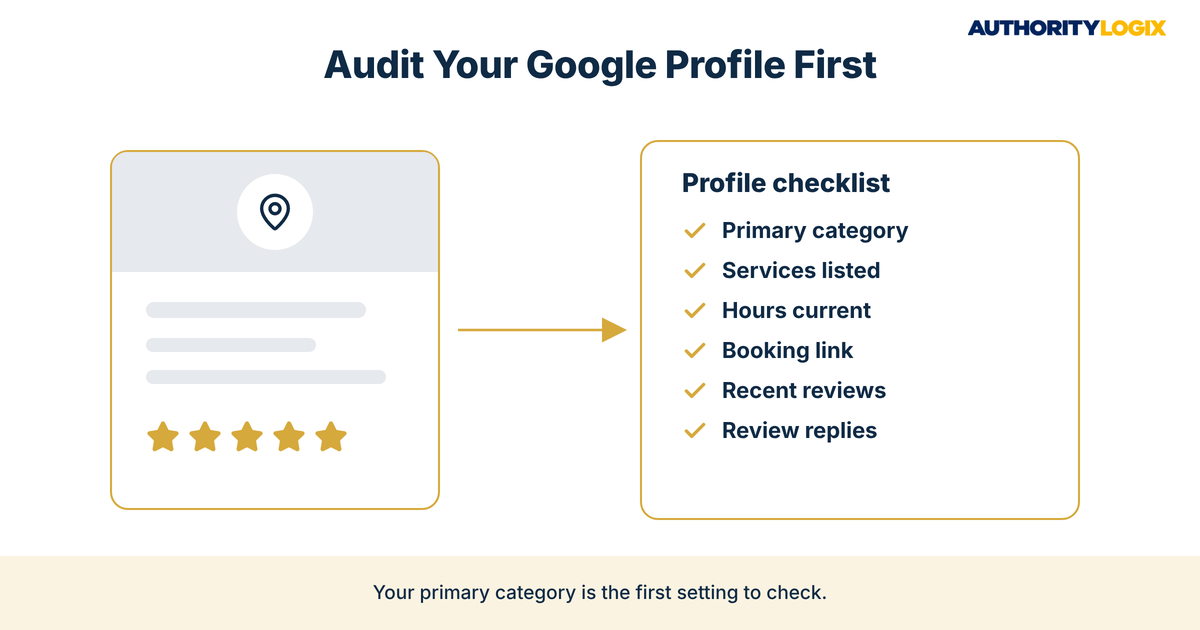
Start a PT local ranking audit with your Google Business Profile, because it shapes most of what appears in the map pack. Whitespark’s 2026 Local Search Ranking Factors report, built from a survey of 47 local search experts, placed “Primary GBP Category” first among its local pack and Maps factors. In a physical therapy SEO audit, that makes the primary category the first setting to check.
Confirm the primary category is the most accurate description of the practice, then review the additional categories, which the same survey also ranked among its top pack factors. Only categories that honestly describe your services belong there, and the profile name should match your signage rather than carry extra keywords.
Next, look at reviews the way a new patient would. Whitespark’s experts ranked high numerical Google ratings and the quantity of native Google reviews with text among the top ten pack factors, and Google says more reviews and positive ratings can help local ranking. Record your rating, review count and review recency, because reviews are one of the clearest signals of practice authority a new patient sees.
Then check every basic field. Google says businesses with complete and accurate info are more likely to show up in local search results, so hours, services, appointment links, attributes and photos all belong on the physical therapy SEO audit checklist. A practice that offers pelvic health or vestibular care but lists only general physical therapy gives Google less to match.
Finally, check activity. Google notes that replying to reviews shows you value the feedback, though replies should never confirm that a reviewer is a patient or mention any detail of care. A profile that has gone quiet is a gap that a steady authority distribution rhythm fixes, because educational material published elsewhere can be shared as profile updates.
Finding the PT Local SEO Gaps on Your Website
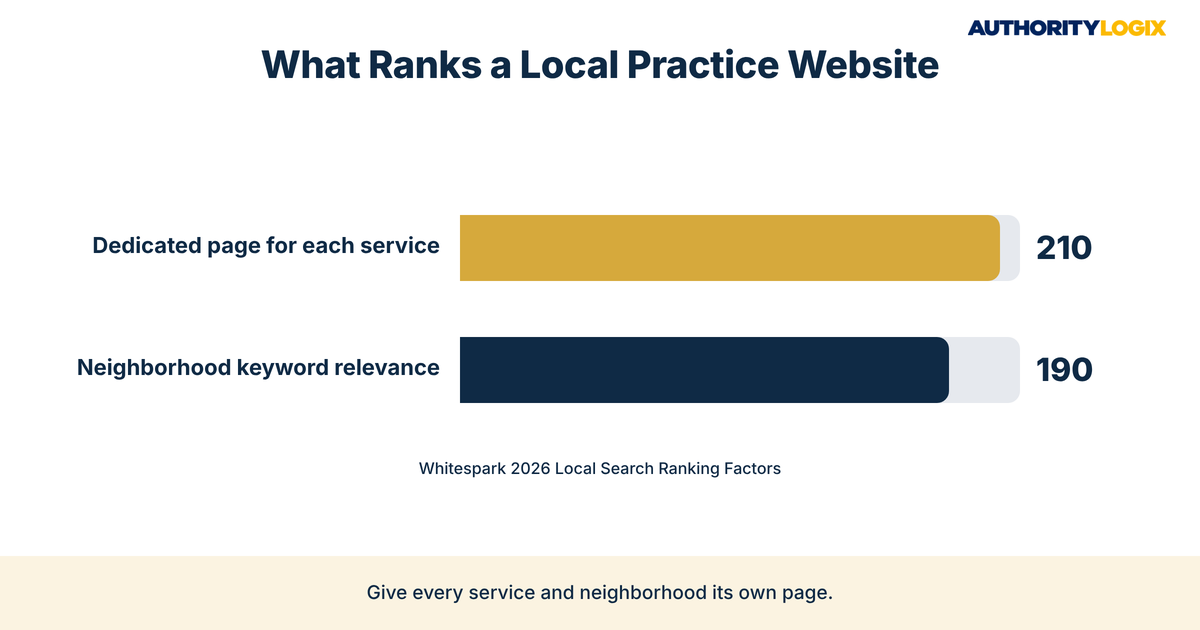
Your website carries the other half of local rankings. In Whitespark’s 2026 ranking factors survey of 47 local search experts, published November 6, 2025, “Dedicated Page for Each Service” was the top-scored local organic ranking factor at 210, followed by “Geographic (City/Neighborhood) Keyword Relevance of Content” at 190. Those two findings describe the most common PT local SEO gaps almost exactly.
Most practice websites were built as brochures, with one services page that lists everything in a paragraph and gives Google one thin page to rank for dozens of searches. A structured content SEO plan replaces that list with pages built around how patients actually search, one service and one location at a time.
Service Page and Neighborhood Content Gaps
A physical therapy SEO audit should list every service your clinicians want to be known for, then check whether each has its own page. Post-surgical rehabilitation, running injury care and pelvic health each need a page explaining who it is for, what the first visit involves and how to book. Any service without a page lets a competitor with one appear ahead of you.
Do the same for geography. If patients come from several neighborhoods, the site should explain how you serve each one with real detail such as parking, transit and the clinicians at that location. Pages that only swap the town name rarely help, which is why repeatable content systems matter: they produce local pages with useful detail on a schedule.
Then check depth. Condition pages, FAQ answers and short guides give Google more relevance signals and give patients reasons to trust the practice before they call. A physical therapy SEO audit should flag any service page that leaves common patient questions unanswered, and patient education content written for the reader closes those gaps.
Finish the physical therapy SEO audit of your website with the technical basics: fast pages on a phone, a unique title tag naming each service and location, and a name, address and phone number that match your Google profile exactly. The same survey ranked keywords in the Google profile landing page title tag among its top five local organic factors.
Checking Citations, Reviews, and Links Against Local Competitors
A physical therapy SEO audit only makes sense in comparison. Your rankings depend on how you stack up against the few practices that appear above you for your most important searches, so name those competitors first and audit them with the same checklist you used on yourself.
Start with citations. Search your practice name on the major directories and health listing sites, and record every version of your name, address and phone number. Old suite numbers and former phone lines are common, and a deliberate NAP consistency cleanup removes those conflicting signals. Whitespark’s report notes that citations have lost some weight over the years, so treat them as basic hygiene.
Next, compare reviews side by side. A physical therapy SEO audit records each competitor’s rating, review count and the date of its latest reviews. The report ranked recency of reviews 11th among local pack factors, so a steady flow of recent reviews may compare well against a larger but older total.
Then look at links. The same survey ranked the quality and authority of inbound links third among local organic factors. A focused competitor analysis shows which local organizations, sports clubs, schools and partners link to the practices ahead of you, and each one becomes a relationship to pursue rather than a mystery.
Finally, compare content depth. If a physical therapy SEO audit shows a competitor with a full library of condition pages against your handful, the gap is a shortage of useful answers. An educational hub closes it with condition guides and patient FAQs that can earn links on their own.
Not sure which local gaps are holding your practice back? The assessment reviews your Google profile, website and listings against local competitors and shows which fixes should come first.
Prioritizing PT Local SEO Fixes by Impact and Effort
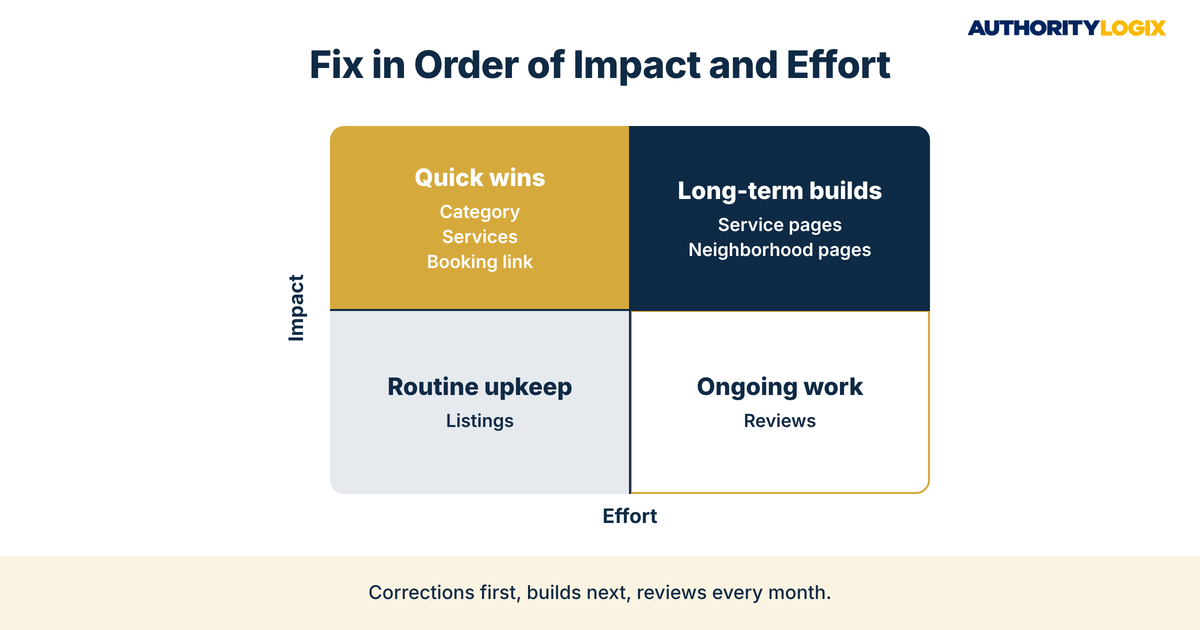
A physical therapy SEO audit usually produces more findings than a practice can fix in a month. That is normal. Sort every finding by two questions: how much will this change what patients and Google see, and how much time will it take?
The highest-impact PT local SEO fixes sit closest to the moment a patient decides. A wrong category or a broken booking link costs calls this week; a missing blog post costs very little. Tie each fix to your patient acquisition goals, such as more direct-access evaluations, so the order reflects what the practice needs.
| Audit finding | Effort | Impact | When to fix |
|---|---|---|---|
| Vague or wrong primary Google category | Low | High | This week |
| Missing services, hours or booking link on the profile | Low | High | This week |
| Name, address or phone mismatch across site and directories | Low to medium | Medium | This month |
| No dedicated page for a core service | Medium | High | This quarter |
| No neighborhood or location content | Medium | Medium to high | This quarter |
| Fewer recent reviews than local competitors | Ongoing | High | Every month |
Quick Wins vs. Long-Term Projects
Quick wins are corrections. Fixing categories, filling in services, aligning your name, address and phone number, and repairing broken links usually takes days rather than months. Do these physical therapy SEO audit items first and record the date, so later changes in calls can be read against a clear starting point.
Long-term projects are builds. Service pages, neighborhood content, a review routine and local link relationships take months, but they are the PT local SEO fixes that keep working after the audit closes. Connect each new page to a clear lead generation path with a booking option, so better rankings turn into evaluations.
The same principle shaped BKDSCR.com, AuthorityLogix’s own proof-of-concept platform in the NYC DSCR real estate niche, which was built page by page into 18 pillar pages and 7 interactive tools with zero paid ads. Authority compounds when each new page strengthens the pages already published, and a physical therapy SEO audit is how you decide which page to build next.
Physical Therapy SEO Audit FAQ: Common Owner Questions
These are the questions owners ask most often after a first audit. More answers on local visibility and content are collected in the AuthorityLogix PT resources library.
How often should you conduct an SEO audit?
Run a full physical therapy SEO audit at least once a year and a shorter profile and listings check every quarter. Audit again after any move, new location, new service line or website rebuild, because those changes create new gaps quickly.
Can I pay Google for a better local ranking?
No. Google states that there is no way to request or pay for a better local ranking on Google. Ads can buy a paid placement, but the map pack and organic results are earned through relevance, distance and prominence.
Should I add keywords to my Google Business Profile name?
Use the name your practice actually operates under. A keyword-stuffed name confuses patients who compare it with your sign and website, and it can cause problems with the profile itself. Put service and location relevance into categories, services and your website instead.
Can I run a physical therapy SEO audit myself?
Yes, and the checklist in this article covers a solid first pass. The harder part is fixing the long-term gaps on a schedule while running a clinic, which is where our services come in for practices that want the build handled for them.
Ready to have the gaps from your physical therapy SEO audit closed for you, with the Google profile, service pages, neighborhood content and review routine built as one local search system?
Scheduling Audits So Gaps Never Pile Up Again
Gaps return because practices change. Clinicians join and leave, services expand, hours shift, and a competitor publishes the pages you meant to write. A physical therapy SEO audit run once captures a moment; a physical therapy SEO audit run on a schedule keeps the practice accurate as it grows.
Set the rhythm now. Review your Google Business Profile monthly, check citations and reviews every quarter, and run a full physical therapy SEO audit of the website each year, logging every finding in one sheet. That cadence makes local search a routine part of your PT marketing system, owned by a named person on your team.
None of this depends on tricks. Google has said plainly that local rankings cannot be bought, which is why our approach starts with what a physical therapy SEO audit measures: accurate information, a page for every service, useful local content and steady patient reviews.
The honest answer is that most practices are not missing page one because their care is worse. The practices above them made their expertise easier to find, and an audit shows exactly where that difference lives. Close those gaps on a schedule, and your visibility can finally reflect the practice you have already built.