


Key Takeaways
- BKDSCR.com was built from zero to a functioning content authority platform in the NYC outer-borough DSCR real estate investor niche — 18 pillar pages, 48 SEO-optimized blog posts, and 7 interactive investor tools, all generating organic engagement without paid advertising. This case study documents the specific architecture, sequencing, and compliance framework that produced the result, so other financial services firms can apply the same model.
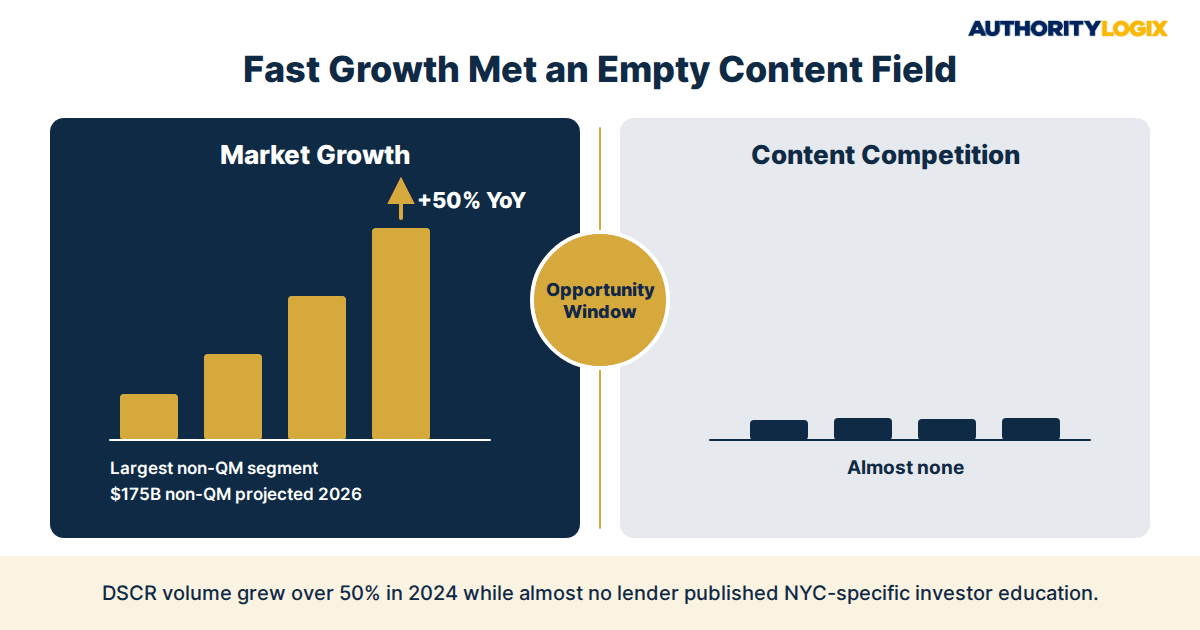
- The timing of the build coincided with a genuine market opportunity: DSCR loan volume grew more than 50% year over year in 2024, surpassing bank statement loans to become the largest segment of non-QM production, according to Scotsman Guide reporting. Non-QM originations are projected to reach approximately $175 billion in 2026, with DSCR and other investor products accounting for roughly half of all non-QM collateral. The niche was growing — but few lenders were publishing educational content deep enough to capture the borrowers actively researching it.
- The platform was built around a narrow geographic and product focus — NYC outer-borough DSCR investors — rather than attempting broad national coverage of every mortgage product. That narrowness is what made deep topical authority achievable within 18 months; a broader scope would have diluted the same content budget across too many topics to reach depth on any of them.
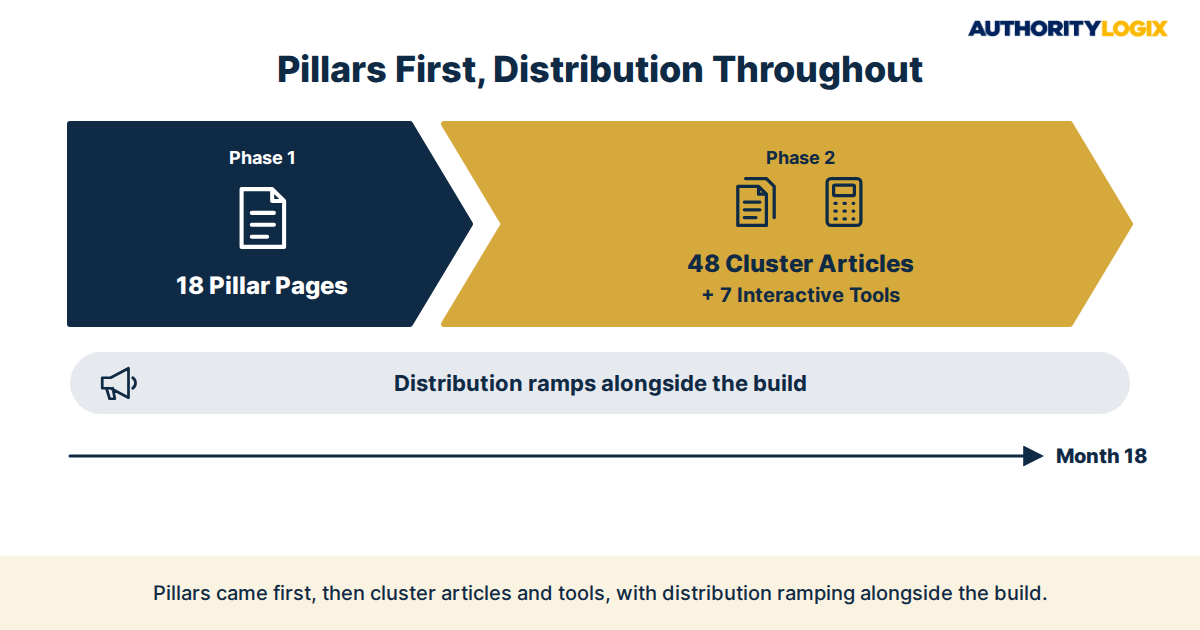
- The build followed a strict architectural sequence: pillar pages first, then cluster articles with interactive tools built alongside them, and distribution ramping alongside the entire build — the pillar-first order never reversed. Every piece of content was built to the educational content standard from day one, avoiding Regulation Z trigger terms and building the CFPB-compliant foundation that made consistent publishing sustainable rather than a compliance liability.
- The 18-month build produced measurable results across three dimensions: organic search visibility for competitive DSCR-related queries, inbound engagement from investors and brokers without paid advertising, and a reusable proof-of-concept that AuthorityLogix now applies to client engagements across the financial services vertical. The case study is not a marketing claim — it is a documented build log that other financial services firms can use as a reference architecture.
- The lessons from BKDSCR.com apply beyond DSCR lending: any financial services firm — mortgage, advisory, insurance — operating in a specific niche with genuine expertise can apply the same sequence. Define the niche narrowly, build pillar-and-cluster architecture within that niche, maintain compliance discipline throughout, and commit to the 18-month timeline before expecting compounding results.
Table of Contents
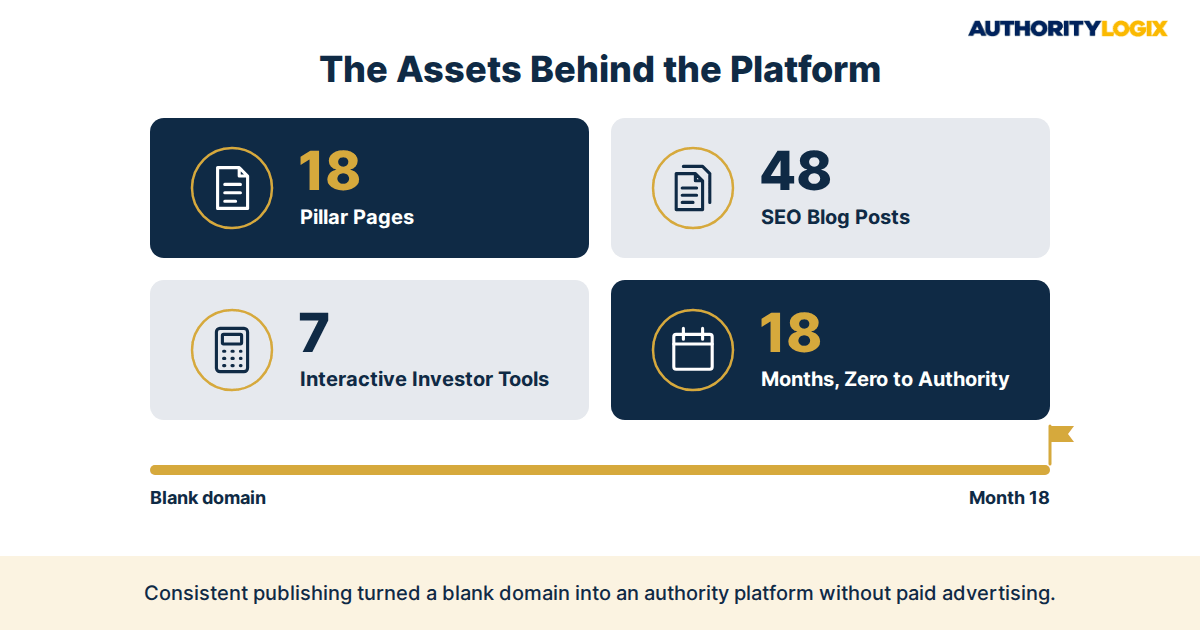
This financial authority platform case study documents that build specifically. The build of BKDSCR.com, AuthorityLogix’s proof-of-concept platform in the NYC outer-borough DSCR real estate investor niche, from a blank domain to a functioning content authority platform in 18 months. 18 pillar pages, 48 SEO-optimized blog posts, 7 interactive investor tools, all generating organic search visibility and inbound engagement without any paid advertising spend.
This is not a hypothetical framework. It is a documented build log — what was built, in what order, on what compliance foundation, and what the platform produces as a result. The SEO playbook covers the general strategy that financial services firms should apply; this case study covers the specific execution of that strategy in a real, competitive, CFPB-supervised lending market.
The timing of the BKDSCR.com build coincided with genuine market growth in the DSCR lending niche. DSCR loan volume grew more than 50% year over year in 2024, surpassing bank statement loans to become the largest segment of non-QM production, according to Scotsman Guide reporting. Non-QM originations are projected to reach approximately $175 billion in 2026, with DSCR and other investor products accounting for roughly half of all non-QM collateral.
Despite that growth, few lenders serving the NYC outer-borough investor market were publishing educational content deep enough to capture borrowers actively researching DSCR qualification, coverage ratios, and program requirements. That gap — genuine market growth paired with almost no content competition — is what made the 18-month build produce the results it did.
The authority guide covers why published expertise is the primary trust mechanism for financial services firms. This case study covers the specific application: how BKDSCR.com’s architecture, publishing sequence, and compliance framework converted that principle into a functioning platform, and what other financial services firms — mortgage, advisory, insurance — can take from the build as a reference architecture for their own niche.
The complete framework this case study demonstrates — content architecture, publishing cadence, and compounding growth strategy — is in the Financial Services Growth Playbook.
The Starting Point: Why NYC Outer-Borough DSCR Investors, Specifically
Niche Scope in the Financial Authority Platform Case Study
The first strategic decision in building BKDSCR.com was narrowing the scope — not broadening it. Rather than attempting to build authority across every mortgage product nationally, the platform was scoped to a specific niche: DSCR loans for real estate investors in NYC’s outer boroughs. That narrowness was deliberate. Deep topical authority within 18 months requires concentrated content investment; a broader scope would have diluted the same content budget across too many topics to reach genuine depth on any of them. The FS industry hub covers why niche concentration produces faster authority accumulation than broad coverage — a principle BKDSCR.com was built to demonstrate in practice, not just describe in theory.
Market Gap Validation in the Financial Authority Platform Case Study
The niche selection also reflected a genuine market gap. NYC outer-borough real estate — Brooklyn, Queens, the Bronx — has a distinct investor profile: smaller multi-family properties, LLC-titled ownership structures common among local investors, and borrowers who are frequently self-employed or running small portfolios rather than institutional-scale operations. That profile does not match the generic national DSCR content that most large lenders publish, which tends to address broad national qualification criteria without addressing the specific documentation and structuring questions that NYC outer-borough investors actually have. The credibility gap in this specific niche was wide open: investors searching for NYC-specific DSCR guidance found almost nothing written for their exact situation.
The Architecture: 6 Topic Clusters, 18 Pillar Pages
BKDSCR.com’s content architecture was organized into 6 topic clusters covering the major DSCR scenario categories relevant to the target investor. DSCR loan requirements and qualification, NYC investment property financing specifics, DSCR for self-employed borrowers, multi-unit property DSCR programs, short-term rental investment financing, and BRRRR strategy with DSCR financing. Each cluster was anchored by 2–3 pillar pages, comprehensive enough to cover the broad topic while linking to the scenario-specific cluster articles beneath them.
The search statistics on how mortgage borrowers research support the logic behind this structure. NYC investors searching “DSCR loan requirements” needed the broad pillar page; investors searching “DSCR for LLC-titled multi-family in Brooklyn” needed the specific cluster article. And both needed to exist, linked to each other, for either to fully capture its target search intent.
The content systems that produced this architecture treated the 18 pillar pages as permanent infrastructure from the start — not blog posts scheduled for a content calendar, but canonical resources built to the 3,000–4,000-word standard, with named authorship, cited external data, and structured for Google’s YMYL trust evaluation. This is the same distinction that separates a genuine content moat from disposable content marketing: BKDSCR.com’s pillar pages were built to be the definitive resource on their specific topics for years, not months.
| Topic Cluster | Pillar Pages | Target Investor Scenario |
|---|---|---|
| DSCR Loan Requirements | 3 | Investor evaluating whether they qualify for DSCR financing generally |
| NYC Investment Property Financing | 3 | Investor purchasing in Brooklyn, Queens, or the Bronx specifically |
| DSCR for Self-Employed Borrowers | 3 | Investor without W-2 income seeking DSCR alternative to income-based qualification |
| Multi-Unit Property DSCR | 3 | Investor financing 2–4 unit or larger multi-family properties |
| Short-Term Rental Investment | 3 | Investor evaluating STR income for DSCR qualification |
| BRRRR Strategy With DSCR | 3 | Investor refinancing a rehabbed property into long-term DSCR financing |
The Build: 48 Cluster Articles and 7 Interactive Tools
Once the 18 pillar pages were published, the build moved to the 48 cluster articles — 6–10 scenario-specific pieces per topic cluster, each targeting a specific long-tail query and linking back to its pillar page. The pillar strategy resource describes this architecture in general terms; BKDSCR.com is the specific implementation. Article titles included scenario-specific queries like “DSCR for LLC-Titled Multi-Family Properties in Queens,” “How Short-Term Rental Income Qualifies for DSCR in NYC,” and “Self-Employed Investor DSCR Documentation Requirements” — each answering a specific question a real NYC investor would search rather than a generic national query.
Alongside the written content, BKDSCR.com built 7 interactive investor tools — a DSCR Calculator, a Deal Filter, a Cash Flow Analyzer, and additional scenario-specific tools — each embedded within the relevant cluster articles as lead capture mechanisms. The educational hub architecture that organized this content ensured that every interactive tool was scenario-matched to the article it accompanied: the DSCR Calculator appeared on articles about coverage ratio calculation; the Deal Filter appeared on articles about property evaluation criteria. This scenario-matching is what produced meaningfully higher engagement than a generic contact form would have — visitors interacted with tools that were directly relevant to the specific question that brought them to the page.
Compliance: Built In From Article One, Not Retrofitted
Every one of BKDSCR.com’s 66 published assets — 18 pillar pages and 48 cluster articles — was written to the educational content standard from the first piece published, not retrofitted for compliance after the fact. That meant avoiding Regulation Z trigger terms (specific APR, payment amounts, loan terms) in all educational content, ensuring named authorship and credential attribution appeared consistently, and maintaining a documented review trail for every published piece. The E-E-A-T guide covers why this compliance discipline is inseparable from the trust signals Google’s YMYL evaluation requires — the same named authorship and cited sourcing that satisfies CFPB educational content standards also satisfies Google’s trust evaluation for financial content.
The compliance system that governed BKDSCR.com’s publishing workflow classified every piece before writing began — educational content following the compliant template, with no trigger terms and no advertised loan terms — which meant the review stage confirmed compliance rather than catching structural problems that required rewriting. This is the operational difference between a content build that can sustain 66 published pieces over 18 months and one that stalls at 10 pieces because every article requires extensive compliance rework.
Not sure how your financial services firm’s niche compares to the BKDSCR.com opportunity? The FS Authority Gap Assessment maps your specific market gap.
Distribution and Results: What 18 Months of Consistent Execution Produced
Distribution for BKDSCR.com ramped alongside the content build rather than waiting until the full library was published. Each new article and pillar page was promoted through LinkedIn posts targeting NYC real estate investor and broker audiences, email broadcasts to the growing subscriber list captured through the interactive tools, and syndication placements that extended reach beyond organic search. The AI search dimension became relevant as the content library matured — the same named authorship, scenario specificity, and topical depth that built Google organic rankings also positioned BKDSCR.com’s content for AI citation eligibility as AI platforms began surfacing answers to DSCR-related queries.
By month 18, BKDSCR.com was ranking for competitive DSCR-related queries and generating inbound engagement from investors and brokers organically — without a dollar in paid advertising. The authority distribution layer that amplified the content throughout the build is what accelerated this result from the baseline organic timeline: articles that might have taken 12–15 months to reach meaningful ranking positions through organic crawling alone reached those positions faster because distribution generated early traffic and engagement signals that helped Google’s algorithm recognize the content’s relevance more quickly.
What Other Firms Should Take From This Financial Authority Platform Case Study
Narrow the niche before building anything
BKDSCR.com’s 18-month timeline to organic authority was achievable specifically because the scope was narrow — one product type, one geographic market, one investor profile. A financial services firm attempting the same build across a broader scope — every loan product, every U.S. market — would need proportionally more content investment to reach the same depth, extending the timeline well beyond 18 months. The competitive moat article covers why topical concentration produces more defensible authority than broad coverage — BKDSCR.com is the applied proof of that principle.
Sequence matters — pillar pages before cluster articles, always
BKDSCR.com’s build never published a cluster article before its pillar page existed. This sequencing discipline is what ensured every cluster article had somewhere to link back to from its first day live — no orphaned content, no wasted publishing effort on articles that could not participate in the topical authority network until a pillar was eventually built. The content infrastructure article covers why this sequencing produces measurably different compounding results than publishing cluster content ahead of the pillar it should belong to.
18 months is the realistic timeline — not a marketing promise
BKDSCR.com’s 18-month timeline to organic authority was not an accelerated or unusually fast build — it reflects the realistic timeline for a financial services firm publishing consistently, with compliance discipline maintained throughout, in a niche with genuine content competition gaps. Firms expecting faster results, or firms that pause the build after 6 months because results are not yet visible, are working against the documented timeline this case study demonstrates. The build requires the full 18 months because that is how long topical authority takes to accumulate — not because the execution was inefficient.

Ready to have the same authority platform behind BKDSCR.com built for your firm?
Applying This Financial Authority Platform Case Study to Your Firm
BKDSCR.com is a working demonstration, not a theoretical framework — every principle described in AuthorityLogix’s financial services resource library has been applied and tested on this platform first. The organic leads framework that documents the higher close rate for organic financial services leads is drawn from patterns observable on platforms built this way.
The long-term positioning article lays out a three-layer authority stack: content, distribution, referral. That is the exact model BKDSCR.com operates on today, with all three layers active and compounding.
The lead generation infrastructure that connects BKDSCR.com’s content to its interactive tools and eventually to booked conversations is the same architecture available to any financial services firm willing to commit to the 18-month build. The niche will be different — a different loan product, a different advisory specialty, a different insurance vertical, a different geography — but the architecture, the sequencing, and the compliance discipline that produced BKDSCR.com’s results are transferable to any financial services firm with genuine expertise in a defined niche.
When you’re ready to build your firm’s version of this platform, work with us is the starting point. From there, we map the build against what BKDSCR.com already proved works.