

Key Takeaways
- A physical therapy second location should open into a market that can already find the practice, not into a neighborhood that has never heard of it.
- Physical therapy expansion readiness is a marketing question as much as a financial one: reviews, website structure, content and tracking need to work at the first clinic before they can be copied.
- Google’s Business Profile guidelines say not to create more than one profile for each location and expect permanent signage at the address, so the profile for a physical therapy second location goes live only when the clinic is real.
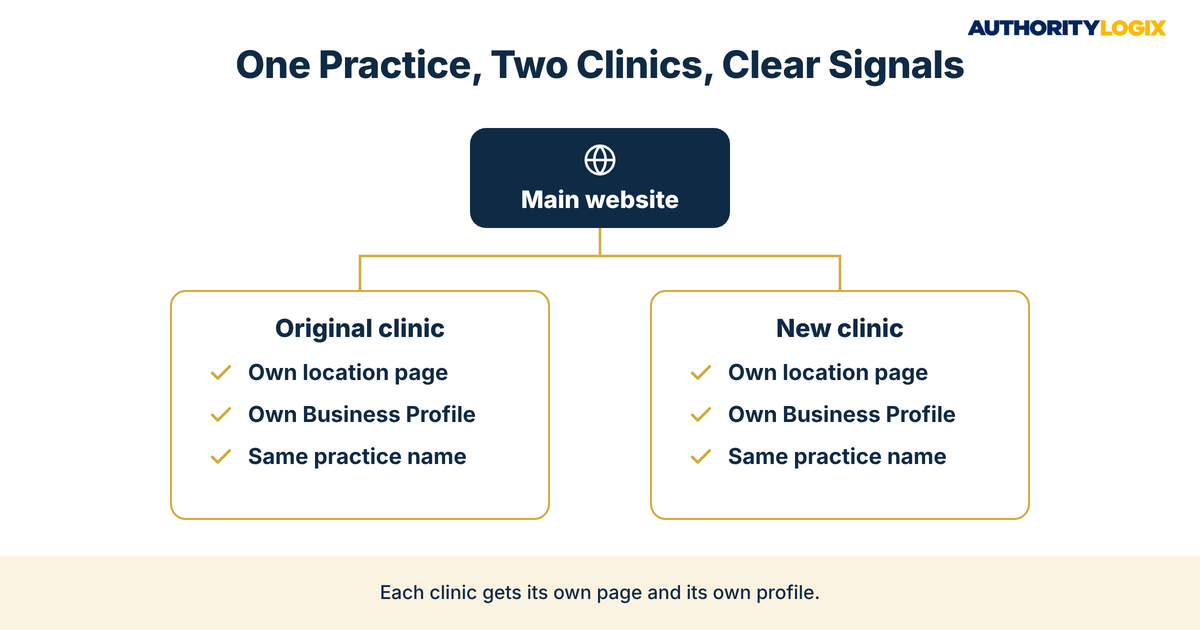
- Each clinic needs its own location page, its own Business Profile and the same practice name on every listing.
- Condition and neighborhood content published months before opening gives a physical therapy second location search history on its first day.
- The original clinic needs protected marketing attention during the ramp-up, or the practice trades one strong location for two weak ones.
Table of Contents

When a Physical Therapy Second Location Makes Sense From a Marketing Standpoint
A physical therapy second location is usually planned around a lease, a hiring plan and a payer mix, while the marketing question gets answered last, if at all. That order is backwards. A new clinic’s first months depend on whether people in an unfamiliar neighborhood can find it, trust it and book, which is the same patient acquisition problem your first clinic already solved, now in a place where the practice has no history.
You already have the clinical reputation. A few miles away, none of that is visible: the search results in that zip code show other clinics, other reviews and other names, and the new location starts from zero unless the groundwork is laid first.
Demand for care is not the obstacle. According to the U.S. Bureau of Labor Statistics occupational outlook for the profession, employment of physical therapists is projected to grow 12 percent from 2025 to 2035, with about 13,400 openings projected each year, on average, over the decade. Growth like that brings more clinics into most markets, which means a physical therapy second location will compete for attention with practices that may already rank where you plan to open.
Practices that expand cleanly treat the new site as a visibility project before it becomes a construction project. They check whether the first clinic’s reviews, rankings and website could carry a second address, and they study what local visibility looks like in the target neighborhood: who holds the map results and how many reviews they have. That research tells you how much groundwork the physical therapy second location will need.
Referral dependence is the other reason to plan early. A new clinic that leans on one or two physicians in the area is exposed from the start, because one referring doctor retires and the pipeline dries up overnight. Building direct-access demand through deliberate PT marketing gives a physical therapy second location a source of evaluations that does not rest on any single relationship.
Industry experience matters here, and it is a large part of why AuthorityLogix focuses on a small number of industries, physical therapy among them. The patterns of a PT expansion repeat: referral overlap, new-neighborhood search competition and clinician bios that must exist before launch. Planning for them early costs far less than fixing them after the doors open.
The Physical Therapy Practice Authority Growth Blueprint lays out the authority infrastructure a practice needs before it grows, including where a physical therapy second location fits in a long-term growth plan.
Physical Therapy Expansion Readiness: The Marketing Foundation to Check First
Physical therapy expansion readiness starts with an honest audit of the clinic you already have. If the first location struggles to rank, collects reviews only by accident or runs a website that cannot add pages easily, a physical therapy second location will inherit every one of those weaknesses. Copying a weak system to a new address doubles the problem instead of solving it.
Practices grow in different ways, and the growth differences between a practice that adds clinics smoothly and one that stalls usually trace back to infrastructure rather than clinical skill. The smooth expanders have a website built to hold more than one location, a review process staff follow every week and tracking that shows where new patients come from. Those systems transfer. Good intentions do not.
Signs Your Brand Is Ready to Travel to a New Neighborhood
A brand travels when people outside your current patient base can recognize it and trust it quickly. Look for a steady flow of new reviews, a website that already ranks for a handful of condition searches and a practice name that patients mention when they refer friends. If those signals exist, the physical therapy second location can borrow credibility from the first one instead of building it alone.
| Readiness signal | What it looks like at the first clinic | Why it matters for a physical therapy second location |
|---|---|---|
| Reviews | New reviews arrive every month | The new profile starts with none |
| Website structure | Location pages can be added without a rebuild | The new clinic needs its own page on day one |
| Content library | Condition pages already rank locally | Pages can be connected to the new area |
| Source tracking | Every new patient’s source is recorded | Shows which channels to repeat |
| Clinician visibility | Bios and credentials are current | Patients research the therapist first |
If two or more rows come up short, fix them at the first clinic before the lease is signed. The work takes months, and it sits at the center of our services for practices preparing to grow: building the review process, site structure and tracking once, so every future location starts with them.

PT Multi-Location Marketing Preparation for Search and Maps
PT multi-location marketing preparation is mostly about helping Google understand that one practice now serves two neighborhoods. Search engines need clear, consistent signals: a distinct page for each clinic, a distinct Business Profile for each address and matching details everywhere the practice is listed.
Structure matters as much as the words on the page. A sound multi-location SEO setup gives each clinic its own URL under the main domain, links each location page to the services offered there and keeps the practice name, address format and phone details consistent across directories and insurance listings. A physical therapy second location placed on a separate, disconnected website gives up the history the main domain has already earned.
Location Pages and Business Profiles for Each Clinic
Each clinic needs its own page, written for its neighborhood rather than copied from the first. Strong location pages include the address, hours, parking and transit details, the clinicians who work there, the services offered at that site and a map, so a person searching nearby finds answers to practical questions. A physical therapy second location page that only swaps the address on a template gives patients little reason to choose it.
Google’s own rules shape the timing. Its Guidelines for representing your business on Google say not to create more than one profile for each location, to create the profile for the actual, real-world location, and that businesses showing their address should maintain permanent fixed signage of the business name there. In practice, the profile for a physical therapy second location is prepared in advance but published only once the clinic is open, signed and staffed.
Once the profile is live, the work shifts to completing it: categories, services, photos of the actual clinic, hours and a booking link that points to the new location page. The clinician side matters too, and building local search authority around the therapists who staff the physical therapy second location helps patients connect a familiar name with an unfamiliar address.
Building Content and Authority Before a Physical Therapy Second Location Opens
Content is the part of a launch that cannot be rushed. Pages need time to be indexed, earn links and build search history, so a physical therapy second location that publishes everything on opening day starts months behind. The better approach is to begin publishing for the new neighborhood well before the ribbon cutting.
That publishing should follow a plan rather than a burst. A practical content SEO approach maps the conditions people search for in the new area, connects those condition pages to the upcoming location page and adds local detail such as nearby employers and schools, so the pages read as written for that community. Authority compounds, and every month of head start helps the new clinic.
What the Physical Therapy Second Location Website Should Include
- A location page with address, hours, parking and a map
- Bios and credentials for every clinician at the new site
- Service pages listing the programs that clinic offers
- Condition pages connected to the new location
- A booking path to the correct clinic’s schedule
- An opening notice on the main site linking to the new page
Clinician bios deserve special attention. People choosing a new clinic want to know who they will see, and showing clinical authority through credentials, specialties and patient education written by those therapists helps a new address feel established. That content is marketing, not clinical advice, and it should describe what each therapist focuses on without promising results.
BKDSCR.com, a real estate investment education platform built as the AuthorityLogix proof-of-concept, was assembled with 18 pillar pages, 7 interactive tools and 48 blog posts, with zero paid ads, in under 18 months. The industry is different, but the lesson carries over to a physical therapy second location: structured content published ahead of demand is what a new address has to rank with when it opens.
Not sure whether your current clinic’s search presence and content could carry a physical therapy second location? The assessment shows where the gaps are before you sign a lease.
PT Second Clinic Marketing in the First 90 Days
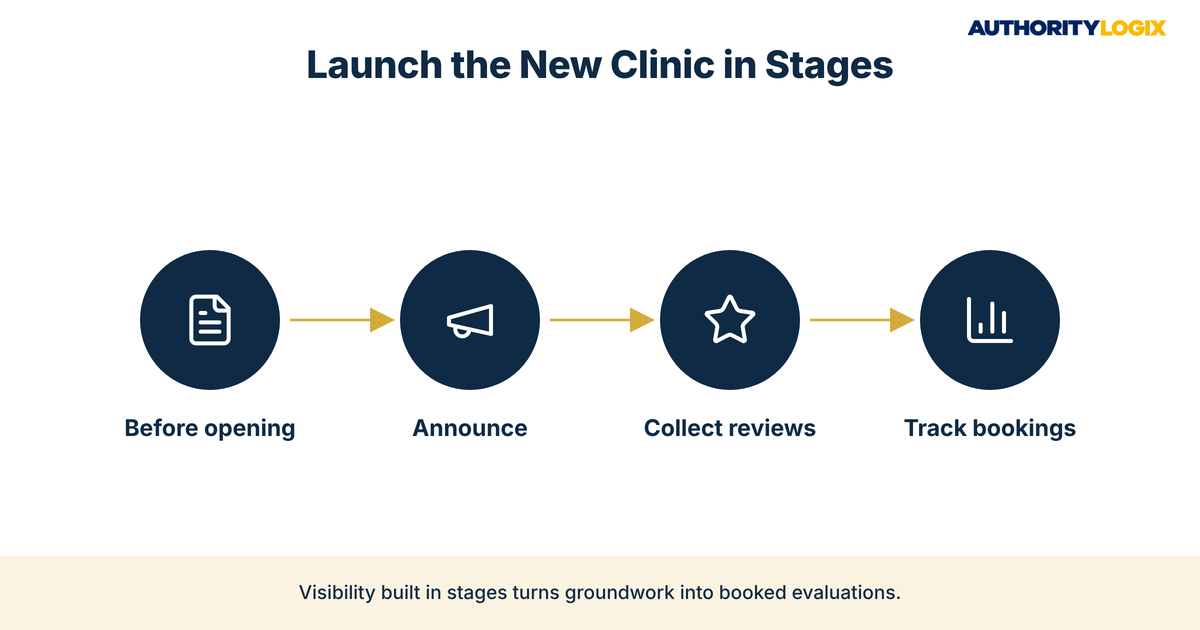
PT second clinic marketing in the first 90 days has one job: turn the groundwork into booked evaluations while the new location builds its own reviews and rankings. The early weeks are when a physical therapy second location is least visible and most dependent on the original practice’s reputation. Use every existing asset, from current patients to the main website, to point people to the new address.
| Period | Marketing focus | What to track |
|---|---|---|
| Before opening | Location page live, profile prepared, condition content published | Pages indexed and early search impressions |
| Days 1–30 | Profile published, opening announced to current patients and partners | Calls, booking requests and profile views |
| Days 31–60 | Review requests at every visit milestone, local partner outreach | New reviews and new-patient sources |
| Days 61–90 | Content gaps filled based on the questions early callers ask | Evaluations booked by channel |
The booking path is where many launches leak. A dedicated landing page, a scheduling link that routes to the right clinic and a fast response from the front desk all belong to the practice’s lead generation system, and each should be tested before the first patient calls. A physical therapy second location that loses inquiries to a confusing phone tree wastes the visibility it worked to build.
The announcement itself should travel. An email to current patients who live near the new clinic, a note to referring physicians and community partners, and short articles shared across the practice’s channels make up the authority distribution side of the launch.
How to Keep the Original Clinic Strong While the New One Ramps Up
The risk few owners plan for is the first clinic slipping. Owners and senior therapists split their time, the marketing budget shifts to the launch, and the location that pays the bills quietly loses reviews, content updates and referral attention. A physical therapy second location that grows at the expense of the first leaves the practice no stronger than before.
The fix is to run marketing as a system with owners and schedules, not as the founder’s personal project. Repeatable content systems keep both clinics publishing on a set cadence, keep review requests running at both front desks and split reporting by location, so a dip at either site shows up within weeks rather than quarters.
Practice-wide pages, such as your approach to care and your team, support both locations, while each clinic’s page speaks to its own neighborhood. Watching new-patient numbers for the original clinic and the physical therapy second location separately is the simplest early warning that one of them needs attention.
FAQ: Second Location Marketing Questions From Practice Owners
How early should marketing start before a physical therapy second location opens?
Several months ahead is a sensible target. Location and condition content needs time to be indexed and build search history, while the Business Profile waits until the clinic is real and signed.
Can I create more than one Google Business Profile?
Yes, one for each real location. Google’s guidelines say not to create more than one profile for each location, so a practice with two clinics should have two profiles, each tied to its own address and carrying the same business name.
Should the second clinic have its own website?
In most cases, no. Adding the new clinic to the existing domain lets it share the history and pages the practice has already built, and an educational hub of patient guides on that domain can serve people near both clinics. A separate site splits that authority in two.
How do patients know which clinic to book?
Clear location pages, separate booking links and the same practice name on every listing make the choice simple. Owners working through these decisions can find related guides on location pages, local search and growth planning in the PT resources collection.
Ready to build the location pages, search profiles and pre-launch content that let your physical therapy second location open with patients already able to find it?
Opening the Next Clinic With Visibility Already in Place
A physical therapy second location rarely struggles because its clinicians are less skilled. It struggles because the new neighborhood cannot see what the practice has already earned. The reviews, the referral relationships and the clinical reputation all stay at the old address until something carries them over.
That carrying over is infrastructure work: a website structured for more than one clinic, a page and profile for each location, content published before opening and a launch plan that protects the original site. It follows the same sequence as our process with every practice, from audit to build, publishing, distribution and measurement, applied to a new address.
The honest answer is that most practices ready to expand already have the expertise. The missing piece is the infrastructure that lets a physical therapy second location open into a market that can already find it, trust it and book.